The first thing Catherine Hart noticed was the ribbon. It was red, bright as the lining of a new coat, and tied around a parchment that a stranger claimed had survived more than a hundred years in the unsettled country of northern Texas. The second thing she noticed was that three of the four men at her gate were carrying rifles across their saddles, their hands positioned where they could bring the barrels around without wasting a moment. She had been kneading bread when she heard them ride up. Now she stood on the porch with flour drying along the side of one thumb, looking at a document that was apparently old enough to take away everything she and her husband had built.
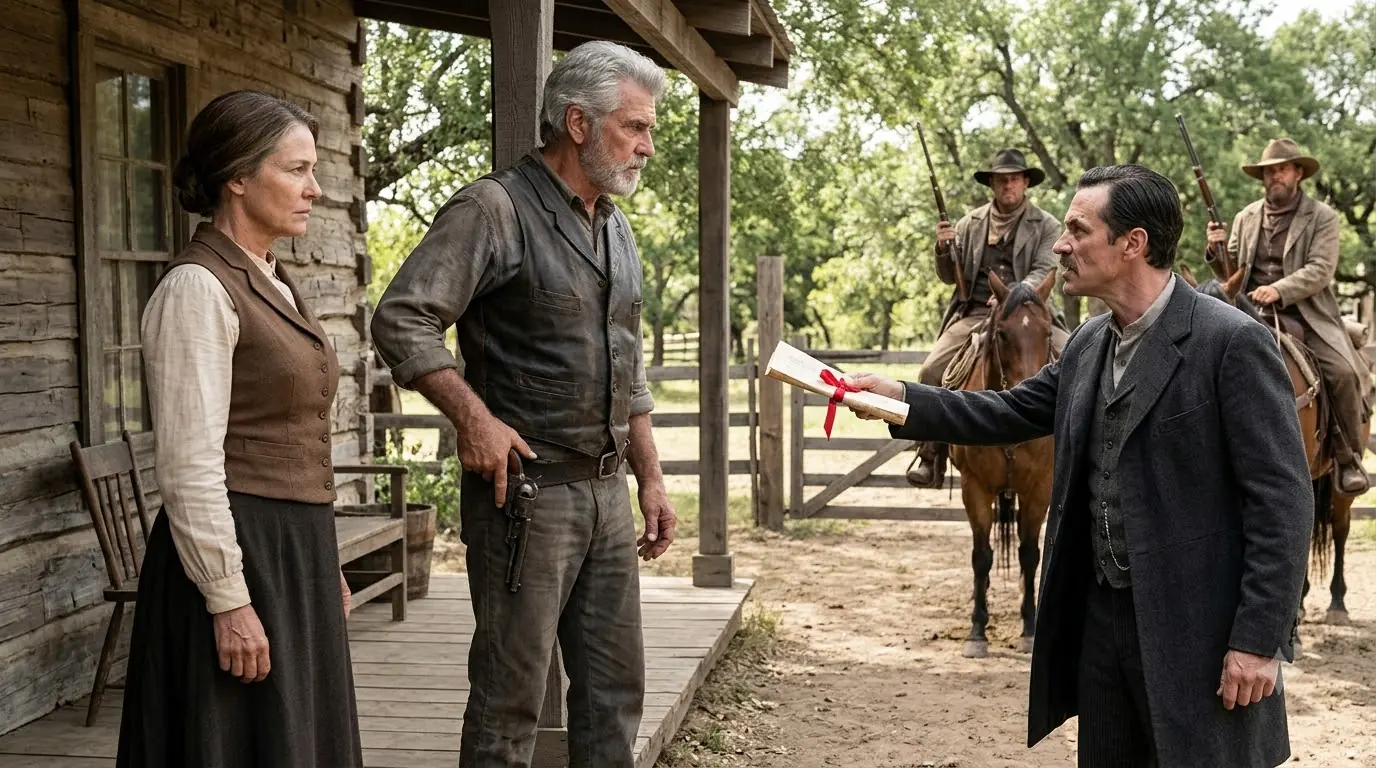
The leader called himself Garrett Voss. He had a narrow face, a thin mustache, a new gray vest, and polished boots entirely too fine for a man who had ridden twenty miles through the sand and cedar. He held the paper toward her with the practiced care of an actor presenting a treasured object before the audience had even decided to believe in it. The Spanish government, he announced, had granted the land to the Delgado family in seventeen ninety-eight. Their surviving heirs had retained the rights, and the Harts had thirty days to clear the property before the heirs took possession.
Catherine looked past him to the creek winding through the cottonwoods. The house was not grand, but every board in its walls held something of their lives: winters when the roof leaked, summers when the well ran low, the year their son fell ill and she slept beside him without undressing for nine nights. Beyond the house stood the barn they had rebuilt after a lightning fire, the windmill Matthew had raised with the help of three neighbors, and the corral whose stubborn gate had nearly cost him a finger. Twenty-two years lay between the first fence post and the morning this stranger arrived. She was not about to throw them aside because he had tied a pretty ribbon around a threat.
“Who sent you?” Catherine asked. Voss said he represented the heirs and would provide the name of his employer when the case was filed. She asked whether a case had been filed already. He admitted that it had not, though he disguised the admission with an impatient wave of the parchment. Catherine put out her hand and asked to inspect the document. For a moment she thought he might refuse, but his confidence in the appearance of the thing seemed stronger than his caution.
The parchment felt almost right. Its edges were roughened, the ink faded, the fold lines darkened where fingers had touched them, but the middle was unnaturally smooth. Catherine had handled old letters from her mother's family, and they carried the soft fatigue of paper that had been folded and unfolded for generations. This sheet had the stiffness of something deliberately aged. She noticed that the boundary drawing omitted the bend where Ash Creek divided below their barn, and that Voss kept one finger pressed over the lower corner while she read.