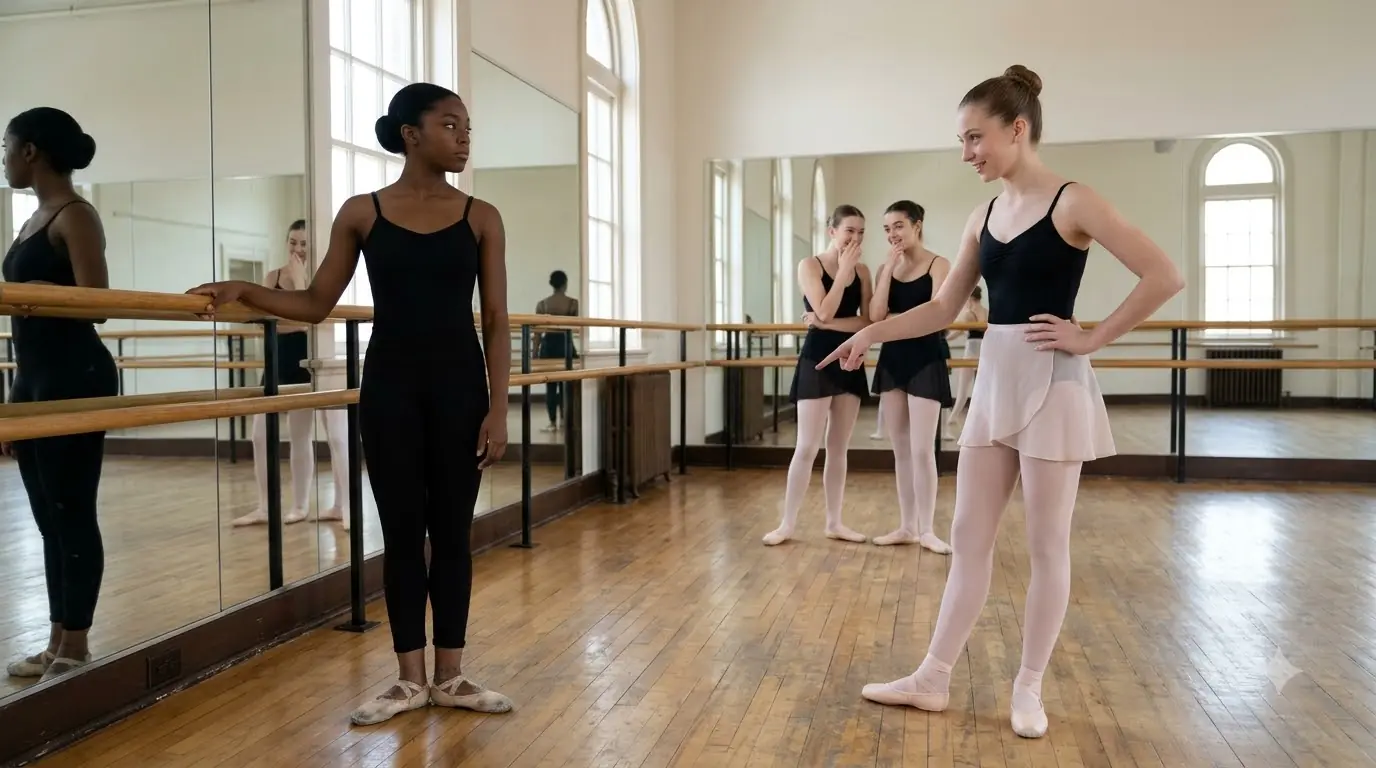
“A garage?” Brielle Ashford repeated, loud enough for every dancer in Sterling Hall’s mirrored studio to hear. “You mean you actually learned ballet in a garage?”
Imani Carter stood with her weight balanced over one worn shoe. Around her, girls in matching practice clothes exchanged smiles, and someone raised a phone. Imani could have told them about the winter nights she had practiced until the mirror fogged, or the grandmother who counted each movement through pain. None of it would have mattered to an audience that had already decided what was funny.
“Are you finished?” she asked.
Brielle stepped closer. “Not until everybody sees what you really are.”
Ten days earlier, Imani had still believed that walking into the academy with a contestant number would be the hardest part. She had no idea that a few seconds of rehearsal would be edited into a public humiliation, or that the greatest threat to her chance at a scholarship would come from people who never needed to earn one. To understand why she stayed in that room instead of leaving, you would have to know where she had learned to dance.
Imani Carter learned ballet in a garage that had no reason to feel holy.
It sat behind a narrow brick house on the east side of Cleveland, where the winters bit hard, the summers sat heavy on the pavement, and the streetlights flickered like they were tired of keeping watch. The block had corner stores with bars over the windows, old houses with missing porch rails, and empty lots where families used to live before the city forgot to come back for them. Nobody drove through that neighborhood looking for ballet.
But every night after homework, dinner, and the last bus groaning past the corner, music came from the Carter garage.
Her grandmother, Mae Carter, had built that little studio out of stubbornness and memory. She laid the wood floor herself over cracked concrete, one board at a time, sanding until her palms blistered and sealing it with the care of someone blessing a church. The barre was a salvaged pipe from a demolished building, bolted into the wall with screws a neighbor gave her from an old toolbox.
The mirror was three broken panels from a beauty salon that closed on Euclid Avenue. A long crack ran through the middle, cutting every reflection into pieces. Mae used to tell Imani not to hate that crack. “It tells the truth,” she would say. “A person can be split clean down the middle and still stand tall.”
Mae had once been the kind of dancer people remembered even when programs forgot her name.
In the old photographs, she looked almost impossible: long neck, strong legs, lifted chest, arms soft as smoke, body hanging in the air like gravity had loosened its grip just for her. She danced in regional companies before most directors wanted Black women near center stage unless the part required “something ethnic” and brief. They called her gifted. They called her expressive. They called her difficult to cast, which was the polite way of saying they did not know where to put a Black girl who danced like she belonged everywhere.
At twenty-eight, during a showcase that could have changed her life, Mae landed badly.