The cook arrived at the Stone Creek Ranch carrying a brown trunk, a carpetbag with one broken handle, and a tin box she would not let the freighter touch. Caleb Hart watched her climb down from the wagon without asking for help. Dust lifted around her boots. She was a small woman beside the wagon, perhaps twenty-seven, with chestnut hair pinned close to her head and a plain gray traveling dress buttoned at the wrists despite the heat. She looked at the low ranch house, the wind-tilted porch and the broad fields beyond, with the steady attention of someone deciding what had to be endured before she could begin.
Caleb had been filing a crack from a wagon hinge when she arrived. He kept the file in his hand as he crossed the yard. The freighter, a man who always had two opinions for every mile of road, began explaining that the woman had been quiet the whole trip from Cheyenne. Caleb cut him off with a nod and turned to her. "You're the woman Mr. Mercer sent?" he asked. "I'm Evelyn Porter," she answered. "And I understand you need a cook." He looked at her trunk as if it might supply the missing proof that she knew a kitchen from a feed shed.
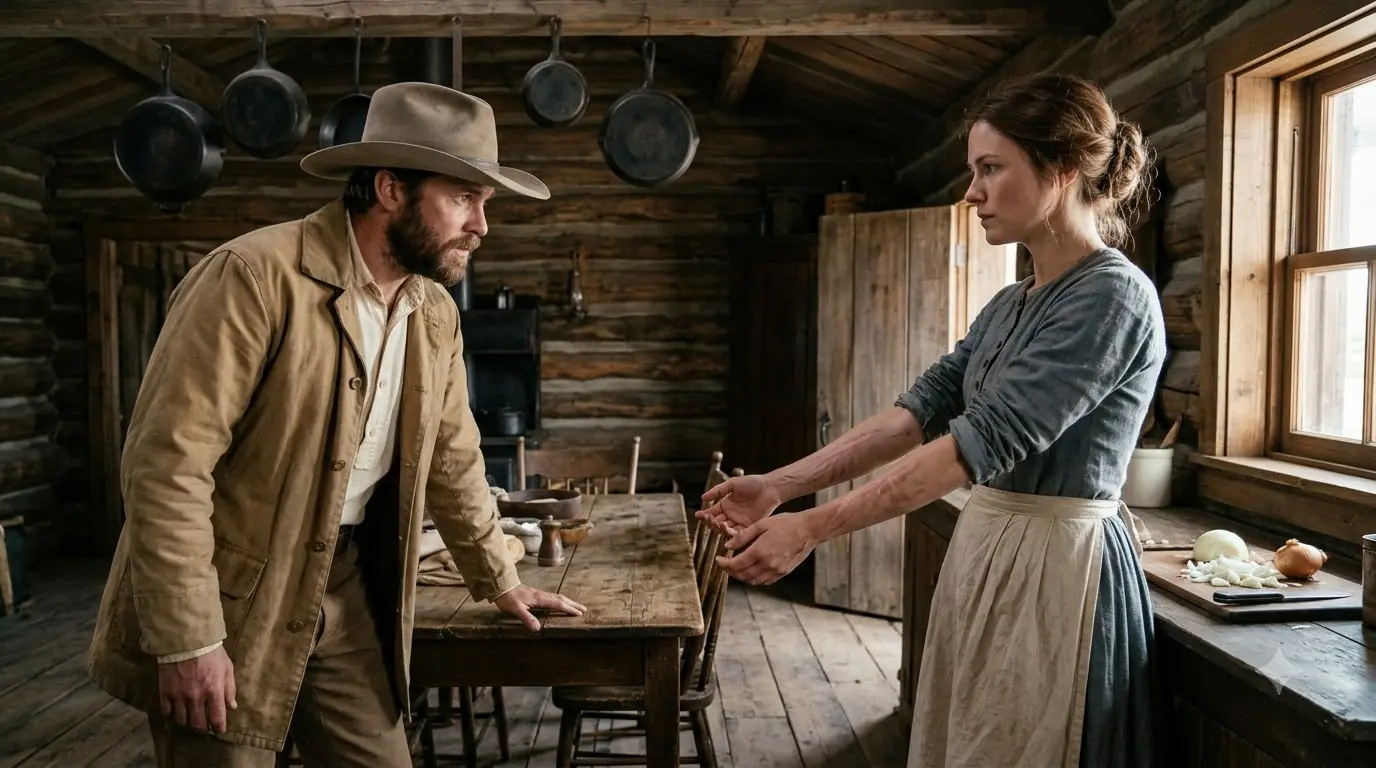
"Breakfast before sunup, dinner at noon, supper when the men finish," he said. "The pantry stays accounted for. The stove stays clean. What happens outside the kitchen is my affair." Evelyn waited until he had finished, then asked whether he had arrangements for washing the men's plates and whether the kitchen pump still worked. He told her the pump worked most mornings and that she could speak to the foreman about anything else. "All right," she said. "I'll begin tomorrow." It was a smaller answer than he expected from someone being given a house's worth of conditions.
She picked up the carpetbag and the tin box. Caleb reached for the trunk and she allowed him to take its weight, but when his free hand moved toward the box, she drew it against her ribs. "I have this," she said. Something about her tone made him step back before he understood he had done it. The freighter watched with interest, hoping for an argument that would improve the telling of his next journey. None came. Evelyn carried the box into the house herself.
In the summer of 1879, Stone Creek sat in the southern Wyoming grasslands where the wind had no patience with weak fences or loose shingles. Nine thousand acres sounded like a fortune to visitors from the East. To Caleb it meant water holes to inspect, miles of wire to stretch and livestock that could not afford the luxury of his moods. His father had acquired the first tract before the railroad came through the region, and Caleb had added parcels after two profitable seasons. He owned nearly four hundred cattle and a debt that had begun to wake him at night.