The youngest man in the saddle laughed when he saw the gray-haired woman standing on the porch. He was no older than twenty-three, with a red scarf tied at his throat and a revolver riding low against his leg. Beside him, six other riders watched the farmhouse in the early afternoon sun. Their leader, a broad-shouldered man named Clayton Rusk, looked from the widow who owned the property to the older woman at her side. He smiled as though the afternoon had just offered him a little entertainment.
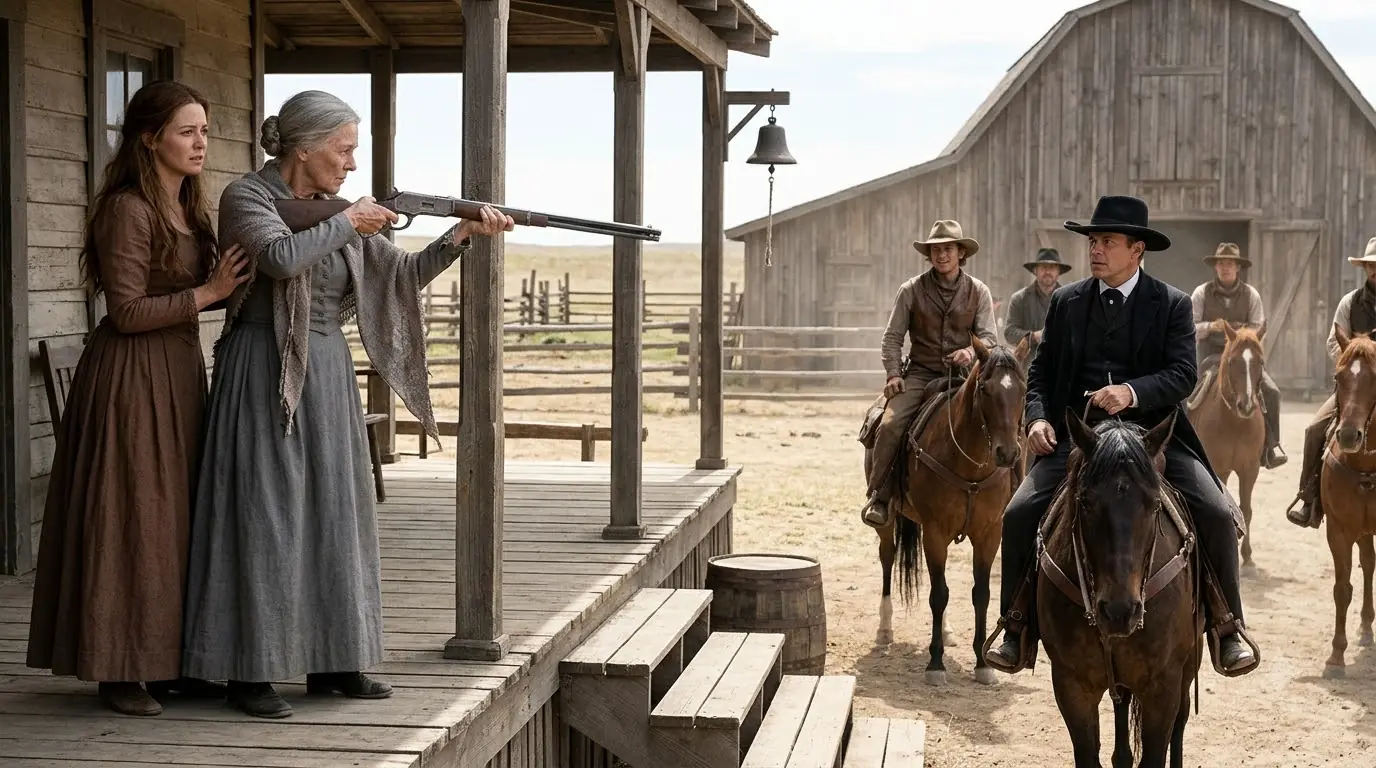
"This is the protection you sent for?" Rusk asked. "Your mother?" The young gunman leaned forward in his saddle and laughed harder. "No disrespect, ma'am, but she looks like she'd have trouble protecting a chicken from a fox." A few of the men joined him. The old woman did not move, except to tighten the edge of her shawl against the Wyoming wind. She looked beyond their horses, toward the iron dinner bell hanging from a timber frame beside the barn.
"How far would you say that bell is from here?" she asked. Rusk blinked at the unexpected question. One of the older riders turned to look. "Sixty yards," he said, measuring the distance with his eyes. "Maybe sixty-five." The woman nodded. "Sixty-five sounds right." The young rider grinned and asked whether she meant to ring it with her knitting needles. "With something a little louder," she replied.
Her daughter, Rebecca Larkin, heard a difference in that quiet voice. She knew her mother as a woman who preserved peaches, read by lamplight, and sent birthday cards in handwriting so precise it looked printed. She had never heard her speak as she spoke now, as if every word had been weighed and there would be no reason to say it twice. Nine days earlier, Rebecca could not have imagined asking the woman she had spent years avoiding to stand between her and armed strangers. Nine days earlier, she had barely allowed herself to believe her husband was dead.
For eighteen months, the Willow Bend Ranch had been a place where life and work seemed to fit together. Peter Larkin rose before sunrise, checked fences with a dog named Moss at his heels, and returned each evening carrying the smell of saddle leather and cold air. Rebecca kept the books, managed deliveries, negotiated feed prices, and knew the name of every hired hand's children. They had bought the property believing they could make a life on three thousand acres of difficult but honest country. The creek crossing the north pasture was the ranch's greatest blessing and its greatest responsibility, because six smaller places downstream depended on it through the dry months.
Peter understood that. When an eastern investment company approached him about purchasing the northern land, he refused to discuss a sale until its representatives explained what would happen to the neighboring ranchers. He spent two evenings at the kitchen table drawing possible water agreements on scraps of paper. He wanted the creek protected by enforceable guarantees, not friendly promises made over whiskey. "A creek doesn't read a deed," he told Rebecca. "But men who want to own one certainly do. We had better make the paperwork say exactly what we mean."