The Rich Cowboy Chose the Outcast Sister - And Shocked the Entire Town of Blackridge
“You think you can just steal what belongs to your sister?”
The words cut through the Montana twilight like a whip crack. Clara Hail stood in the dust, her father’s face twisted with rage, her sister Vivien weeping theatrically on the porch. Behind Clara stood the stranger on horseback, the wealthy rancher who had chosen the wrong daughter.
In thirty seconds, Clara would make a choice that would shatter her family, ignite a war across two ranches, and force her to fight for survival in a world that never wanted her. But first, she had to find the courage to say one word. No.
The Hail Estate had been dying for as long as Clara could remember. Not the dramatic death of fire or flood, but the slow, humiliating kind: paint peeling in long strips from the main house, fences sagging like old men, cattle sold off one season at a time until only twelve head remained in pastures that once held hundreds.
It was the kind of death that happened when a proud man refused to admit he was drowning. Edmund Hail still wore his good suit to Sunday dinner every week, even though the cuffs were frayed and the shoulders had gone shiny with age. He still demanded the silver be polished, though half the pieces had been sold years ago.
He still spoke of the Hail name as if it meant something beyond the dusty Montana hills where nobody remembered and fewer cared. But Clara knew the truth. She had known it since she was twelve years old, mucking stables while her father tutored Vivien in French verbs and piano scales.
The Hail Estate was not a ranch anymore. It was a stage set, a pretty lie maintained for one purpose: to marry Vivien off to money. And now, after eighteen years of preparation, the audience had finally arrived.
“Stand still, Clara, for heaven’s sake. Stand still.”
Clara gritted her teeth as her stepmother, Margaret, yanked the brush through her hair with enough force to make her eyes water. They were in Clara’s small room, barely larger than a closet, at the back of the house, the room that had once belonged to the housekeeper before the housekeeper had been let go.
Through the thin walls, Clara could hear Vivien’s delighted laughter echoing from the grand bedroom at the front. Margaret abandoned the brush and reached for pins, muttering that Clara’s hair had more knots than a rope. Clara said quietly that perhaps it was because she had spent the morning repairing the south fence.
Margaret said that was Jacob’s job. Clara reminded her that Jacob had quit two weeks ago because no one was paying him. Margaret’s hands paused for just a moment, then she jammed a pin into Clara’s scalp hard enough to make her wince.
Margaret said Clara should have said something, and that her father would have handled it. Clara met her stepmother’s eyes in the cracked mirror and said her father knew. He simply did not care about fences when Vivien needed a new dress.
The slap came fast and sharp across Clara’s cheek. It was not hard enough to bruise, but enough to sting. Margaret had perfected that particular blow over the years, painful but leaving no evidence.
“You will not speak of your sister that way,” Margaret hissed. “Vivien is this family’s future. The Mercer boy arrives in less than an hour, and if your jealous tongue costs us this opportunity, I swear to you, Clara, you will wish—”
“I will wish what?” Clara stood, pulling away from her stepmother’s grip. “That I had been born prettier? That I had spent eighteen years learning to smile and curtsy instead of keeping this place from collapsing? I already know I am the wrong daughter, Margaret. You do not have to keep reminding me.”
For a moment, something almost like shame flickered across Margaret’s face. Then it hardened again into the mask Clara knew so well. Margaret told her to wear the gray dress, not the blue one, because Clara was there to serve tea, not sit for it.
Clara understood perfectly. She was furniture, decoration, part of the stage set, like the polished silver and her father’s false smile. She was not the show.
Colton Mercer arrived at exactly three o’clock, which told Clara everything she needed to know about him before he had even dismounted. She watched from the kitchen window as the small party crested the ridge. Three riders, two pack horses, and enough dust to announce them a mile out.
The man in front sat his horse like he had been born in the saddle, straight-backed and easy. Even from a distance, Clara could see quality in everything: the cut of his coat, the shine of his tack, and the powerful sorrel gelding that probably cost more than the Hail Estate’s remaining cattle combined.
Vivien’s shriek carried through the entire house. Clara turned from the window and picked up the tea tray she had prepared. Her hands were steady. They were always steady, even when everything else was falling apart.
By the time Clara reached the parlor, the performance had already begun. Edmund Hail stood in the center of the room with one hand extended in welcome, his voice booming with false heartiness. Vivien swept forward in a rustle of blue silk, her blonde curls perfectly arranged, her smile bright enough to hurt.
Clara set the tea tray on the side table, keeping her eyes down. She had seen Vivien perform this role a hundred times: the gracious lady, the perfect flower of frontier society. Clara had to admit her sister was good at it. Vivien had spent eighteen years preparing for this exact moment, and it showed in every practiced gesture.
Colton Mercer’s voice was deeper than Clara expected, with a trace of something western and rough underneath the educated polish. Clara could not help glancing up. He was younger than she had imagined, perhaps twenty-five, with sun-darkened skin and the lean, strong build of a man who had done real work, not just ridden for pleasure.
His dark hair needed cutting, and a thin scar along his jaw suggested he had lived harder than his expensive clothes implied. But it was his eyes that caught Clara’s attention. They were gray and steady, taking in the room with an assessment that felt less like a social call and more like a land survey.
Those eyes swept past Vivien’s smile, past Edmund’s eager handshake, past Margaret’s calculating stare, and landed directly on Clara. She froze, one hand still on the teapot. For one long moment, Colton simply looked at her, not the dismissive glance servants usually received, but a real look, curious, direct, and uncomfortably thorough.
Then his mouth quirked slightly, and he turned back to Edmund. He said the home was lovely. The lie was so smooth that Clara almost believed it herself.
Edmund gestured toward the best chairs, the ones that were not splitting at the seams. He told Colton he must be exhausted from the journey, then snapped at Clara to pour the tea and not stand there like a post.
Clara moved forward, focusing on the ritual. Cup, saucer, three-quarters full, handle to the right. She had done this a thousand times.
Vivien settled into the chair opposite Colton with practiced grace and asked about his journey from the Mercer Ranch. Colton answered simply that the ranch was large, that his father had built it from nothing, and that he was proud of that. Edmund jumped in at once, praising the Mercer name and mentioning fifteen thousand acres.
Colton’s voice stayed carefully neutral as he explained they were looking to diversify timber rights, water agreements, and possibly mining interests. His father believed in growth. Margaret purred that it was a wise philosophy and said she understood he was looking to establish a family of his own.
There it was, the hook baited and cast. Colton set down his teacup with a click that seemed too loud in the tense room. He said his father believed a man of his position should marry well and had made his preferences clear.
Vivien leaned forward and asked what Colton believed. For the first time, he smiled, and it was not a pleasant expression. He said he had spent his whole life following his father’s preferences, and perhaps it was time he made a choice of his own.
Clara’s hand trembled slightly as she poured the next cup. There were currents moving beneath the polite words, and she did not understand any of them. Edmund suggested that Vivien show Colton the gardens, but Colton asked to see the stables instead.
The room went very quiet. Margaret started to object, but Clara heard herself say she would be happy to show him. Every head turned toward her. Vivien’s eyes widened in shock, Margaret went pale, and Edmund looked like he might swallow his tongue.
Colton stood and brushed dust from his pants. He called her Miss Clara, and she corrected him. Clara Hail. He repeated her name as if he were memorizing it, then asked her to lead the way.
The walk to the stables was the longest hundred yards of Clara’s life. She could feel her family’s eyes burning into her back and practically hear Margaret’s scream of rage being swallowed behind clenched teeth. This was not the script. This was not how any of this was supposed to go.
Clara told Colton he did not have to do this, that the horses were nothing special. He said he was not there for the horses. She stopped walking and asked why he had come.
Colton studied her with those steady gray eyes, and Clara felt as if she were being measured against some invisible standard. He asked her age, whether she was married, and why she was not. The question was so blunt she almost laughed.
She said she was not the daughter anyone wanted to marry. When he asked why, she gestured at herself, at the plain gray dress mended a dozen times, at her roughened hands, at the face that had never been anything special even before sun and wind had weathered it. She told him to look at her and then look at Vivien.
Colton said Vivien was beautiful, like a china doll: delicate, decorative, and fragile. He had met a hundred girls like her, pretty things who would shatter the first time life hit them hard. He was not there for delicate. He was there for strong.
Clara said she did not understand. Colton told her she did. He opened the stable door, and the familiar smell of hay and horse sweat washed over them.
He said her fence posts were rotting, and she had fixed them herself. Her father was broke, but spending money on dresses and tea sets to impress him. She was serving tea in a house that should have been hers, watching her family sell her sister like livestock, and she had not said one word against it.
In the dim stable light, Clara saw something in his expression that made her breath catch. Not pity, but something harder. Recognition.
Colton said that kind of silence took strength most people did not have. It was the kind he needed. Clara asked what he needed it for, and Colton answered bitterly, “To survive my father.”
Victor Mercer had built an empire, and he was not about to let his only son run it into the ground. He wanted Colton married to someone impressive, polished, pretty, and politically useful. Someone like Vivien.
Clara told him to go back to the house. Vivien was educated, refined, beautiful, and everything he could want in a wife. Colton said she was also completely unprepared for the life he was offering, which was a ranch war.
His father was expanding into territory neighboring ranchers considered theirs. They had already had cattle poisoned, fences cut, two barns burned, and someone had taken a shot at their foreman the previous month. The woman who married him would not be sitting in parlors drinking tea. She would be standing beside him when the bullets flew.
Clara told him he was insane. He admitted he probably was, but he was also right. Vivien would last maybe a week before Victor Mercer broke her. Clara had been fighting her whole life; she had simply never had anything worth fighting for.
Then Colton offered her freedom. He had two horses saddled outside. In about ten minutes, he would ride back toward the Mercer Ranch. If Clara was on the second horse, they would be married within the week. If she was not, he would tell Edmund that Vivien was lovely and that he would consider the offer.
Clara whispered that he was asking her to choose. Colton said he was asking her to save herself, because nobody else would do it for her.
Clara did not remember walking back to the house. One moment she was standing in the stable with Colton’s words echoing in her head. The next, she was pushing through the kitchen door, her mind spinning.
Vivien found her in the hallway, venom in her whisper. She asked what Clara had done and why Colton had asked for her. Clara said honestly that she did not know, but Vivien accused her of trying to steal him.
Colton’s voice cut through Vivien’s rising hysteria. He stood in the parlor doorway, hat in hand, and told both sisters their father wanted a word.
The parlor had transformed into a courtroom. Edmund sat in his chair like a judge on a bench, Margaret rigid beside him, while Colton remained near the door with an unreadable expression. Clara and Vivien stood in the center like prisoners waiting for a verdict.
Edmund said Mr. Mercer had made his intentions clear. He wished to formalize a courtship with Clara. Vivien made a sound like a wounded animal.
Edmund tried to explain that Clara was not prepared for such a role and suggested Colton spend more time with both daughters before deciding. Colton said he would not reconsider. He had made his choice.
Vivien screamed, asking what Clara had that she did not. Colton looked at Clara, long and steady, then said one word. Calluses.
The word landed like a slap. Margaret said Clara was not suitable for a man of his position, that she was uneducated, unrefined, and completely unprepared for society. Colton said he did not need society. He needed a partner.
Then Edmund exploded. He called Clara worthless, with no dowry, no education, no accomplishments, and said she was a servant in her own home because that was all she was good for. He pointed to Vivien and said she was the daughter he raised, invested in, and cared about.
Clara felt something crack inside her chest. She had always known, but hearing it said out loud in front of witnesses felt like being gutted. Colton quietly told Edmund that, with all due respect, he was an idiot.
Colton said he had spent the last three hours watching the family. One daughter could play piano and speak French, while the other had kept the ranch from complete collapse. Edmund had a show horse and a workhorse, and he was trying to sell the show horse while the workhorse was the only thing keeping him alive.
He was choosing Clara not despite her calluses, but because of them. Margaret hissed that it was insane. Colton looked at Clara and said it was her choice to make, not theirs.
Everyone turned to Clara. Edmund warned that if she embarrassed the family by throwing herself at a man who was clearly toying with her, she would not be welcome back. He said they had fed her, clothed her, and given her a roof her entire life.
Clara heard herself say she was repaying them by saving herself. The words came from somewhere deep and buried. She said she had fixed the fences, mucked the stables, mended the tack, fed the horses, repaired the roof, kept the books, and cooked the meals while they polished Vivien like a prize pig for slaughter.
She said she dared speak because she had nothing left to lose. They had already made it clear she was worthless, that she did not matter, that she was just furniture in her own home.
Colton held out his hand and asked if she was coming. Clara looked at that outstretched hand, then at her father’s purple face, her stepmother’s rage, and her sister’s tears. She asked herself what she truly owed these people.
The answer came quickly and clearly. Nothing.
Clara owned almost nothing, which made packing quick. Two mended dresses, a spare pair of boots, a few pieces of her mother’s jewelry Edmund had not sold, the leather work gloves she had bought herself, and the only photograph of her mother that remained.
Vivien appeared in the doorway and told Clara that Colton was using her. He was doing this to humiliate Edmund, to prove some kind of point, and when he was done, he would throw Clara away like garbage. Clara said maybe he would, and that she was going anyway.
Vivien asked why she was doing this to her. She said this had been her chance, what she had worked for over eighteen years. Clara asked if Vivien truly wanted a chance to marry a stranger so Edmund could pay his debts and then spend the rest of her life smiling and pretending in a house that might kill her.
Vivien said it was better than this, and at least she would be someone. Clara told her she already mattered; she just did not know it yet. Vivien’s voice turned cold. She told Clara not to pity her and promised that when Colton regretted choosing her, she would laugh.
The words should have hurt, and perhaps they did. But Clara had spent twenty-one years absorbing her family’s cruelty, and she had developed calluses there too. She said goodbye and did not look back.
Colton waited by the horses exactly as he had promised. Edmund and Margaret stood on the porch like judges at an execution. Colton quietly told her she still had one last chance to change her mind.
Clara looked up at the peeling paint, the sagging roof, her father’s contempt, and her stepmother’s cold fury. She said it seemed like she had made the choice a long time ago; she simply had not known it until today.
Colton helped her onto the second horse, a sturdy bay with kind eyes. Clara settled into the saddle, and for the first time in hours, something in her chest loosened. She knew horses. She understood them. This, at least, made sense.
Edmund’s voice cracked across the yard. He told Clara that if she rode away with this man, she was no longer his daughter, no longer a Hail. She would have nothing and be nothing.
Clara looked at the man who had spent twenty-one years telling her she was not good enough, who had fed her scraps and dressed Vivien in silk, who had worked her like a mule and called her worthless. Then she said she would finally have something in common with the Hail name, and turned her horse toward the trail.
They rode in silence for the first mile, the Hail Estate shrinking behind them until it was just a smudge against the horizon. Clara did not look back. She had spent her whole life looking at that place. She was done.
Colton said she had handled it well. Clara said she had called her father worthless. Colton replied that he deserved it.
He warned her that her family would spread stories, that she had seduced him, stolen him from Vivien, and betrayed the family. Clara said she had been called names her whole life. At least these would be her choice.
As the sun sank toward the horizon, painting the Montana sky in orange and gold, Clara’s body ached from the saddle and her mind kept circling back to what she had done. She had abandoned her life and destroyed her family. Yet underneath the fear was something she had not felt in years.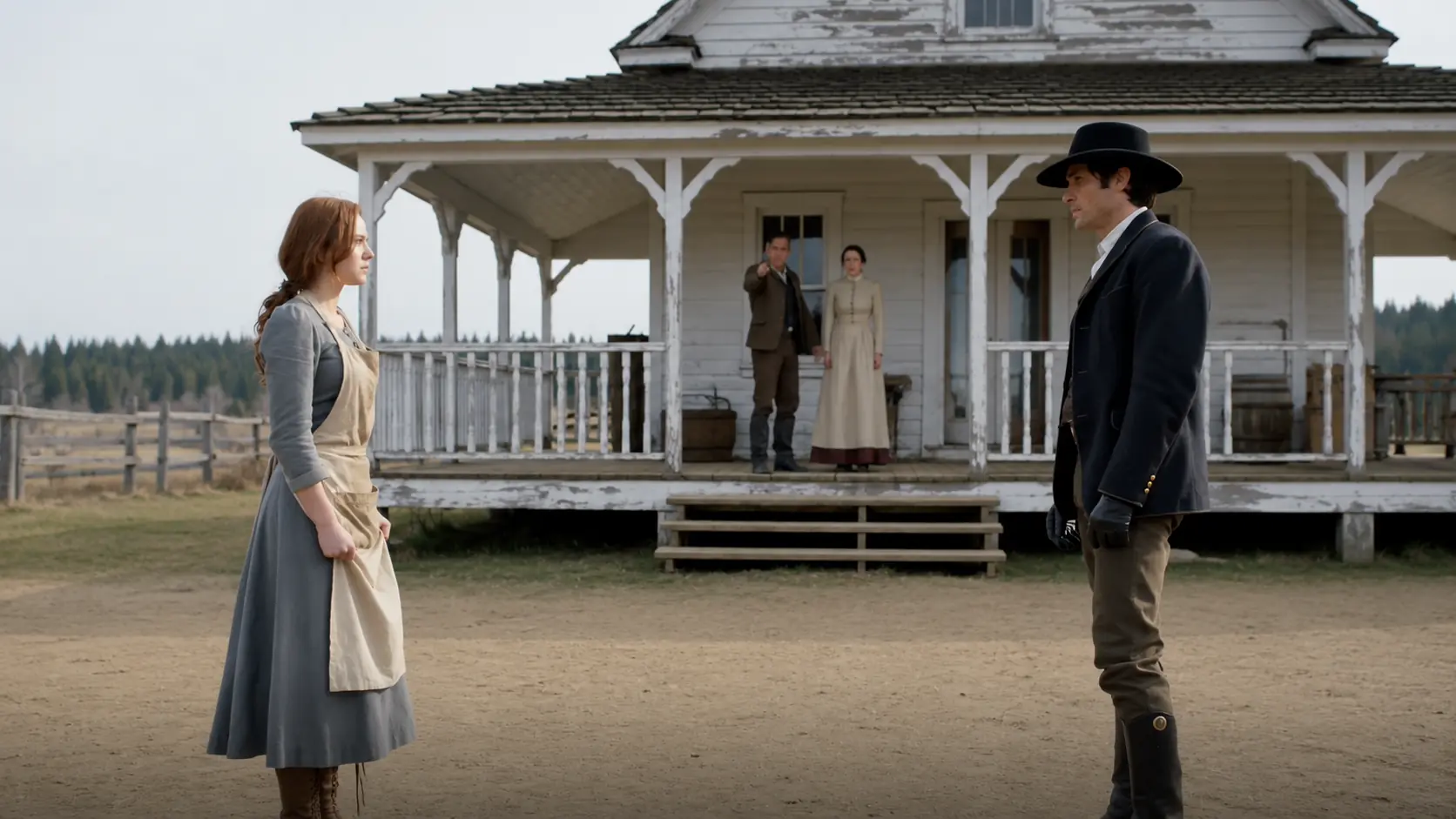
Hope.
She asked Colton why he had really chosen her, and told him not to say it was because of her calluses. After a long silence, he told her the truth. When he had walked into her house, he had seen himself.
Different circumstances, different prison, but the same trap: family that saw them as property and a future mapped out by people who did not care what they wanted. He had thought perhaps if he could save her, he could save himself too.
Clara turned and truly looked at him. She saw past the expensive clothes and confident manner to something tired and trapped beneath. He told her his father was going to try to break her.
When she asked what would happen if Victor succeeded, Colton smiled sharply and said they would break him first. It was not a promise. It was a declaration of war.
Clara asked him to tell her about the ranch and what she was walking into. As they rode through the gathering dusk, Colton told her about the Mercer Empire: fifteen thousand acres of prime Montana rangeland, timber forests, and water rights that controlled half the county.
He told her about Victor Mercer, who had built it all from nothing and defended it with lawyers, bribes, and when necessary, violence. He told her about expansion plans, neighboring ranchers fighting back, fires, poisonings, and midnight threats.
He admitted they were not the good men in the story. His father had stolen water, bribed officials, and run families off land they had held for generations. Victor called it progress, but Colton had seen what it cost.
Clara asked why Colton did not stop him. Colton said Victor was dying of cancer, with perhaps a year left, and he was determined to finish his empire before he went, no matter whom he destroyed to do it. When Colton took over, he wanted to fix what he could.
They camped that night under a sky so full of stars it looked like someone had punched holes in black canvas. Colton made a fire while Clara tended the horses, falling into an easy rhythm born from years of ranch work.
By the fire, he told her more about Victor. He had come west with nothing but the clothes on his back and a knife in his boot. He had built the ranch through work, luck, and ruthlessness, mostly ruthlessness.
Victor had wanted Colton to marry the daughter of Judge Morrison, a man who controlled half the county courts. The girl was pretty, educated, politically connected, and cruel. Colton had seen her beat a horse bloody for stumbling and humiliate servants for amusement.
He admitted he was not a good man either. He had done things for Victor that kept him awake at night: threatened people, helped run families off their land, and put blood on his hands. He told Clara because she deserved the truth.
Clara stared into the fire and told him her father had called her worthless every day, sometimes with words, sometimes just with looks. She had believed him. She thought if she worked harder, did more, fixed enough fences, and cooked enough meals, he would finally see her.
When Colton offered a way out, she almost said no because at least at the Hail Estate, she knew the rules. But then she had wondered what the point of surviving was if she was already dead inside.
They sat in silence, two broken people on opposite sides of the fire, bound together by choices neither of them fully understood. Colton said they were a mess. Clara smiled and agreed.
The Mercer Ranch appeared on the horizon the next afternoon like a kingdom carved from stone and timber. Clara had expected something impressive, but nothing prepared her for the scale of it. The main house sprawled across the valley floor, three stories of dark wood and river stone, with wide porches wrapped around every level.
Behind it stretched barns bigger than the entire Hail Estate, corrals that seemed to go on forever, and pastures dotted with more cattle than Clara had ever seen in one place. This was not a ranch. It was an empire.
Ranch hands paused to stare as they rode in. A woman hanging laundry let the sheets fall back into the basket. The prodigal son had returned, and he had brought the wrong woman with him.
Victor Mercer stood in the doorway when they arrived. He was shorter than Clara expected, barely taller than she was, but he radiated power like a furnace radiated heat. His hair was steel gray, his face hard angles and deep lines, his eyes the same gray as Colton’s, but colder and utterly merciless.
Victor asked about Clara, calling her some ranch girl in a secondhand dress. Colton said she was Clara Hail, his fiancée. The word landed like a bomb in the yard.
Victor said no. Colton replied that he was not asking permission. Victor told him to return her to whatever dusty corner he had found her in and complete the arrangement with Judge Morrison.
Colton said he was marrying Clara, and Victor could accept it or fight it, but he could not stop it. Victor turned to Clara and asked her family name. She lifted her chin and said Hail.
Victor recognized Edmund Hail as a bankrupt drunk with a falling-down ranch and delusions of grandeur. He accused Edmund of sending Clara to seduce his son. Clara answered that no one had sent her anywhere. She had chosen to come.
Victor laughed harshly and told her she had chosen to trade one master for another. He called her nobody from a nothing family, with no education, refinement, or connections, dead weight wearing a dress. Colton started forward, furious, but Clara stopped him.
She asked if Victor was finished. Then she answered him with facts of her own. She was nobody by society’s standards, but she could ride, rope, brand, break horses, mend fences, birth calves, read weather, work sixteen hours without stopping, and rise before dawn to do it again.
She said she did not know French or piano, but she knew how to survive. If Victor thought that made her worthless, then he did not know half as much about ranching as he believed.
The yard went silent. No one spoke to Victor Mercer that way. No one challenged him on his own land.
Victor studied her and said she had teeth, though teeth without breeding were just another problem. He told her to come to dinner at seven and said they would see how she handled herself at a table before he made his final decision.
Colton said it was not Victor’s decision to make. Victor answered that everything on the ranch was his decision until he was dead. Then he ordered someone to find Clara something decent to wear, because she looked like a stable hand.
Inside the main house, Clara was given a room larger than her entire bedroom at the Hail Estate. A severe housekeeper named Mrs. Chen brought water and a dress under Victor’s orders. The gown was beautiful, deep emerald silk with black lace trim, but at least two sizes too small.
Clara understood immediately. Victor had done it on purpose. Mrs. Chen said Victor did nothing by accident.
Clara chose to wear her own gray dress, mended so many times the stitches showed like scars. In the mirror, she saw what Victor saw: a plain ranch girl in a poor dress, completely out of place in the grand house. But she also saw a woman who had chosen to be there.
Dinner was served in a room that could have seated twenty. Victor sat at the head of the table, Colton to his right, and a fourth guest arrived: Margaret Morrison, elegant, jeweled, and poisonous. She was connected to the marriage Victor had originally planned for Colton.
Margaret and Victor tested Clara with questions about education, accomplishments, society, and what she brought to the union. Clara answered that she brought work. Real work. The kind that kept ranches running when pretty words and social connections were not enough.
When Margaret mocked her as provincial, Clara said provincial girls knew how to survive while fancy ones were still waiting for servants to help them. Colton choked on his wine. Victor watched with amusement and calculation.
Victor asked what Clara knew about running a ranch this size. She admitted she knew nothing about an operation that large, but she knew about work. She knew no lasting thing could be built without people willing to do hard jobs, and empires built on pretty faces and political favors collapsed when real trouble arrived.
Victor told her she had a mouth on her and that it would get her in trouble. Clara said she had been in trouble her whole life, but at least this time she had chosen it.
Victor ordered brandy and then asked if Clara could ride. When she said yes, he told her to be ready at dawn for the north pasture run, twelve miles of rough terrain. If she could not keep up, she could pack her bags before lunch.
At dawn, Clara found Victor waiting in the stable yard with a difficult chestnut mare for her. He had given her a green horse that spooked easily. Clara approached slowly, spoke low, and settled the animal with steady hands.
The north pasture run was brutal. Victor pushed the pace through rocky terrain, steep inclines, and slopes that made the mare scramble for footing. Clara’s thighs burned and her lungs ached, but she stayed in the saddle.
When they crested the ridge at sunrise, Victor slowed and said she sat a horse better than most men he knew. Then he reminded her that riding was one thing; surviving the ranch was another. She would be a target if she married Colton.
Clara said she would learn to shoot back. Victor laughed and admitted she had spine, though spine did not stop bullets or win political wars. He told her Colton needed power and connections, not merely courage.
Clara asked what those connections would give Colton personally besides a lifetime of misery. Victor answered survival. Clara said survival was not all that mattered.
That night, in Victor’s private study, he laid out terms. He did not want the marriage, but Colton had chosen her, and Victor was practical. If Clara married Colton, she would become part of the ranch and work for real. She would also learn everything Victor could teach about business, politics, and the dirty machinery of power.
In exchange, Victor would give her his blessing, public support, access to resources, and would not sabotage her. If she refused, she could still marry Colton, but she would do it as an enemy of the ranch.
Clara accepted, but added one condition. Victor had to teach her honestly, with no tricks and no setting her up to fail. If she was going to prove her value, she needed a fair chance. Victor studied her, then shook her hand.
Over the next month, Victor kept his word. Every morning, Clara rode with Colton and the hands, learning the operation: water sources, pasture rotations, sick cattle, and the rhythm of work on a massive ranch. Every afternoon, Victor summoned her to his office and taught her the empire’s darker machinery.
He showed her contracts written to favor Mercer interests, political connections maintained through gifts and veiled threats, and water rights secured through legal manipulation that skirted fraud. Clara listened, learned, and asked sharp questions that sometimes made Victor almost approve.
When she warned him his expansion plan was too aggressive, targeting six ranches at once, he challenged her to explain. She said he was dying and trying to build his legacy before time ran out, but empires built too fast collapsed. She advised choosing three targets instead of six, negotiating hard but fair, and building loyalty instead of resentment.
That night at dinner, Victor announced they would scale back the expansion to focus on key acquisitions. Colton looked at Clara across the table with wonder.
The ranch hands were harder to win over. The foreman, Jack Thornton, dismissed her when she tried to help with a difficult calving. Clara rolled up her sleeves, knelt in the mud, turned a breech calf herself, and saved both calf and heifer.
After that, the men stopped telling her to go back to the house. They did not exactly welcome her, but they stopped treating her like decoration. It was progress.
Four weeks after Clara’s arrival, fire broke out in the North Timber stand. Someone had set it deliberately, and the wind drove it toward the Quinn property, a neighboring ranch already hostile to the Mercers. If the fire crossed the fence, it could start a war.
Clara rode with the others to cut a firebreak. They worked for hours through smoke and heat, chopping, digging, and dragging brush until their hands bled. When the fire reached the break, the wind shifted, and the flames turned back on themselves.
Then Thomas Quinn arrived with a dozen armed men, ready to accuse Victor of burning him out. Both sides reached for weapons. Clara stepped forward and told Quinn the truth no one wanted to see: burning Mercer timber was a stupid way for the Mercers to drive Quinn out.
Someone had set the fire to make both ranches fight. Someone who would benefit from both sides being weak. Victor supported her, and Quinn realized the mining consortium had been pressuring both ranches for mineral rights.
A shooting war was avoided. Quinn told Victor that he owed Clara a debt because she had just saved both their lives. Victor told Clara her action had been either very brave or very stupid. Clara said probably both.
But the danger did not end. Edmund Hail arrived at the Mercer Ranch with Vivien, demanding Clara return home, apologize, and convince Colton to court Vivien publicly. When Clara refused, Edmund revealed that he had arranged Vivien’s marriage to Harold Westbrook, a wealthy sixty-three-year-old widower with a cruel reputation and two dead wives behind him.
It was blackmail. Edmund said Vivien’s fate was Clara’s fault unless she fixed what she had broken. Clara begged him not to do it, but Edmund was unmoved.
Victor stepped in and said no. He called Edmund a bankrupt coward trying to sell his daughters to pay his debts and told him Clara belonged with the Mercers now. Clara offered Vivien a place at the ranch, but Vivien was too afraid to choose freedom. She went back with Edmund, saying someone had to save the family.
Clara was gutted. Victor told her she could not save someone who would not save herself. Colton promised they would watch out for Vivien, but Clara knew her sister was walking into a cage.
The weeks that followed brought new battles. Clara faced Margaret Morrison’s social attacks and Judge Morrison’s legal threats. When the mining consortium filed claims on the water rights that fed both the Mercer and Quinn ranches, backed by Morrison’s approval, violence seemed inevitable.
In an emergency meeting, Quinn wanted to run the consortium off by force. Clara proposed something different. The consortium wanted profit, not land. The Mercers had timber, the Quinns had grazing land, and both could offer a partnership that was more profitable and less risky than mining.
Judge Morrison would broker the agreement and receive credit for resolving the conflict peacefully. The plan worked. The water rights stayed where they belonged, the ranches avoided war, and Victor looked at Clara with genuine respect.
But Clara still carried guilt over Vivien. When Vivien married Harold Westbrook, Clara attended and found her sister pale, terrified, and resigned. Vivien accused Clara of saving herself and leaving her to drown. Clara offered help, but Vivien refused again, saying she would rather die as Mrs. Westbrook than live as a poor relation everyone pitied.
Later, after Victor’s study was ransacked and stolen letters exposed the truth of his old crimes, the Mercers faced a reckoning. Victor admitted he had built much of the empire on forged wills, false surveys, stolen land, and manipulated water rights. Those letters could destroy them.
Clara proposed they act first. They would find the families Victor wronged, return land, offer restitution, and make peace before the evidence could be used against them. Victor resisted, but Colton agreed. If the old empire was built on lies, they would rebuild it on truth.
They began with the Brennan family, whose land Victor had stolen through a forged will. Michael Brennan accepted the land but refused to offer forgiveness. Clara understood. Restitution did not erase damage, but it was a start.
Over six weeks, they worked through Victor’s ledger. Some families accepted with tears, others spat at them, and one widow said no amount of land could bring her husband back. She was right. Still, they tried, because trying was all they had left.
Then James Caldwell, the man who had stolen the letters, returned them. His dying father had been one of the men Victor wronged, but after receiving restitution, he had asked James to return the evidence. Revenge, he said, was not worth holding on to when forgiveness was offered.
Clara later told Colton there was one person they had missed: Vivien. Their freedom had helped trap her, and they owed her a way out. They negotiated with Harold Westbrook, offering money and timberland in exchange for an annulment. Westbrook agreed within an hour because Vivien was only a trophy to him.
When Clara brought the annulment papers to Vivien, her sister stared at them as if they were written in a foreign language. Then she whispered that Harold hit her when she did not smile enough or when dinner was not perfect. Clara held her while she sobbed and promised she was safe now.
Vivien returned to the Mercer Ranch and slowly came back to life. She apologized to Clara, admitting she had been too angry and bitter to see that they had both been trapped in different cages. Clara told her she was simply glad they were both free.
On Clara’s wedding morning, Vivien brought her breakfast and told her she was proud. Vivien also revealed she had accepted a teaching position in Helena at a girls’ school, teaching music and French. It was something she had earned for herself.
Victor asked to see Clara before the ceremony and gave her his late wife’s silver bracelet, engraved with intertwined vines. He said it reminded his wife that strength and beauty could exist in the same place. He believed she would have liked Clara.
The ceremony took place under blazing gold aspens and a clear Montana sky. Ranch hands, neighbors, former enemies, and families the Mercers had made restitution to gathered to witness it. Thomas Quinn stood as one of Colton’s witnesses. Vivien stood as Clara’s.
When Judge Morrison pronounced them married, Colton kissed Clara with tenderness, and the crowd cheered. Clara Mercer, once Clara Hail, had become part of the family not because she had been chosen like a decoration, but because she had earned her place.
Victor died two weeks later. Before his death, he told Colton to take what he had built and make it better. He told Clara to keep Colton honest and human, and not let the ranch turn him into what Victor had been. His final words were apologies to Samuel Brennan and everyone he had wronged.
After Victor’s funeral, Colton and Clara gathered the ranch hands, neighbors, and restitution families in the study. They announced they would restructure the Mercer Ranch as a cooperative. Major landowners would receive shares, decisions about expansion and water rights would be made collectively, and profits would be distributed fairly.
Some called it madness. Thomas Quinn stood first and supported them. Michael Brennan followed. One by one, enough people joined to make the cooperative real.
The Mercer Ranch stopped being a kingdom and became something closer to a community. Land was redistributed where necessary, water rights were protected from hoarding, and major decisions were made through votes instead of decrees. Clara stood at the center, negotiating disputes and proving day after day that the wrong daughter had become the right leader.
Vivien wrote from Helena about her students and later married a quiet bookshop owner who loved her mind more than her beauty. Edmund Hail died drunk and alone, his estate collapsed under debt. Clara buried him without tears and moved on.
Years passed. Clara and Colton had a daughter named Victoria, then two sons. The cooperative flourished and became a model others studied. Victoria grew fierce and intelligent, announcing at seven that she would become the first woman governor of Montana, and no one doubted her.
Twenty years after Clara rode away from the Hail Estate, she stood on the porch beside Colton and looked over the land they had transformed. He asked if she ever regretted choosing this life.
Clara thought about the struggles, the battles, Victor’s sins, her father’s cruelty, Vivien’s pain, and her own fears. But she also thought about the families they had helped, the land they had restored, the empire they had transformed from tyranny into community, and the children they had raised free to choose their own paths.
Not for a second, she said. It had been hard, but especially because it had been hard, it had mattered. Easy things did not change the world. They only maintained it.
Clara had never wanted to maintain anything. She had wanted to transform it.
She had been the wrong daughter, the unwanted one, the girl who fixed fences while her sister learned piano. She had been called worthless, treated like furniture, and told she would never amount to anything. She proved every single one of them wrong, not by becoming what they wanted, but by becoming exactly what she chose to be.
Clara Mercer, once Clara Hail, had built a legacy that would outlast her. Not through force or fraud, but through courage, partnership, honesty, and the radical act of choosing herself. The wrong daughter had never been wrong at all. She had simply been in the wrong place, with the wrong people, measured by the wrong standards.
When she finally had the courage to leave, to build something new from the ashes of what others thought she should be, she became who she was always meant to be.
Tags:
News in the same category

My Wife Cheated on Me - So I Betrayed Her With the One Woman She Never Expected
My Son Gave My Bedroom to His In-Laws and Put Me in the Garage - Then He Learned Whose House It Really Was

My Son Watched Them Strip Me of My Seat at Christmas — Then Walked Away and Took Everything Back

My Mom Stole My $45,000 College Fund for My Sister’s House - Then I Faced Them as a Millionaire

Mom Mortgaged Her House to Fight Me in Court - All to Defend My Convicted Brother
They Called Her Too Old to Marry - Until London’s Most Desired Duke Chose Her
He Said “You’re Not What I Ordered” - Then She Returned His Ring and Left Him Speechless
The Maid Said “Sir, I Speak 9 Languages” - Then the Duke’s Fiancée Laughed at the Wrong Woman
The Duke Hid His Royal Crest - Then He Fell for the Woman Who Understood His Deaf Brother
Married at 17 to a Cold Husband - Then the Duke Said “Mine”
A Barefoot Girl Asked a Cowboy for Work - Then He Saw What She Carried to His Porch
"Be My Wife for One Night" - Then Her Kiss Stopped Him Cold
Nobody Wanted the Giant Cowboy as a Husband - Then She Saw His Gentle Heart
She Thought She Married a Poor Mountain Man - Then He Drove Her to a Hidden Mansion

They Refused His Wheat at the Elevator - Then His Old Barn Made Him Rich

They Called His Well a Joke—Then the Drought Forced Them to Beg Him for Water
Her Father Called the Quarry Worthless - Then One Pound of Her Mushrooms Sold for Thousands
News Post
My Mother Slept With My Fiancé - Then Came Back Begging for an Unthinkable Favor
My Wife Cheated on Me - So I Betrayed Her With the One Woman She Never Expected
My Son Gave My Bedroom to His In-Laws and Put Me in the Garage - Then He Learned Whose House It Really Was
My Son Watched Them Strip Me of My Seat at Christmas — Then Walked Away and Took Everything Back
My Mom Stole My $45,000 College Fund for My Sister’s House - Then I Faced Them as a Millionaire
Mom Mortgaged Her House to Fight Me in Court - All to Defend My Convicted Brother
She Told Her Mother-in-Law to Reheat Leftovers - Then The House Was No Longer Hers
They Called Her Too Old to Marry - Until London’s Most Desired Duke Chose Her
He Said “You’re Not What I Ordered” - Then She Returned His Ring and Left Him Speechless
The Maid Said “Sir, I Speak 9 Languages” - Then the Duke’s Fiancée Laughed at the Wrong Woman
The Duke Hid His Royal Crest - Then He Fell for the Woman Who Understood His Deaf Brother
Married at 17 to a Cold Husband - Then the Duke Said “Mine”
A Barefoot Girl Asked a Cowboy for Work - Then He Saw What She Carried to His Porch
"Be My Wife for One Night" - Then Her Kiss Stopped Him Cold
Nobody Wanted the Giant Cowboy as a Husband - Then She Saw His Gentle Heart
She Thought She Married a Poor Mountain Man - Then He Drove Her to a Hidden Mansion
They Refused His Wheat at the Elevator - Then His Old Barn Made Him Rich
They Called His Well a Joke—Then the Drought Forced Them to Beg Him for Water