"Be My Wife for One Night" - Then Her Kiss Stopped Him Cold
“Touch her again,” the voice came low, almost quiet, the way a rifle cocks before it fires, “and you will lose that hand before you feel the pain.”
The saloon went dead silent. Every man in the room turned, and every breath seemed to stop because the man rising slowly from the back corner was not just any cowboy. He was Colt Mercer. In Black Hollow, that name meant one thing: when Colt Mercer stood up for someone, it was already too late for everyone else in the room.
The blizzard had hit Black Hollow without mercy. It came down from the mountains fast, mean, and without warning, turning the narrow main street into a wall of white and freezing the mud beneath boots that had nowhere left to run. Evelyn Cross had been running for four days. She had not slept properly since leaving Philadelphia, had not eaten a real meal since Kansas City, and had not drawn one breath that did not taste like fear.
Since the morning she discovered what kind of man Nathaniel Baron truly was, and what her father had agreed to sell her into, she had told herself she was not afraid. She repeated that lie for four days straight until she almost believed it. But standing outside that saloon in the Montana night, with snow tearing at her coat and her one suitcase growing heavier by the second, Evelyn finally admitted the truth. She had no idea what she was going to do next.
The train had stopped in Black Hollow because of the storm. The conductor said it would not move again until morning at the earliest, maybe longer if the drifts worsened overnight. The other passengers had family in town or enough money to secure the two decent hotel rooms before Evelyn even stepped off the platform. That left her standing in a mining town she had never heard of, with seventeen dollars in her coat pocket and a stolen ticket bearing someone else’s name.
The saloon was the only building with enough light to look like warmth. She pushed through the door, and the noise hit her first: rough laughter, clattering glasses, and a piano being played badly by someone who did not care. The smell hit her next: whiskey, woodsmoke, and the sourness of men who worked hard and bathed rarely. Every face in the room turned toward her.
Evelyn kept her chin up. She moved toward the bar the way her mother had taught her to walk into any room, as if she belonged there and everyone else was simply visiting. She asked the barkeep for something hot to drink and a quiet corner to wait out the storm. The barkeep looked her over slowly, then nodded toward the far end of the bar without a word.
She made it exactly eleven steps.
“Well, look at that,” a voice drawled from her left, lazy, amused, and already slurring at the edges with whiskey. “Train must have brought us something worth looking at tonight.”
Evelyn did not stop walking. The voice came louder, and then a hand shot out and caught her arm. “I’m talking to you, darling.”
She turned slowly and looked at the man holding her. He was big and wide through the shoulders, with a red face and small eyes that had the gleam of a man who had never once been told no by anyone smaller than him. “Take your hand off me,” Evelyn said.
He grinned, and the two men beside him grinned too. “Traveling alone in weather like this ain’t smart, sweetheart. A woman alone needs somebody looking after her.”
“I am looking after myself just fine,” Evelyn said, holding his gaze. “Which is more than I can say for your grip. Let go.”
He did not let go. Instead, he stepped closer, and the men on either side shifted to cut off the space around her. The barkeep suddenly found something very interesting to study at the far end of the counter. The piano kept playing, the room kept drinking, and Evelyn felt the first real spike of fear run through her chest like a cold wire.
She looked toward the back of the room instinctively, the way a person looks for a door when the walls start closing in. That was when she saw him. He sat alone at a corner table with a glass of whiskey he had not touched, watching her with eyes that had been on her since the moment she entered. He was not loud or puffed up like the drunken miner, but there was a stillness to him that made the air around him feel heavier.
He had dark hair touched with gray at the temples, a jaw that looked carved rather than grown, and a thin silver scar along his left cheekbone. It told the story of a man who had survived things most men had not. He was watching her the way a man watches a situation he has not yet decided to enter. Without knowing why, Evelyn looked directly back at him and held his gaze.
The drunken miner yanked her arm. “Stop ignoring me.”
Then the quiet voice came from the back corner.
“Touch her again, and you will lose that hand before you feel the pain.”
The drunk froze. The entire saloon froze. Colt Mercer was standing now, though Evelyn had not even seen him rise. He was simply there, like a mountain with his right hand resting loose at his side, his eyes fixed on the drunken miner with no anger at all.
That was the frightening part. Not rage, not heat, just cold certainty.
“Colt Mercer,” someone whispered behind Evelyn.
The name moved through the room like a current. The drunken man’s grip went slack. His face changed, the bravado draining from it so fast it was almost comic, replaced by something pale and raw.
“We were just talking,” the drunk muttered.
“You weren’t talking,” Colt said. “You were holding. There’s a difference.”
He looked at the hand still loosely wrapped around Evelyn’s arm. “I’ll say it once more.”
The drunk let go. He stepped back. His two friends stepped back with him, nearly tripping over each other as they retreated to the far end of the bar with their drinks, bruised pride, and eyes pointed carefully at the floor.
The saloon exhaled. The piano started again. Colt Mercer picked up his whiskey glass, finished what was in it in a single swallow, and sat back down as if nothing had happened. Evelyn stood where she was, her arm finally her own again and her heart still slamming against her ribs.
She should have said thank you, found her corner, and kept her head down. Instead, she walked directly to Colt’s table. He looked up when she stopped in front of him, not surprised, just watching. Up close, his eyes were darker than she expected, like river water over deep rock.
“Thank you,” she said.
“Don’t mention it.”
“I mean it. That could have gone badly.”
“It wasn’t going to go badly,” he said simply. “Not in here. Not tonight.”
Something in his tone suggested the conversation was over. Something in her situation demanded that it not be. “My name is Evelyn,” she said.
Colt studied her for a long moment. “I know who you are.”
Her blood ran cold. “What does that mean?”
“It means the barkeep told me there was a woman on the train from back east, traveling alone on a stolen ticket. Whole town knew before the train stopped.”
Evelyn pulled out the chair across from him and sat without being invited. “Then I need you to listen to me, because I think I have about twenty minutes before this gets significantly worse.”
Something shifted in his expression, not warmth, exactly, but the recalculation of a man adjusting to new danger. “Talk fast,” he said.
So she did. She told him about Nathaniel Baron, though not everything and not the worst of it. She told him enough to explain why she had taken a ticket that was not hers and boarded a train toward the edge of the country instead of walking down the aisle of a Philadelphia church like her father wanted. Colt listened without interrupting, his face hardly changing.
When she finished, the saloon doors burst open. Four men entered, and they were not dressed like miners or cowboys. They wore dark coats, flat eyes, and the posture of men paid to find things. Evelyn’s chair scraped back half an inch before she caught herself.
Too late. She had already looked at them, and the man in front had already looked back. His face was weathered leather, and his eyes missed nothing.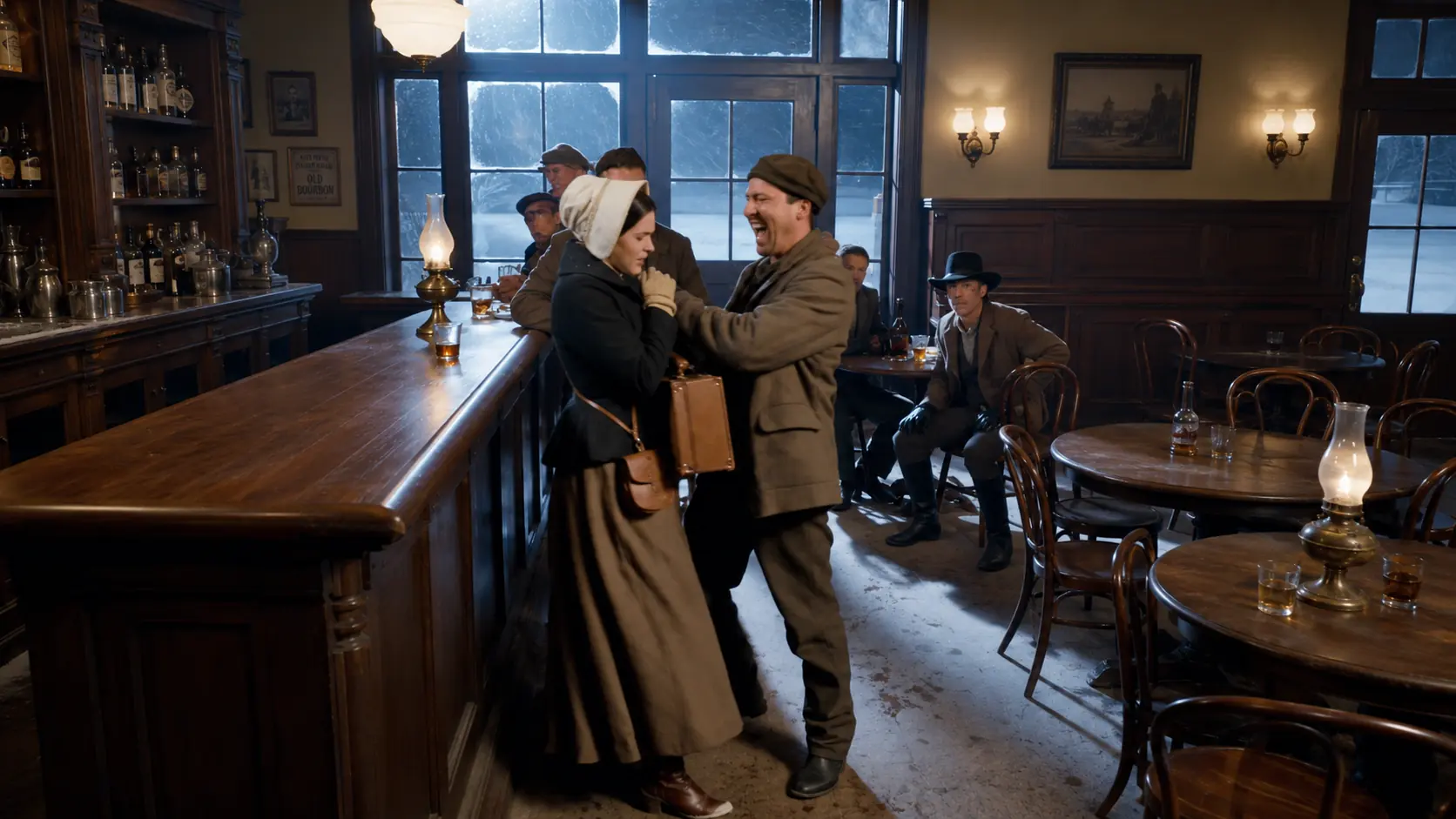
“Railroad men,” Colt said quietly.
“Yes.”
“They know your face?”
“The man who sent them does. He would have shown them a photograph.”
Colt kept his eyes on his empty glass. For three seconds, he was very still. Then, without looking up, he asked, “How much do you want to go back?”
“I would rather die.”
Another three seconds passed. “Then stop talking,” he said. “And do exactly what I do.”
He reached across the table and took her hand. Not gently, not tenderly, but firmly and deliberately, the way a person takes hold of something necessary. His thumb pressed once against her knuckles, as if telling her to stay still, stay calm, and stop looking at them.
The lead railroad man scanned the room. His gaze moved across the tables professionally, the way a man searches when he has done it many times. It reached their table and stopped because what he saw was a man and woman sitting together in the easy, settled way of people who belonged to each other. A woman’s hand rested in a man’s hand on the tabletop, and the man’s eyes lifted with the unhurried disinterest of someone with nothing to hide.
The railroad man’s gaze moved on. Evelyn did not breathe for thirty seconds. When he finally turned away, she let the air out so slowly it hurt.
“They’ll do a full pass of the room,” Colt said quietly. “Then they’ll ask the barkeep about passengers. He’ll tell them about the woman traveling alone on the stolen ticket. Then they’ll start asking if anyone has seen her.”
“How long does that give us?”
“Twelve minutes. Maybe less if the barkeep gets nervous.”
“What do we do?”
Colt finally looked up at her. “There is one thing I can do that makes you invisible to them tonight. One thing that makes them walk out of this saloon without you.”
She waited.
“But you are not going to like it.”
“Tell me anyway.”
He set down the glass. “From this moment on, you are my wife.”
Evelyn stared at him.
“You are Colt Mercer’s wife,” he said, his voice low enough that only she could hear. “Everybody in this county knows that name. Nobody working for a railroad heir will risk the trouble that comes with touching something of mine.”
“I am not something of yours.”
“You are tonight,” he said. “Or you are theirs. Choose fast, Miss Cross. We have eleven minutes now.”
God help her, she chose.
When the lead railroad man made his second pass and stopped at their table to ask if they had seen a young woman traveling alone, well-dressed, dark-haired, Colt looked up with the same slow disinterest as before. “My wife,” he said.
He reached over without looking at Evelyn and tucked a loose strand of hair behind her ear with a touch so natural that she almost forgot it was not real. “She has been with me since the train stopped. We have been sitting here for the better part of two hours. I do not make a habit of noticing other women when mine is in the room.”
The railroad man looked at Evelyn. She smiled the kind of smile that costs everything to hold steady. “Long trip,” she said. “We are both exhausted.”
The man looked between them for three long seconds, then moved on.
They stayed at the table another forty minutes until the railroad men gave up the search and moved on to other buildings. Colt ordered two more whiskeys, one for himself and one for her. Evelyn drank all of hers. Neither of them spoke much.
At some point, the drunk who had grabbed her arm left through the back with his friends. The blizzard kept howling outside. Evelyn Cross sat across from a man she had known for less than an hour, a man who had just told three railroad enforcers that she belonged to him. She thought about that word: belonged.
She thought about what it had meant in her father’s house, and what it had meant in Nathaniel Baron’s smile when he looked at her like a painting he had already purchased. Then she looked at Colt Mercer, who was staring at the window with the expression of a man working through something difficult. This was different, she thought, though she did not know why.
“Thank you,” she said again.
“Don’t thank me yet,” Colt said. “They’ll be back. Men like that don’t stop because they hit one dead end.”
“I know.”
“They’ll check the hotels. Both of them. They’ll go room by room if they have to.”
“I know that too.”
He turned and studied her face. “You said you would rather die than go back.”
“I meant it.”
“I believe you.” He paused. “I have a ranch six miles out of town, up in the hills. Nobody goes out there unless I invite them, and I do not invite people.”
Evelyn waited.
“It is one night,” he said. “The storm breaks by morning. The train runs again, and you get on it headed somewhere else. In exchange, nothing. You are not in a position to offer me anything I need.”
He said it without cruelty. It was simply a fact. “You come to my ranch tonight, keep up the story, and at sunrise you are gone. No emotions, no questions, no complications.”
Evelyn tilted her head. “Do you make a habit of rescuing women from railroad men?”
“No.”
“Then why?”
He was silent longer than she expected. “I do not like men who use money to own people. Simple as that.”
She picked up her suitcase and stood. “All right, Colt Mercer. Lead the way.”
They rode out of Black Hollow in the dark and snow. If anyone watched them go, they saw exactly what they were supposed to see: a man taking his wife home through a storm, moving together as if they had done it a hundred times before. The road into the hills was rough, and Colt rode slightly ahead without speaking. Evelyn did not mind, because she was thinking about her father.
She was thinking about the letter he had sent three weeks earlier, explaining in careful, apologetic language that the arrangement with Nathaniel Baron had been finalized and that her feelings were no longer a factor that could be considered. Halfway up the trail, Colt reined in and told her two things. His ranch hands would accept the story without question, but she had to behave like she meant it when they were around. He would not explain himself to his own people.
The second thing was his nephew, Noah. The boy was nine years old. He had lost his parents eight months earlier and was still very quiet. “He does not need to know this is not real,” Colt said. “Do not give him reason to get attached to something that is not going to stay.”
There was something in the way he said it that struck Evelyn low in the chest. He was not asking her to protect him. He was asking her to protect a child from another loss.
“I understand,” she said quietly.
The ranch appeared gradually out of the dark: first the barn, then the main house with two warm squares of lamplight in the windows. A young ranch hand named Pete came out to take the horses and stopped short when he saw her. Colt swung down from the saddle. “My wife,” he said flatly. “Storm came in fast. She was on the train.”
Pete looked between them, then nodded. “I’ll get the horses settled. Marta left supper on the stove.”
Inside, the house was warmer than Evelyn expected and more lived in than she feared. It had dishes in a cabinet, a worn quilt over a chair, and small boots by the door that could only belong to a child. Marta, a broad-shouldered woman in her fifties, appeared from the kitchen with the energy of someone who had run a large household for years. Colt introduced Evelyn as his wife, and Marta looked at her with eyes that took in everything quickly.
“Supper is on the stove,” Marta said. “I’ll make up the room.”
“The room is fine as it is,” Colt said.
“I’ll put fresh sheets on it anyway,” Marta replied, making it clear that this was not a negotiation.
A door opened down the hall, and Noah appeared in a nightshirt and wool socks, holding a book tight against his chest. He looked at Evelyn, then Colt, then back at Evelyn. “Who’s she?”
“Her name is Evelyn,” Colt said. “She will be staying tonight.”
Noah asked if she was nice. Evelyn did not laugh or smile falsely. She looked at him straight and said, “I am trying to be. Some days are better than others.”
Noah seemed to accept this. He returned to his room, and Evelyn stood in Colt Mercer’s house with a stolen ticket in her pocket, a false marriage on her shoulders, and hired men still looking for her six miles down the mountain.
Over supper, Colt asked about Nathaniel Baron. Evelyn told him her father had signed papers, the kind that transferred a person the way one might transfer a deed. Colt’s eyes hardened. He asked if she had somewhere to go after sunrise. She said she would figure that out.
“That is not an answer,” he said.
“It is the only one I have.”
He studied her, then said, “It is your life.”
Marta had made up the main bedroom and placed a narrow cot in the adjoining room. Evelyn offered to take the cot, but Colt told her to take the bed. He had slept on worse. At sunrise, he would have Pete saddle a horse. The station was a straight ride down the main trail.
As he turned to leave, Evelyn said his name. He stopped. She realized he always stopped when she said it, as if the word caught him off guard every time.
“You did not have to do any of this,” she said.
“No,” he agreed. “I did not.”
He left her standing in a room that smelled of cedar, woodsmoke, and something steady she did not know how to name. She sat on the edge of the bed with her coat still on, thinking about a nine-year-old boy, six miles of frozen mountain road, and the men paid to find her. One night, she told herself. Just one night.
Downstairs, Colt Mercer sat awake by the fire all night, watching the door.
The blizzard held through morning. Colt had not slept. Evelyn found him in the kitchen before dawn, still in his coat, with an untouched whiskey glass nearby and coffee already on. He told her the men had not come up the mountain. He would have heard the horses.
She asked why he had listened all night.
“Because you are on my property,” he said.
“I am a stranger on your property.”
He looked at her. “I have my reasons.”
When she asked for one, he told her about a good man he once knew whose wife had been trapped in a situation much like hers. A powerful man, legal papers, nowhere to run. Colt had not been there when it mattered, and the woman had gone back because she had no choice. He had been there in his head ever since.
The storm did not break. The hands came in for breakfast, stopped when they saw Evelyn, then accepted her presence because Colt gave them no room not to. Evelyn made biscuits, and by the time the second batch came out golden and uneven but genuinely good, the men had reached a preliminary verdict. Garrett, the oldest hand, helped himself to three. Danny, the youngest, took four.
Noah appeared at seven, saw her still there, and asked if she had made the biscuits. When she said yes, he sat down. Later, he showed her a loose board on the back porch that he had been trying to fix for two weeks. Evelyn found a hammer and nails, knelt in the cold, and fixed it while Noah passed tools with grave focus.
Garrett walked by and saw her working. “Ma’am, that board’s been bad for a month and a half.”
“I can see that,” she said, hitting the nail cleanly.
Colt came around the corner and stopped. He watched her on her knees in the cold, coat dirty at the elbows, repairing a porch board with practiced efficiency. He asked where she had learned. She told him her mother’s family were builders, and her grandfather believed girls should know what their hands were for.
The storm held all day. By afternoon, it was clear the train would not run, and nobody was going up or down the mountain until the weather broke. Evelyn helped Marta in the kitchen and organized the pantry. Then she found Colt’s ranch paperwork piled on the sideboard and started reading.
When Colt returned from the fence line, tired and snow-covered, he found her annotating a water rights contract. She told him he would lose the dispute if he signed it as written because a clause allowed the neighboring property to divert his creek access in dry months. Colt read the clause once, then again. He had been planning to sign it the next day.
She apologized for touching his papers. Colt instead asked her to review the rest of them. In exchange, she would have a safe place to stay and time to figure out where she was going when she left. She looked at him and said that was not a deal, that was him asking her to work.
He accepted that. She pulled the stack toward her and said his filing was terrible. Colt admitted it and went to eat while Evelyn sat in his house, reading legal documents by gray afternoon light. Nobody said the word wife again that day. They did not need to.
That night, Noah found her reading by the fire. He told her Colt did not let people touch his papers. Evelyn said he had made an exception. Noah thought for a moment and said Colt trusted her, even if he did not want to.
Colt heard the end of the conversation from the doorway. He sent Noah to bed, then sat in the chair his brother used to sit in before he and his wife were killed. The room carried more ghosts than Evelyn had known. Later, Marta found Evelyn in the kitchen and told her plainly that she was not Colt’s wife.
Evelyn did not deny it. Marta said Colt could not walk past trouble and never could, especially after the war. He had come back different, colder, like someone had taken something out of him and replaced it with something hard. She said Colt had once laughed more, had plans, and had loved a woman who left while he was overseas.
That night, Evelyn found him awake in pain. She knocked once on his door, heard no answer, and pushed it open. Colt sat on the edge of the bed with his shirt off, one hand pressed to his right side, his jaw locked. His first reaction was not anger but the look of a man caught in something he had spent years making sure no one saw.
“Get out,” he said.
Evelyn stepped inside instead. She dampened a cloth and asked if it was an old wound. He told her not to. She stopped, looked at him, and saw what his shirt had hidden: bullet scars, a burn across his side, and the evidence of a life that had tried several times to end him.
He watched her look, braced for disgust or pity. Evelyn crossed the room, sat near him but not against him, and held out the damp cloth. “Then you do it,” she said quietly.
He took the cloth after a long moment. She did not speak while he used it. She did not look away either. She simply sat in the silence and did not perform concern in a way he would hate.
Eventually, he said one word. “War.”
“I know,” she said.
He told her about a farmhouse outside Petersburg, about trying to get men out, about saving most of them but not all. He said he had never been able to get properly warm since, not even in summer. The cold brought the aches back, and he had learned to live with it.
“You should not have to get used to it,” Evelyn said.
He looked at her directly. “Why are you still here?”
She answered honestly. “I know what it is like to be in pain you have been told to make quiet.”
Something changed between them then, slight but undeniable, like a wire releasing one degree of tension. He told her she should go back to her room. She agreed that she probably should, but neither of them moved. In that silence, with the blizzard pressing against the house, something shifted between Colt Mercer and Evelyn Cross that neither of them knew how to undo.
The storm broke on the third morning. Evelyn knew it before she opened her eyes because the silence had changed. The road would open again. She had no more excuses.
She dressed before full light, took her suitcase from under the bed, and went downstairs. Colt was already in the kitchen. He said the storm was done and that he would have Pete bring a horse around. Neither of them moved.
Marta passed through with linens, felt the weight of the air, set them down, and walked right back out without a word. Evelyn mentioned the third contract and the liability clause she had marked the night before. Colt stared at her. She had stayed up marking his contracts.
Then he said she did not have to go that day. The trail would be icy until midday. It was safer to wait. He said it with the straight face of a man absolutely manufacturing reasons, and both of them knew it.
She agreed to wait until midday. Midday came and went. Nobody mentioned the horse.
By two in the afternoon, Garrett came in with bad news. Six riders were coming up the east trail, not local, armed and moving slowly like they were searching. Colt looked at Evelyn, who had gone pale but kept her hand steady on the mare she had been checking. He ordered Danny to the ridge and told Evelyn to go inside.
In the main room, with the marked contracts between them, Colt demanded everything about Nathaniel Baron that she had left out. So she told him. She told him about the dinner party where Nathaniel backhanded a servant for spilling wine, then smiled through the next forty minutes as if nothing had happened. She told him about rumors, evidence, and legal documents showing that Baron had used railroad money to buy land through fraud, intimidation, and suspicious deaths.
Colt listened without interrupting. When she finished, he went to the window and asked how many men Baron traveled with. Evelyn warned him that if Baron found out she was there, he would not just take her. He would come after everyone who helped her and call it legal action.
Colt rode down to town to find out what was being said. He returned at five with tightness around his eyes. Nathaniel Baron was in Black Hollow with eight men, legal papers signed by a judge in Philadelphia, and a warrant for Evelyn’s return on the grounds of broken contract. He was offering five hundred dollars to anyone who could tell him where she was.
Five hundred dollars was more than many men in Black Hollow would see in three years. Evelyn thought of Pete and his sick mother. Colt admitted he could not promise Pete would not talk. Evelyn said she had to leave.
Colt stopped her. Running was what Baron counted on. If she ran, he would catch her on open ground with no witnesses and legal papers in his pocket. She argued that staying put his people at risk, especially Noah.
“Stop making my decisions for me,” Colt said.
“I am not making your decisions. I am telling you what the right decision is.”
“They are not always the same thing.”
Before they could say more, Danny burst in. Four of Baron’s men were at the south gate, asking for Colt. Colt met them alone. When he returned, he said Baron wanted a meeting the next morning at the church.
That night, Evelyn made a decision. She would leave before dawn. If she was gone, Baron would have no reason to stay. Colt’s ranch, his nephew, his people, and his house would return to what they had been before a desperate woman walked into the wrong saloon.
She left a note on the table beside the marked contracts and went to the barn. The horse was half saddled when the barn door opened. She did not hear Colt come in, but she felt the change in the air.
He stood in the doorway, took in the suitcase, the horse, and her coat. “No,” he said.
“I left a note,” she said.
“A note?” His voice stayed low, but something raw pushed beneath it. “After everything this week, you left a note?”
“I do not owe you a goodbye.”
“I know exactly what you owe me and what you don’t. That is not what this is.”
“Then what is it?”
“You are running,” he said. “The same thing you did in Philadelphia, except this time you are running from something good instead of something bad, and you are calling it the right decision so you do not have to feel it.”
The words hit like cold water. She said it was not fair. He said it was true. She told him she was leaving because Baron would destroy everything he built. Colt told her to stop using Noah to make it about something other than what it was.
“You are terrified,” he said quietly. “Not of Baron. Not of the ranch. Of staying somewhere that feels like it might actually hold you.”
The barn went silent. Evelyn told him he did not know her well enough to say that.
“I know you better than anyone has known you in a long time,” Colt said. “And so do you.”
Then he did something he said he had not done in years. He asked for something.
“Stay.”
Every wall Evelyn had built in the last four days failed at once. She grabbed the front of his coat and kissed him. It was not gentle. It was hard, desperate, furious, terrified, and full of everything she had been holding back.
Colt went still for half a second. Then he kissed her back, not roughly, not as a man taking something, but like someone being handed something fragile and irreplaceable. His hands came to her face carefully, holding rather than pulling. She felt his whole body exhale against hers, years of tension leaving him in one long breath.
When they parted, their foreheads rested together. Neither spoke for a long time.
“I am still scared,” she whispered.
“I know,” he said. “So am I.”
“That does not help.”
“No. It does not.”
She looked at his face in the dark barn and saw the man beneath the control. She asked what they were doing. Colt admitted he genuinely did not know. But when she said she trusted him, the words surprised her because they were true.
He took her suitcase and set it beside the stall. Then he took her hand differently than he had in the saloon, not as performance, but as choice. “Come inside,” he said.
She went.
Dawn came cold and clear. Colt rode to the meeting at the church. Nathaniel Baron was not the man Colt expected. He was quiet, well dressed, clean-handed, handsome in a deliberate eastern way, with pale still eyes. He had legal papers proving Evelyn had never been Colt’s wife and claimed she was under obligation to return to Philadelphia.
Colt said she was under his protection. Nathaniel threatened the ranch through litigation: water rights, grazing land, and the deed itself. He offered Colt a clean exit if he walked away. Colt leaned close and told him he had been threatened by men who meant it, and they had been scarier than Baron.
When Colt returned, Evelyn told him the worst truth. Her father’s gambling debts had been settled through the marriage arrangement. She had not been a bride. She had been payment.
Colt stood by the window, hands closing and opening at his sides. Nathaniel had proposed the arrangement himself. Her father had agreed. Colt turned back to her, and his face showed something older and deeper than anger.
“He is not getting you back,” Colt said. “Not while I am breathing.”
The attack came at ten that night. Baron’s men set the barn on fire from the east while others tried to move near the ranch. The horses screamed, men shouted, and for twenty minutes the yard became controlled chaos. Colt’s men got the horses out, contained the fire, and captured several intruders.
Then Danny ran in with his face white. Noah had been taken from the Henderson farm by men carrying papers. They had taken him to the abandoned mining camp north of the ridge. Colt grabbed his rifle, and Evelyn said she was going with him.
He looked at her for two seconds. “Stay behind Garrett. Do exactly what I say. No arguments.”
They rode into the dark.
At the abandoned mining camp, Nathaniel Baron waited with eight men and Noah sitting on an overturned crate. Colt ordered him to release the boy. Baron agreed, and Noah walked steadily to Colt without running. Colt sent him to Garrett.
Then Nathaniel addressed Evelyn, explaining that arrangements like hers were common in certain circles. Evelyn remembered him hitting a servant and smiling afterward. Colt stepped between them.
“No man owns her,” Colt said. “Not your father’s money, not your lawyers, not your papers. Not while I breathe.”
Nathaniel ordered his men to take Colt. They rushed him from the sides, and for the first three seconds, they had him. Then Colt broke free with the speed and violence of a man shaped by war. Garrett fired a warning shot from the ridge, and several of Baron’s men lowered their weapons.
Colt reached Nathaniel, knocked him down, and raised his fist. For one moment, he felt what he would become if he finished it. Then Evelyn’s voice cut through the cold.
“Colt, stop.”
He stopped. His fist stayed raised over Nathaniel’s bleeding face. For three seconds, no one moved. Then Colt stood and stepped back.
“He is not worth what it would cost you,” Evelyn said.
“No,” Colt agreed. “He is not.”
Twenty minutes later, the sheriff arrived with deputies and a federal warrant for Nathaniel Baron’s arrest on charges of land fraud, falsification of documents, and conspiracy linked to the deaths of men who had refused to sell. Pete, offered five hundred dollars, had not betrayed them. Instead, he had gone to other ranchers and told the truth.
Baron was taken away to Billings. Noah clung to Colt’s side, finally letting himself stop being brave. Evelyn touched Colt’s bruised jaw gently, and he let her. That letting her touch the damage without flinching told her everything.
“You stopped,” she said.
“You asked me to.”
“You would have stopped anyway.”
“Maybe,” he said. “I had good reason.”
“What reason?”
He looked at her. “You are here. That was reason enough.”
Noah asked if they could go home. Colt said yes. They rode back down the mountain together through the Montana dark, toward a house with two windows lit like eyes.
The next morning, Colt spoke to Pete. Pete admitted he had been tempted by the money because of his mother’s medical bills, but he could not sell out a woman who had fixed a broken porch board without being asked. Colt arranged to help with the bills. Pete said Evelyn was good for the ranch.
Colt looked toward the mountains. “Yes,” he said. “She is.”
Ten days later, a letter arrived from Philadelphia. Evelyn recognized her father’s handwriting and sat with it for a long time before opening it. It was not exactly an apology, but it was a man trying to write one while finally accepting enough truth for the words to matter. He confessed the debt, the desperation, and the lie he told himself when he agreed to Baron’s offer.
He was cooperating with federal investigators. He admitted his failure belonged to him. Evelyn told Colt it did not fix anything. Colt said no, it did not.
But it was something.
She began planning a school on Colt’s land for the children around Black Hollow who had no access to proper education. Colt offered lumber and contacts. Marta sewed curtains without admitting it had anything to do with sentiment. Pete built desks, and Danny helped address letters to book suppliers back east.
By April, sixteen children came to the school. Noah read three grade levels above where he had started. A judge from Billings came to the ranch and delivered the final legal answer: Baron’s complaint was dismissed, the contract declared fraudulent and unenforceable, and Evelyn was free in every legal definition of the word.
Evelyn held the document in both hands. Freedom felt like taking off something heavy she had worn so long she forgot it was not part of her. Colt told her she could go anywhere now. Philadelphia, back east, anywhere.
“I know,” she said. “But I am not going.”
He asked why.
“Because this is mine now,” she said. “This ranch, this school, these people, you. You are mine, and I am yours. I stopped being temporary the same moment you did.”
He knew exactly when that was.
“The barn,” he said.
“The barn,” she agreed.
He kissed her then, not desperately like that night, but deliberately. It was the kiss of two people who were no longer falling anywhere because they had already arrived.
Months later, the story traveled across counties and saloons. Some told it as a tale about a railroad man who overreached. Garrett told it as proof that men with principles mattered more than men with guns. Pete told it as the story of a woman who fixed a porch board and made him think twice about five hundred dollars.
Noah told it most accurately. He said it was about a woman who did not know where she was going, and a man who did not know what he was waiting for, until a blizzard kept them in the same room long enough for both of them to figure it out.
Evelyn told her students the simplest version.
“I got on the wrong train,” she said, “and ended up exactly where I was supposed to be.”
Colt never told the story. He was not a man who spoke much about himself. But on the anniversary of the blizzard, he found an annotated legal contract on the sideboard, with Evelyn’s note at the bottom: “Third clause is still your best one.”
He kept the note in his coat pocket for a week before realizing he was doing it. Then he kept it there on purpose.
In the end, that was the whole story. Two people who had both spent a long time building walls against loss met in a storm and chose, with their eyes open, to come in from the cold. The school stood, the ranch held, Noah grew, and the contracts stayed sound.
Every evening, when the mountains turned gold, Colt Mercer sat on his porch with his wife beside him, his real wife, his chosen wife. The woman who had walked into the wrong saloon, fixed his broken board, kissed him in a barn, and built something out of what he had left standing. Neither of them needed to say much.
Everything worth saying was already there.
Some people never find the place where they belong. Some find it on the other side of the most frightening door they have ever opened. Some are lucky enough to find it in the heart of the person who scared them most. And when they finally stop running, they realize it had been waiting for them the whole time.
Tags:
News in the same category
My Wife Cheated on Me - So I Betrayed Her With the One Woman She Never Expected
My Son Gave My Bedroom to His In-Laws and Put Me in the Garage - Then He Learned Whose House It Really Was
My Son Watched Them Strip Me of My Seat at Christmas — Then Walked Away and Took Everything Back
My Mom Stole My $45,000 College Fund for My Sister’s House - Then I Faced Them as a Millionaire
Mom Mortgaged Her House to Fight Me in Court - All to Defend My Convicted Brother
She Told Her Mother-in-Law to Reheat Leftovers - Then The House Was No Longer Hers
They Called Her Too Old to Marry - Until London’s Most Desired Duke Chose Her
He Said “You’re Not What I Ordered” - Then She Returned His Ring and Left Him Speechless
The Maid Said “Sir, I Speak 9 Languages” - Then the Duke’s Fiancée Laughed at the Wrong Woman
The Duke Hid His Royal Crest - Then He Fell for the Woman Who Understood His Deaf Brother
Married at 17 to a Cold Husband - Then the Duke Said “Mine”
A Barefoot Girl Asked a Cowboy for Work - Then He Saw What She Carried to His Porch
Nobody Wanted the Giant Cowboy as a Husband - Then She Saw His Gentle Heart
The Rich Cowboy Chose the Outcast Sister - And Shocked the Entire Town of Blackridge
She Thought She Married a Poor Mountain Man - Then He Drove Her to a Hidden Mansion
They Refused His Wheat at the Elevator - Then His Old Barn Made Him Rich
They Called His Well a Joke—Then the Drought Forced Them to Beg Him for Water
Her Father Called the Quarry Worthless - Then One Pound of Her Mushrooms Sold for Thousands
News Post
My Mother Slept With My Fiancé - Then Came Back Begging for an Unthinkable Favor
My Wife Cheated on Me - So I Betrayed Her With the One Woman She Never Expected
My Son Gave My Bedroom to His In-Laws and Put Me in the Garage - Then He Learned Whose House It Really Was
My Son Watched Them Strip Me of My Seat at Christmas — Then Walked Away and Took Everything Back
My Mom Stole My $45,000 College Fund for My Sister’s House - Then I Faced Them as a Millionaire
Mom Mortgaged Her House to Fight Me in Court - All to Defend My Convicted Brother
She Told Her Mother-in-Law to Reheat Leftovers - Then The House Was No Longer Hers
They Called Her Too Old to Marry - Until London’s Most Desired Duke Chose Her
He Said “You’re Not What I Ordered” - Then She Returned His Ring and Left Him Speechless
The Maid Said “Sir, I Speak 9 Languages” - Then the Duke’s Fiancée Laughed at the Wrong Woman
The Duke Hid His Royal Crest - Then He Fell for the Woman Who Understood His Deaf Brother
Married at 17 to a Cold Husband - Then the Duke Said “Mine”
A Barefoot Girl Asked a Cowboy for Work - Then He Saw What She Carried to His Porch
Nobody Wanted the Giant Cowboy as a Husband - Then She Saw His Gentle Heart
The Rich Cowboy Chose the Outcast Sister - And Shocked the Entire Town of Blackridge
She Thought She Married a Poor Mountain Man - Then He Drove Her to a Hidden Mansion
They Refused His Wheat at the Elevator - Then His Old Barn Made Him Rich
They Called His Well a Joke—Then the Drought Forced Them to Beg Him for Water