Nobody Wanted the Giant Cowboy as a Husband - Then She Saw His Gentle Heart
The wind off the Rockies cut through Blackwater like both a promise and a threat. March in Montana Territory meant mud deep enough to swallow wagon wheels, ice forming in water troughs overnight, and a loneliness that settled into a person’s bones. Eliza Hart stood behind the counter of Morrow’s General Store, her hands dusted with flour from the morning’s baking, watching the wind rattle the windows. She had been awake since four, kneading bread before dawn, shaping rolls, crimping pies, and earning every dollar of the three a week Morrow paid her.
Morrow let her sleep in the storage room, but it was not charity. Eliza earned that space with her Parker House rolls, butter biscuits, pies, and the steady patience of a woman who had learned to survive without asking anyone for kindness. Old Jim Wheelen came in that morning smelling of tobacco and horses, asking for more butter biscuits. Eliza wrapped six in brown paper while he counted the coins with fingers twisted by arthritis.
“You’re too good for this place, Miss Hart,” he said. “Someone ought to marry you proper.”
Eliza smiled the way she had trained herself to smile, pleasant, distant, and final. “I do fine on my own, Mr. Wheelen.”
After he left, she swept flour from the counter and tried not to think about the truth. She was twenty-six years old, living in a storage room, and had been in Blackwater for eight months without making a single real friend. The women at church looked through her like glass. The men looked at her in ways that made her check the lock on her door twice.
Then the bell over the door jangled, and Sarah Pritchard burst in waving a paper, followed by Mary Chen and Constance Wells. All three women were red-faced, breathless, and thrilled by whatever scandal they had carried in from the street. Sarah slapped the notice onto the counter and announced that Rhett Callahan was looking for a wife. Eliza picked up the paper and read the precise handwriting.
“Man of property seeks wife. Must be strong, honest, and willing to work. No drunkards, no gossips, no fragile temperaments. Life will be hard but fair. Compensation, security, respect, share in all holdings. Serious inquiries only. R. Callahan. Callahan Ranch, north boundary.”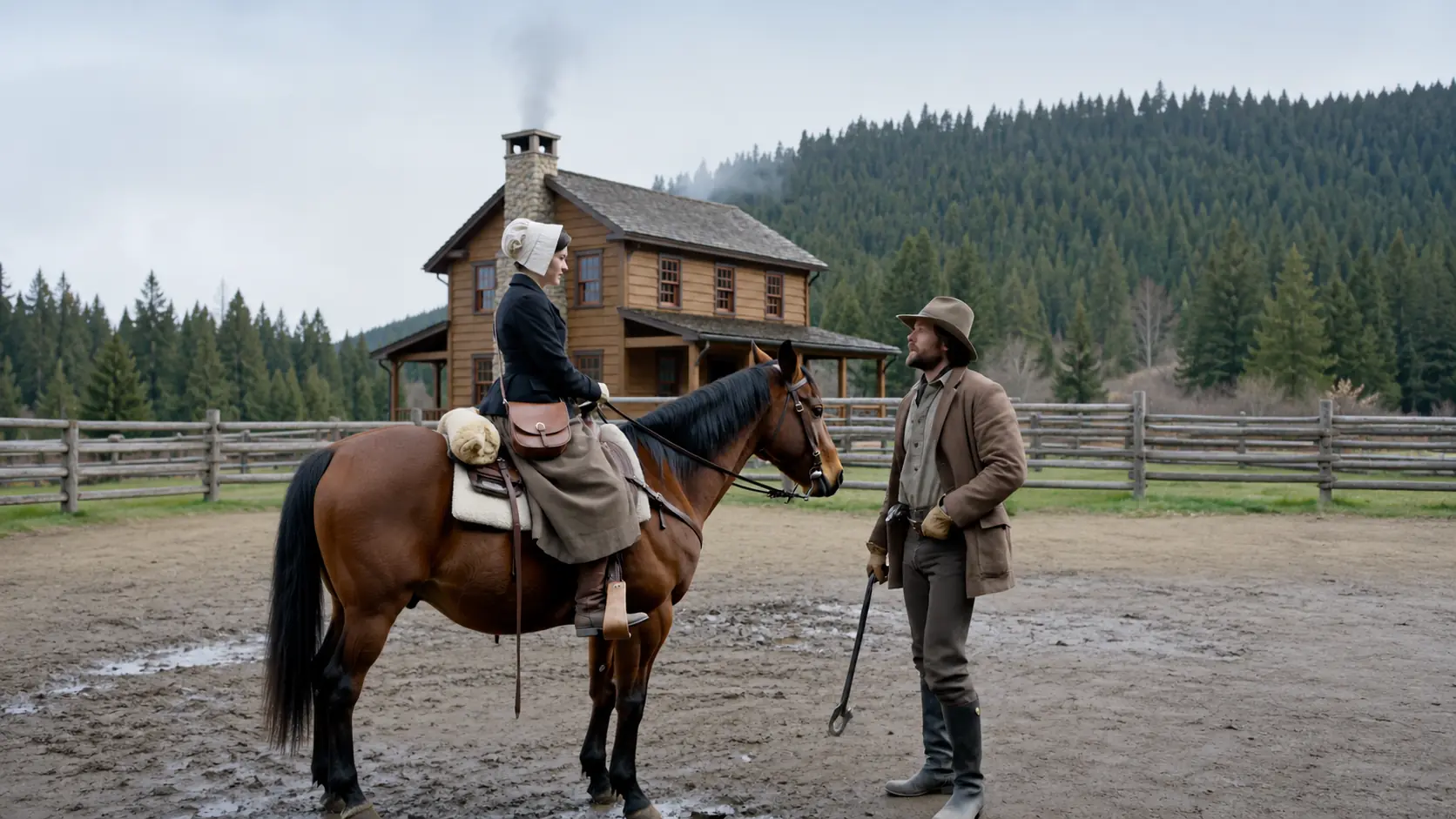
The women laughed as though the notice itself were obscene. Mary said it sounded like ordering a plow from a catalog. Constance wrinkled her nose and said everyone knew Rhett Callahan was a brute, huge, mean, and nearly silent. Sarah lowered her voice and said he had killed a man with his bare hands.
“That was self-defense,” Eliza said quietly. “Sheriff Dawson said the other man drew first, and the killing was ruled lawful.”
The three women turned toward her. Sarah snatched the paper back and said lawful or not, Rhett Callahan was still a savage. He lived alone like a hermit, owned a ranch bigger than anyone’s, and worked it himself because no one wanted to work for him. Eliza asked why no one would work for him, and Mary said it was because he was terrifying.
“He is six and a half feet tall, built like a bull, barely speaks ten words a month, and comes to town only a few times a year,” Mary said. “He does not drink, does not gamble, and does not go to church.”
“Sounds like he minds his own business,” Eliza said.
The women laughed harder. Sarah said the notice proved Rhett was so unpleasant he could not find a woman the normal way. Then they left in a cloud of whispers and giggles, already eager to spread the story. Eliza stood behind the counter, staring at the empty space where the notice had been.
Strong, honest, willing to work. Security, respect, share in all holdings. Respect. When was the last time anyone had offered her that?
By noon, the entire town knew. The saloon crowd found it hilarious, the church ladies found it scandalous, and the merchants found it unfortunate because Callahan spent real money when he came to town. Eliza kneaded dough and shaped loaves while the idea grew heavier in her chest. She knew what people saw when they looked at her: a woman alone, past the age when towns forgave a woman for being unmarried, with no family and no prospects.
She had been in seven towns in three years, and the pattern had always been the same. Find work, keep her head down, save what she could, and leave when questions started or attention grew too pointed. She was tired of leaving. At closing time, she counted the register, swept the floor, locked the door, and went to the storage room.
There, she sat on her cot and pulled the small wooden box from beneath the floorboard. Inside were her savings, a deed to land in Kansas she had never seen, a silver locket she could not pawn, and a folded newspaper clipping she had carried for years. She did not unfold it. She knew every word by heart.
Woman sought in fraud investigation.
Eliza closed the box, pushed it back under the floor, took out a sheet of paper, and began to write. The ride to Callahan Ranch took four hours. She left before dawn, telling Morrow she needed a day for personal business. She borrowed a horse from the livery, said she was visiting a sick friend north of town, and paid extra so no one would ask too many questions.
The directions were simple. North road to the fork, west trail to the boundary markers, then follow the creek until the valley opened. The scrub and sagebrush gave way to pine, the air grew colder and cleaner, and snowcapped mountains rose in the distance. Then the valley appeared below her.
Grassland, water, timber, corrals, outbuildings, and a real working ranch spread across the land. The main house was solid timber, two stories tall, with a wide porch and a stone chimney sending smoke into the sky. Eliza tightened her hands on the reins. She had rehearsed what she would say, but now the words vanished.
Rhett Callahan was shoeing a horse when he heard hoofbeats. He did not look up at once, only finished driving the nail, checked the fit, and set the hoof down gently. “Easy,” he said in a low voice, and the gelding settled. Only then did Rhett turn.
He was as large as the rumors claimed, but not careless with it. He moved like a man who had learned to be gentle because the world expected him to break things. He saw Eliza sitting on the borrowed horse at the edge of his yard and knew who she was. The baker from Morrow’s store.
“Miss Hart,” he said.
“Mr. Callahan,” she answered. “I came about your notice.”
For a long moment, neither of them spoke. A crow called from the pines, and somewhere beyond the yard, the creek moved over stone. Rhett asked if she had read the notice and understood what it said. Eliza said she thought so.
He wiped his hands on a rag and studied her. Then he told her plainly that he was not looking for romance, nor someone to decorate a house or pour tea. He needed a partner, someone who could work, stay steady under pressure, and speak the truth. That was what he was offering in return: partnership, not a fairy tale.
“I am not looking for a fairy tale, Mr. Callahan,” Eliza said.
“What are you looking for?”
She met his eyes. “A place to stop running.”
The words struck him harder than either of them expected. He studied her again, not just her face, but the weariness beneath it. He asked what she was running from. She asked if it mattered.
“Might,” he said. “The law?”
“No.”
For reasons he could not explain, he believed her. She said she had disappointed someone, made choices people disapproved of, and grown tired of explaining herself. Rhett said people in town talked about him too. They said he was mean, dangerous, and had killed a man.
Eliza said she had heard it. When he asked if that bothered her, she answered that he had posted a notice instead of simply taking what he wanted, and that told her something. Rhett almost smiled. Then he invited her inside for coffee.
The house was cleaner than Eliza expected, sparse but well kept. There was a good stove, a table, chairs, shelves with books, and tall doorways built for a very large man. Rhett poured coffee, and they sat across from one another in a silence that was not uncomfortable. Eliza asked why he had posted the notice.
“Because I am tired of being alone,” he said.
There was no shame in it. He had built the ranch over ten years, with land, water, timber, livestock, and everything a man could want except someone to share it with. He had tried talking to women at church socials and town dances, but it never worked. His size made people nervous.
Eliza asked if he had ever hurt anyone who did not deserve it.
“No,” he said.
“Then they are fools.”
This time, he did smile. He told her he had grown tired of pretending to be smaller and gentler just to make people less afraid. So he wrote the truth and waited to see whether anyone brave enough would answer. Eliza was the first, and the only one.
Rhett asked about her life, and she told him enough. The work she had done, the towns she had passed through, and the fact that she had no family, no ties, and no place anchoring her. She did not mention the clipping. She did not mention Kansas.
He asked if she could shoot, ride, cook, and handle livestock. She answered honestly: she could use a rifle or pistol well enough, ride well enough, cook better than most, and had helped with chickens and pigs but never cattle. Rhett said he would teach her. Then he told her the ranch was not small.
Three thousand acres, two hundred head of cattle, contracts with the army for beef, timber rights, water rights, and mineral rights. If they married, half of it would become hers legally. He would have papers drawn up. Her breath caught.
“That is fair,” he said before she could protest. “You will be working the same as me. You will earn it.”
She asked why he would trust her with so much.
“Because if I cannot trust my wife, what is the point of having one?”
It was the least romantic proposal Eliza had ever heard. Somehow, it almost made her cry. She said she needed time to think. Rhett told her to take it.
Then she asked to see the rest of the property. He saddled horses, and they rode for two hours. He showed her the boundaries, the creek that never ran dry, timber stands, cattle in the south pasture, the barn with its organized tack room, and a garden plot that was empty but rich with soil. On a ridge overlooking the valley, Eliza said it was beautiful.
“It is hard,” Rhett corrected.
Winters were brutal. Sometimes the ranch was snowed in for weeks. Cattle died, things broke, people got hurt, and a person could go days without seeing another soul. Eliza asked if he thought that would bother her.
He looked at her with unsettling clarity. “I think you have spent a long time pretending to be smaller than you are. Quieter. Less. This place does not want that. It wants everything you have.”
Something opened in her chest. Before she left, she asked what had happened with the man he killed. Rhett’s jaw tightened. The man had been cheating at cards, Rhett had called him on it, the man drew first and missed, and Rhett did not.
People blamed him anyway because they needed someone to fear. A monster they could point at made them feel safer. Rhett had stopped trying to convince them otherwise. Eliza told him she would have an answer in three days.
The ride back to Blackwater felt longer than it should have. She let the horse walk while her mind spun around three words: partnership, respect, home. When she reached town, Sarah Pritchard was waiting on the steps of Morrow’s store. Sarah demanded to know where she had gone.
Eliza said it was personal business. Sarah accused her of riding north to see Rhett Callahan and warned that people would talk. Eliza turned on her with a calm that made Sarah step back. She said she had been in seven towns in three years, and in every one, people like Sarah had decided who she was before she ever opened her mouth.
“So no, Sarah,” Eliza said. “I do not care what people say anymore.”
The next morning, Eliza found a rock through Morrow’s front window. Morrow came in to find her sweeping glass. He liked her, he said, and she was a good worker, but he could not have trouble. People would talk, and his family and reputation mattered.
Eliza reminded him that visiting a man who had posted a public notice in broad daylight did not make her loose, and throwing rocks through windows was far less proper. Morrow apologized but fired her anyway. He gave her a week’s pay and a good reference. Eliza packed in an hour.
Her clothes, the wooden box, her savings, the locket, and the past she still had not outrun all fit into a small bundle. Standing in the empty storage room, she expected grief. Instead, she felt relief. She walked to the telegraph office and sent a message.
“R. Callahan. Answer is yes. E. Hart.”
Three hours later, the reply came. “Come tomorrow. Bring everything. R. Callahan.”
That night, Eliza slept in a rented bed and thought not of Kansas or the clipping, but of the future. A valley. A ranch. A man who had promised partnership and meant it.
Rhett was waiting at the boundary line when she arrived. He had brought a packhorse for her belongings, and the careful thoughtfulness of that nearly undid her. They rode together into the valley. When he asked what had happened in town, she told him she had been fired.
He asked if it was because of him. She said it was because of small minds and broken windows. He apologized, but she told him not to. She was not sorry.
At the ranch, Rhett helped her down with hands careful despite their size. He said he would put her things in the guest room unless she wanted the master bedroom. It was her choice. She chose the guest room for now.
The next morning, they rode into Blackwater. The land office smelled of paper and tobacco smoke, and people had somehow learned they were coming. Thomas Greeley, the land clerk, said the marriage contract was irregular. Rhett asked whether it was legal.
Greeley admitted it was. Rhett told him to file it. The papers gave Eliza equal ownership of all property and holdings. Most men did not do that, but Rhett was not most men.
He signed first, his handwriting surprisingly elegant for such large hands. Then he offered the pen to Eliza. Once she signed, it was real, binding, with no going back. Her hand moved almost on its own.
Eliza Jane Hart.
Then they went to Judge Morrison’s office across the square. The judge questioned her directly, asking if she understood marriage was a legal contract and if she understood she had known Rhett only two days. Eliza said she knew what she needed to know. He was honest, he was offering partnership instead of ownership, and he would keep his word.
Morrison studied them both, then performed the ceremony. There were no flowers, no music, and no speech about romance. Only law, consent, obligation, and two people choosing each other in a room full of ink and dust. When the judge pronounced them husband and wife, the name struck Eliza like a fist.
Mrs. Callahan.
Outside, a crowd had gathered. Sarah Pritchard stood at the front, arms crossed, and mocked the speed of the courtship. Then she stepped closer and asked if Rhett knew why Eliza kept moving. Eliza’s stomach dropped.
Sarah said she had a cousin in Kansas who wrote detailed letters. There had been a woman there, trouble with money, fraud, and a description that matched Eliza perfectly. Rhett looked down at his new wife with questions in his eyes. Eliza could not speak.
Rhett said they were leaving. He took her arm gently but firmly and led her toward the horses while Sarah called after them, accusing Eliza of running again. They rode out of Blackwater at a trot that became a canter. Neither spoke until the ranch came into view.
Then Rhett asked if it was true. Eliza said it was complicated. He said that was not an answer. So she told him.
She had worked at First National Bank of Topeka as a clerk. Her supervisor, Richard Vaughn, had been embezzling money, moving funds between accounts and falsifying records. When Eliza discovered it and reported him, he used his connections and destroyed evidence. By the time investigators arrived, he had made it look like she was the thief.
Rhett asked if she had stolen the money. She said no. He asked if she could prove it. She said no.
That was why she had run. Staying meant prison for a crime she did not commit. Rhett was silent for a long time. Then he told her she had lied.
Eliza said she had not lied; she simply had not told him everything. He said that was the same thing, and his honesty hurt worse than anger. She told him she understood if he wanted an annulment. She would leave.
Rhett asked where she would go. She did not know. Somewhere else. She was good at that.
Inside the house, Rhett asked whether she would steal from him. Eliza said never. He asked how he was supposed to know that. She told him he had to decide whether to trust her, the same way she had decided whether to trust him.
The words hung between them. Eliza apologized for not telling him before the judge. Rhett said sorry did not fix it. She offered to sleep in the barn and leave in the morning if that was what he wanted.
Rhett refused. She was his wife, and legally, that meant something. He did not break contracts, even ones he might regret. The word regret hurt, but Eliza accepted it.
At dawn, she found the kitchen empty. A note waited on the table in Rhett’s precise handwriting. He had gone to check the north fence, and the coffee was hot. Eliza poured a cup and tried to understand what the note meant.
By noon, she could not stand waiting. She went to the barn and studied the tack room, feed barrels, and tools. Everything had a place, and everything was maintained. This was the barn of a man who cared about what he built.
When Rhett returned, he told her the fence was fixed. She asked if he needed help with anything. He asked if she knew how to muck stalls. She said she could learn.
They worked side by side in silence until her shoulders burned. Then Rhett said he had thought about what she had said. Both of them had been running. She was right.
He had hidden at the ranch just as she had hidden by moving. Different methods, same result. He was not good at trust, but he had posted a notice asking for a wife, and now he had to choose whether to trust the woman who answered it. He told Eliza he was choosing to trust her.
Not because he was sure, but because if he could not trust his wife, the whole thing meant nothing. Relief hit her so hard she had to grip the pitchfork. Then he told her trust worked both ways. He was trusting her with the ranch and everything he had built, and she needed to trust him back.
So Eliza told him more about Richard Vaughn. He was married, admired, respected, and praised for civic duty. He had offered to mentor her at the bank, invited her to dinners, introduced her to his wife, and made her believe he was being kind. Then the suggestions began.
Comments about her appearance. Private meetings. Locked doors. When she refused and reported him, the investigation into her began three days later.
Rhett’s face darkened. He asked if Vaughn was still in Kansas. Eliza said she did not know because she had not looked back. Rhett said if Vaughn ever came to the ranch, he would regret it.
Eliza said men like Vaughn did not follow women like her. They destroyed them and moved on. After a long silence, Rhett said he believed her. Not because the story made her look good, but because it did not.
That evening, Rhett told her he would begin teaching her the ranch properly. Cattle handling, fence repair, water management, contracts, and seasons would take months, but they had time. Eliza asked about cooking and cleaning. Rhett said they would split those too.
Weeks passed, and the ranch slowly became a rhythm. Eliza woke before dawn, dressed in sturdy work clothes Rhett bought for her, and learned to feed horses, check cattle, repair fences, handle rope, and see illness before it spread. She failed often at first, but Rhett never mocked her. He simply showed her again.
Their marriage remained legal on paper and practical in daily life. They slept in separate rooms, neither naming the distance between them. Each morning, Rhett made coffee. Each evening, Eliza mended something of his.
Then the past came closer. On a trip into Blackwater for supplies, Sheriff Dawson pulled them aside. A telegraph had come from Kansas. The marshal’s office was looking for Eliza Jane Hart, wanted for questioning in a fraud case involving twenty thousand dollars from First National Bank of Topeka.
Eliza said she had stolen nothing. Dawson asked why she had run. She told him staying would have meant prison for a crime she did not commit. The sheriff studied her and said he did not like the smell of the case.
If she had truly stolen that much money, she would not be living on a ranch mucking stalls. He would wire Kansas that the inquiry had come to nothing, but if anyone else made the connection, he could not help her again. He advised her to clear her name. Running only worked for so long.
Back at the ranch, Rhett said they needed a plan. Eliza said she would leave if the truth threatened him. Rhett refused. He had promised partnership and security, and he would not break that promise, even if it cost him the ranch.
They wrote to the Pinkerton Agency in Denver, requesting an investigation into possible ongoing embezzlement at First National Bank of Topeka. Weeks passed. The ranch demanded work, and the threat of Kansas sat in the house like a loaded gun. Then the Pinkerton letter arrived.
Richard Vaughn was still at the bank, still in power, and still stealing. Agent Marcus Webb, posing as an auditor, had found irregularities in twelve accounts and thirty-two thousand dollars missing over the previous three years. The pattern matched what Eliza had described. But to prove Vaughn had framed her, Webb needed her testimony.
Eliza would have to return to Kansas. Rhett said no because it was too dangerous. Eliza said she was tired of running. If the past could find her in Montana, it could find her anywhere.
She wanted to face it before it destroyed the life they were building. Rhett asked if she had already decided. She said yes. Then she asked him to come with her because she did not want to face it alone.
Rhett agreed, but only if everything was done properly. Immunity in writing. A lawyer. Protection before she set foot in Kansas.
The telegraph came back confirming the arrangements, and they left at first light. The trip to Topeka took three days by train. At the station, Marcus Webb met them with legal papers. The immunity agreement was approved.
If Eliza testified fully and truthfully, all charges against her would be dropped. No prosecution. No prison. A clean record.
Within forty-eight hours, she would give a deposition, and Richard Vaughn would be in the room. The thought nearly knocked the breath from her. But she had come too far to turn back. At the courthouse, prosecutor Daniel Pierce prepared her for the testimony.
When Eliza entered the deposition room, Richard Vaughn looked almost the same. A little older, perhaps, but still wearing the same expensive suit and easy smile. He greeted her as Eliza Hart. She corrected him.
“It is Callahan now.”
His smile widened.
The deposition lasted hours. Eliza told the full story: the bank, the mentoring, the locked doors, the refusal, the report, the forged records, the clerk code used against her, and the evidence that disappeared. Vaughn’s attorney tried to make her look convenient, bitter, and unreliable. Eliza stayed steady.
At the end, Vaughn passed close enough to whisper that he had been untouchable for three years and would remain untouchable when the farce ended. Eliza said they would see. A few days later, Pierce announced they were moving forward with charges. Vaughn had tried to access his office files after hours and was caught with fifty thousand dollars in cash and a train ticket to Mexico.
Eliza and Rhett returned to Montana knowing the trial would come later. For the first time, the train ride home felt lighter. In Blackwater, some people still whispered, but the story had changed. Some said Eliza had courage for going back instead of running.
At the ranch, Eliza moved from the guest room into the master bedroom. She told Rhett she cared for him more than she had planned to. He told her he cared too. That night, their marriage became more than a contract.
Summer came, and Eliza baked again. Rhett built her an outdoor oven, and she began selling bread and pies at the Saturday market. At first, people stared. Then they bought everything.
Even Sarah Pritchard came to offer something close to an apology. She admitted she had been cruel and wrong. Eliza accepted enough of it to move forward. The trial came in September.
For nine days, Pierce built the case. Webb’s documents showed the embezzlement pattern. Clerks testified, and Morrison admitted the old investigation had been compromised. Then Eliza took the stand.
She told the truth again. Vaughn’s lawyer attacked her for running, called her unreliable, and suggested she had invented her story to escape prosecution. Eliza admitted she had run because she was scared, poor, alone, and certain no one would believe her. But she had come back because running had not worked, and because Vaughn had to face consequences.
The jury deliberated for two days. When the verdict came, the courtroom filled again. Guilty on count one. Guilty on count two.
Guilty on seventeen of eighteen counts.
Richard Vaughn sat frozen as the verdict was read. It was over. Justice had finally reached him. Pierce said Vaughn would likely face at least twenty years.
That evening, Eliza and Rhett raised glasses to freedom. They went home. The ranch felt different now. Eliza could breathe there without fear waiting behind every sound.
In January, a letter confirmed Vaughn had been sentenced to twenty-two years in territorial prison. Eliza read it twice, then burned it in the fireplace. The case was closed. Spring brought calves and the first sign of a child.
Eliza told Rhett she was pregnant, and he was stunned, joyful, and terrified. Their daughter was born early, loud and healthy, and they named her Sarah after Rhett’s mother. Years later came Thomas, then Margaret. The ranch grew.
The bakery grew. The house filled with noise, work, and life. Two years after the trial, the bank recovered most of Vaughn’s stolen money, and Eliza received a five-thousand-dollar reward. She chose to invest it in the ranch, buying adjacent land, building a schoolroom, and hiring help.
Callahan Ranch expanded to nearly four thousand acres and became one of the strongest operations in the territory. Rhett and Eliza built it together, not as owner and dependent, but as partners. On their tenth anniversary, they stood on the porch watching their children play in the yard. Rhett asked if she ever thought about Kansas.
Eliza said sometimes, but not the way she once had. It no longer hurt like an open wound. It was just something that had happened. Part of the story, but not the whole story.
Years passed. The children grew. Montana became a state. Rhett and Eliza grew old together, their partnership deepening into a love neither of them had expected when he posted that blunt notice asking for a wife.
People in Blackwater told stories about them. The woman who answered a stranger’s notice. The giant rancher who trusted her. The couple who built an empire from work, faith, and courage.
The stories were not always accurate, but the heart of them was true. Two lonely people, both running from different kinds of fear, had chosen each other. In choosing, they created something worth having. Rhett died peacefully at seventy-two, with Eliza holding his hand.
She thanked him for believing her and choosing her. He squeezed her hand and told her it was the best decision he had ever made. Eliza lived eight more years, long enough to see grandchildren, growth, and proof that what they had built would last beyond them. On her last day, she sat on the porch with Sarah beside her, looking out over the valley that had become home.
Sarah told her she had done good. Everything she had fought for had worked. Eliza corrected her gently. “We did good. Your father and I. Together. That was the secret.”
The secret was finding someone who saw you for who you truly were, not who you were running from, not who you were trying to become, but simply you, and choosing them anyway. Eliza died that night in the bed she had shared with Rhett for nearly fifty years. Her last thought was of the notice, the risk, and the choice that changed everything. The ranch continued.
The valley remained. The real story lived on in the land, the cattle, the children, and the courage passed down through the generations. Because what matters in the end is not the running, the hiding, or even the victory. It is what you choose to build when you finally stop running and start living.
That was Eliza and Rhett’s story.
And in every way that counted, it was a good one.
Tags:
News in the same category
My Wife Cheated on Me - So I Betrayed Her With the One Woman She Never Expected
My Son Gave My Bedroom to His In-Laws and Put Me in the Garage - Then He Learned Whose House It Really Was
My Son Watched Them Strip Me of My Seat at Christmas — Then Walked Away and Took Everything Back
My Mom Stole My $45,000 College Fund for My Sister’s House - Then I Faced Them as a Millionaire
Mom Mortgaged Her House to Fight Me in Court - All to Defend My Convicted Brother
She Told Her Mother-in-Law to Reheat Leftovers - Then The House Was No Longer Hers
They Called Her Too Old to Marry - Until London’s Most Desired Duke Chose Her
He Said “You’re Not What I Ordered” - Then She Returned His Ring and Left Him Speechless
The Maid Said “Sir, I Speak 9 Languages” - Then the Duke’s Fiancée Laughed at the Wrong Woman
The Duke Hid His Royal Crest - Then He Fell for the Woman Who Understood His Deaf Brother
Married at 17 to a Cold Husband - Then the Duke Said “Mine”
A Barefoot Girl Asked a Cowboy for Work - Then He Saw What She Carried to His Porch
"Be My Wife for One Night" - Then Her Kiss Stopped Him Cold
The Rich Cowboy Chose the Outcast Sister - And Shocked the Entire Town of Blackridge
She Thought She Married a Poor Mountain Man - Then He Drove Her to a Hidden Mansion
They Refused His Wheat at the Elevator - Then His Old Barn Made Him Rich
They Called His Well a Joke—Then the Drought Forced Them to Beg Him for Water
Her Father Called the Quarry Worthless - Then One Pound of Her Mushrooms Sold for Thousands
News Post
My Mother Slept With My Fiancé - Then Came Back Begging for an Unthinkable Favor
My Wife Cheated on Me - So I Betrayed Her With the One Woman She Never Expected
My Son Gave My Bedroom to His In-Laws and Put Me in the Garage - Then He Learned Whose House It Really Was
My Son Watched Them Strip Me of My Seat at Christmas — Then Walked Away and Took Everything Back
My Mom Stole My $45,000 College Fund for My Sister’s House - Then I Faced Them as a Millionaire
Mom Mortgaged Her House to Fight Me in Court - All to Defend My Convicted Brother
She Told Her Mother-in-Law to Reheat Leftovers - Then The House Was No Longer Hers
They Called Her Too Old to Marry - Until London’s Most Desired Duke Chose Her
He Said “You’re Not What I Ordered” - Then She Returned His Ring and Left Him Speechless
The Maid Said “Sir, I Speak 9 Languages” - Then the Duke’s Fiancée Laughed at the Wrong Woman
The Duke Hid His Royal Crest - Then He Fell for the Woman Who Understood His Deaf Brother
Married at 17 to a Cold Husband - Then the Duke Said “Mine”
A Barefoot Girl Asked a Cowboy for Work - Then He Saw What She Carried to His Porch
"Be My Wife for One Night" - Then Her Kiss Stopped Him Cold
The Rich Cowboy Chose the Outcast Sister - And Shocked the Entire Town of Blackridge
She Thought She Married a Poor Mountain Man - Then He Drove Her to a Hidden Mansion
They Refused His Wheat at the Elevator - Then His Old Barn Made Him Rich
They Called His Well a Joke—Then the Drought Forced Them to Beg Him for Water