He Said “You’re Not What I Ordered” - Then She Returned His Ring and Left Him Speechless
“You’re not what I ordered,” the Duke of Ashcombe said.
Evangeline Marchmont did not flinch. The ring lay between them on a velvet cloth, the precise color of old burgundy. It was a heavy old thing, gold cradling a square emerald set to announce ownership. The emerald caught the light from the tall mullioned window and threw a small green shape onto the marble floor between her boots and his.
She had traveled four days to reach this hall. Her hem carried two counties of mud, sharp pale chalk below Winchester and darker clay from the Hampshire border above. Her hair had been pinned three times since the final change of horses, and pinned poorly, because the ladies’ maid her uncle had promised had not been sent. She had not been permitted to change her traveling clothes, and she had not been offered water.
A duke’s household had four footmen, a steward, and a housekeeper, and not one of them had thought to treat her as a guest. The absence of welcome had told her, before any sentence of his did, what the interview was going to be. She looked at the duke across the two yards of marble. He was tall, as her uncle’s solicitor had mentioned twice, but she had not expected the quality of the stillness he stood in.
He did not fidget. He did not shift his weight to the other foot. One hand rested lightly on the dark polished table beside him, the other hanging open at his side. He had the look of a man who had said the sentence and was waiting to see what sort of woman stood opposite him.
The sort that wept. The sort that pleaded. The sort that argued. He had not allowed for the fourth sort.
Evangeline reached forward, not for the ring, but past it. Her fingers moved steadily, and the trembling she had expected did not come. She took the velvet cloth by its corner, folded it neatly over the ring as one folds a napkin for a guest who will not stay for pudding, and placed the entire bundle back into the duke’s open hand. The gold clicked once against his signet as she let go.
“Then you may keep it,” she said. “I am not what I ordered, either.”
She turned. The hall was long, and the black-and-white marble rang under her boots. Behind her, the steward, a slim man in a pewter-gray coat, made a small strangled sound. The housekeeper on the staircase dropped her folded linens. Eva did not look back.
The iron-banded doors at the end of the hall were open, and beyond them the drive gleamed wet where a thin spring rain was falling onto the gravel. She heard the duke’s boots behind her before she reached the doors. He did not call out. He did not run. He walked with long, measured strides that closed the distance faster than shouting would have done.
He called out just as she stepped under the portico. Not loudly. Not needing to be loud. He called her madam, which is what a gentleman calls any woman whose identity has disappointed him. Eva kept walking.
The gravel bit into the thin soles of her boots. Four days of coaches had worn them, and the rain was finishing what the roads had begun. She reached her hired chaise and put her hand on the door. Behind her, his voice corrected itself.
“Miss Marchmont.”
That stopped her. Not the sound of his voice, but the fact that until that moment, he had not used her name. Her own name in his mouth was a concession. She turned slowly.
He stood at the edge of the gravel, the rain darkening his dark hair at the temples. Six feet and more of him, with shoulders that filled the doorway behind him. His gray eyes were the color of wet slate, and his mouth looked as though it had probably been pleasant once, when it had been permitted to smile. He observed that she had not let him explain.
She answered pleasantly that she had not because she found the phrase “You’re not what I ordered” reasonably complete on its own. His jaw set. He began to say that what he had spoken had been something else, and she cut him off without unkindness.
“Accurate,” she suggested. “Or rude. Both, in my experience, can live together.”
A vein showed in his temple. The spring rain sifted down between them, silver threads on dark wool. Behind him, the steward appeared in the doorway, pewter-coated and narrow-faced, his hands folded in front of him. His eyes were on Eva like a cat’s on a door latch.
The duke suggested, with what he evidently considered a gesture of conciliation, that she at least come inside. They could speak. A carriage would be sent for her in the morning, a proper one. She inclined her head with the sparse courtesy of a woman who did not require any carriage he could send.
“I have one already,” she answered. “And a destination.”
She bade him good day, climbed into the chaise, and closed the door herself. She did not slam it. That mattered. She wanted to be able to tell herself later that she had walked out as a woman who had decided, not as a woman who had fled.
The leather of the seat was damp beneath her. The straw on the floor smelled of other people’s journeys. A cobweb trembled in the corner of the window where the glass met the frame. She fixed her eyes on it as the coachman clucked to the horses and they moved off through the curtain of rain toward the gatehouse and the road beyond.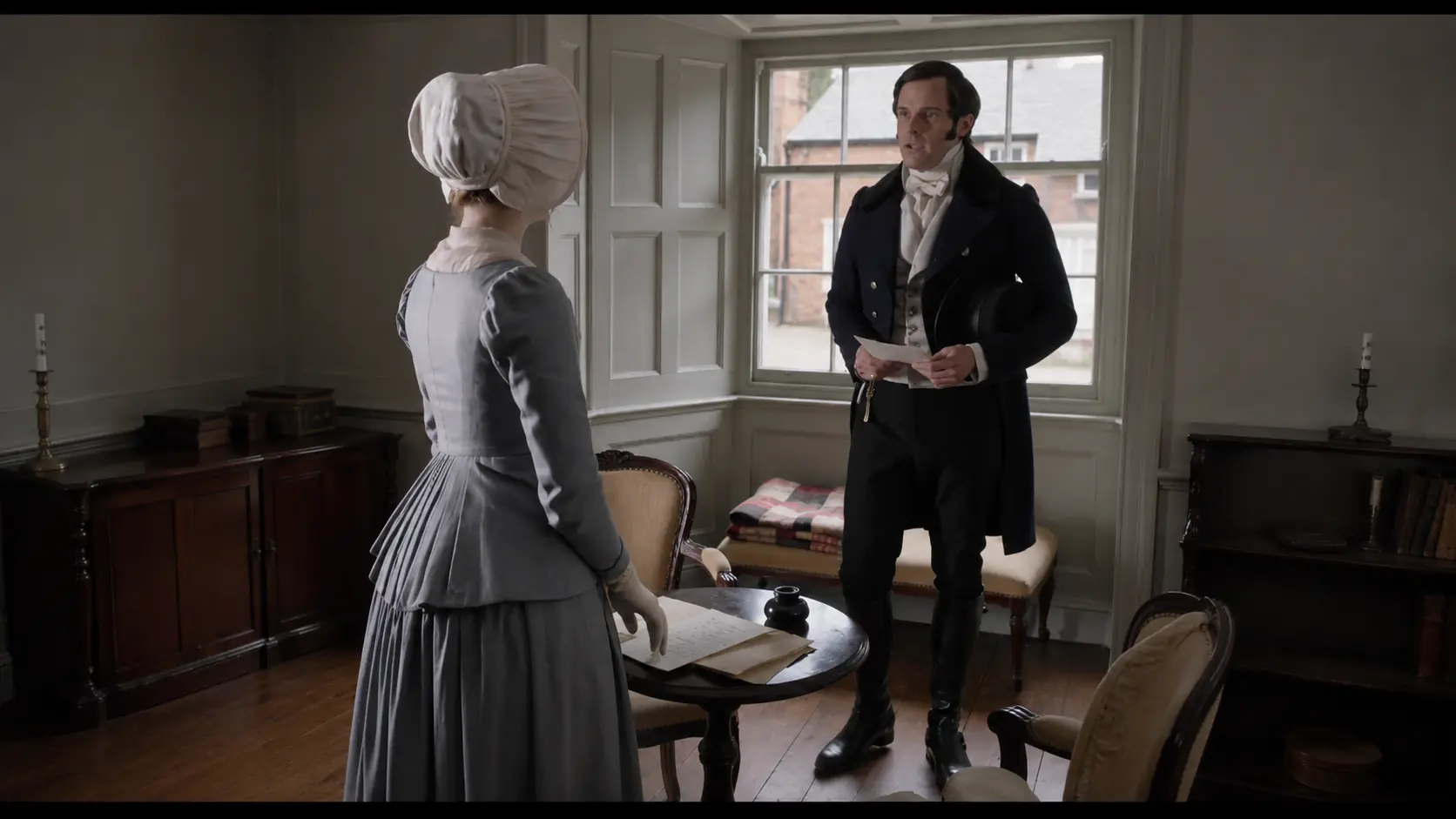
Through the small rear window, Eva watched the duke grow smaller. He did not move. The pewter-coated steward came out and spoke beside him, one hand rising and falling in a gesture that looked like reassurance. Around them, Ashcombe Manor stood stone-like against the spring sky.
For a moment, the whole grand front of Ashcombe seemed like a stage with two actors on it, the woman in the carriage being given her last view of a play she had refused to act in. Then the lane dipped, the house vanished behind a hedgerow, and the cobweb in her window gave one last tremor and parted. The journey was no longer a leaving. It was a going.
Eva’s fingers found the worn silver locket at her throat. The chain was thin, and the catch was a little loose, but her thumb knew the shape of the engraving without needing to see it. A primrose. Her father had given it to her in the last month of his life, unclasping it from her mother’s throat while her mother still wore it.
“You take care of this now,” he had said.
She had been nineteen. She was twenty-four now. As the chaise rattled onto the high road, she discovered that her hands were shaking. That was permitted. It had been permitted for the last forty minutes of the last four days.
The village of Ashcombe Underhill lay two miles from the manor gates. The chaise brought her to the Rose and Compass Inn, which was brick-fronted, climbing rose-wreathed, and not expecting any guest beyond the Tuesday mail coach. Mrs. Clegg, the innkeeper’s wife, put a hand on her broad hip at the sight of Eva stepping down in her traveling clothes during a spring shower.
“Dear me, miss, you’ve had a journey.”
“I’ve had several.”
“Parlor or private?”
“Private, please. And a bath, if it can be managed. Also some tea and a pen.”
Mrs. Clegg, who had heard many things come out of carriages in her life, nodded without remark. The blue room was small, sloped, and whitewashed, with a bowed window looking onto a yard of cobbles and a single pear tree not yet fully in leaf. The afternoon light came through the warped glass in bars and picked out the patchwork quilt on the narrow bed. Every square of it was mismatched, and every square had faded to the same honest gray-brown as Eva’s whole afternoon.
Eva sat on the edge of the bed without removing her bonnet and drafted three letters in her head before she wrote any of them. Her traveling trunk had not come in. She had only the small valise at her feet: a change of linen, a hairbrush, a traveling Bible her mother had given her, and a clean handkerchief. The smallness of the inventory struck her as the truest accounting of her life.
The first letter was to her uncle, Sir Horace. She had arrived. The duke had rejected the match. He was not to expect her at his house. She would write again when she had arrangements.
The second was to her old governess, Mrs. Hartle in Bath, now a milliner’s widow. May I impose for a fortnight or two while I consider? The third, never to be sent, was to the man she had just walked away from. I am not what you ordered. I hope it costs you. I hope it costs whoever told you what to order. I hope, someday, you are grateful I walked.
She wrote only the first two. Then she sealed them and rang the bell.
At Ashcombe Manor, the pewter-coated steward was being very carefully hospitable to his employer. A decanter of sherry had been produced, and a small fire crackled in the grate for the duke’s convenience, though the evening was mild. Mr. Parish had been Ashcombe’s steward for fourteen years. He had trained under the previous duke, closed the books on the previous duke, and opened them again for this one.
He understood the delicate management of a nobleman whose plans had just collapsed.
“A most regrettable incident, Your Grace.”
“Yes.”
“One could not have anticipated it.”
“Could one not?”
Parish considered the sherry decanter. The young lady, he confessed, had been a surprise to him as well. Sir Horace’s correspondence had led them to expect a somewhat different person. The duke set down the sherry he had not touched.
“The portrait you showed me was a lie.”
“I beg Your Grace’s pardon.”
“You showed me a miniature of a fair-haired, pale young lady with a fashionable bearing. The woman who stood in my hall is not that woman. I have eyes, Parish. I have used them for thirty-one years.”
Parish smiled tightly. The Marchmont family, he explained, was complicated. Sir Horace had two nieces in his household. He had written concerning one. Perhaps he had sent the other.
“Which was I supposed to receive?” Maxwell asked.
Parish hesitated as a man hesitates when he has not yet decided which lie is cheaper.
“Miss Cordelia, Your Grace. The younger. The fairer.”
“And the one who arrived?”
“Miss Evangeline. The elder.”
“I had understood she was considered unsuitable.”
“Some irregularity, I was led to believe, in her upbringing since the baron, her father’s, death.”
“What irregularity?”
“I do not have the particulars, Your Grace.”
“The matter is not closed,” the duke said.
He stood. He was not a shouter and never had been, but when he rose to his full height in that drawing room, the air thinned slightly around him. Parish’s smile faded at the edges. Maxwell ordered him to find every particular, every correspondence, every letter Sir Horace had sent the house in the last twelve months. Tonight.
Maxwell walked to the window. The rain had thinned to a mist that silvered the lawn. In the glass, Parish’s reflection hovered behind his own, narrow and composed. Maxwell realized he had never examined Parish the way a landowner was supposed to examine his steward.
His father had hired the man. His father had trusted the man. That had been reason enough to overlook a certain slipperiness in the man’s handling of minor affairs. But minor affairs, Maxwell was beginning to understand, sometimes grew into the sort that walked up a drive in the rain and back down it again.
Somewhere below the slope of the hill was the village. In the village was the Rose and Compass. In the Rose and Compass was a woman who had placed a velvet cloth, folded over an emerald ring, into his hand and walked out of his house as though she were the one finishing the interview.
The next morning was clear. Spring had arrived in earnest, with hedgerows thick with first green and cherry blossoms over the churchyard wall. Eva washed her face in cold water, pinned her hair without trusting the mirror, and looked at her reflection until she was certain the face she wore was hers, not someone else’s castoff.
She came downstairs in her only other gown, plain gray wool that had survived the coach better than her traveling coat. Mrs. Clegg brought bread, butter, and a pot of tea so strong the spoon nearly stood in it. Then Miss Greaves arrived, a small, birdlike woman in a schoolmistress’s dark poplin. Her reader had fallen ill, half the older girls were out with measles, and she needed someone for the infant class.
Three hours, a shilling, and tea.
Eva agreed before she could think better of it. She had not had anything to do for four days. Teaching the alphabet to other people’s small children was not nothing. It was a thing.
By half past eleven, she had spent three hours in a room full of children between four and seven, teaching them the sounds the letter C could make. She read aloud from a primer, mediated a dispute over a wooden counter, tied back the hair of a small girl who had been crying into her slate, and learned that the infants of Ashcombe Underhill considered the letter Q deeply unfair. She gave them permission to think so as long as it did not affect their copybooks. At noon, Miss Greaves brought tea, buttered bread, and a shilling, and asked whether Eva might return on Thursday.
Eva said she would.
She walked back to the inn through the village the long way, past the smithy, the chandlers, and a bow-fronted haberdasher arranging spring ribbon. A child lifted his hand to her as though she were an old acquaintance in need of reassurance. She lifted hers back. Halfway along the lane, she realized she had not thought of the Duke of Ashcombe in three hours.
That lasted until the Rose and Compass came into view.
In its yard stood a tall chestnut horse, expensive and long-legged, being walked by a groom in polished pewter livery. Eva stopped briefly at the corner by the saddler and took stock. Her bonnet was straight. Her gloves were clean. A smudge of chalk from a child’s slate had printed itself on her left hand, and she wiped it off on the hedge.
She did not turn away. Her grandmother used to say a wrecker does not turn. A wrecker walks in.
She walked in.
The duke was in the parlor, standing at the window with his hands clasped behind him. He turned at the sound of the door. He had not sat while he waited. His coat was brushed, his cravat simple, his boots attended to. A man dressed with care for an interview he was not sure how to conduct.
“Miss Marchmont.”
“Your Grace.”
“I owe you an apology.”
“You do?”
“Yes.”
A small silence breathed between them. Eva took off her bonnet and set it on the side table. She did not invite him to sit. He did not sit.
“I was misled,” he said. “Concerning who was coming. I had been shown a portrait that did not resemble you. The name on the contract did not correspond to the name on the portrait, and neither corresponded to the woman who walked into my hall. I have spent the night finding out why.”
“Have you?”
“I have not finished finding out. I came to tell you what I know so far, and to beg your pardon for what I said.”
Eva sat because her knees were suddenly less reliable than they had been in the schoolroom. She told him what she knew. Her uncle had two nieces: herself and her cousin Cordelia. Negotiations had been conducted by her uncle’s solicitor. She had been put in a coach four days ago and told the journey was arranged. She had not been shown the contract. She had been told the duke had chosen to meet her, not that he had chosen her.
Maxwell had been told the choice was Cordelia.
Eva had suspected as much. Her uncle’s household was not one in which she was trusted with particulars. She had been given a gown of her cousin’s to travel in, and it had not fit, which was why she wore her own now. She had been told to be pleasant, brief, and agreeable.
The duke asked why they would substitute her.
Eva met his eyes. The simplest explanation, she said, was that Cordelia had refused to come. Cordelia did not do things she did not wish to do. She was beautiful, had a small fortune of her own, and would not have wanted to travel four days to meet a duke who might disappoint her. Eva would have been sent because someone had to be sent.
“I was the household’s convenience,” she said.
Maxwell was silent for a long moment. Then he asked whether she would have stayed.
Eva’s hand found the primrose locket at her throat.
“If the portrait had been of me, and I had come as myself, would you have sent me away?”
His jaw worked. He did not answer at once, and this, Eva thought, was at least a point to him. He did not rush into a polished sentence. He let the silence sit.
“I do not know,” he said finally. “I would like to say no. I think I would have been a fool. But I cannot tell you what I would have done because I did not do it. I said what I said. I have thought about it all night, and I cannot pretend the sentence arrived unbidden. I had expectations that were stupid, and I spoke them.”
“At least,” Eva said, “you are honest about the stupidity.”
“Yes.”
“Go home, Your Grace. Think about what else you have ordered that you should not have. When you know, you may come back.”
He looked at her. He had expected, she thought, to be thrown out or taken back. He had not expected to be given an instruction.
“Very well,” he said. “Good day, Miss Marchmont.”
“Your Grace.”
He left. Through the bow window, she watched him mount the chestnut and ride out of the yard, the groom in pewter livery following. She touched the locket and discovered her hand was steady. Then she ordered another pot of tea.
Maxwell rode back over Ashcombe Hill at a walk. The track was soft with the night’s rain, the chestnut knew the way, and Maxwell needed the time. He discovered a curious echoing largeness inside himself, like a great room emptied of furniture. He identified it at the boundary stone.
Doubt.
He passed into the stable yard, handed over the reins, and entered the house through the kitchen door. Mrs. Fenwick, the housekeeper, was at the long table kneading dough. He asked for his mother’s writing desk. Her hands paused before she told him it was in the dressing room off the green chamber, where it had always been.
The green chamber had been his mother’s and had not been open since her death five years earlier. The desk was a delicate walnut thing with drawers lined in pale silk. In the third drawer, he found a bundle of letters tied with a faded ribbon.
The first was from his father to his mother, dated the summer of 1811. Eva would have been sixteen.
His father had just returned from Ashbourne. Sir Horace’s household was lively, but the elder niece, Evangeline, had impressed him at once. She had taken over the accounts for her father’s home farm since the baron’s illness had confined him to his chair, and she did it with a quiet competence that made the land agent weep. She was plain-spoken, but not coarse. Grave until she laughed, and then the room stopped.
“I think of Maxwell often,” his father had written. “I shall make inquiries.”
Maxwell read the sentence twice.
His mother’s handwriting joined his father’s in the letters that followed. The Marchmont match had been discussed, kept in view, and never completed because his father had died before Maxwell came home from the Peninsula, and his mother had followed a year later. The house had gone silent. The final note was in his mother’s thinning hand.
Speak to M about the Marchmont girl when he is home. His father’s judgment on this was very particular. E, not C.
Maxwell held the ribbon as he went down to the estate office. Halfway down the stairs, he steadied himself against the paneled wall, not with grief, but with the peculiar embarrassment of a man who had spent eleven months thinking himself in charge of a house and discovered the house had been running him instead.
His father had chosen a woman for him. His mother had kept the choice alive. Another man had erased it. And he, the only person who could have corrected the erasure, had failed to look in the one drawer where the truth had been left plainly for him to find.
Parish was at the great oak desk, ledger before him. Maxwell asked who had negotiated the match. Parish answered as he always answered uncomfortable questions, with a sentence that began with concession and ended with blame resting on a solicitor in Surrey. Maxwell listened to the end, then placed his mother’s letters on the desk.
He recited the relevant portions of his father’s correspondence, his mother’s notes, and the final instruction.
E, not C.
Parish put down his pen very carefully. He claimed he had known nothing of any distinction and that Sir Horace’s solicitor had plainly named Miss Cordelia. Maxwell asked to see the correspondence. Parish produced a leather folio, but his fingers moved slowly.
The folio rustled like a folio whose contents had been recently reordered. The letter Parish produced named Miss Cordelia Marchmont. Maxwell read it, set it aside, and asked for the earlier letter, the first one in which either niece’s name appeared.
Parish hesitated too long.
“Which pocket?” Maxwell asked.
“I beg Your Grace’s pardon?”
“Which pocket holds the letter you do not want me to see?”
Parish went very still. Then, after a long silence, he unbuttoned his coat and withdrew from the inner breast pocket a folded paper that had no business being on his person. Maxwell unfolded it. It was a letter from Sir Horace’s solicitor, dated the previous summer, naming Miss Evangeline Marchmont, elder daughter of the late Baron Winthrop, as the proposed subject of negotiation.
In Parish’s hand, the word Evangeline had been crossed through, and Cordelia written above it.
The alteration was neat. It had been made with the tranquil concentration of a man who had not expected anyone to ask to see the original.
“Explain this,” Maxwell said.
Parish did not speak. Maxwell did not fill the silence. At last, Parish admitted that Miss Cordelia’s mother was his second cousin. Maxwell stated back to him, plainly, what he had done: substituted the name of the woman Maxwell’s own mother had asked him to marry with the name of his cousin’s daughter, for that family’s advancement.
Parish also admitted that Miss Evangeline would have been, in his respectful judgment, a very effective duchess and would have taken an interest in matters usually left to the steward.
Maxwell looked at him for a long moment. The anger he had carried into the room thinned into something cooler and harder.
“Go,” he said.
Parish began to protest. Maxwell did not permit it. He instructed the steward to pack his things, leave the house before dusk, take what was his and nothing else, and be out of the county by the following evening, under pain of a charge of fraud that Maxwell would bring personally.
By three o’clock, Parish was gone from Ashcombe Manor.
Maxwell stood at the window of the empty estate office and watched the smaller curricle recede down the drive. The oak desk behind him felt larger than it had that morning. Without the steward’s narrow figure hunched over it, the room had the dishonored grandeur of a place finally emptied of someone who had occupied it too long for the sake of politeness.
Then Maxwell called for his horse.
The Rose and Compass was quiet that afternoon. Eva sat at the parlor table with a folded slate, working through the next week’s schoolroom exercise at Miss Greaves’s request. She had ink on her second finger.
Maxwell entered without his hat. Mrs. Clegg, in the passage, did not speak. Eva looked up.
“Your Grace?”
He asked if he might come in. She answered dryly that he already was. He closed the door, sat without being asked, and said without preamble, “My father had intended you.”
Eva set down her pen.
He laid out what his mother’s correspondence had made plain. His father had met her at Ashbourne in 1811, when she had been sixteen and keeping her father’s farm books during his illness. His father had written about her. His parents had discussed the match. His mother had left a note before her death instructing him to marry Evangeline Marchmont, not Cordelia.
His steward had substituted her cousin’s name.
That was the whole story.
The color left Eva’s face. She had prepared herself for many possibilities, but none resembled this. She repeated aloud that his father had met her, as though she needed to turn the fact in her hand to feel its weight. She remembered the late duke. She had shown him the south meadow drainage sketches she had done. She had thought he had merely been kind.
“He had been kind,” Maxwell told her. “He had also been watching you.”
Eva sat back. Her hand rose to the primrose locket and stayed there.
“My uncle knew,” she said at length.
“Your uncle’s solicitor knew, whether your uncle directly—”
“My uncle knew. My aunt knew. Cordelia knew. They knew for years that my future had been settled with your father, and I was never told. They sent me in a coach without a contract to meet a man who thought he had ordered my cousin. This was not household laziness. This was contempt.”
“Yes,” Maxwell said.
“I am not surprised,” she whispered. “I should like to be. I cannot be. That is the saddest thing I have said aloud in some time.”
Maxwell owed her a second apology, a more particular one, for all the years he had not come looking. He had been in Spain, then in mourning, and he had not asked the questions he should have asked when he came home. If he had, she would not have spent five years in that house.
“You did not know I was there,” Eva said.
“I should have.”
Eva wiped her eyes quickly. He did not remark on it, and she thought afterward that she might forgive him for that alone.
“I am going to have to think,” she said.
“I know.”
“I am going to ask you to leave me to think for a day, at least.”
“Yes.”
“I will write you in the morning.”
“I will wait.”
At the door, he paused without turning around.
“My mother liked you very much, from my father’s description. I wish I could have had some of her sentences before I opened my mouth yesterday.”
“So do I, Your Grace.”
The next morning, she wrote him a single line on ink paper.
I shall stay in the village a fortnight. I make no further promises. E.M.
He replied within the hour.
I ask for no promise. I ask for the fortnight. A.
Word traveled as word in a village will. By the end of the week, Ashcombe Underhill had merged two competing stories into one inaccurate but charitable tale: that the duke had rescued Miss Marchmont from a bad match contrived by his wicked steward and was now waiting, as a gentleman ought, for her to decide whether she could forgive him.
Her uncle’s answer came by the Monday post. It was outrage, accusation, scandal, and demand across four close-written sides. Sir Horace ordered her immediate return and enclosed a draft for the coach fare. Eva read the letter twice, walked to the inn’s writing desk, and composed the shortest letter of her life.
Uncle,
Your draft is returned. I shall not be coming back. I have learned from a source I believe that the late Duke of Ashcombe intended a match with me on his own initiative in 1811, and that this intention was concealed from me for reasons I now understand. I shall address you further through an attorney when I have engaged one.
Evangeline.
She returned his draft in the same envelope.
At the end of the second week, Sir Horace arrived in person. His carriage clattered into the Rose and Compass yard at dusk, his great red face framed in the lowered window. Mrs. Clegg met him with a lantern and informed him that whether Miss Marchmont received him depended on Miss Marchmont, not on him.
Eva came down in her gray wool, hair freshly pinned, hands folded before her.
“Get into the coach,” her uncle ordered.
“No.”
She agreed to speak with him in the private parlor. He began with the inevitable speech: her behavior was disgraceful, she had brought scandal on the family, her aunt was prostrated, and she would come home at once. Eva listened without interrupting, because she had been the silent recipient of such speeches for five years and knew they ran themselves out faster if not fed.
When he finished, she told him the subject under discussion was not her behavior. It was why, for five years, he had kept from her a marriage proposal from the late Duke of Ashcombe. It was why he had sent her four days in a hired coach to meet the new duke without the protection of a signed contract.
Sir Horace attempted denial. Eva informed him that the duke had produced his father’s correspondence and his mother’s notes, and that the solicitor’s first letter naming her had been discovered in Mr. Parish’s pocket. The only reason to conceal such a match was to profit from substituting another in her place.
“My girl—”
“I am not your girl.”
He tried to explain that the Duke of Ashcombe was hard and cold, and that Cordelia would have known how to handle him. Eva finished the sentence for him.
“How to spend his money for you.”
Then she asked him to leave.
He attempted a threat. She cut it off. If her uncle wrote a single letter of slander, she would set an attorney on him. She wished him a good afternoon.
He left red-faced and furious. Mrs. Clegg, who had been polishing a tankard that did not need polishing, said to no one in particular, “Well. That was a thing.”
Eva’s knees trembled only afterward. She sat on the parlor bench, set her forehead on her folded hands for ten seconds, then asked for a small brandy. It was disgusting. She drank it anyway.
The next morning, Maxwell invited her to tea at the manor. Mrs. Fenwick would be present as chaperone. The doors would remain open. Eva could leave at any moment. A carriage would call.
Eva wrote back that she accepted, but she would walk. He was not to send a carriage.
She walked the two miles by the lane, wearing her gray wool and the primrose locket at her throat. At the manor, the doors of the hall were open. Mrs. Fenwick waited at the foot of the staircase in a plum-colored gown and curtsied. Eva, who had not been curtsied to by a housekeeper in five years, inclined her head in answer.
The withdrawing room was south-facing and full of late afternoon sun. The duke stood with his back to the fireplace in a dark blue coat and fresh cravat. Mrs. Fenwick sat by the window with her knitting. Maxwell brought the tea himself and poured.
He told Eva that he had not asked her there to propose. He wished to be plain. If he asked today, it would only be because she had been publicly humiliated and he felt he owed her reparation. She might say yes out of exhaustion or convenience, and that was not the marriage he wished.
He did not want to marry her because his father had asked it, or because his steward had tricked him, or because her uncle had insulted her. He would wish to marry her only if and when he had come to know her well enough to wish it on his own account, and he wished her to know him on hers.
“That is a long sentence, Your Grace.”
“I confess I rehearsed it.”
“It shows. But I do not say that unkindly.”
He offered her something else. The south lodge of the estate had been empty for eight months. It was small but respectable, with honest servants who had belonged to his mother’s household. He wished to offer it to Eva for four months on the condition that she accept a small wage and the position of steward in training.
The estate had no steward, and he would not appoint a new one lightly. He wished, in the interim, to rely on her competence in estate matters. She asked levelly whether he wished to employ her. He confirmed that he did, publicly, for her protection and his own instruction.
She would have her own rooms. She would sit at his table when he entertained tenants. She would attend him in the estate office three mornings a week. At the end of four months, she might go wherever she pleased.
“And marriage?” she asked.
“I will not ask you during those four months. I should like to earn, by then, the right to ask.”
Eva stirred her tea, set down the spoon, and gave him her terms. A hundred a year. The right to dismiss any groom or footman who was rude to her twice. No letters to her uncle without telling her. Answers, at any time, to any question she asked about the running of the estate, however small.
“Done,” Maxwell said to each.
“Then I accept.”
She held out her hand. It was not the sort of thing a lady did. She did it anyway. He took it, and they shook once, firmly, like one businessperson to another.
The south lodge became hers. By the first week, Eva had seen every tenant on the south side of the estate. By the second, she had discovered discrepancies in the timber accounts that explained three years of quiet theft. Maxwell read her memorandum twice and said that if she ever agreed to marry him, he should very much like it to be a condition of the marriage that she continue this work.
“You said four months,” Eva replied.
“Four months, yes. I am talking, I hope, about after the four months.”
“Then you still have three months and three weeks and four days.”
“Noted.”
The estate began to feel alive again.
They worked in the library on evenings when estate papers needed sorting and old manuscripts needed reading. Eva found a bound manuscript in the late duke’s hand, notes on estate drainage that were better than anything written in the interim. She brought it to Maxwell, and they sat at the long table with a single lamp between them, reading passages aloud.
One conversation required another. Then another. On a rainy evening, somewhere between the drainage of the South Valley and the replanting of the East Wood, he told her about his mother’s last year. Somewhere between the East Wood and a lost sow, she told him about her father’s last winter.
Neither of them spoke of the ring. Neither of them spoke of the hall. They were past those doors.
A month into her four-month arrangement, a carriage arrived at ten o’clock at night. Mrs. Fenwick came to the library with her face arranged for bad news.
“Miss Cordelia Marchmont, Your Grace. And her mother.”
Eva closed the manuscript in her lap and sat still for a count of three. She instructed Mrs. Fenwick to show them into the drawing room. She would receive them alone for one minute, then Maxwell was to come in.
Her aunt was dressed for a ball. Cordelia was dressed for a funeral, in black silk with a single jet brooch. The housekeeper had not offered either of them a chair, which in this house, on this night, read as an instruction.
Her aunt greeted Eva with endearments and said they had come to fetch her. Eva declined to be fetched. Cordelia stepped forward and swore she had known nothing. She claimed she had been told she was too delicate to travel and that she had been furious.
Eva let the speech run itself out, then reminded Cordelia of a ball the previous December at which Cordelia had told her friend Ellen she would be a duchess by midsummer. That remark had been made three months before any coach had been ordered for Eva.
A small silence followed.
Eva observed only that Cordelia had known enough. She had not wondered. She had arranged her silk.
A moment later, Maxwell entered.
He told Mrs. Marchmont and Miss Marchmont that Evangeline was under his protection and his employment. Any approach to her would be made through him. They had arrived uninvited at ten o’clock at night. They would be shown to rooms at the village inn at his expense for one night, and they would leave Ashcombe Underhill tomorrow. They would not return, write, send Sir Horace, or send an intermediary.
“Your Grace, we are her family.”
“You are the family that substituted her. You are not her family in any sense that requires my protection of you.”
Mrs. Fenwick saw them out.
Afterward, Eva found her hands quite steady.
“Thank you,” she said.
“I was very nearly rude.”
“You were, I would say, almost exactly rude enough.”
A few weeks later, the day after the four months ended, Maxwell stood in the library on the first warm morning of early June. Eva entered at her usual hour in a green walking gown that had finally replaced the gray wool of April. She carried the previous week’s accounts in her hand.
He asked whether she had a quarter of an hour. She said she had. He invited her to sit. She sat, and he remained standing.
“The four months are finished,” he said.
She confirmed that they were.
“I should like to ask a question I have been holding for the whole of them.”
She already knew what it was.
“Evangeline, will you marry me?”
She waited, then said quietly that he had not brought a ring.
He had, he answered, but not the one. He wished to speak his terms first, as she had spoken hers four months ago. She gestured that he should.
He would like her to continue running the estate books with him. He would like her signature to carry the same weight as his on matters concerning tenants, improvements, and the household. If they had children, they would be raised knowing their mother’s competence was not less than their father’s. When he was away, decisions would be hers and not deferred. The South Lodge would always be hers, because he could not promise to be a perfect husband and she should always have a place to go if he was not.
He would also like to be permitted, if she found it permissible, to love her in a great many ways that were not very dignified in a duke. Most of all, he wished to ask her forgiveness once for the first sentence he had ever spoken to her.
Eva listened to all of it. When he finished, she put her hands flat on the table. She accepted the apology once, but not every morning. She would not be married to a man perpetually on his knees. She accepted the South Lodge, though she did not intend to need it. She accepted signatures, children, and competence without remark.
Then, on the matter of love, her voice caught.
She told him she should like him to know that she loved him. She had loved him from some evening in this room, perhaps the evening of the drainage manuscript, perhaps the evening of his mother’s note, perhaps another evening altogether. It did not matter which.
She told him he might ask her now.
He came around the table and produced a small plain gold band, older, softer, scratched, and narrow. It had been his mother’s. She had worn it every day beneath her court ring. She had said the court ring was for company, and this was for her.
He asked again.
Eva answered yes.
He slid the ring onto her finger. It was a little loose. She would have it fitted.
He kissed her, not as a man kisses in a novel, but as a man who has walked three miles and arrived. She kissed him back. The library, which had been cold and cluttered in April, was warm and airy in June, and outside the long windows, the hawthorn was in its last blossom.
Mrs. Fenwick, coming down the corridor with a tray of tea, stopped at the library door, turned around, and went back to the kitchen, saying pleasantly to no one in particular that the tea could wait a quarter of an hour.
They were married in the small parish church of Ashcombe Underhill on the last day of July. It was a private wedding, with no London invitations and no London papers. Miss Greaves stood up with Eva because Eva had no one from her uncle’s side who was welcome there. The vicar remarked at the wedding breakfast that there were very few dukes whose wives arrived at the altar having already cleared three fraud cases and a drainage scheme, and very few brides who looked so entirely at ease.
The emerald ring, the old heavy thing Eva had folded back into Maxwell’s hand on a wet spring afternoon, was melted down a week later. The gold paid for a new roof on the village schoolhouse. The emerald was set into a small pendant and given to Miss Greaves, who protested for two days and then wore it on her coat every Thursday for the rest of her life.
In October, Eva was in the library, bent over a tenant ledger, when Maxwell came in with a letter from Mrs. Fenwick. She was bored already and tempted to return for Christmas, if there was a corner where she might be useful.
“Tell her to come for the whole month,” Eva said. “I shall need her for the Christmas accounts.”
Maxwell paused.
“Evangeline.”
“Yes?”
“It is raining again.”
She looked up. The long windows showed a soft October shower, the hedgerows dark with wet, the hawthorn long past flower, and the year moving on. The fire had been lit. The single lamp burned on the table between them. On her finger, her mother-in-law’s plain gold band caught the lamplight.
“Yes,” she said. “So it is.”
She laid down her pen. Maxwell came around the table and stood beside her chair, his hand on her shoulder, his thumb just touching the edge of the primrose locket at her throat. They watched the spring rain they had both first seen from opposite sides of a hall grow into an autumn rain neither of them had to weather alone anymore.
Tags:
News in the same category

My Wife Cheated on Me - So I Betrayed Her With the One Woman She Never Expected
My Son Gave My Bedroom to His In-Laws and Put Me in the Garage - Then He Learned Whose House It Really Was
My Son Watched Them Strip Me of My Seat at Christmas — Then Walked Away and Took Everything Back
My Mom Stole My $45,000 College Fund for My Sister’s House - Then I Faced Them as a Millionaire
Mom Mortgaged Her House to Fight Me in Court - All to Defend My Convicted Brother
She Told Her Mother-in-Law to Reheat Leftovers - Then The House Was No Longer Hers
They Called Her Too Old to Marry - Until London’s Most Desired Duke Chose Her
The Maid Said “Sir, I Speak 9 Languages” - Then the Duke’s Fiancée Laughed at the Wrong Woman
The Duke Hid His Royal Crest - Then He Fell for the Woman Who Understood His Deaf Brother
Married at 17 to a Cold Husband - Then the Duke Said “Mine”
A Barefoot Girl Asked a Cowboy for Work - Then He Saw What She Carried to His Porch
"Be My Wife for One Night" - Then Her Kiss Stopped Him Cold
Nobody Wanted the Giant Cowboy as a Husband - Then She Saw His Gentle Heart
The Rich Cowboy Chose the Outcast Sister - And Shocked the Entire Town of Blackridge
She Thought She Married a Poor Mountain Man - Then He Drove Her to a Hidden Mansion

They Refused His Wheat at the Elevator - Then His Old Barn Made Him Rich

They Called His Well a Joke—Then the Drought Forced Them to Beg Him for Water
Her Father Called the Quarry Worthless - Then One Pound of Her Mushrooms Sold for Thousands
News Post
My Mother Slept With My Fiancé - Then Came Back Begging for an Unthinkable Favor
My Wife Cheated on Me - So I Betrayed Her With the One Woman She Never Expected
My Son Gave My Bedroom to His In-Laws and Put Me in the Garage - Then He Learned Whose House It Really Was
My Son Watched Them Strip Me of My Seat at Christmas — Then Walked Away and Took Everything Back
My Mom Stole My $45,000 College Fund for My Sister’s House - Then I Faced Them as a Millionaire
Mom Mortgaged Her House to Fight Me in Court - All to Defend My Convicted Brother
She Told Her Mother-in-Law to Reheat Leftovers - Then The House Was No Longer Hers
They Called Her Too Old to Marry - Until London’s Most Desired Duke Chose Her
The Maid Said “Sir, I Speak 9 Languages” - Then the Duke’s Fiancée Laughed at the Wrong Woman
The Duke Hid His Royal Crest - Then He Fell for the Woman Who Understood His Deaf Brother
Married at 17 to a Cold Husband - Then the Duke Said “Mine”
A Barefoot Girl Asked a Cowboy for Work - Then He Saw What She Carried to His Porch
"Be My Wife for One Night" - Then Her Kiss Stopped Him Cold
Nobody Wanted the Giant Cowboy as a Husband - Then She Saw His Gentle Heart
The Rich Cowboy Chose the Outcast Sister - And Shocked the Entire Town of Blackridge
She Thought She Married a Poor Mountain Man - Then He Drove Her to a Hidden Mansion
They Refused His Wheat at the Elevator - Then His Old Barn Made Him Rich
They Called His Well a Joke—Then the Drought Forced Them to Beg Him for Water