The little girl took one bite of apple pie, and her father saw something he had not seen in almost a year. Her lips moved before she could stop them. She stared at the woman behind the roadside table, and the slice trembled between her hands. Then a voice so thin it might have been carried by the wind came out of her. "Mama made it like this."
Across the road, Caleb Whitcomb dropped the harness strap he had been tightening. He was a tall rancher with a sun-browned face, a trace of gray at his temples, and hands shaped by thirty years of work. He had learned not to run when his daughter was frightened, because sudden movements sent her farther into herself. This time he crossed the dusty road without remembering the warning. His daughter, Molly, had not spoken since the morning they buried her mother eleven months before.
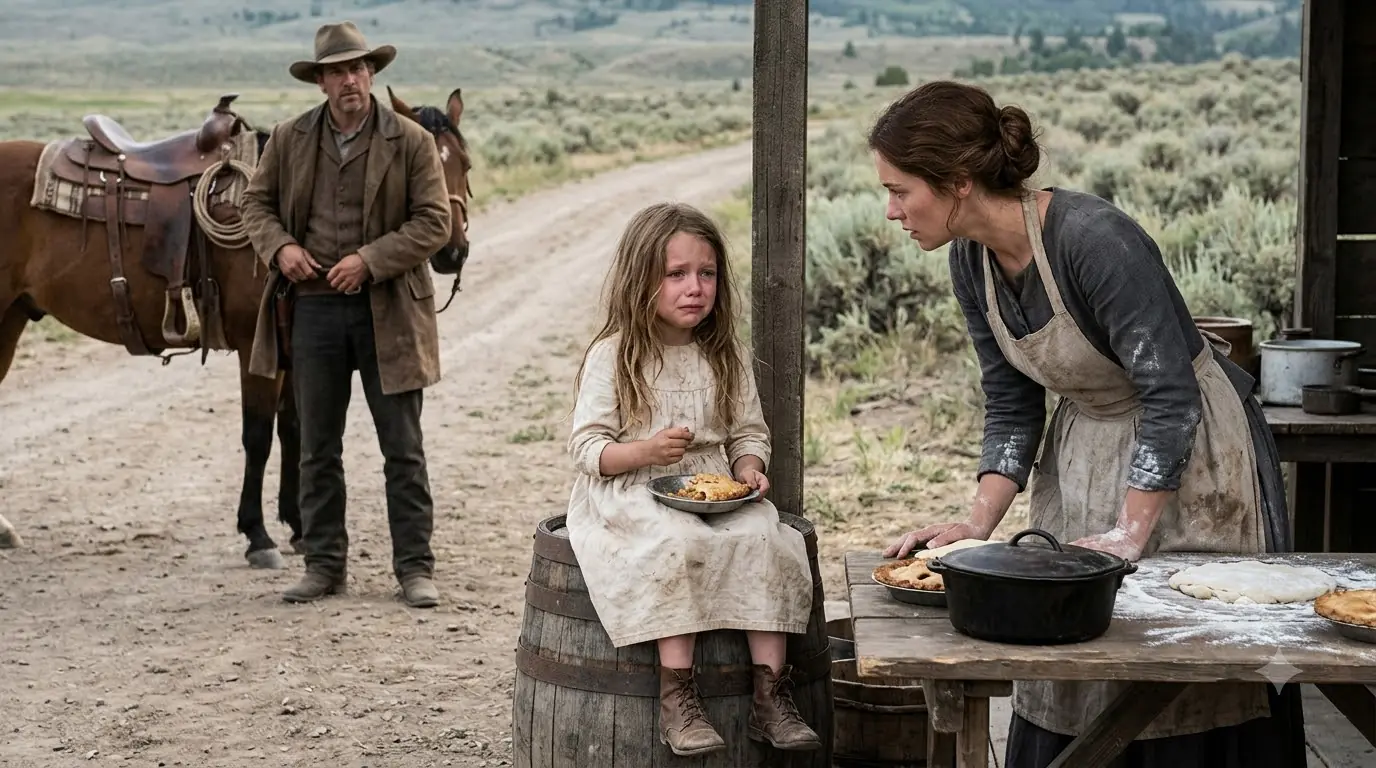
The woman selling pies stood motionless, her hands white with flour. She wore a black dress faded to charcoal and a clean apron repaired twice along the hem. The table consisted of two barrels and a plank, with a Dutch oven cooling beside a small pit fire and a crooked sign offering apple pie for fifteen cents a slice. She had a narrow face, brown hair pinned securely at the nape, and watchful gray eyes that had learned to measure strangers before trusting them. Her name was Rose Hart, though the name that mattered to this place had been given to her long before her marriage.
"What did you say, sweetheart?" Caleb asked. He did not kneel beside Molly, because he was afraid the slightest suggestion that she must repeat herself would close the door again. He merely waited, holding his hat against his chest. Molly looked down at the pie, touched a finger to the crimped edge, and said nothing. The silence was familiar, but for one astonishing instant it had broken.
Rose swallowed. "I didn't mean to upset her."
"You didn't." Caleb looked at the slice, at its dark filling and delicate crust. "Where did you learn to make a pie like that?"
"From a girl I knew when I was little." Rose looked from his face to Molly's fingers. "We had a kitchen where the flour was rationed and the apples came bruised in barrels. She discovered that a little vinegar made the pastry easier to work and black pepper gave the fruit something to hold against the sweetness. She made the edge that way so we could tell our pies apart from the cook's."
Caleb bent close enough to see three thumbprints followed by a sharp pinch. It was a pattern his dead wife had left on pies, on the edges of little clay bowls, even once on a pretend crust made from mud for their daughter. He had watched her make it a hundred times without considering that the gesture had a history beyond his kitchen. "What was the girl's name?"