The man who had promised to marry Eliza Rowan stepped away from her on the railway platform as though a stranger had reached out of the crowd and laid a hand on his shoulder. For six months she had known Calvin Pike by the slant of his handwriting, the earnest questions in his letters, and the small, practical kindnesses he claimed mattered more to him than beauty. Now he stood beneath the station awning in Red Creek, Montana Territory, staring at the scar that traveled from her left temple across her cheek to the corner of her mouth. He looked at her once, glanced at the people coming down from the train, and looked away again. The most painful part was not his surprise. It was how quickly he began calculating who had seen it.
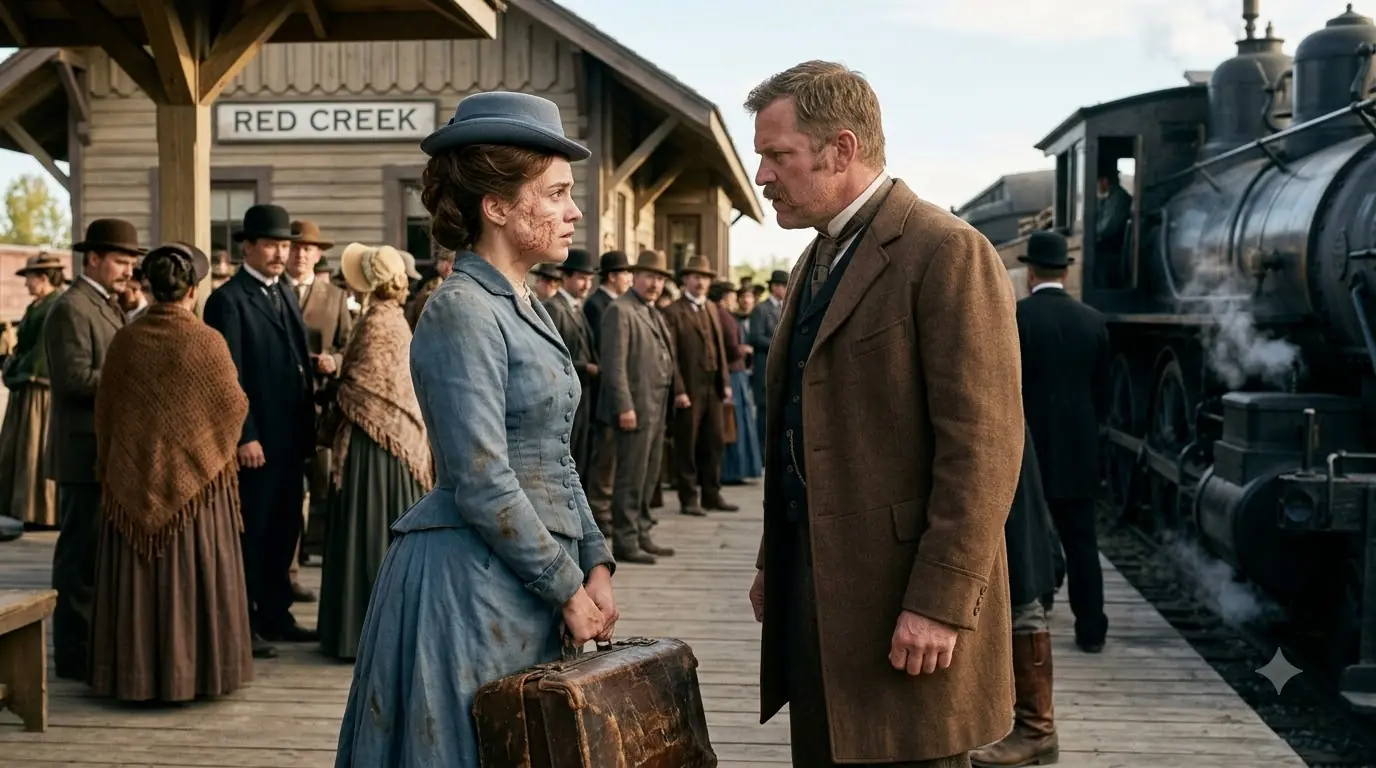
“Eliza?” he asked, although she had already spoken his name. She stood with a battered trunk beside her and a smaller wooden case in her gloved hand, her traveling dress creased from four days of trains and one jolting stagecoach. “I was beginning to think you might not recognize me,” she said. She managed a smile that pulled slightly at her scar. Calvin did not return it.
“You never told me about your face.” His voice was low, but the porter bringing another passenger’s luggage down the steps heard him. “You never asked for a likeness,” she replied. “I told you where I was born, how old I am, what work I can do, and what happened to my parents. I told you everything that mattered to me.” The porter shifted his grip on the luggage and hurried away. Calvin watched him go as if the man had stolen something important.
“A wife has a place in a community,” Calvin said. “People look. They talk.” Eliza glanced toward the families greeting their travelers, a boy holding his father’s coat, two elderly women embracing, a woman waving a bright kerchief above the crowd. “They were greeting people until you began staring at me,” she said. “Perhaps they would go back to their business if you did.” Calvin’s cheeks flushed, but she could not tell whether from shame or anger.
He took one step toward the baggage shed, motioning for her to follow. “Come where we can speak privately.” She set her small case on top of the trunk. “This platform suited you well enough when you expected a bride. We can speak here.” He glanced at the stationmaster and at a group of men near the telegraph office. “I have traveled a great distance to establish a household,” he told her. “I hoped you understood what that required.”
“I crossed most of the country because I believed you were inviting me to share a life,” she answered. “I did not come because I could promise your neighbors a pleasing sight.” She heard the careful plainness of her own words. There had been a time when she would have hurried to explain the injury, telling him about the house fire, the child she carried out, the beam that fell. She had learned that a story offered as a defense was sometimes treated as a confession. She did not intend to begin a marriage by begging forgiveness for her face.