The courtroom smells like floor wax and cheap suits, the distinct scent of a system running exactly as it was designed to. Officer Daniel Reed adjusted his tie, comfortable in the witness box. He had ruined a hundred lives from this very seat. To him, the woman sitting at the plaintiff's table was just another statistic, another angry citizen who wouldn't be believed. But Daniel Reed didn't know he had just walked into a trap and the jaws were about to snap shut.
Federal District Court courtroom 4B was not a place of grand sweeping justice. It was a factory, a sterile room of heavy oak panels, humming fluorescent lights, and a sluggish American flag drooping beside the judge's bench. It was a room where truth was usually secondary to procedure and where the word of a man in a police uniform carried the weight of scripture. Officer Daniel Reed knew this room. He lived in it.
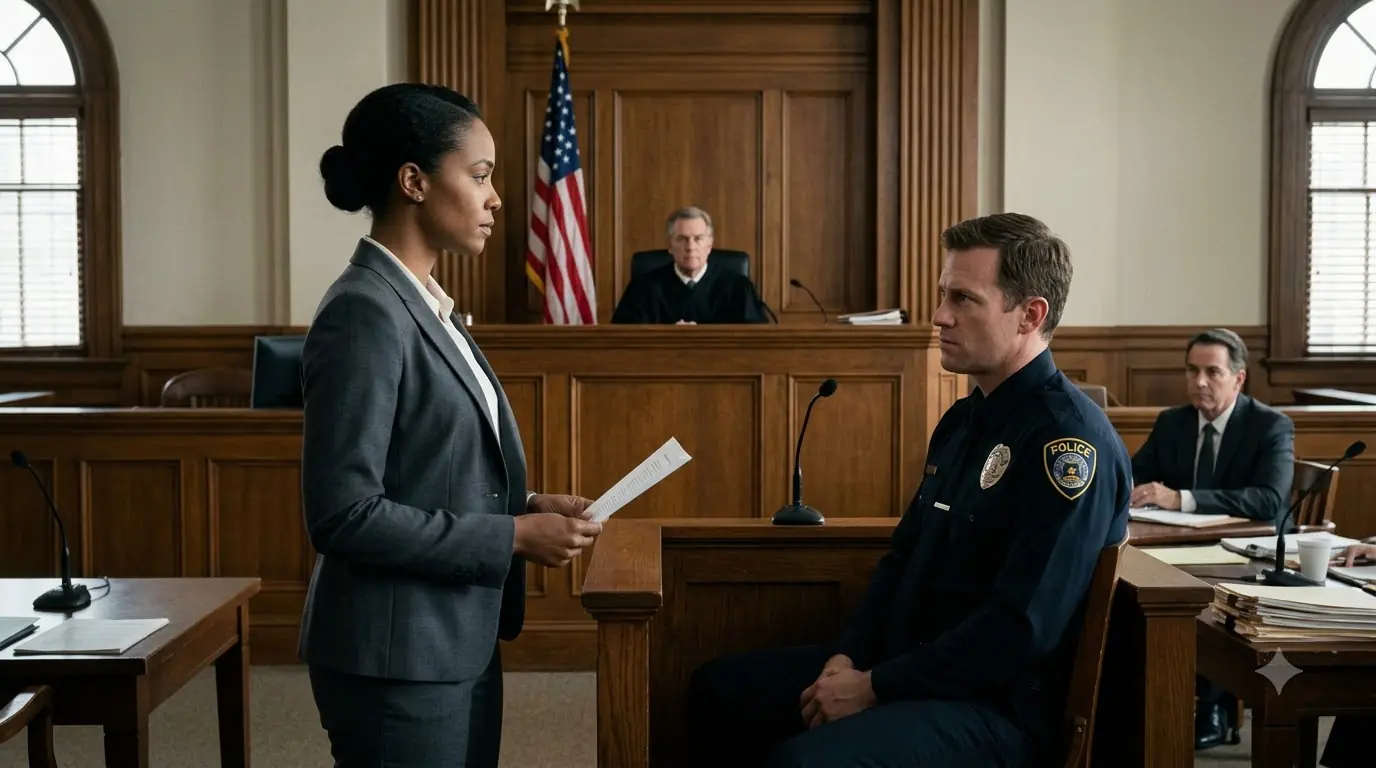
Over his 12 years on the force, he had testified in dozens of cases, assaults, narcotics, resisting arrest. The script was always the same and Reed knew his lines by heart. He sat in the witness stand, broad-shouldered and impeccably groomed. His uniform was pressed to a razor edge, the brass buttons catching the overhead light. He exuded the calm, slightly weary demeanor of a public servant who was simply doing a tough, thankless job.
He looked at the jury box, eight white faces, four brown, all leaning forward slightly. He had them. He always had them. Juries wanted to believe the police. It made the world feel safer.
At the defense table, technically the plaintiff's table in this civil rights lawsuit, sat Naomi Bennett. She wore a charcoal gray suit devoid of flash. Her hair was pulled back into a tight, no-nonsense bun. She hadn't fidgeted once in the two hours Reed had been on the stand. She just watched him, dark eyes still and unblinking, taking notes with a silver fountain pen.
She didn't look like a victim. She didn't look angry. She looked like a surgeon observing a tumor. Arthur Pendleton, the city attorney representing Officer Reed, paced casually in front of the jury box. He was a man who smelled of expensive cologne and cheap tactics.
"So, Officer Reed," Pendleton said, his voice a soothing baritone, "let's return to the night of October 14th, the night you pulled over the plaintiff." Reed leaned into the microphone. "Yes, sir." "Can you describe the conditions that night?" "It was raining, heavy downpour. Visibility was low." Reed kept his voice steady, reasonable. "I was on routine patrol down Highway 9 when I observed a black sedan swerving over the yellow line. Given the weather and the erratic driving, I initiated a traffic stop.
Public safety was my primary concern." "Of course," Pendleton murmured, ensuring the jury caught the heroism in the mundane act. "And when you approached the vehicle?" "The driver, Ms. Bennett, was uncooperative from the start," Reed lied. The lie was smooth, practiced. It slid out of him without a spike in his pulse. "She refused to roll her window down more than an inch.
She was yelling obscenities. When I asked for her license and registration, she began reaching frantically under the passenger seat." Pendleton stopped walking. He turned to the jury, letting the silence stretch. "She reached under the seat in the dark, in the rain." "Yes, sir." "What went through your mind, Officer Reed?" "I feared for my life." There it was, the magic phrase, the skeleton key that unlocked total immunity. "I feared for my life." Reed saw two jurors nod slightly.