They Invited Her Only to Fill an Empty Seat - Then the Most Eligible Duke Chose the Chair Beside Her
Helena Ashford had never seen her name look so small. It sat there, inked in a delicate slanting hand on the cream-colored place card: Miss Helena Ashford. It had been positioned at the far end of the Viscountess of Harbury’s grand dining table, close enough to the wall that the footman would have to angle his arm awkwardly to serve her. The sweeping arrangement of house lilies partly shaded the card, as if even her name had been tucked away.
If one wished to invite someone and yet almost not invite them at all, this was precisely the place to put them. Helena folded her gloved hands tightly around the fan in her lap, the painted sticks biting faintly into her palms. She told herself it did not matter. At six and twenty, she was far too old to care where she sat at dinner, but the thought would not settle.
“You must not look as though you are about to be executed, my dear,” her aunt murmured beside her as they waited in the drawing room. Conversation flowed gently around them, bright and polished, like a current meant to carry prettier women forward. “You know we are very fortunate to have received an invitation at all. The Viscountess’s tables are quite sought after.”
“Fortunate,” Helena repeated, her smile thin. The invitation had arrived that very morning, hours after her cousin Alicia had been triumphantly waving hers at the breakfast table for nearly a week. Helena’s card had come with a hurried note in the Viscountess’s hand, explaining that there had been a last-minute opening. Would Miss Ashford be so good as to help complete the number for dinner?
Help complete the number. The phrase stayed with her, cold and hard. It made her feel like a candlestick pulled from some dusty cupboard to balance the mantelpiece. She had not meant to see the note, but her aunt had left it open on the writing desk, and Helena, sent to fetch a spool of thread, had glanced down by reflex.
Now, in the drawing room, Alicia rustled past in sea-green silk, cheeks flushed with excitement. “Try not to sigh quite so much, Helena,” Alicia whispered with sisterly frankness. “It makes people notice you are standing alone.” Helena answered that she was not sighing, though she was. Then she added, with a smile that barely held, “I rather thought no one noticed me at all.”
Alicia only laughed and turned toward a group of whispering young ladies. Helena watched her go, her gown a bright splash of color in the lamplight, and felt the old hollow place where envy and affection tangled together. The doors to the dining room were thrown open with ceremony. Couples began to process through in an orderly chain of silk gowns and black coats.
Helena, unescorted, waited until nearly the end, passing beneath the crystal chandeliers alone like a small boat lagging behind a fleet. When she reached her place at the table and saw the lonely little card by the wall, something tightened in her chest. She took her seat quietly and smoothed the skirts of her modest dove-gray satin gown. The dress was well made and carefully altered by her own hand, but it did not whisper or glow as the others did.
Her aunt had insisted it was perfectly suitable. Helena could not help hearing suitable as another way of saying forgettable. The conversation flowed around her like a river in which she sat as a stone. At the center of the table, Alicia sparkled between a captain of dragoons and a baronet’s son.
Snatches of talk floated down to Helena’s end, opera, horses, a scandalous waltz at Almack’s, but they faded before quite reaching her. A footman murmured, “Wine, miss?” Helena thanked him, grateful simply to be acknowledged. As she lifted her glass, she caught two matrons across from her casting quick, assessing glances her way. One whispered something behind her hand, and the faint pitying tone was enough to make Helena’s cheeks heat.
She did not hear every word, only enough to understand. Some cousin of Lady Ashford’s. Quite on the shelf, poor thing. Useful for filling out a table. Helena lowered her gaze to the untouched soup before her, while the room seemed suddenly too warm and the fragrance of lilies became sharp and cloying.
She could leave now, she thought wildly. She could slip away, plead a headache, disappear back into the quiet safety of her aunt’s house. Would anyone notice? Would anyone mind? Her heart fluttered foolishly, but she told herself that would be childish.
She had learned long ago to endure such evenings with a calm face. Yet a faint dizziness threatened at her temples, and the murmur of voices blurred into a hum. As the servants began to clear the first course, Helena pushed back her chair a fraction. “Pray excuse me,” she murmured to no one in particular. “The heat.”
She rose carefully, leaving her napkin folded upon the table and her place card standing like a sentinel by her empty plate. Moving as unobtrusively as she could, she slipped through the partially opened door into a dim side corridor, where cooler air drifted from an unshuttered window. She drew in a slow breath and rested her forehead briefly against the pane. The glass cooled her skin and steadied her.
Somewhere beyond, in the main hall, the butler’s sonorous voice carried faintly. “His Grace, the Duke of Evermere.” There was a stir audible even through the wall, a ripple of surprise, excitement, chairs scraping, and Lady Harbury’s higher tones rising in welcome. The Duke of Evermere, Helena thought dully. Of course, he would not have been present when they first processed in, or half the ladies would have fainted from anticipation.
He was England’s most eligible gentleman, if the newspapers and Alicia’s breathless chatter were to be believed. Wealthy, unattached, remarkably handsome, and according to rumor, determined never to marry. Helena straightened her shoulders. She would wait a few minutes until the commotion settled, then quietly reclaim her insignificant seat.
Inside the dining room, however, Lady Harbury was experiencing a small, exquisite panic. One more guest, and that guest exceptionally important, made her carefully balanced table suddenly uneven. “Your Grace,” she simpered, fluttering her fan as Adrian Blackthorne, Duke of Evermere, bowed over her hand. “What an unexpected honor. We had quite despaired of you.”
“I must beg your pardon, Lady Harbury,” he replied, straightening, his voice smooth and faintly amused. “My business in town detained me longer than I anticipated.” She assured him it did not matter, though her eyes darted down the length of the table. Every seat was filled, except for one chair by the wall, pushed back slightly, its napkin neatly folded and its place card gleaming pale in the candlelight.
“There,” she said, relief flooding her face. “There is a seat free. Pray be so good as to take it.” One gentleman nearby began to protest that the seat belonged to someone else, but Lady Harbury dismissed him briskly. Her fingers closed over Helena’s fragile place card before she looked at it properly. With a decisive movement, she bent it backward so the name could not be read and gestured to the footman.
“Remove that, if you please. His Grace shall sit here.” Adrian followed the direction of her hand, his gaze taking in the small island of emptiness amid the glittering company. For the briefest moment, he wondered about the person who had occupied it. The careful fold of the napkin suggested someone who chose order over carelessness.
Then the thought slipped beneath the weight of politeness and expectation. He inclined his head and moved toward the chair while the guests parted for him, their eyes bright with curiosity. The chair that had belonged to Miss Helena Ashford scraped softly over the polished floor. The most eligible duke in England sat down in her empty seat.
Adrian Blackthorne had long ago learned the art of moving through a room as though nothing in it touched him. It was useful for a man who attracted attention merely by existing. Yet, as he settled into the chair by the lilies, he felt a faint sensation of having stepped into a space not meant for him. The soup was served, and conversation tilted toward him like flowers turning toward the sun.
He engaged because it was his duty to be neither rude nor dull. Alicia Ashford, seated nearby, blushed becomingly and supplied her name with practiced ease. Lady Harbury leaned forward, full of maternal calculation. The table brightened around him, but part of his attention remained fixed on the folded napkin and the bent place card being carried away.
The card turned just enough for him to catch a single word before it vanished into the servant’s hand. Helena. He did not see the surname, only the flowing H and the elegant curve of the L. Helena. Odd, he thought faintly, that her absence felt more real than the presence of half the table.
In the dim side corridor, Helena had no notion that the Duke of Evermere now occupied the chair where she had so carefully arranged her hands. She leaned near the open window, drawing in the cool air and willing her cheeks to lose their betraying color. It was foolish to be so affected. No one had said anything truly cruel, no scene had been made, and no great insult had been shouted across the table.
It was only a late invitation, a distant seat, a pair of pitying glances, little cuts, nothing more. She ought to be accustomed to such things by now. Yet it was never only the cut itself. It was what it confirmed. They did not see her.
Footsteps sounded at the far end of the corridor. Helena straightened and lifted her fan. It was only a young footman with folded cloths in his arms, and he started when he nearly walked into her. “Beg pardon, miss. I did not see you.”
“Few people do,” she said lightly, then colored at how it sounded. “That is, think nothing of it. Pray go on.” The footman bowed awkwardly and hurried past. Helena drew a steadying breath, knowing she could not hide like a child forever.
When she reentered the dining room, the scene had shifted. The air seemed thicker with excitement, laughter pitched higher, and the reason stood out instantly. The Duke of Evermere sat in her chair. Helena paused just inside the doorway, fingers tightening around her fan until the ribs bit into her skin.
For one breathless second, she felt as though she were looking at a stage upon which her role had been quietly reassigned. A footman appeared at her side with the uncanny instinct of trained servants. “Miss Ashford,” he murmured, almost too quietly to hear, “Her Ladyship begs your pardon. The arrangement has been slightly altered. If you will be so good as to join the small table in the morning room, it is quite more comfortable.”
Helena’s gaze flicked to the corner where two older ladies and a timid gentleman sat at a smaller spillover table half hidden behind a screen. More comfortable, she thought. Somewhere she could be entirely out of sight. Heat crawled up her throat, but she said, “Of course. Pray do not trouble Her Ladyship with apologies. I assure you, I am perfectly content.”
She was not content, but she had learned to wear contentment like one of her plainest gowns, serviceable, colorless, and impossible to remark upon. As she moved quietly toward the morning room door, no one at the main table glanced her way. No one, except for the briefest moment, the duke. He had been answering Alicia when a slight movement at the edge of his vision caught his eye.
A young woman in dove gray paused at the threshold, her profile turned toward him. She was not beautiful in the obvious way that drew rooms like moths, but something in the line of her neck and the way her hand clenched around her fan struck him as wrong. A cord plucked out of tune. Before he could look more fully, a laugh rose nearby, and someone addressed him directly.
Later, after the gentlemen lingered over port and the ladies withdrew, Adrian stood apart with a glass in his hand. A folded scrap of card lay forgotten on a sideboard. His gaze rested on it, then sharpened. Helena Ashford. So the ghost of the seat had a full name after all.
He set down his glass, the decision forming before he had properly named it. Tomorrow, he would send a note to Lady Ashford paying his respects and inquiring after her niece’s health. He found that he very much wished to see what Miss Helena Ashford looked like when she was not vanishing from rooms. The thought surprised him with its certainty.
The next morning dawned ordinary and quiet, almost dishonest after the scented humiliation of Lady Harbury’s dinner. Helena woke with a faint ache in her chest, as if some invisible muscle had been strained. She scolded herself as she plaited her hair and pinned it with care. It had been only another dinner party, another evening of sidelong glances and careful invisibility.
By eleven, she sat in the smaller sitting room near the window, her work basket at her feet. She embroidered a sprig of wildflowers on a handkerchief for her aunt, the stitches tiny and neat in shades of blue and green. Outside, sunlight glanced off neighboring rooftops, a milk cart rumbled by, and a boy called out the morning paper. Then the bell rang.
Helena did not look up at first. Callers came often enough for her aunt that the sound scarcely registered. A moment later, the housemaid appeared at the door with round eyes and pink cheeks. “Miss Helena, ma’am. Her Ladyship requests you in the front parlor at once.”
“Has someone called?” Helena asked, setting her needle carefully into the cushion. “Not exactly called, miss,” the maid said, nearly bouncing. “It is a card with a crest on it. A ducal sort of crest, Mrs. Briggs says.” A strange tremor moved through Helena’s fingers.
In the front parlor, Lady Ashford stood by the writing desk, holding a square of stiff pasteboard as though it might ignite. Alicia hovered beside her in pale lavender, a ribbon artfully tied at her throat. “There you are at last,” Lady Ashford said, though Helena had come within a minute. “Do you know whose card this is?”
Helena’s gaze dropped to the cream pasteboard. A coat of arms delicately stamped in black and silver gleamed at the top. Beneath it was the elegant masculine hand of His Grace, the Duke of Evermere. Her breath caught, but Alicia quickly explained that he had not called in person. He had sent a note.
Lady Ashford unfolded the thick paper and read aloud. The duke begged forgiveness for the liberty of his note and explained that his late arrival at Lady Harbury’s dinner might have caused some disarrangement of the table. A young lady, Miss Helena Ashford, may have been inconvenienced on his account. Lady Ashford looked up in astonishment. “He remembers your name.”
Helena felt her pulse in her throat. “He cannot possibly. I was not introduced to him.” But the note continued, saying he had observed Miss Ashford leaving the room and hoped it was nothing more serious than the heat. He asked that his sincere apologies be conveyed to her and expressed his earnest hope that she had recovered.
The words wrapped around Helena like a warm shawl, though mortification burned beneath them. The Duke of Evermere had noticed her leaving. He had gone so far as to write about it. It felt less like honor and more like exposure. Then Lady Ashford read the final part: if permitted, he wished to pay his respects in person within the week.
Silence fell, bright and taut as crystal. Alicia said he wrote out of politeness, and perhaps Lady Harbury had spoken of them. Surely he hardly remembered which of them was Helena and which was Alicia. Lady Ashford murmured that the note was specific and named Miss Helena Ashford twice.
Helena wished the floor would open and swallow her. She insisted it was only courtesy, that he must feel obliged and need not trouble himself to call. Lady Ashford sharply refused to throw away ducal attention like unwanted ribbon. Helena would be at home, suitably dressed, and properly composed.
There it was, the familiar twist. The note might have been addressed to Helena, but the possibilities it represented immediately rearranged themselves around Alicia like iron filings drawn to a magnet. Helena did not blame them. She had long known that if fortune ever glanced in their direction, it would most likely fix its gaze on her cousin’s bright loveliness, not her quiet edges.
At three, the household was prepared like a battlefield. Floors had been swept again, silver polished, and roses placed in the parlor. Alicia sat where the light kissed her hair to gold. Helena stood slightly aside, near enough to be included and far enough to be ignored if convenience demanded it.
The bell rang, and a reverent hush fell. The Duke of Evermere entered with the same contained grace Helena remembered from the night before. She dropped her curtsy with her eyes fixed properly on the carpet. When she finally lifted her gaze, she met his eyes fully for the first time.
In that instant, she had the unnerving impression that the most eligible duke in England was not looking past her or around her, but directly at her. She was not a number, not a seat to be filled, but a person he had deliberately come to see. Lady Ashford fluttered forward with formal delight. Adrian bowed to her, greeted Alicia, then turned back to Helena.
“And Miss Ashford,” he said, with the slightest pause. Lady Ashford began to supply Alicia’s name, but Adrian gently corrected the universe itself. “And Miss Helena Ashford.” Helena curtsied again, smaller this time. “Your Grace.”
She expected his attention to slide away, drawn by brighter colors and easier prospects. Instead, he crossed the room toward her with unhurried purpose. He said he hoped she would forgive his intrusion and added that he had been told he might have caused her discomfort. Every eye in the room fastened on Helena.
She forced her voice steady and told him the fault belonged entirely to the heat of Lady Harbury’s dining room. She was not accustomed to so many lilies in one place. Amusement warmed his eyes. He replied that he would remember never to seat her near his conservatory.
Then his contrition returned. He said he was sorry his arrival had displaced her, and that he had not known until later that a place had been taken from her to provide one for him. The words taken from her struck with unexpected force. Helena said quickly that it had been nothing of consequence and that she had been more comfortably situated afterward at the smaller table. Adrian asked, with mild interest and deeper meaning, “At the quieter one?”
She met his gaze. “Comfort is a matter of perspective, is it not?” Respect flashed across his face. Alicia stepped gracefully between them and laughed that Helena slipped easily from one place to another. Adrian answered smoothly that adventures were rarely appreciated by those standing in their path, and that Miss Helena had the right of it in seeking the quietest territory available.
Tea was served, and the familiar choreography returned. Alicia poured with polished grace while Helena moved to ring for more hot water. But when Adrian took his seat, he angled it not toward Alicia at the tea table, but toward the corner where Helena resumed her place. He confessed his visit was selfishly motivated.
He said society had grown efficient to the point of dullness, with the same people in every drawing room and the same stories repeated in different chairs. Having nearly been an instrument of Miss Helena’s disappearance the night before, he owed it to himself to discover who precisely he had nearly caused to vanish. Lady Ashford laughed before she quite understood the implication. Then she said Helena was very good at not attracting notice.
“Do you prefer it?” Adrian asked Helena. She could have given the expected answer, but his gaze made it difficult to lie. “I prefer peace,” she said slowly. “And kindness. Those are not always found at the center of a room.” He held her eyes and agreed softly that they were not.
Alicia tried to draw the conversation toward Evermere’s estate, and Adrian answered courteously. He spoke of the lake, old oaks, and his steward’s pride in a new variety of rose. Yet even as he spoke, his gaze returned to Helena again and again. She felt it each time like a touch she could not quite believe in.
Before leaving, Adrian invited Lady Ashford and both young ladies to a small musical evening hosted by his sister, Lady Marianne Weatherbee. Alicia’s eyes shone at once. Helena’s heart gave a small, panicked leap. Another room, another table, another chance to be shifted like an afterthought.
Adrian seemed to hear the thought. He said it would be a great favor to his sister, who had lately discovered the comfort of quieter company. This time, the words were unmistakably meant for Helena. She bent her head and murmured that she would not like to deny Lady Marianne that comfort. When the door closed behind him, Helena realized she had just agreed to place herself once more in the center of a world she had learned to avoid.
Lady Marianne’s musical evening arrived with dread and reluctant curiosity. Her house was large without being ostentatious, softened by climbing ivy and warmed by candlelight. The company was gentler than Lady Harbury’s, with no crush of bodies and no sense of people jostling to be seen. Small groups stood at ease, as though they had come to listen rather than perform.
Lady Marianne greeted them herself, naming each carefully. “Lady Ashford, Miss Ashford, Miss Helena. My brother has spoken of you.” Helena’s cheeks warmed. Marianne smiled and said her brother was not often intrigued, and when he was, she listened. Alicia laughed lightly, assuming the compliment could only be general.
The drawing room had been arranged for music, chairs in welcoming rows and a pianoforte gleaming near the hearth. Helena found herself seated not at the back, but in the second row, guided there by Marianne’s apparently accidental touch. Alicia sat just ahead, perfectly placed for every arrival to see her profile. Then Adrian entered without ceremony, yet the room shifted around him.
He greeted his sister first, then came straight toward the Ashford ladies. He spoke Helena’s name last, but with a care that made it feel like the true destination. He hoped she did not regret accepting his sister’s invitation and assured her that the evening was rarely hazardous. “There are no lilies, at least,” he added.
Helena’s mouth curved despite herself. “Then I am already less endangered than at our last gathering, Your Grace.” The music began, and conversation faded to a respectful hush. Helena let the notes wash over her. It was simple and almost homely, and she found herself breathing more easily.
During an interval, Marianne sat beside her and said she knew Helena would understand that sort of evening. There were those who attended only to be seen, she explained, and others who came because they truly listened. Her brother had told her Helena preferred quiet corners. Marianne had found that those who preferred quiet corners often heard more than anyone else.
Later, Adrian stepped beside Helena’s row and said his sister informed him that Helena was depriving them of a musical talent. Helena insisted her talent extended no farther than humming to aid the rhythm of her stitching. He replied that perhaps they might prevail upon her to embroider in their presence for the sake of the tune. His teasing was light, but underneath it was a genuine desire to know her.
After the final sonata, Adrian offered his arm and asked if she would allow him to show her his sister’s conservatory. Helena’s pulse leapt. To walk alone with him would invite eyes and whispers, yet when she glanced around, no one was looking at her. For once, that did not feel entirely like a wound.
The conservatory was warm and green, scented faintly of earth and citrus. Adrian closed the door only partly, enough to hush the drawing room into a distant murmur. Helena touched the glossy leaves of an orange tree and asked what he wished to say. He came to stand opposite her and said there were two things, one small and one perhaps less so.
The small question was whether she would forgive him if he never again permitted himself to sit down where she was meant to be. The memory of Lady Harbury’s table rose between them, the lonely place by the lilies, the folded napkin, and the bent card. Helena said there was no need. Adrian answered gently that there was every need.
He said he had spent his life being ushered toward the head of every table. It had not fully crossed his mind that each time, someone else might be moved quietly into shadow to make room for him. Helena said she had grown used to such adjustments since coming to London. One became rather expert at being convenient.
“Convenient,” he repeated. “Is that what you believe yourself to be?” Helena gave a small, helpless lift of one shoulder. She was often invited when a number needed evening, when a table lacked a final chair, or when an aunt feared appearing slighted by coming with only one niece. She took up space neatly and did not disturb the pattern.
Adrian called it not a talent, but a defense. He said he had seen neither peace nor kindness offered to her at Lady Harbury’s table. She had left the room, and no one noticed except a stranger who had taken her place. Helena asked what he would have had her do. Object? Refuse to move? Demand her chair back from a duke?
“No,” he said. “But it would have been just.” Helena laughed softly and said justice was not always invited to such gatherings. It tended to clash with the upholstery. Adrian smiled briefly, then asked the larger question. If she were allowed truly to choose where she might sit, where would she place herself?
“At the table?” she asked faintly. “In life,” he said simply. Helena stared at him. No one had ever asked her that. People had told her where to stand, where to wait, and where to make herself useful, but never where she wished to be.
“I do not know,” she admitted. “I have spent so long slipping into empty spaces that I have never quite dared imagine being wanted in one.” Silence folded around them, heavy and tender. Adrian said perhaps it was time someone asked her to imagine it. When she asked whether he would choose the head of the table if it were not required, he laughed softly.
He said the head of the table was not freedom, only another kind of confinement. To be always watched, weighed, and treated as a prize was its own prison. Helena looked at him properly then and saw the weariness at the edges of his eyes, a man fenced in by admiration. “Then we are both misplaced,” she said wonderingly. “You too seen, I too unseen.”
Over the coming weeks, Adrian asked whether she would permit the possibility that he sought her company because he chose it. Helena did not know what others would think, but if he said he chose it, she would try to believe him. His smile was small and luminous. “That is all I ask. For now.”
Rain had begun beyond the glass, soft and steady, the kind that changes a garden overnight. They did not stay long in the conservatory, only a few minutes, yet time enough for words that unsettled whole years of habit. When they returned to the drawing room, Helena felt as though she had crossed from one world into another, though not a hair on her head had changed. Marianne only met Helena’s eyes and gave a small, satisfied nod.
In the days that followed, Helena began to believe, then doubt, then doubt more. Mrs. Pharaoh, a cheerful acquaintance of Marianne’s, remarked that everyone was quite certain His Grace meant to choose among the Ashford girls. Her eyes lingered naturally on Alicia, the bright blossom most in view, then slid away from Helena. The words were not cruel, only matter-of-fact, and that made them sharper.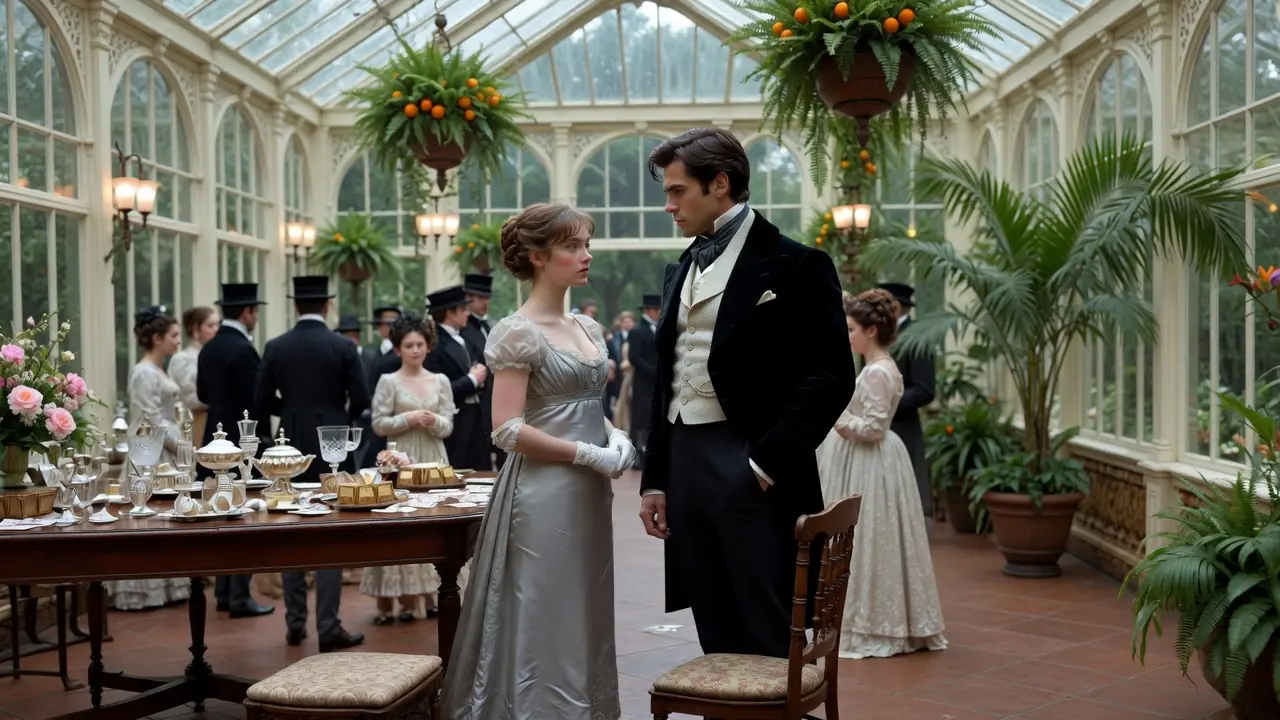
On the drive home, Lady Ashford was nearly giddy. Alicia spoke carefully, pretending not to dream of coronets, while clearly dreaming of them. Helena sat with her hands folded, feeling the chair she had begun to occupy in her own heart being quietly moved back again. Of course they assumed it would be Alicia. Why should they not?
That night, Helena wrote to Lady Marianne and excused herself from the next gathering. She spoke vaguely of an old acquaintance in the country who needed companionship. She did not wish to disturb the easy arrangement of Marianne’s evenings by appearing and disappearing without consistency. She sealed the letter and left it for the morning.
Across the city, Adrian unfolded a letter from his sister. Marianne wrote that Helena had declined their next invitation and spoke of some vague duty in the country. She suspected Helena’s true errand was to spare everyone’s feelings but her own. If Adrian meant to let it go, Marianne told him to do so with a clear conscience; if not, he should consider who was being displaced this time.
The next morning, Helena sent the letter quietly with the maid and asked that nothing be said to her aunt. At breakfast, Alicia chatted of gowns and rumored balls while Lady Ashford spoke of opportunity. Helena kept her gaze on her plate. Then the bell rang.
The butler entered with subdued excitement. “Your Ladyship, His Grace, the Duke of Evermere.” Helena’s knife slipped against her plate with a small scrape. Alicia’s hand flew to her hair. Lady Ashford ordered him shown into the front parlor and turned on her nieces like a general before inspection.
In the front parlor, Adrian stood near the window, morning light picking out the strong line of his profile. He bowed to Lady Ashford, Alicia, and Helena. Then he explained that he had come on an errand that could not wait. His sister had received a letter from Miss Helena, in which she excused herself from further gatherings and spoke of retiring to the country.
Lady Ashford turned sharply to Helena, but Adrian asked to hear Helena’s explanation himself. He said he seemed to be the party most affected. The room changed. Alicia looked bewildered, Lady Ashford’s fan stilled, and Helena gripped the arms of her chair.
Adrian requested permission to speak frankly to Helena and about her. Lady Ashford, confused and hopeful, could hardly refuse a duke. Adrian turned fully to Helena and closed the distance until he stood before her chair. He did not sit or kneel. He simply looked at her as though committing every feature to memory.
He said she had written as though she were a misplaced ornament to be tidied away. She had been taught to believe her presence was a favor granted by others, and that her absence was easier for them. Then he said, very steadily, “Sometimes it is not. For me.” The silence thickened around them.
He had watched the way she vanished to make room for others. He had watched the world assume that if he was to choose, he must choose where they had already set a place for him, at the brightest point, beside the most obvious blossom. But he was not a place card. He would not be written on by other hands.
Helena’s breath hitched. “You speak as though you have already chosen.” Adrian answered simply, “I have.” The words fell between them like a stone dropped into still water. Helena whispered that he could not mean it, but he said he had never been more certain.
He said that if he was to sit at the head of any table for the rest of his life, he would only do so with one woman at his side. That woman was the one the world kept pushing to the farthest chair by the wall. Then he turned to Lady Ashford and formally asked permission to address Miss Helena Ashford with the intention of making her his wife. For a long, fragile moment, no one moved.
Alicia sat very still, then surprised them all by speaking softly. She had watched Adrian watching Helena. It startled her and stung, but she was relieved to know that whatever happened to her would be because someone wanted her for herself, not because she stood where everyone expected her to be. Helena’s throat closed at the kindness she had not expected. Alicia gave a watery smile and reminded them she was twenty-two, not a tragic relic.
Lady Ashford confessed that she had always imagined such an honor would come through Alicia because Alicia was so suitable. Adrian replied that he was not asking for suitability. He had had that offered to him at every turn. He was asking for Helena.
Then he turned to Helena again. He said she had once asked where he would choose to sit if he were not required to sit at the center. His answer was that if he must sit at the head, he would only do so with the woman beside him who reminded him that corners existed. He wanted the woman who knew the worth of quiet, kindness, and listening.
“I choose you, Helena Ashford,” he said, “not because you fill a number, not because you are convenient, but because when you left that table and the world did not notice, I did. I have not stopped noticing you since.” Tears came hot and unchecked. Helena whispered that he did her too much honor. He answered that he did her not nearly enough.
She asked whether he would have regrets when people questioned his choice and wondered why he did not take the blossom most in view. Adrian smiled with certainty. Every day of his life, people had praised him for decisions that were not truly his. This, at least, would be a choice made with his eyes open.
“If there is to be gossip,” he said, “let it be about a duke foolish enough to fall in love with the woman everyone else forgot to see.” The word love hung there, soft and astonishing. Something long curled inside Helena unfurled like a leaf toward light. She rose slowly, unsteady but no longer hiding.
She said she had accepted the chairs others left for her all her life. It seemed only fair that, for once, she should decide where she sat. If he was quite certain, then yes, she would be his wife. Lady Ashford broke into muffled sobs, Alicia laughed through tears, and Adrian exhaled as though in prayer.
Months later at Evermere, Helena walked into a great dining room hung with portraits and lit by a hundred candles. At the head of the table, two chairs waited, equal and side by side. As she took her place with Adrian’s hand steady and warm in hers, she felt every empty seat of her past fall away like old shadows. She was no longer a number, no longer a gap to be filled.
She was exactly where she belonged. The most eligible duke in England sat proudly beside the woman the world had invited only to fill the table. They had never realized she was the one who made it complete.
Tags:
News in the same category
They Laughed at Her for Planting Eucalyptus in the Pasture - Then the Drought of 1988 Proved Her Right
A Duke Wrote Letters Seeking a Wife - Then the Humblest One Stayed
My Mother-in-Law Planned My Divorce and Had My Twins Abandoned - Then My Husband Saw Us on TV

My Family Skipped My Housewarming for My Brother’s New Car - Then I Found Out Who Paid for It

They Left Me in the Woods as a Joke - Then I Owned Their Town
On Mother’s Day, My Millionaire Son Asked About the $5,000 - Then the Truth Finally Came Out
My Mother Gave My Room to the Nanny - Then Made It Clear Which Daughter She Never Wanted

My Father Embarrassed Me in Front of Everyone - Then I Revealed the Life He Was Never Invited Into

My Cheating Wife Ran Off With Another Man - Then On the Day She Made Her Biggest Mistake
Wife of 18 Years Secretly Became a Surrogate for Her Sister - Then Her Husband’s Revenge Destroyed Everything
My Dad Suspended Me Until I Apologized to My Sister - Then The Next Morning, She Smirked Me
My Dad Looked Down on Me for Being a Janitor - Then His Thanksgiving Toast Made Me Walk Away Forever
Her Sisters Married Lords - Then England’s Most Powerful Duke Knelt for the Forgotten Eldest Spinster
At Every Ball, Men Asked About Her Sisters - Then the Most Desired Duke Said, “I Came for You, Not Them”
She Fell Into the Crippled Duke’s Lap - Then He Walked Again and Whispered, “You’re Mine”

A Rich Cowboy’s Dog Found a Dying Ranch Girl - Then He Realized She Was His Promised Bride
The Wealthy Rancher Disguised Himself as a Farmhand - Then the New Cook Saw Through Him Instantly
News Post
I Forgot My Hearing Aid and Turned Back - Then I Heard My Daughter Say, “Tonight, We End This”
They Laughed at Her for Planting Eucalyptus in the Pasture - Then the Drought of 1988 Proved Her Right
A Duke Wrote Letters Seeking a Wife - Then the Humblest One Stayed
My Mother-in-Law Planned My Divorce and Had My Twins Abandoned - Then My Husband Saw Us on TV
My Family Skipped My Housewarming for My Brother’s New Car - Then I Found Out Who Paid for It
They Left Me in the Woods as a Joke - Then I Owned Their Town
On Mother’s Day, My Millionaire Son Asked About the $5,000 - Then the Truth Finally Came Out
My Mother Gave My Room to the Nanny - Then Made It Clear Which Daughter She Never Wanted
My Father Embarrassed Me in Front of Everyone - Then I Revealed the Life He Was Never Invited Into
My Cheating Wife Ran Off With Another Man - Then On the Day She Made Her Biggest Mistake
Wife of 18 Years Secretly Became a Surrogate for Her Sister - Then Her Husband’s Revenge Destroyed Everything
My Dad Suspended Me Until I Apologized to My Sister - Then The Next Morning, She Smirked Me
My Dad Looked Down on Me for Being a Janitor - Then His Thanksgiving Toast Made Me Walk Away Forever
Her Sisters Married Lords - Then England’s Most Powerful Duke Knelt for the Forgotten Eldest Spinster
At Every Ball, Men Asked About Her Sisters - Then the Most Desired Duke Said, “I Came for You, Not Them”
She Fell Into the Crippled Duke’s Lap - Then He Walked Again and Whispered, “You’re Mine”
A Rich Cowboy’s Dog Found a Dying Ranch Girl - Then He Realized She Was His Promised Bride
An Obese Widow Was Sent to Wash Dishes for an Angry Giant Cowboy - Then He Refused to Let Her Leave