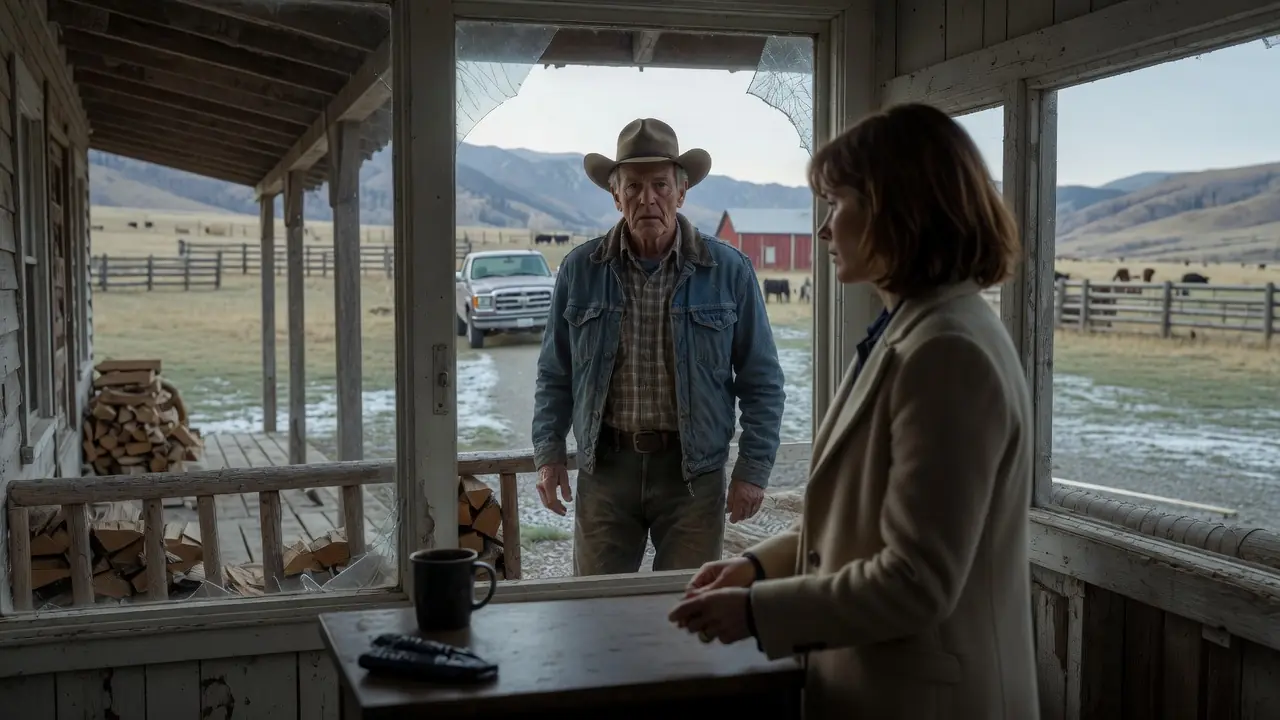
An Obese Widow Was Sent to Wash Dishes for an Angry Giant Cowboy - Then He Refused to Let Her Leave
The auctioneer grabbed Harriet Sullivan’s arm and shoved her onto the platform. “Last one, gentlemen. Widow with three mouths to feed, strong back, good for cooking, cleaning, whatever else you need.” Laughter rippled through the crowd as Harriet’s daughters clung to each other below the platform, tears streaming down their faces. “Come on now, she ain’t pretty, but she’s big enough to do the work of two.”
More laughter followed. Harriet stood there with her face burning and her heart shattering into pieces. “Two dollars. Anyone give me two dollars for the fat one?” Harriet kept her eyes fixed on her daughters, because Ruth had her arms wrapped around Clara and Maggie, and all three of them were crying.
That was all that mattered. Not the laughing faces, not the pointing fingers, not the auctioneer’s sweaty hand still gripping her arm, just her girls. “A dollar fifty. Got a dollar fifty from Mr. Carson.” Someone shouted that she would eat through that in a week, and the crowd roared.
Harriet had stood on that same platform three hours ago with hope in her chest. The town labor auction, they had told her, was dignified, a way for folks to find honest work. She had dressed in her cleanest dress, braided her hair neatly, and practiced her smile. Then she had watched them auction off everyone else first.
Young women went for ten dollars, fifteen dollars. Even the older ones fetched five or six. Men joked and bid and talked about needing help with spring planting. When Harriet’s turn came, the auctioneer had looked at her and sighed. “Well, let’s see what we can do.”
That had been an hour ago. The crowd had thinned, and most folks had already bought their help and gone home. The ones who stayed were the ones who wanted to watch, to laugh, and to see how low she would go. “A dollar fifty going once.”
“Mama.” Maggie’s wail cut through the noise. “It’s okay, baby,” Harriet said, though her voice cracked. “Mama’s okay.” The auctioneer called out, “A dollar fifty going twice.”
“Two dollars.” The voice came from the back, deep and flat. Everyone turned. Harriet’s breath stopped. The man stood apart from the crowd, leaning against a post like he had been there all along.
He was tall, well over six feet, with shoulders broad enough to fill a doorway. His dark hair was shot through with gray, and his eyes were like winter ice fixed on the auctioneer with an expression that made the laughter die in people’s throats. “Mr. Beaumont,” the auctioneer said, his voice suddenly smaller and careful. “Didn’t see you there.”
“Two dollars.” The man pushed off the post and walked forward. The crowd parted for him. “That’s what I said.” The auctioneer swallowed and asked, “You want her?”
“Did I stutter?” Beaumont said. The auctioneer quickly answered, “No, sir. Two dollars to Mr. Beaumont. Going once, twice, sold.” Harriet’s legs nearly gave out as Beaumont stopped at the edge of the platform and looked up at her with a face that gave away nothing.
“You got children?” he asked. “Three girls,” Harriet answered. “They healthy?” “Yes.” “They work?” “The older two can. The little one is only five.”
Beaumont nodded once, then turned to the auctioneer. “I’m taking all four.” The auctioneer hesitated. “Sir, the children weren’t part of...” “I’m taking all four,” Beaumont said, his voice dropping to something dangerous. “You got a problem with that?”
The auctioneer held up his hands. “No problem, Mr. Beaumont. No problem at all.” Harriet climbed down from the platform on shaking legs. Ruth grabbed her immediately, while Clara and Maggie pressed close. “Mama, who is that man?” Ruth whispered. “Why did he buy you?”
“I don’t know, baby,” Harriet said. Beaumont approached, and all three girls shrank back. He stopped, keeping his distance, his eyes moving over each of them. When his gaze landed on Maggie, something flickered across his face, gone too fast to read. “What’s the little one’s name?”
Harriet hesitated. “Maggie.” Beaumont went still, completely still. For three heartbeats, he did not move, did not breathe. Then he said, “My wagon is at the end of the street. Can you walk that far?”
“We can walk,” Harriet said. “Then let’s go.” He turned and headed down the street without looking back. Harriet gathered her daughters and followed because she had no other choice. Two dollars had bought her body, her labor, and maybe her life.
Her children were hungry, and this stranger was the only one who had bid. “Mama, I’m scared,” Clara whispered. Harriet pulled her closer. “I know, sweetheart. Me too.” They had almost reached the wagon when a voice rang out behind them.
“Hold up there, Beaumont.” Harriet turned to see a young man striding toward them, with two friends flanking him like dogs. He wore expensive boots and clean clothes, and his face looked like it had never known real work. Beaumont stopped, but did not turn. “Vernon.”
“What the hell do you think you’re doing?” Vernon Whitmore demanded, planting himself in front of the wagon with his arms crossed. “You can’t just buy that woman.” “Already did.” “My father wanted her for the ranch. Kitchen work.” “Then your father should have bid.”
Vernon’s face reddened. “You know damn well he was coming. He just got delayed at the bank.” Beaumont’s voice stayed flat. “Not my problem.” Vernon stepped closer. “I’m making it your problem. Name your price. Three dollars. Four.”
“She’s not for sale.” Vernon sneered. “Everything’s for sale, Beaumont. That’s how the world works.” Beaumont finally turned, slow and deliberate. The movement made Vernon’s friends take a step back. “Let me be clear.”
His voice was quiet, but it carried. “This woman works for me now. Her children are under my protection. If you, your father, or anyone else comes near them, I will consider it a personal threat, and I don’t respond well to threats. Understand?”
Vernon’s jaw worked. “You’re making a mistake.” “Wouldn’t be my first,” Beaumont said. “My father...” Vernon began. “Can go to hell,” Beaumont cut in. “And you can deliver the message personally.”
Beaumont turned to Harriet. “Get in the wagon.” She did not argue. She lifted Maggie up, helped Clara climb in, then pulled herself onto the seat. Ruth scrambled up beside her, pressing close.
Beaumont swung into the driver’s seat, gathered the reins, and clicked his tongue at the horses. The wagon lurched forward. Vernon shouted something behind them, but Harriet did not hear it over the blood pounding in her ears. “Mama,” Clara said in a thin voice. “Are we going to be okay?”
Harriet pulled all three girls close, wrapping her arms around them as the wagon rolled out of town. “I don’t know, baby,” she whispered. “I don’t know.” They rode in silence for nearly an hour before Harriet finally spoke. “Mr. Beaumont.”
“Yeah.” “Why did you buy me?” He did not answer right away. The horses plodded on, and the wagon creaked over the rutted road. “Needed help,” he said finally. “Ranch is too much for one man.”
“There were others at the auction,” Harriet said. “Younger, stronger.” Beaumont looked straight ahead. “Didn’t want younger. Didn’t want stronger.” “Then what did you want?” Beaumont glanced at her for only a second. “Someone who wouldn’t quit.”
Harriet frowned. “How do you know I won’t quit?” “Because you stood up there for an hour while they laughed,” he said. “Because you kept your eyes on your girls instead of crying. Because when Vernon Whitmore tried to buy you out from under me, you didn’t say a word. You just waited.”
He turned back to the road. “That’s not someone who quits.” Ruth leaned forward. “How do we know you’re not going to hurt us?” “Ruth,” Harriet said quickly. But Beaumont’s voice did not change. “It’s a fair question.”
“You don’t know,” he said. “I could be lying. I could be planning something awful. You’ve got no way to tell.” He paused. “But I’ll say this once, and I won’t repeat it. I’ve never raised my hand to a woman in my life, and I never will.”
He kept his eyes on the road. “You’re coming to work for me, not belong to me. If you don’t like it, you can leave. I won’t stop you.” Ruth’s voice stayed sharp. “But you paid two dollars for my mother. That’s a lot of money.”
“It’s nothing,” Beaumont said, his jaw tightening. “What they did back there, putting her up on that platform, making her stand while grown men laughed, that’s worth a hell of a lot more than two dollars to fix.” Harriet stared at him. “Fix?” His hands tightened on the reins. “They wanted to humiliate you. Wanted to show you what you were worth in their eyes.”
“I wanted to show them they were wrong.” Nobody spoke for a long time after that. The ranch appeared as the sun began its descent, painting everything with clean late-day light. Beaumont pointed ahead. “There. That’s home.”
Harriet looked out at the land. The house was solid timber and stone, weathered but standing firm, with a large barn nearby, horses in a corral, and land stretching out in every direction, empty and vast. “It’s big,” Clara breathed. “Fifteen hundred acres,” Beaumont said. “Most of it grazing land.”
He pulled the wagon to a stop near the house. “Cattle’s out on the range right now. Horses, you can see.” Ruth climbed down first, helping Maggie after her. Clara jumped down on her own, already looking toward the barn. “Are those kittens?” she asked, pointing at a small shape moving in the barn doorway.
“Barn cat had a litter last month,” Beaumont said. “Seven of them.” Clara’s eyes widened. “Can I see?” Beaumont looked at Harriet, asking permission. She hesitated, then nodded. “Go with your sisters. Stay together.”
Clara grabbed Maggie’s hand and ran toward the barn. Ruth followed more slowly, glancing back at Harriet with worried eyes. “She doesn’t trust me,” Beaumont said. Harriet watched her daughter disappear into the barn. “She’s thirteen. She’s been the man of the house since her father died. Trust isn’t something she gives easy.”
“Good,” Beaumont said. “She shouldn’t.” He climbed down from the wagon and started unloading supplies. “Come on. I’ll show you inside.” The house was sparse, with a main room and fireplace, a kitchen through one door, and a hallway leading to bedrooms.
Everything was clean but neglected. Dust sat in the corners, the curtains were sun-faded, and a general air of emptiness hung over the place. “Three bedrooms,” Beaumont said. “You and the girls can have two. I’m in the third.” Harriet asked, “Where did you sleep before?”
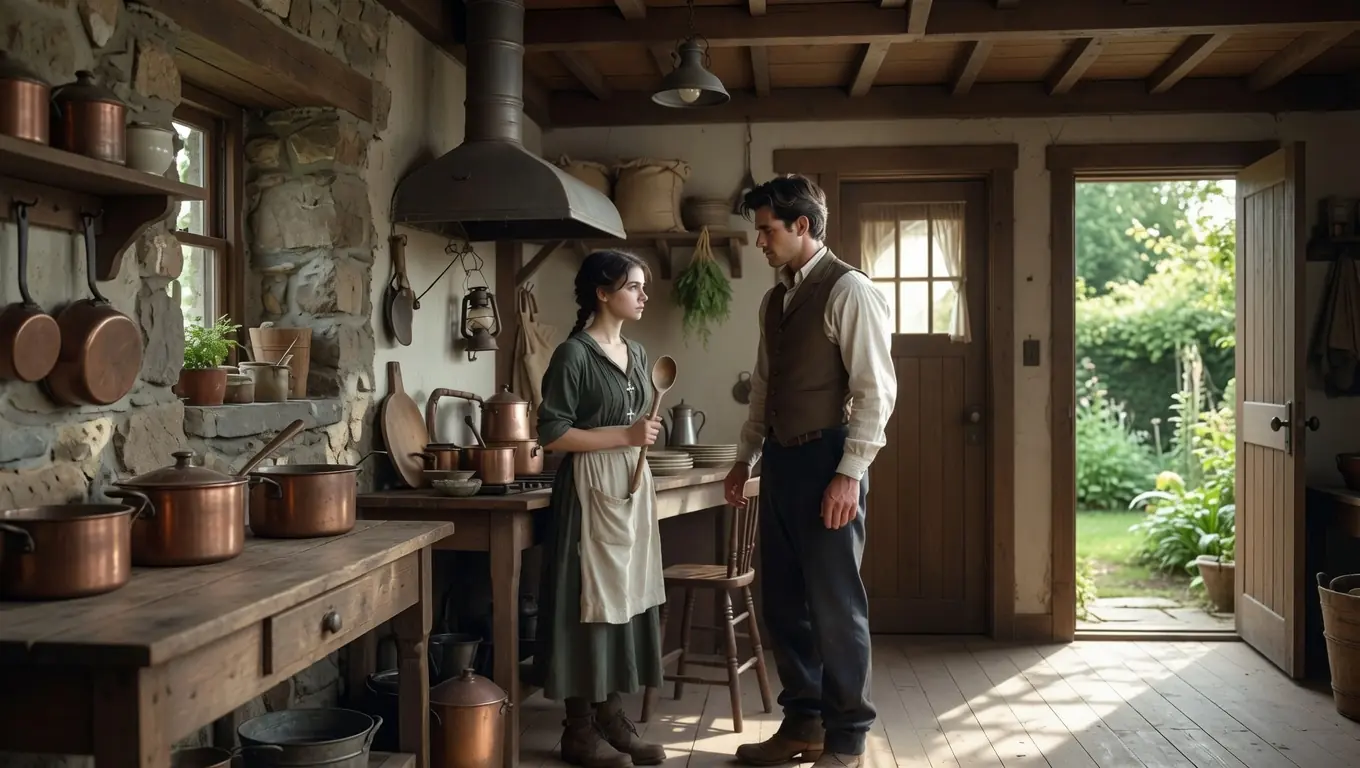
“Same place,” he said. “Just didn’t use the other rooms.” Harriet walked into the kitchen. The stove looked functional, and the pantry was stocked with flour, salt, dried beans, and cured meat. Nothing fancy, but enough. “I can work with this.”
“Good.” Beaumont leaned in the doorway. “I don’t eat much. Whatever you make will be more than I’ve had.” Harriet turned to look at him. Really look. He was thinner than she had first noticed, with cheekbones too sharp and deep marks beneath his eyes.
“When did you last have a real meal?” she asked. “Can’t remember.” Harriet’s voice softened despite herself. “When did your wife die?” Beaumont’s expression shuttered. “Five years ago.” “And you’ve been alone since then?” “Yeah.”
“No one to cook for you, care for you?” “Didn’t want anyone.” His voice hardened. “Still don’t particularly, but I need the help, and you need a place. That’s all this is.” Harriet nodded slowly. “I understand. I’ll start supper.”
She had made it three steps toward the pantry when he spoke again. “Her name was Margaret. Everyone called her Maggie.” Harriet froze. “She was pregnant when she died. Baby died, too. Both of them, same night.”
His voice was flat, reciting facts. “I buried them out back under the oak tree. Haven’t said either of their names out loud in five years.” Harriet turned toward him. “Mr. Beaumont...” He swallowed. “When your girl said her name was Maggie, I almost walked away. Almost left you there.”
“But then I looked at her, your little one, and I thought...” He stopped again. “I thought maybe this was supposed to happen. Maybe God or fate or whatever you call it put you on that platform at that moment for a reason. Maybe I was supposed to find you.” Harriet’s eyes burned. “Do you believe that?”
“I don’t know what I believe anymore,” Beaumont said. Then he pushed off from the doorway. “Make your supper. Get your girls settled. We’ll figure out the rest tomorrow.” He walked out before she could respond.
Supper was simple: beans, ham, biscuits, and fried eggs. The girls ate like they had not seen food in days, because they had not, not really. Two days of scraps and charity had come before the auction, and a week of short rations before that. Beaumont ate slowly and methodically, but Harriet noticed his hands trembling slightly.
When was the last time he had sat at a table with other people? Clara swallowed a mouthful and asked, “Mr. Beaumont, what’s the mama cat’s name?” “Doesn’t have one.” “Everything needs a name.” “Then you give her one.”
Clara’s eyes went wide. “Really?” “Really.” She smiled for the first time that day. “I’m going to call her Duchess, because she walks like she owns everything.” The corner of Beaumont’s mouth twitched. “Duchess it is.”
Ruth watched the exchange with narrowed eyes. “Mr. Beaumont, what exactly will my mother be doing here?” “Ruth,” Harriet warned. “I want to know what he expects.” Beaumont set down his fork. “Fair enough.”
He looked at Ruth directly, speaking to her like an adult. “I expect your mother to cook meals, keep the house clean, do laundry, and do mending. In exchange, you all get a roof, food, and wages when I can afford them. She’s not a servant. She’s not a slave. She’s hired help, same as any ranch hand.”
“The only difference is she lives here,” he added. Ruth lifted her chin. “And what do you expect from us, me and my sisters?” “Help your mother when she asks,” Beaumont said. “Stay out of trouble. Don’t go near the cattle. They’re dangerous if you don’t know what you’re doing.”
“Other than that?” he said with a small shrug. “Be children. That’s all.” Ruth stared at him for a long moment. Then she nodded once and went back to eating. Harriet let out a breath she did not know she had been holding.
After supper, the girls explored the house while Harriet cleaned the dishes. Through the window, she saw Beaumont walking toward the barn, his stride heavy and his shoulders bowed. “Mama,” Maggie said from the doorway. She clutched her rag doll against her chest. “Yes, baby?”
“The tall man is sad.” Harriet crouched to Maggie’s level. “What makes you say that?” Maggie hugged her doll tighter. “His eyes. They looked like yours did after Papa went away.” Harriet’s heart clenched. “Maybe he is sad, sweetheart. He lost someone too.”
“Who?” “His wife. And his baby.” Maggie considered this. “Then he needs hugs. Hugs help when you’re sad.” Harriet almost smiled through the ache in her chest. “They do, but some people don’t like hugs from strangers.”
“We’re not strangers,” Maggie said. “We live here now.” Out of the mouths of babes. Harriet brushed a hand over her daughter’s hair. “Go get ready for bed, Maggie. I’ll be there soon.” That night, all four of them slept in one room.
The girls piled together on the bed, and Harriet stayed in a chair by the door. She could not sleep. Every sound made her flinch, every creak of the house, every gust of wind. Around midnight, she heard footsteps in the hallway, slow and careful, stopping outside their door.
Harriet’s hand found the knife she had hidden under her skirt. A long pause followed. Then the footsteps moved away. She sat there until dawn, knife in hand, watching the door. When morning came, she found coffee already made and a note on the table.
“Working the north fence. Back by supper. Girls can see the kittens if they want. SB.” Ruth read the note over her shoulder. “He’s strange.” Harriet looked at her eldest daughter, this child who had grown up too fast, who had taken on burdens no thirteen-year-old should carry. “Yes. But maybe not that strange.”
“Maybe not,” Ruth agreed. “We’ll see.” The first week passed in a blur of work. Harriet threw herself into making the house livable. She scrubbed floors that had not been touched in years, beat rugs, washed curtains, organized the pantry, and cooked meals that actually tasted like something.
Beaumont said little, but she noticed things. He always knocked before entering a room. He kept distance between them. He answered the girls’ questions with a patience she had not expected. Clara adopted three kittens as her personal responsibility, naming them Sir Whiskers, Lady Fluffbottom, and General Fuzzyface.
Beaumont did not complain. Maggie started following him around the yard, asking questions in her quiet voice. He answered every one. Ruth remained wary, watching and waiting for him to slip. He never did.
On the seventh day, Vernon Whitmore came to call. Harriet saw the riders first, three of them coming fast from the south, and her stomach dropped. “Girls inside. Now.” Ruth started to protest, but Harriet’s voice sharpened. “Now, Ruth.”
She got them into the house and closed the door just as the riders reached the yard. Vernon Whitmore dismounted, his face twisted with the same ugly expression she remembered from town. “Mrs. Sullivan,” he called out like they were old friends. “Come out and talk.” The door opened behind her.
Beaumont stepped out, rifle in hand. “Get off my land, Vernon.” “This doesn’t concern you, Beaumont.” “Everything on this land concerns me, including her.” Vernon laughed. “You sweet on the fat widow? That’s a new low, even for you.”
Beaumont raised the rifle. Vernon’s companions reached for their guns. “I’m going to say this once,” Beaumont said, his voice like ice. “You have ten seconds to get back on your horses and ride out. After that, I start shooting, and I don’t miss.” Vernon’s face went white, then red.
“My father will hear about this.” “Good,” Beaumont said. “Tell him what I said. Tell him if he sends you here again, I’ll send you back in pieces.” Vernon’s jaw tightened. For a moment, Harriet thought he might do something stupid, but one of his friends grabbed his arm.
“Vernon, let’s go.” “This isn’t over,” Vernon snarled. “It is for today,” Beaumont said. He did not lower the rifle. “Nine. Eight. Seven.” They mounted up and rode out, dust billowing behind them.
Beaumont watched until they disappeared, then finally lowered the rifle. His hands were steady, but Harriet saw the tension in his jaw. “Thank you,” she said quietly. “Don’t thank me,” he replied. “I just made things worse.” “How?”
“Vernon’s father is Cornelius Whitmore,” Beaumont said. “Owns half this territory. He wanted you for his ranch because he thought you’d be easy to control. A desperate woman with hungry children.” He turned to look at her. “I took something he wanted. He won’t forget that.”
“What will he do?” Harriet asked. “I don’t know,” Beaumont said. “But whatever it is, it won’t be good.” Harriet wrapped her arms around herself. “Then why did you do it? Why buy me at all?”
Beaumont was quiet for a long moment. “Because I saw you up there on that platform,” he said finally. “Saw them laughing at you, making jokes about your body, treating you like cattle. And I thought about my sister. About how she died alone because nobody would help her. About how I wasn’t there to protect her.”
His voice roughened. “I couldn’t save her, but I could save you.” Harriet lifted her chin. “I don’t need saving.” “I know.” Something shifted in his eyes. “That’s why I wanted to help. Because you don’t think you deserve it.”
He stepped closer but still left space between them. “Because you would have stood on that platform all day taking their abuse as long as your girls were fed. That’s not weakness, Mrs. Sullivan. That’s the strongest thing I’ve ever seen.” Harriet’s throat tightened. “Harriet.” He looked confused. “What?”
“If we’re going to fight the Whitmores together, you should call me Harriet.” Beaumont studied her for a moment, then slowly nodded. “Silas.” She almost smiled. “Silas, then.” That night after the girls were asleep, Harriet found Silas on the porch staring at the stars.
“Couldn’t sleep?” she asked. “Never do.” She sat down on the step beside him, keeping space between them. “What you said earlier, about your sister?” “What about it?” “What was her name?”
Silas was quiet so long that she thought he would not answer. “Eleanor,” he said finally. “Ellie. She was three years older than me. Used to braid my hair when I was little, before I realized boys weren’t supposed to like that.” A ghost of a smile crossed his face.
“She was smart, kind,” he said. “Could have done anything she wanted if the world had let her.” Harriet asked, “What happened?” “She married a man who promised to take care of her. He didn’t. When she needed help, nobody gave it. Not even me.”
His voice hardened. “I was young and stupid. Thought she’d be fine. Thought someone else would help. By the time I realized nobody would, it was too late.” Harriet said softly, “That wasn’t your fault.” “Doesn’t matter whose fault it was. She’s still dead.”
Harriet let the silence stretch between them. Then she said, “My husband died in a mine collapse. Thomas. Six years ago. Maggie was born two months later. I’ve been on my own ever since.” She looked out over the yard. “No family. His parents disowned him when he married me. Mine died before I was fifteen.”
“It’s been just me and the girls for a long time.” Silas nodded slowly. “You’ve done good by them. They’re good kids.” “They’re everything.” “I know,” he said.
He turned to look at her, and in the starlight his eyes were almost soft. “That’s why I’m going to keep them safe. All of you. Whatever it takes.” Harriet held his gaze. “Even against the Whitmores?” “Especially against the Whitmores.”
“Why?” she asked. “You don’t owe us anything.” “No,” Silas said. “But maybe I owe Eleanor. Maybe I owe myself. Maybe I just need to believe that doing the right thing matters even when it costs.” He looked back at the stars. “Or maybe I just don’t want to be alone anymore.”
The words hung in the air between them. Harriet thought about standing up, going inside, keeping distance, keeping safe, and keeping the walls she had built around her heart. Instead, she stayed. “Neither do I,” she said quietly. “Neither do I.”
Fifteen miles away, in the finest house in Bitter Creek, Cornelius Whitmore poured whiskey into a crystal glass and listened to his son’s furious account. “He threatened to shoot me, Father,” Vernon said. “In front of my men, over that woman.” Cornelius sipped his whiskey, savoring the burn. “Yes, you mentioned that.”
“So what are we going to do about it?” Vernon demanded. Cornelius set down his glass. “Silas Beaumont has been a thorn in my side for years. That ranch of his sits right in the middle of the territory I’m trying to control. I’ve offered to buy him out a dozen times. He refuses.”
“So we take it from him?” Vernon asked. Cornelius smiled. “We will. But not directly. Direct confrontation gives him something to fight against, and Beaumont is good in a fight. We need to take away his reasons to fight instead.”
Vernon frowned. “I don’t understand.” “The woman,” Cornelius said. “The children. They’re his weakness now. He’s attached himself to them. Made himself responsible for them.” Vernon’s eyes glittered. “So we attack them.”
“Quietly,” Cornelius said. “Legally. We make life impossible for that woman. We drive her away. We break his spirit.” Vernon leaned forward. “How?” Cornelius pulled a piece of paper from his desk drawer. “I’ve already started.”
“Judge Blackwell owes me several favors,” he said. “By morning, there will be questions about the legitimacy of that auction. Questions about whether a single man should be housing a woman and her children. Questions about the welfare of those girls.” Vernon asked, “You’re going to take her children?” Cornelius smiled again. “I’m going to threaten to. That’s usually enough.”
The night settled over Wyoming Territory, peaceful over the Beaumont ranch and heavy with schemes in the Whitmore mansion. Harriet Sullivan, who had stood on an auction block that morning, slept for the first time in months without dreaming of hunger. She did not know what tomorrow would bring. She did not know that enemies were already moving against them. She only knew that tonight her daughters were safe and fed, and there was a man who had looked at her, really looked, and seen something worth saving.
For now, that was enough. For now, that was everything. Three weeks changed everything and nothing. Harriet woke before dawn every morning, started the fire, made coffee, and cooked breakfast. Silas ate without complaint, nodded his thanks, and disappeared into the land until supper.
The girls found their rhythms. Ruth helped with laundry. Clara chased kittens. Maggie trailed after Silas like a small shadow, and he pretended not to notice. It was the closest thing to peace Harriet had known in six years.
She should have known it could not last. “Mama, there’s someone coming.” Ruth’s voice brought Harriet to the window. A wagon approached from the south, driven by a woman in dark clothes. Behind it rode two men on horseback. Harriet’s stomach tightened. “Girls, stay inside.”
She wiped her hands on her apron and stepped onto the porch just as the wagon pulled into the yard. The woman who climbed down was perhaps fifty, severe-faced, with iron-gray hair pulled back tight. She carried a leather folder like a weapon. “Mrs. Sullivan?” “Yes.” “I’m Mrs. Adelaide Pritchard, representative of the Territorial Children’s Welfare Board.”
The woman’s eyes swept over Harriet with obvious distaste. “I’m here to inspect the living conditions of your daughters.” Harriet’s blood went cold. “On whose authority?” “On the authority of Judge Blackwell, who received a complaint regarding the welfare of minor children residing in an irregular household.”
Mrs. Pritchard opened her folder and consulted her papers. “Ruth Sullivan, age thirteen. Clara Sullivan, age nine. Margaret Sullivan, age five. Currently residing with their mother in the home of an unmarried man. Is that correct?” Harriet kept her voice steady. “I work here. It’s employment, nothing more.”
“That’s what we’re here to determine.” The door opened behind Harriet, and Silas stepped out. He carried no rifle, but his presence was just as formidable. “Mrs. Pritchard,” he said, his voice flat. “Didn’t expect to see you out this way.”
“Mr. Beaumont,” the woman said, her lips thinning. “You know why I’m here.” “I know Cornelius Whitmore sent you.” Her face tightened. “I don’t know what you’re implying.” “I’m not implying anything. I’m stating fact. Whitmore wants this woman gone. He’s using you to do it.”
Silas crossed his arms. “Question is, are you going to let him?” Mrs. Pritchard’s face reddened. “I have a job to do, Mr. Beaumont. The welfare of children is not something I take lightly, regardless of who filed the complaint.” Silas stepped aside. “Then do your job. Inspect the house. Talk to the girls. See for yourself how they’re living.”
“But if you came here looking for neglect or abuse,” he added, “you’re going to be disappointed.” Mrs. Pritchard studied him for a long moment, then turned to Harriet. “May I come inside?” Harriet’s hands trembled, but she kept her voice steady. “Of course.” The inspection took two hours.
Mrs. Pritchard examined every room, every corner, and every inch of the house. She questioned Ruth about her schooling. She asked Clara about her meals. She tried to speak to Maggie, but the little girl hid behind Harriet’s skirts and would not say a word. Through it all, Harriet answered questions calmly.
She showed the pantry stocked with food, the beds with clean linens, and the clothes she had mended and washed. She explained the work arrangement, the wages promised, and the separate sleeping quarters. Mrs. Pritchard wrote everything down, her expression giving nothing away. Finally, she closed her folder. “Mrs. Sullivan, I’ll be frank with you. This situation is unconventional.”
“Unconventional isn’t illegal,” Harriet said. “No,” Mrs. Pritchard replied. “But it raises questions. A widow with three young daughters living in the home of an unmarried man, miles from town, with no family or community oversight.” Her voice hardened. “If I receive another complaint, I’ll be required to take more serious action.”
“What kind of action?” Harriet asked. “Removal of the children to a proper facility until their welfare can be assured.” Harriet’s world tilted. “You can’t.” “I can,” Mrs. Pritchard said. “And I will if circumstances warrant.”
She tucked her folder under her arm. “My advice, Mrs. Sullivan, is to find more suitable arrangements, quickly.” Then she turned and walked out without another word. The wagon rolled away, taking the two riders with it. Harriet stood in the doorway, unable to move.
“Mama,” Ruth said in a small voice. “What did she mean? Are they going to take us away?” “No,” Harriet said, and the word came out fierce. “No one is taking you anywhere.” Ruth began, “But she said...” “I don’t care what she said.”
Harriet pulled Ruth close, then Clara, then Maggie, wrapping all three in her arms. “I will die before I let anyone separate this family. Do you understand me? I will die first.” Silas watched from across the room, his face unreadable. Later, after the girls were settled, he found Harriet on the porch staring at nothing.
“She’ll be back?” Harriet asked without turning. “Probably.” “And next time, she’ll have legal authority to take my children.” “Maybe.” Harriet finally looked at him. “How can you be so calm?”
“Because panic doesn’t help,” Silas said. He moved to lean against the porch railing. “We need to think. Figure out what Whitmore’s angle is and cut him off.” Harriet wrapped her arms around herself. “What angle? He wants me gone. That’s been clear from the start.”
“No,” Silas said. “He wants me broken. You’re just the weapon he’s using.” His jaw tightened. “If he can’t drive you away through harassment, he’ll try through the law. If the law doesn’t work, he’ll try something else.”
“What else is there?” Harriet asked. Silas did not answer. “Silas, what else?” He finally met her eyes. “There’s always something else. Men like Whitmore don’t stop until they get what they want or until someone stops them.”
“How do we stop him?” “I’m still figuring that out.” Harriet looked toward the dark yard. “Maybe Mrs. Pritchard is right. Maybe I should take the girls somewhere else, somewhere safer.” Silas’s voice sharpened. “Safer where? Another town that will treat you the same way? Another auction block?”
“You think running will protect them?” he asked. “It won’t. Men like Whitmore exist everywhere. The only protection is standing your ground.” Harriet turned on him. “Easy for you to say. They’re not your children.” The words hung in the air between them.
Silas’s expression flickered, hurt maybe, or something deeper. “No,” he said quietly. “They’re not. But that doesn’t mean I don’t care what happens to them.” Harriet closed her eyes. “I’m sorry. I didn’t mean...” “Yes, you did,” Silas said. “And it’s fair.”
He pushed off from the railing. “I’m a stranger. You’ve known me three weeks. I’ve got no right to tell you what to do with your family.” Harriet said his name, but he raised a hand. “I’m going to say this once, and then I’ll leave it alone.” He turned to face her fully.
“I’ve spent five years alone on this ranch,” he said. “Five years of silence and work and nothing else. Then you showed up, you and those three girls, and suddenly the house isn’t empty anymore. Suddenly, there’s noise and laughter and someone asking me questions I haven’t answered in years. It’s terrifying.”
His voice softened. “It’s also the best thing that’s happened to me since Maggie died.” Harriet’s breath caught. “I’m not asking for anything,” Silas continued. “Not expecting anything. But if you leave, if Whitmore wins and drives you out, I’ll go back to being that empty man in an empty house, and I don’t know if I can survive that again.”
He paused. “So when I say we fight him, I’m not saying it for you. I’m saying it for me. Because I need you to stay.” Harriet stared at him, her heart pounding. “You need us to stay?” “Yeah,” Silas said, and the word sounded like it cost him everything. “I do.”
“Why?” she whispered. “Because I’m tired of being alone,” he said, his voice cracking slightly. “Because your girls have made this place feel like a home again. Because you look at me like I’m worth something, and nobody’s done that in five years.” He stopped and swallowed hard. “Because I think I’m falling in love with you, and it scares me to death.”
The world went still. Harriet could not breathe, could not think. She could only stand there staring at this man who had bought her for two dollars and given her everything. “Silas.” “You don’t have to say anything,” he said quickly. “I shouldn’t have said that. It’s too soon, too fast, too...”
“Silas,” she said again, grabbing his arm before he could retreat. “Stop.” He stopped. “Look at me.” He looked. Harriet’s voice shook. “I’m a thirty-four-year-old widow with three children and a body that makes people cross the street to avoid me.”
“I have no money, no prospects, no future that doesn’t involve scrubbing someone else’s floors,” she said, her voice breaking. “Why would you... Why would anyone fall in love with me?” Silas’s expression softened. “Because you’re strong. Because you’re kind. Because you love your children so fiercely it makes my chest hurt to watch.”
“Because you make biscuits that taste like heaven,” he continued. “Because you sing when you think no one’s listening. Because you look at my dead wife’s garden like it’s something worth saving.” Tears spilled down Harriet’s cheeks. “Because you’re beautiful,” Silas said quietly. “Not despite your body, because of it. Because of everything you are.”
“And anyone who can’t see that is blind.” Harriet whispered his name. Silas reached up hesitantly and wiped a tear from her cheek. “You asked me why I bought you at that auction. I told you it was because I needed help. That was true, but it wasn’t the whole truth.”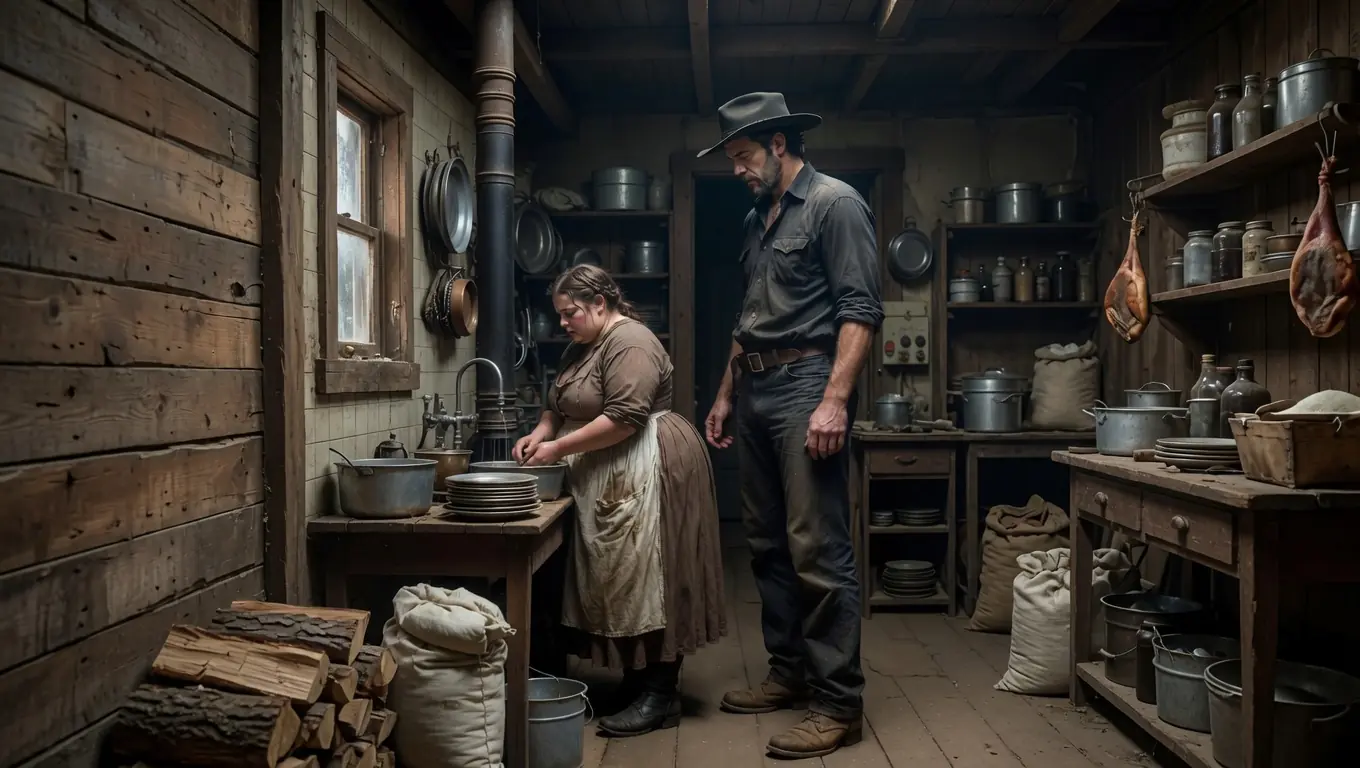
“The whole truth is, I saw you standing on that platform, and something in me recognized something in you,” he said. “Something broken calling to something broken. And I thought, if I let this woman walk away, I’ll regret it for the rest of my life.” Harriet leaned into his touch without thinking. “I don’t know what this is,” she whispered. “I don’t know what we’re doing.”
“Neither do I,” he said. “I’m scared.” “Me too.” “What do we do?” Silas’s thumb brushed across her cheekbone. “We figure it out. Together. One day at a time.”
Harriet closed her eyes, feeling the warmth of his hand and the steadiness of his presence. “Okay,” she breathed. “Okay.” Neither of them moved, and neither of them wanted to. Then a small voice said, “Mama, why is Mr. Silas touching your face?”
They sprang apart. Maggie stood in the doorway with her rag doll clutched to her chest, her eyes wide with curiosity rather than alarm. Harriet stammered, “I... We...” Silas cleared his throat. “Your mama had something in her eye. I was helping her get it out.” Maggie considered this. “Oh. Okay.”
She padded over to Silas and tugged on his sleeve. “Can you tell me a story before bed? Mama always tells the same ones.” Silas looked at Harriet helplessly. “Go ahead,” Harriet said, surprised by how steady her voice sounded. “I’ll finish cleaning up.” She watched Silas follow Maggie into the house, the big man shortening his stride to match the little girl’s pace.
Something warm bloomed in Harriet’s chest. Maybe this was impossible. Maybe Whitmore would win. Maybe everything would fall apart. But right now, in this moment, she had something she had never expected to find again. Hope.
Tags:
News in the same category
They Laughed at Her for Planting Eucalyptus in the Pasture - Then the Drought of 1988 Proved Her Right
They Invited Her Only to Fill an Empty Seat - Then the Most Eligible Duke Chose the Chair Beside Her
A Duke Wrote Letters Seeking a Wife - Then the Humblest One Stayed
My Mother-in-Law Planned My Divorce and Had My Twins Abandoned - Then My Husband Saw Us on TV

My Family Skipped My Housewarming for My Brother’s New Car - Then I Found Out Who Paid for It
They Left Me in the Woods as a Joke - Then I Owned Their Town
On Mother’s Day, My Millionaire Son Asked About the $5,000 - Then the Truth Finally Came Out
My Mother Gave My Room to the Nanny - Then Made It Clear Which Daughter She Never Wanted

My Father Embarrassed Me in Front of Everyone - Then I Revealed the Life He Was Never Invited Into
My Cheating Wife Ran Off With Another Man - Then On the Day She Made Her Biggest Mistake
Wife of 18 Years Secretly Became a Surrogate for Her Sister - Then Her Husband’s Revenge Destroyed Everything

My Dad Suspended Me Until I Apologized to My Sister - Then The Next Morning, She Smirked Me
My Dad Looked Down on Me for Being a Janitor - Then His Thanksgiving Toast Made Me Walk Away Forever
Her Sisters Married Lords - Then England’s Most Powerful Duke Knelt for the Forgotten Eldest Spinster
At Every Ball, Men Asked About Her Sisters - Then the Most Desired Duke Said, “I Came for You, Not Them”
She Fell Into the Crippled Duke’s Lap - Then He Walked Again and Whispered, “You’re Mine”
A Rich Cowboy’s Dog Found a Dying Ranch Girl - Then He Realized She Was His Promised Bride
The Wealthy Rancher Disguised Himself as a Farmhand - Then the New Cook Saw Through Him Instantly
News Post
I Forgot My Hearing Aid and Turned Back - Then I Heard My Daughter Say, “Tonight, We End This”
They Laughed at Her for Planting Eucalyptus in the Pasture - Then the Drought of 1988 Proved Her Right
They Invited Her Only to Fill an Empty Seat - Then the Most Eligible Duke Chose the Chair Beside Her
A Duke Wrote Letters Seeking a Wife - Then the Humblest One Stayed
My Mother-in-Law Planned My Divorce and Had My Twins Abandoned - Then My Husband Saw Us on TV
My Family Skipped My Housewarming for My Brother’s New Car - Then I Found Out Who Paid for It
They Left Me in the Woods as a Joke - Then I Owned Their Town
On Mother’s Day, My Millionaire Son Asked About the $5,000 - Then the Truth Finally Came Out
My Mother Gave My Room to the Nanny - Then Made It Clear Which Daughter She Never Wanted
My Father Embarrassed Me in Front of Everyone - Then I Revealed the Life He Was Never Invited Into
My Cheating Wife Ran Off With Another Man - Then On the Day She Made Her Biggest Mistake
Wife of 18 Years Secretly Became a Surrogate for Her Sister - Then Her Husband’s Revenge Destroyed Everything
My Dad Suspended Me Until I Apologized to My Sister - Then The Next Morning, She Smirked Me
My Dad Looked Down on Me for Being a Janitor - Then His Thanksgiving Toast Made Me Walk Away Forever
Her Sisters Married Lords - Then England’s Most Powerful Duke Knelt for the Forgotten Eldest Spinster
At Every Ball, Men Asked About Her Sisters - Then the Most Desired Duke Said, “I Came for You, Not Them”
She Fell Into the Crippled Duke’s Lap - Then He Walked Again and Whispered, “You’re Mine”
A Rich Cowboy’s Dog Found a Dying Ranch Girl - Then He Realized She Was His Promised Bride