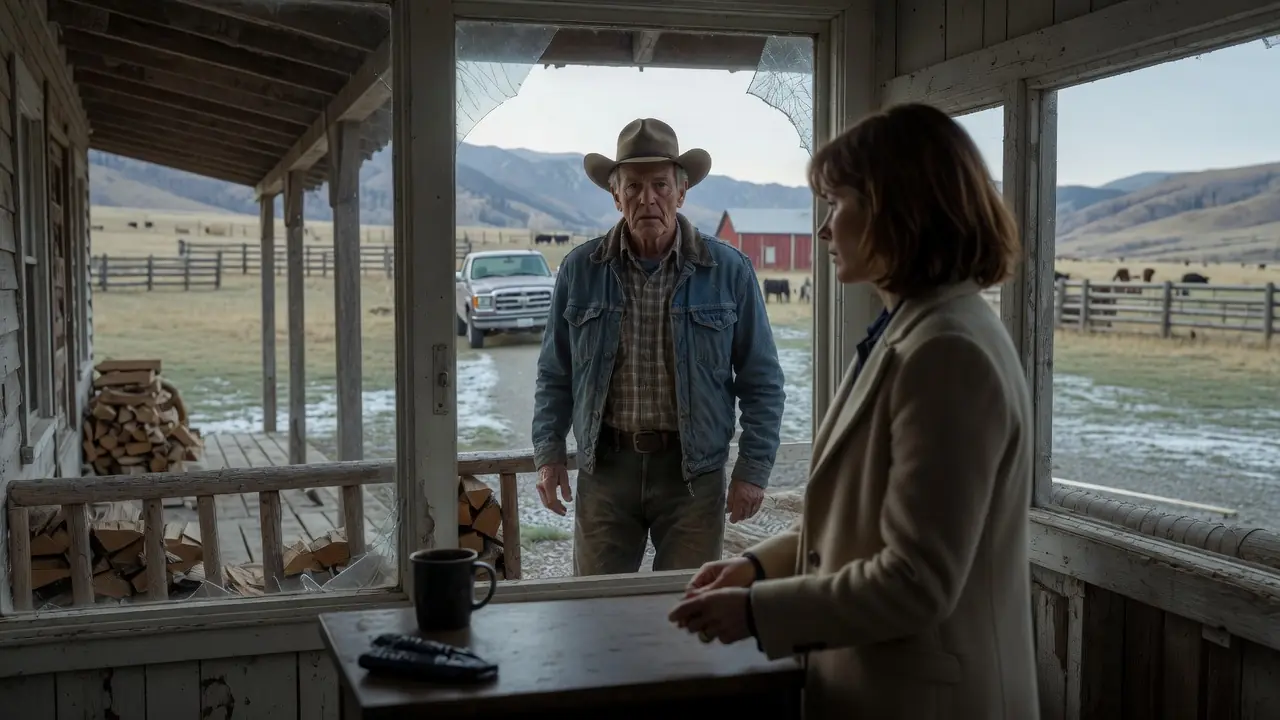
She Fell Into the Crippled Duke’s Lap - Then He Walked Again and Whispered, “You’re Mine”
The candle flew from Ivy Crestwood’s hand the moment the floor gave way beneath her. She did not scream, because there was no time. One second, she was hurrying through the dim servants’ corridor of Thornvale Manor with a tray of medicine balanced carefully in her arms, and the next, the rotted floorboard cracked beneath her foot. The hidden panel door beside her swung inward under the force of her fall, and Ivy tumbled straight through it into a room she had never been told existed.
The tray shattered against the stone floor. Glass skittered in every direction, herbal tinctures spilled across the cold stone, and the candle rolled into the corner, still burning with a small stubborn flame. Ivy landed breathless against something warm, solid, and very much alive. When she pushed herself upright, her palms pressed against a man’s knees, and her horrified eyes lifted to see exactly whose lap she had fallen into. Edmund Harlow, the eighth Duke of Ravenscroft, was staring down at her.
He was the man half of England pitied and the other half feared. He had not left this wing of the manor in three years. Everyone said he would never walk again, and every servant at Thornvale knew the rules of his rooms. Knock, wait, enter only if permitted, place the medicine tray by the door, do not look too long, do not ask questions, and leave quickly.
Ivy had followed those rules for forty-seven days. She counted each day because every wage she earned kept her younger sister Bet fed and warm in the village. She was not a lady’s companion, a governess, or a cook. She was only the under-assistant to old Doctor Perrin, measuring powders, boiling herbs, recording notes, and carrying medicine to rooms where people preferred not to see her.
The Duke’s wing had always been the last stop. Edmund Harlow had once been famous for riding across the estate at full gallop, hosting dinners, and laughing in a way that filled rooms. Then came the accident. A carriage, a ravine, and a night no one fully described had returned him to Thornvale unable to walk, with something cold and closed sitting behind his eyes.
Now Ivy was half-kneeling in his lap with her hands still braced against his knees. Her cheeks burned with panic and shame. “Forgive me, Your Grace,” she whispered. “The floor broke. I did not know there was a door. I did not mean to fall.”
Edmund did not speak at first. He only stared at her as though she had brought light into a sealed room. His hand came up slowly and closed around her wrist, not roughly and not cruelly, but firmly enough to stop her from rising. His voice, when it came, was low, rough, and unused. “You are not leaving,” he said. “Not yet.”
Ivy froze. Edmund looked down at his own legs, and something raw moved across his face. It was not anger. It was wonder, frightened and fragile, like a locked door opening after years of silence. “Did you feel that?” he asked.
Ivy did not understand. “Your Grace?” Edmund’s voice dropped lower. “When you pressed against my knees. Did you feel me press back?” The room seemed to tilt around her.
Ivy looked down at his legs, then back at his face. She had felt it. It had been faint, but it had not been nothing. It had not been the lifeless stillness everyone whispered about. “Yes,” she said quietly. “I did.”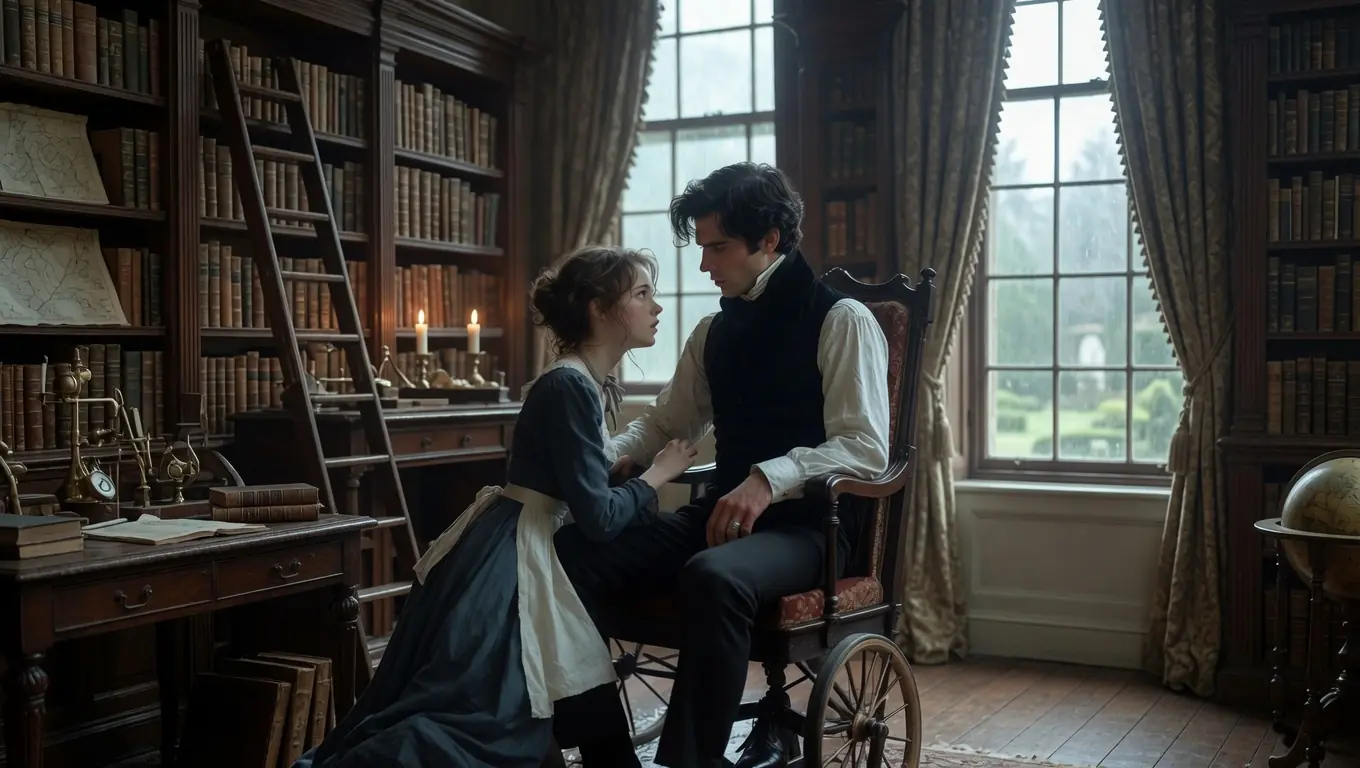
Edmund closed his eyes. For the first time in three years, something in his face softened. Outside, rain kept tapping against the windows of Thornvale Manor, and inside, the little candle in the corner burned on. Ivy did not know it yet, but she had just fallen through a door that would never truly close behind her again.
Doctor Perrin was not pleased when he arrived. He stood in the doorway, taking in the broken glass, the spilled tinctures, the ruined tray, the cracked floorboard in the corridor, and Ivy standing flushed and shaken in the middle of it all. He muttered about the medicine first, then the floorboard, then the panel door. Ivy promised to prepare a new tray and report the damage to Mrs. Dunford, the housekeeper.
The doctor looked past Ivy toward the Duke. Edmund had not moved from his wheeled chair. His expression gave nothing away, but his eyes remained fixed on Ivy with unsettling attention. Doctor Perrin had served the Harlow family for twenty years and was wise enough to know when not to ask questions. “Clean this up,” he said. “Then come and find me.”
After he left, Ivy knelt and began gathering the broken glass carefully into her apron cloth. The Duke watched her work in silence. His study felt different from every other room in the manor, heavier somehow, as though the air had been breathed too many times and never refreshed. Books lay stacked in untidy towers, the fireplace was cold, and the curtains had been drawn for so long the room seemed to have forgotten daylight.
“What is your name?” Edmund asked. Ivy looked up. He was not watching her with the cold stare she had expected. He looked at her as though something unexpected had arrived in a place where nothing unexpected ever happened. “Ivy Crestwood, Your Grace. I assist Doctor Perrin.”
“How long have you been here?” he asked. “Forty-seven days.” His brows shifted slightly. “You counted?” Ivy sat back on her heels. “I count everything. It is a habit.”
“Why?” he asked. She should not have answered so honestly, but the question felt real, and real questions deserved real answers. “Because when things feel uncertain, numbers are steady. They do not change their minds.” Edmund studied her for a long moment. “That is either very practical or very sad.”
“Most practical things are a little sad,” Ivy replied, then caught herself. “Forgive me, Your Grace. I do not usually speak so freely.” “Do not apologize,” he said quietly. “Everyone else in this house speaks to me as though I might shatter. It is exhausting.”
Ivy finished gathering the glass and stood. She knew she should leave, but the question had been sitting in her chest since he asked it. “You said you felt something,” she said. Edmund went very still. “I have not told anyone else that.”
“I will not repeat it,” Ivy said. “Why not?” “Because it would become gossip, and I am not interested in gossip. I am interested in whether it is true.” Edmund looked at her for so long that the back of her neck warmed.
“It has been happening for about six weeks,” he confessed. “Small things. Pressure. Heat. I told Perrin. He was cautious. He said nerves can send false signals and told me not to hope.”
“Did you hope anyway?” Ivy asked. “No,” Edmund said. Then, after a pause, he added, “Yes. Privately.” Ivy nodded. “That seems like the right answer.”
For a moment, the corner of Edmund’s mouth moved. It was not quite a smile, but it was the memory of one. Ivy folded the ruined cloth and set it aside, telling herself again that she should leave. Doctor Perrin was waiting, Mrs. Dunford needed to know about the floor, and three other patients still required attention. She turned toward the broken door.
“Miss Crestwood,” Edmund said. She stopped. “Come back this afternoon with the adjusted tincture.” Ivy hesitated. “Doctor Perrin usually brings the afternoon medicine himself.” Edmund looked at her steadily. “Tell him I have requested you.”
She left through the panel door, stepped carefully over the broken floor, and only when she was back in the corridor did she realize she had been holding her breath. In the kitchen, over a cup of tea she barely tasted, she told herself that nothing unusual had happened. A floorboard had broken. She had fallen. She had made conversation, which was impolite and unwise.
Still, when she closed her eyes, she could feel the warmth of Edmund’s hand resting against her arm. Not gripping. Not restraining. Just resting there, uncertain and human. She counted the tiles on the kitchen floor. There were thirty-two of them, and numbers were supposed to steady her.
Across the manor, Edmund sat alone in his study and stared at his own hand. He had not touched another person voluntarily in three years. He had permitted Doctor Perrin to examine him, and he had allowed servants to assist him when necessary, but choosing contact was different. He pressed his hand flat against his knee and waited.
There it was again. Faint, like a word spoken from another room, but present. A pressure. A signal. A thread of feeling in a body he had believed broken beyond repair.
He had told himself not to trust it. Doctor Perrin had used careful words like unlikely, gradual, and manage expectations. But Ivy had felt it too. She had looked at him directly and said yes. For the first time in years, Edmund found himself waiting for the afternoon.
Ivy almost did not go back. Not because she did not want to, but because wanting anything beyond survival was a luxury she had trained herself not to need. She stood outside the kitchen with the fresh tray in her hands and reminded herself that he was a duke, she was a physician’s assistant, and she was there to deliver medicine, not conversation. Doctor Perrin had raised one expressive eyebrow when she relayed Edmund’s request, then told her not to be late.
When Ivy entered the study that afternoon, the curtains had been pulled back. Gray light fell across the room, and Edmund sat in his chair with a book open across his lap, though he was not reading. He turned toward her. “You came.” Ivy set the tray down. “You requested it.”
“People do not always do what I request,” he said. “That surprises me. You seem like a man people would find difficult to refuse.” Edmund looked toward the window. “They find me difficult to approach, which is different. They agree to my face, then manage me from a distance.”
Ivy studied him. There was bitterness in those words, but also something older. “Were you always like that?” she asked. “Someone people managed from far away?” Edmund absorbed the question in silence. “You ask questions no one else asks.”
“I can stop.” “I did not say to stop.” Ivy pulled a small stool from near the bookshelf and sat down, because standing over a seated person while having a true conversation had always seemed rude to her. Edmund watched the simple gesture as if ordinary ease surprised him.
“My father was a man people managed from a distance,” Edmund said at last. “I grew up watching it. I swore I would be different.” He paused. “Somewhere along the way, I became exactly the same through a different route.”
“What route?” Ivy asked. “Impatience,” he said. “I had no tolerance for pretense, for people who said one thing and meant another, for drawing rooms full of performance. I drove people away, then convinced myself I preferred the distance.”
“And now?” Ivy asked. Edmund looked through the rain-streaked window. “Now I have had three years of the distance I thought I wanted, and it turns out I was lying to myself.” The room fell quiet. The rain had stopped, and Thornvale’s grounds shimmered wet and green beyond the glass.
“May I see something?” Ivy asked. Edmund looked back at her. She stood, moved in front of him, and crouched so she was at his eye level. “May I?” she asked, gesturing toward his knees.
Something passed over Edmund’s face, not suspicion, but the expression of a man bracing for disappointment he had survived too often. “Yes,” he said. Ivy placed both hands flat against his knees, the same way they had landed that morning, and pressed gently. Three seconds passed. Then four. Then five.
And then she felt it. A slow, deliberate pressure back. Not a twitch, not a spasm, not a random misfire of damaged nerves, but intention. A man pressing back because he chose to. Ivy looked up.
Edmund was gripping the arms of his chair so hard his knuckles had gone white. His face was rigid with effort, but his eyes were bright with a dangerous mixture of terror and hope. “That is not a false signal,” Ivy said. “No,” he answered roughly. “It is not.”
“How much can you feel?” she asked. “More than yesterday,” he said. “Much more than last week.” Ivy forgot herself entirely. “Edmund.” He flinched, not with offense, but shock at hearing his name spoken without title or distance.
“You need to tell Doctor Perrin everything,” she said. “Today. Not a careful version. Everything.” Edmund watched her for a long moment. “I will,” he said, “if you stay while I do.” Every sensible rule in Ivy’s life told her to say no. “All right,” she answered.
Doctor Perrin arrived within the hour. His examination was the most thorough he had performed in months. He tested pressure response, heat response, movement, and reflexes, filling four pages of his ledger in increasingly agitated handwriting. When he finally set down his pen, his expression was one Ivy had never seen on him before.
“This is real,” he said. “Genuine recovery. Significant. I do not fully understand it.” Ivy asked if Edmund could walk. Perrin answered, “Not yet, but the nerve response suggests it may be possible with the right exercises and care.”
He warned them that it would take time, that it would be painful, and that there were no guarantees. Edmund accepted this quietly. Perrin warned him not to build hope too high. Edmund looked at his own hands and said, “I have been on the floor of that fall for three years. I am not afraid of it.”
When the doctor left, Ivy stood near the window. Edmund watched her with a gaze that felt too deliberate to ignore. “Why did you agree to stay?” he asked. Ivy considered giving a practical answer about medical assistance. Instead, she said, “Because someone should be here when good news arrives. It seemed you had been alone when the bad news came often enough.”
Edmund’s expression opened in a way that startled her. “Miss Crestwood,” he said. She turned. “Thank you.” Two simple words, but the way he said them made them feel like something much larger. Ivy nodded, picked up the empty tray, and left before her face could confess anything she was not ready to name.
She did not sleep well that night. In her narrow bed in the servants’ quarters, she thought about the pressure of his hands through his knees, the brightness in his eyes, and the way she had said his name. She counted the nails in the wooden wall panel beside her bed. There were fourteen. It did not help as much as usual.
Three weeks passed, and every afternoon Ivy brought medicine to Edmund’s study. Every afternoon, she stayed longer than the medicine required. Doctor Perrin began finding reasons to send her in his place and stopped commenting on it. The exercises began in the second week, and Ivy administered them because Edmund would not attempt them properly when the doctor hovered nearby with cautious eyes.
With Ivy, he worked until sweat stood on his forehead and his hands shook against the arms of the chair. She did not praise too loudly or pity him. She handed him water, steadied the room with her presence, and treated his effort as ordinary and remarkable at once. On the fourteenth day, Edmund lifted his left foot off the footrest of his chair by one inch.
It lasted only a moment, but it was under his own power. When his foot returned to the rest, he dropped his head and pressed the heels of his hands against his eyes. Ivy stood three feet away and said nothing, because some victories belonged first to the person who had fought for them. After a long silence, Edmund looked up.
“One inch,” he said. “One inch,” Ivy agreed. “It is nothing.” “It is everything,” she said. “And you know it.”
Then the complication arrived in the form of Lord Desmond Cale, Edmund’s cousin and heir if Edmund died without issue. Cale was forty, polished, charming, and empty beneath the charm. He moved through Thornvale with the ease of a man already imagining the estate as his own. Within an hour of his arrival, the whole manor seemed colder.
Ivy met him in the east corridor while carrying Edmund’s afternoon tray. Cale inspected her the way men of his kind often inspected women of her station, with a smile that took inventory without permission. “You are the one Edmund has been requesting,” he said. His tone made the word requesting sound improper.
“I administer the Duke’s afternoon treatment,” Ivy replied. Cale smiled without warmth. He said Edmund had been indifferent to recovery for three years, and then suddenly a girl with a medicine tray appeared and he became interested in getting better. He spoke of vulnerability, influence, attachment, and dependence masquerading as progress. Ivy held the tray steady, answered carefully, and walked past him.
That afternoon Edmund noticed at once that something had happened. Ivy tried to keep the matter to herself, but she found she could not lie to that particular face. She told him everything Cale had said, including the tone and the smile that was not a smile. Edmund listened without interrupting, his expression growing still in a way that meant fury.
“He implied you were taking advantage of my vulnerability,” Edmund said. “Yes.” “What did you say?” “Nothing useful. I agreed that I would hate for you to be taken advantage of, then I left.” Edmund watched her for a long moment. “You are the only person in this house I trust.”
The words fell into the room and sat there. Ivy felt them land in a place inside her chest she had tried to keep empty. “That is because I treat you like a person,” she said carefully. “That is not a difficult standard to meet.” “You are wrong,” Edmund said. “It has proven extremely difficult.”
Ivy looked toward the window. “Cale wants you to dismiss me.” Edmund’s voice hardened. “Cale wants many things that are not going to happen. He has waited three years for me to die or surrender the title. He is going to be disappointed on both counts.”
Ivy turned back to him and saw his hands gripping the arms of his chair, not with effort this time, but decision. “Stand up,” she said. Edmund looked sharply at her. “Right now?” “Right now,” she answered. “Not because of Cale, and not to prove anything to anyone else. Because you can.”
He argued that Doctor Perrin had said to be careful. Ivy answered that careful did not mean never. She moved directly in front of him. “I will be right here. You will not fall. And if you do, I will catch you.”
For a long moment, Edmund only looked at her. Ivy saw the war inside him: three years of bracing for disappointment battling something rawer and more dangerous. Then he placed both hands flat on the arms of his chair and pushed. His legs shook. His whole body shook.
Ivy stepped forward instinctively, one hand braced at his arm, not holding him up, only present. He rose halfway from the chair, suspended between sitting and standing, trembling but bearing weight on his own legs. For four seconds, he held it. Then his legs gave in, and he dropped back into the chair, breathing hard.
When he opened his eyes, something in his face had broken open entirely. His hand came up and caught her wrist. Not rough, not gentle, but absolute. “Ivy,” he said, voice shaking. She looked down at him.
Edmund Harlow, the man who had not chosen to touch another person in three years, looked up from the chair where he had just stood on his own legs for the first time since the accident. His eyes were bright, fierce, frightened, and alive. Then he said it, low and certain, like a declaration formed in the bones of a man who did not speak what he did not mean. “You are mine.”
Ivy did not move. She should have corrected him at once. She should have reminded him of title, station, and the impossible distance between them. Instead, she looked at him for a long, still moment. “That is not something you get to simply decide.”
“I know,” Edmund said. “I intend to earn it.” Outside the window, a young horse in the paddock finally stilled beneath a stable hand’s patient touch. Inside, the clock on the mantel kept ticking. Ivy stood in the fading light with the Duke’s hand around her wrist and felt, with terrifying clarity, that numbers were no longer enough to steady her.
By the next morning, the manor knew something had shifted. Great houses breathed, listened, and carried whispers from room to room. The curtains in Edmund’s study had been open three days in a row. The fireplace had been lit before the maids arrived. The Duke had been heard speaking in a normal voice, not ordering or dismissing, but speaking like a man glad someone else was in the room.
Cale noticed all of it. He smiled pleasantly at meals, requested access to estate accounts, and tested every crack in Thornvale’s structure. Then he went to the village where Ivy’s sister Bet lived in the cottage Ivy’s wages paid for. He introduced himself to the landlord as a representative of the estate and left behind, as if by accident, a number written on folded paper. The number was the exact remainder of Bet’s annual rent.
The message reached Ivy through Bet’s frightened letter two days later. Ivy read it three times, folded it precisely, and went about her duties as if nothing had happened. She told herself she was protecting Edmund during a critical stage of recovery. She told herself it was practical. She believed none of it.
She was frightened, not exactly of Cale, but of what Edmund would do if he knew. She was more frightened of how badly she wanted to hand him the letter and let him handle it. She had learned to manage alone, and wanting help felt too much like falling. That afternoon she avoided the study and sent word that Doctor Perrin would attend instead.
Within the hour, Edmund sent a note. His handwriting was bold and impatient. “I know you are avoiding this room. Whatever has happened, come and tell me. I am not made of glass, and I am tired of being managed.” Ivy pressed her thumb against the words, then went.
He was not in the chair when she entered. He was standing by the window, one hand on the frame for balance, pale from effort but upright on his own legs. He had clearly been working at it for hours and was refusing to sit before she saw him. Ivy stopped in the doorway. Edmund turned his head toward her.
For a moment, neither of them spoke. “Show-off,” Ivy said finally. Something almost like laughter crossed his face. “Come in and close the door.”
She told him about Cale, the village visit, and Bet’s letter. She handed him the folded paper and watched him read it. His jaw set, and his eyes went cold, not with the inward cold of three years ago, but with a purposeful cold directed outward. “He threatened your sister,” Edmund said quietly.
“He implied a threat,” Ivy said. “He went to your sister’s home and left a number beside her rent. That is a threat.” Edmund set the letter down. “Why did you not tell me immediately?” Ivy looked at him. “Because I was afraid of what you would do.”
“You were afraid I would handle it.” “I was afraid I would let you,” she said. “I have handled things by myself for a long time. Letting someone else handle something feels a great deal like falling, and I do not have a good recent history with falling.”
Edmund looked at her for a long moment. “Ivy,” he said, “look where the last fall landed you.” Then he pushed away from the window and took one full, unassisted step toward her. Slow, deliberate, and impossible. Then another.
He stood two feet away from her without holding anything. Unsteady, but present. “I am not going to take anything from you,” he said. “Not your independence, not your sister, not the way you count things when you are frightened. I am asking you to let me stand beside you, not in front of you.”
Ivy looked up at him, suddenly aware of his full height and the space he filled without the chair. “Cale will not stop,” she said. “He wants this estate, your title, and right now he believes the clearest path runs through me.” “Then we remove the path,” Edmund said. “How?” “By making it irrelevant.”
He took her hand, not her wrist this time, but her hand properly. “Marry me.” The room went still. Ivy stared at him. “That is a very dramatic solution.”
“It solves the problem,” he said. “You become the Duchess of Ravenscroft. Cale’s leverage disappears. Bet is secure. The estate remains beyond him.” He paused. “And I get to stop pretending I have not been thinking about this for three weeks.”
Ivy looked at their joined hands. “You cannot marry someone because she fell into your lap.” “I am not,” Edmund said. “I am marrying someone because she walked into a room where everything was dark and, without asking for anything in return, made it lighter. The falling was incidental.”
Something inside Ivy released, like ice cracking in spring. “I need time,” she said. “You have it.” “I need to speak to Bet.” “Of course.” “And I have conditions.”
“Name them,” Edmund said. “I remain who I am. I do not become someone managed, displayed, and quieted into a proper shape for drawing rooms. I count things. I say uncomfortable truths. I will absolutely argue with you.” Edmund smiled fully then, and it changed his whole face. “I am counting on all three.”
Ivy looked at him for a long moment. “Ask me again in a week.” “Why a week?” “Because I want to see you walk properly first,” she said. “I refuse to marry a man who cannot dance.” Edmund laughed, rough and rusty with disuse, but real enough to fill the room. Ivy decided she was absolutely not going to tell him that it was the most beautiful sound she had ever heard.
Downstairs, Cale wrote a letter to the family solicitor outlining concerns about Edmund’s state of mind, undue influence from a member of staff, and decisions made during medical vulnerability. He sealed it and gave it to a footman named George. Cale did not know George had served Thornvale for eleven years and had helped carry Edmund upstairs after the accident. George was not about to let that letter leave the estate. Some loyalties ran deeper than position.
The week passed quickly and slowly at once. Edmund walked the length of his study on the third day, twelve feet from window to door, with Ivy watching from the far end. On the fourth day, he walked into the corridor. On the fifth, he reached the top of the grand staircase and stood looking down into Thornvale’s entrance hall.
Mrs. Dunford saw him from below and stopped still with linens pressed to her chest. Her face did something quiet and complicated before she covered it with professionalism. “Good morning, Your Grace,” she said. “Good morning, Mrs. Dunford,” Edmund replied, his voice carrying clearly. “I believe the east drawing room needs to be reopened. We will be having guests this week.”
The first guest was his mother, Dowager Duchess Margaret Harlow, who had written unanswered letters for three years. She arrived in restrained anxiety that dissolved the moment she saw her son standing in the entrance hall to receive her. She crossed the hall, took his face in both hands, and whispered, “You are standing.” Edmund answered, “I am standing.”
Then she collected herself and told him he looked dreadful and asked whether he had been sleeping. He said better recently. The Dowager looked past him and saw Ivy standing respectfully aside. Edmund introduced her as Miss Ivy Crestwood, who assisted Doctor Perrin. “She has been instrumental in my recovery,” he said.
The Dowager took Ivy’s hand and looked at her with sharp, comprehensive attention. “Miss Crestwood, I am very pleased to meet you.” Ivy answered politely, but the Dowager kept her hand for one moment longer. “Thank you,” she said quietly. Two words, but from a mother’s mouth they carried the weight of three years of silence and prayer.
The second guest was not invited. Lord Desmond Cale entered the drawing room later that afternoon and stopped when he saw Edmund standing by the fireplace with a cup of tea in his hand. Ivy, seated near the Dowager, saw Cale calculate, adjust, and change direction in the space of one second. “Edmund,” he said warmly. “This is remarkable. I had no idea you were so improved.”
“I did not announce it,” Edmund said. “You should have. The family will be delighted.” Edmund set down his tea. “Desmond, I would like you to meet my mother, whom you know, and Miss Ivy Crestwood, who will be joining the family shortly.”
The room held its breath. Cale’s smile remained in place, which Ivy found technically impressive. “Joining the family?” he repeated. “As my wife,” Edmund said, clear and calm, because he had nothing to prove to anyone in that room. Cale looked at Ivy, and Ivy looked back with the steady composure of a woman who had learned to stand still while the ground moved.
“How very surprising,” Cale said. “Is it?” Edmund replied. “I think it makes perfect sense.” He walked across the room and stood beside Ivy’s chair. He did not sit. The meaning needed no translation.
“Miss Crestwood has shown better judgment and more genuine loyalty to this estate in forty-seven days than most people manage in a lifetime,” Edmund said. Cale’s smile thinned. He mentioned solicitors and questions. Edmund replied that the solicitors worked for him, and they would have answers.
Cale left Thornvale the next morning without announcement, which was only fair, since he had arrived the same way. Edmund watched his carriage disappear down the long drive. Ivy stood behind him. “Is it done?” she asked. “His leverage is gone,” Edmund said. “He will find other angles, but not here. Not with you.”
Ivy looked at him. “You said joining the family shortly.” “I did.” “You told me to ask again in a week.” “It has been six days.” “Close enough,” she said.
Behind them, the Dowager was already giving Mrs. Dunford instructions about curtains, airing rooms, and restoring the east wing, which was her way of saying she was staying. Ivy looked at Edmund. “Can you dance yet?” He considered this seriously. “I can walk without assistance. I can manage stairs. I cannot yet waltz.”
“That was my condition,” Ivy said. Edmund took her hand carefully. “I will waltz with you at our wedding. I give you my word, even if it kills me, which it may.” Ivy smiled despite herself. “Your word as a duke?” “My word as a man,” Edmund said, “which I have been reliably informed is worth considerably more.”
Ivy thought about forty-seven days, broken floorboards, candles burning in dim rooms, a man who had hoped privately, and a woman who counted things to stay steady. She thought about Bet, safe and already writing letters about the famous manor. She thought about numbers, which had carried her through difficult years, and realized she did not have to stop counting. She simply did not have to count alone.
“All right,” she said. Edmund’s voice carried careful hope. “All right, yes?” “All right, yes,” she said. “But you are waltzing at our wedding if it is the last thing either of us does.” Edmund smiled then, the full smile the older servants had whispered about, and Ivy felt it fill the room.
He lifted her hand and pressed his lips to her knuckles. “You came through a broken door,” he said quietly, “and everything broken in this house started becoming whole.” Ivy looked at him. “I fell.” “You landed,” Edmund said. “There is a difference.”
Six months later, Thornvale Manor hosted a wedding. It was not small, because the Dowager did not believe in small affairs, Mrs. Dunford had three years of suppressed domestic energy to release into flowers, and the kitchen prepared with the intensity of a military campaign. Bet Crestwood stood beside Ivy in the dressing room and pinned the last of her hair into place. Ivy looked into the glass and saw herself, not transformed or costumed, but recognizably herself.
Edmund stood at the bottom of the staircase, without assistance, to receive her. When Ivy descended, his face did something that was nearly tears without becoming them. Several senior servants had to look away. He took her hand. “Hello,” he said. It was not eloquent, but Ivy valued sincerity above eloquence. “Hello,” she answered.
They were married in Thornvale Chapel with the Dowager in the front row, Bet attempting dignity in the second, George the footman failing entirely in the third, and Doctor Perrin regretting he had not brought another handkerchief. At the wedding breakfast, Edmund danced with his wife. Not perfectly. His right leg still moved carefully, but he waltzed.
“You waltzed,” Ivy said. “I told you I would.” “You look like it might actually kill you.” “It might,” Edmund said. “I find I do not care.” Ivy laughed, and he pulled her slightly closer, not scandalously, just enough.
They turned together in the light of a room where every curtain was open and every candle was lit. The long, dark silence of three years was over. Across the room, Bet ate an enormous amount of cake while telling George everything she knew about numbers being steady. The Dowager watched her son dance with his Duchess and allowed herself to feel the full weight of gratitude.
Outside, Thornvale stood warm and lit from within. Its windows glowed the color of candlelight, and its stone walls no longer seemed to brace against the world. Inside, a Duke and his Duchess turned slowly together, and the house breathed around them. Everything broken was not untouched by what had come before, but it was whole in the way real things become whole.
Ivy Harlow, who still counted things when nervous and always would, counted three things as they danced. One was the broken door. Two were the words that had started everything: “You are mine.” Three were the times she had been completely certain without needing to count at all: when Edmund laughed, when he took his first full step, and now, in this bright room, with his hand in hers and the music playing.
Some things did not need counting. Some things were simply and completely true.
Tags:
News in the same category
They Laughed at Her for Planting Eucalyptus in the Pasture - Then the Drought of 1988 Proved Her Right
They Invited Her Only to Fill an Empty Seat - Then the Most Eligible Duke Chose the Chair Beside Her
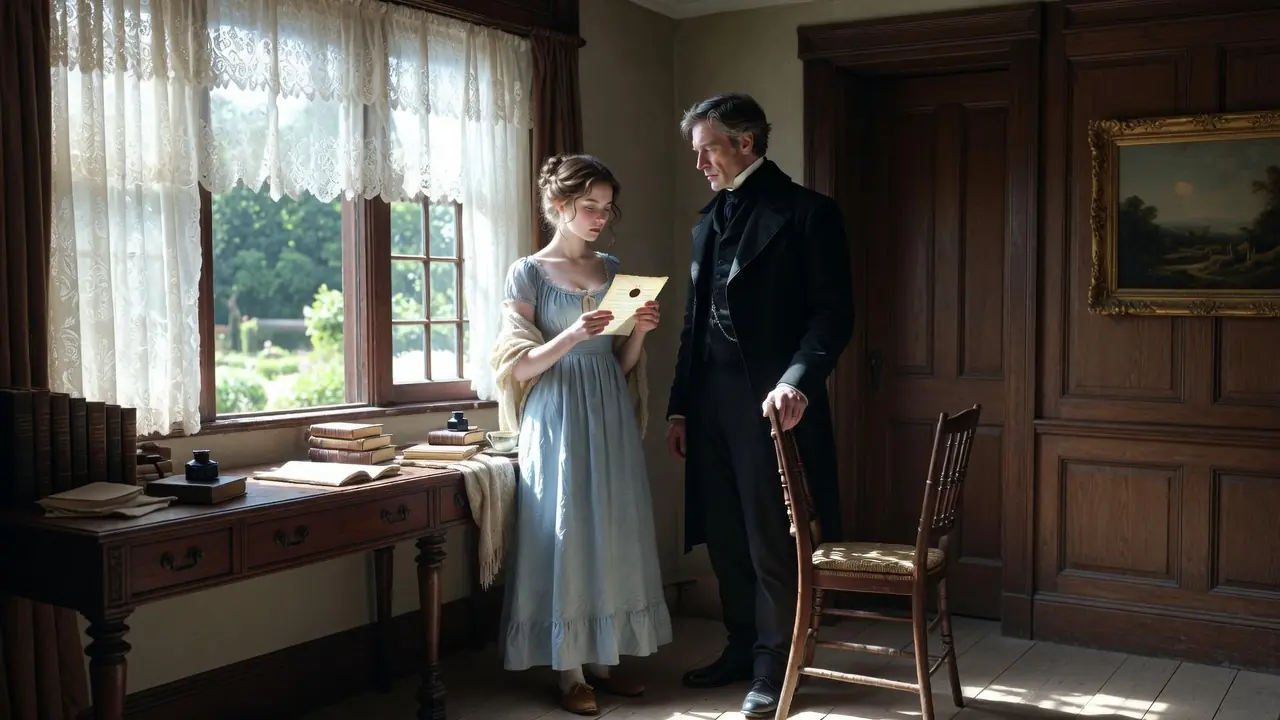
A Duke Wrote Letters Seeking a Wife - Then the Humblest One Stayed
My Mother-in-Law Planned My Divorce and Had My Twins Abandoned - Then My Husband Saw Us on TV

My Family Skipped My Housewarming for My Brother’s New Car - Then I Found Out Who Paid for It

They Left Me in the Woods as a Joke - Then I Owned Their Town
On Mother’s Day, My Millionaire Son Asked About the $5,000 - Then the Truth Finally Came Out
My Mother Gave My Room to the Nanny - Then Made It Clear Which Daughter She Never Wanted

My Father Embarrassed Me in Front of Everyone - Then I Revealed the Life He Was Never Invited Into
My Cheating Wife Ran Off With Another Man - Then On the Day She Made Her Biggest Mistake
Wife of 18 Years Secretly Became a Surrogate for Her Sister - Then Her Husband’s Revenge Destroyed Everything
My Dad Suspended Me Until I Apologized to My Sister - Then The Next Morning, She Smirked Me
My Dad Looked Down on Me for Being a Janitor - Then His Thanksgiving Toast Made Me Walk Away Forever
Her Sisters Married Lords - Then England’s Most Powerful Duke Knelt for the Forgotten Eldest Spinster

A Rich Cowboy’s Dog Found a Dying Ranch Girl - Then He Realized She Was His Promised Bride
An Obese Widow Was Sent to Wash Dishes for an Angry Giant Cowboy - Then He Refused to Let Her Leave
The Wealthy Rancher Disguised Himself as a Farmhand - Then the New Cook Saw Through Him Instantly
News Post
I Forgot My Hearing Aid and Turned Back - Then I Heard My Daughter Say, “Tonight, We End This”
They Laughed at Her for Planting Eucalyptus in the Pasture - Then the Drought of 1988 Proved Her Right
They Invited Her Only to Fill an Empty Seat - Then the Most Eligible Duke Chose the Chair Beside Her
A Duke Wrote Letters Seeking a Wife - Then the Humblest One Stayed
My Mother-in-Law Planned My Divorce and Had My Twins Abandoned - Then My Husband Saw Us on TV
My Family Skipped My Housewarming for My Brother’s New Car - Then I Found Out Who Paid for It
They Left Me in the Woods as a Joke - Then I Owned Their Town
On Mother’s Day, My Millionaire Son Asked About the $5,000 - Then the Truth Finally Came Out
My Mother Gave My Room to the Nanny - Then Made It Clear Which Daughter She Never Wanted
My Father Embarrassed Me in Front of Everyone - Then I Revealed the Life He Was Never Invited Into
My Cheating Wife Ran Off With Another Man - Then On the Day She Made Her Biggest Mistake
Wife of 18 Years Secretly Became a Surrogate for Her Sister - Then Her Husband’s Revenge Destroyed Everything
My Dad Suspended Me Until I Apologized to My Sister - Then The Next Morning, She Smirked Me
My Dad Looked Down on Me for Being a Janitor - Then His Thanksgiving Toast Made Me Walk Away Forever
Her Sisters Married Lords - Then England’s Most Powerful Duke Knelt for the Forgotten Eldest Spinster
At Every Ball, Men Asked About Her Sisters - Then the Most Desired Duke Said, “I Came for You, Not Them”
A Rich Cowboy’s Dog Found a Dying Ranch Girl - Then He Realized She Was His Promised Bride
An Obese Widow Was Sent to Wash Dishes for an Angry Giant Cowboy - Then He Refused to Let Her Leave