At Every Ball, Men Asked About Her Sisters - Then the Most Desired Duke Said, “I Came for You, Not Them”
England, 1809. Lady Kathleen Maitland stood beside the refreshment table at the Countess of Wiltshire’s spring ball, her gloved fingers absently tracing the embroidered edge of the tablecloth. Around her, the ballroom glittered with silk gowns, polished boots, jeweled throats, silver trays, and hundreds of candles reflected in tall mirrors. She had positioned herself as she always did at such events, visible enough to satisfy propriety, yet tucked away where her presence would not invite unwanted attention or pity. At three and twenty, Kathleen had long since accepted her place in society.
As the eldest daughter of the respected Earl of Sherborn, she had been presented at court five seasons ago. That memory still brought a flush of embarrassment to her cheeks, because she remembered how hopeful she had been then, and how painfully naive. Five seasons had come and gone, and she remained unmarried, unnoticed, and increasingly resigned to the narrow future society had assigned her. She was not plain, not truly, for she had fine eyes, a pleasing figure, and chestnut hair that gleamed with auburn in the sunlight, but she lacked the sparkling charm that made her younger sisters irresistible.
“Kathleen,” came her mother’s voice behind her, causing Kathleen to straighten instinctively. “Do try to look less forlorn, dear. It does nothing for your complexion.” The Countess of Sherborn was a handsome woman of forty-five, and her beauty had been passed generously to Caroline and Amelia, though everyone seemed to agree it had skipped Kathleen. Kathleen forced her lips into what she hoped resembled a smile and answered, “Yes, Mother.”
“Your sisters are causing quite a stir,” her mother continued, gesturing toward the dance floor. Caroline, at nineteen, was a celebrated beauty with golden curls and a figure that had already inspired a dozen proposals, all declined with practiced sweetness. Amelia, barely eighteen, was equally stunning, with delicate features and a laugh that carried across the room like music. Kathleen looked toward them and said honestly, “I am pleased for them.”
She meant it, despite the ache that came with watching their success cast her own failures into sharp relief. Her mother whispered that Lord Harrington had been asking about Caroline all evening and that Viscount Bennett had danced with Amelia twice. Kathleen murmured that it was wonderful, then reached toward a small slice of cake as if sweetness might provide a little comfort. Before she could take it, Caroline appeared at her side, breathless from dancing.
“Oh, Kathleen,” Caroline said, smiling without malice. “Not another piece, surely. Remember what I told you about your figure.” Kathleen’s hand froze in midair, then slowly withdrew. Caroline meant well, as she always did, but her thoughtless comments still stung. Their mother offered a weak admonition, but Caroline’s attention had already shifted toward Lord Harrington, and with a swish of pale blue silk, she was gone.
Kathleen released a breath she had not realized she was holding. She told her mother she needed air and slipped away before anyone could object. Few heads turned as she crossed the ballroom. No eager suitors stepped forward to claim her hand for the next dance. She had become skilled at this particular form of social ghosting, present yet unseen, acknowledged yet forgotten.
The terrace was mercifully quiet. Kathleen inhaled the cool spring air and tried to let it steady her. London’s sky was clouded, though a few distant stars showed through, cold and unreachable. “Like me,” she thought, then immediately scolded herself for self-pity.
“Are you unwell, Lady Kathleen?” a deep voice asked. She turned to find Lord Edward Hathaway, a longtime family friend, regarding her with concern. At thirty, Lord Hathaway was a confirmed bachelor with kind eyes and a gentle manner that had always put Kathleen at ease. She assured him she was well and had merely sought a moment of rest from the crush inside.
Edward moved to stand beside her at the balustrade, leaving a comfortable distance between them. “Your sisters are the toast of the evening,” he observed. Kathleen nodded without rancor. “They are very deserving of the attention.” He looked at her thoughtfully and asked, “And you? Do you not deserve attention as well?”
Kathleen smiled because she appreciated his kindness, but she also recognized it as kindness. “We all find our place in society, Lord Hathaway. I have made peace with mine.” Edward frowned slightly and said that sounded remarkably like surrender. Kathleen answered that she was practical, for few men looked past Caroline and Amelia to notice her, and even fewer would prefer her if they did.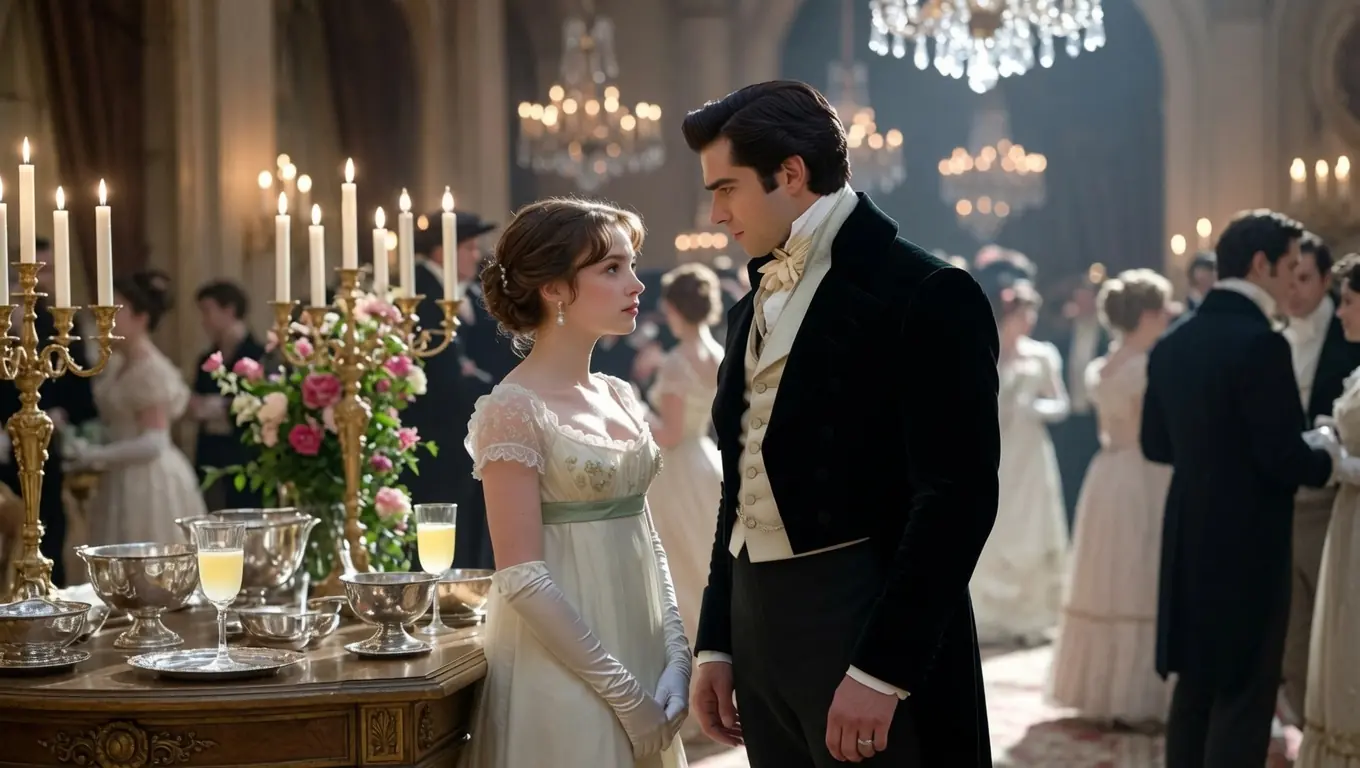
Edward began to praise her intellect and compassion, but Kathleen stopped him before the conversation grew too serious. She asked instead whether he had read the new novel by Mrs. Radcliffe. Edward recognized the deflection but allowed it, and soon they were discussing books, music, travel, and political gossip. For a little while, Kathleen’s spirits lifted, because Edward was one of the few people who seemed to see her as more than Caroline and Amelia’s forgettable older sister.
When they returned toward the ballroom, a commotion near the main doors drew every eye. The music faltered, conversations dimmed, and a collective breath seemed to pass through the assembly. Edward murmured that His Grace had finally deigned to grace London with his presence. Kathleen asked who he meant, and Edward told her it was Edgar Wallace, the sixth Duke of West Morland, newly returned after nearly two years abroad.
Then the crowd parted, and Kathleen saw him for the first time. The Duke of West Morland was tall and powerfully built, with broad shoulders emphasized by his impeccably tailored evening clothes. His dark hair was cut shorter than fashion required, and a slight tan suggested time spent outdoors rather than in drawing rooms. His eyes were intensely blue, seeming to cut through the artificial brightness of the ballroom.
He moved with contained energy, acknowledging greetings with brief nods as he passed through the eager crowd. Edward explained that the Duke was enormously wealthy, notoriously demanding, and famously disdainful of the marriage mart despite his need for an heir. Kathleen watched her mother swiftly maneuver Caroline and Amelia into his line of sight. She could read the familiar choreography from a distance, her mother’s positioning, Caroline’s practiced smile, and Amelia’s delicate upward glance.
Kathleen said quietly that her sisters were about to be introduced. Edward asked, “And you?” Kathleen shook her head. “Mother knows better than to waste His Grace’s time.” She offered a small smile and said she was developing a headache, then withdrew to a shadowed alcove near a potted palm. From there, she could observe without being observed.
The Duke stood among eager introductions, politely listening while Kathleen’s mother spoke and her sisters appeared the perfect picture of beauty. Kathleen watched with the familiar hollow ache in her chest, not jealousy exactly, but loneliness sharpened by years of being overlooked. Her father had once told her she was born in the wrong century because she thought too much. Society, he had said, did not value a thinking woman.
The orchestra began again, and gentlemen moved toward Caroline and Amelia for the next dance. Kathleen’s mother rejoined her father, satisfied with the evening’s progress. Curious despite herself, Kathleen scanned the ballroom for the Duke. He had moved away from the crowd and was speaking with an older gentleman near the windows.
Then, as if sensing her gaze, the Duke turned his head. His eyes swept the room and landed directly on Kathleen in her shadowed alcove. For one breathless moment, those piercing blue eyes seemed to look through every defense she had built, seeing not the forgotten sister, but something else entirely. Kathleen froze, unable to look away, until someone stepped between them and broke the connection.
She exhaled shakily and told herself the man had merely glanced in her direction. It meant nothing. Yet as she gathered her composure, she could not shake the feeling that something had changed in that brief impossible moment. She simply did not know what.
Edgar Wallace was not a man accustomed to indecision. Since inheriting his title after his father’s death, he had managed vast estates, reorganized business interests, traveled to the West Indies to inspect holdings, studied Italian architecture, and negotiated trade agreements with decisive efficiency. Women, in his experience, had always fallen into predictable categories: debutantes paraded before him, sophisticated widows seeking diversion, and matchmakers who saw only his title and fortune. None had challenged his intellect or stirred his soul.
Yet that night, in his London townhouse in Grosvenor Square, Edgar stood before the pre-dawn window with an untouched glass of brandy in his hand, thinking of Lady Kathleen Maitland. He had noticed her immediately upon entering the Wiltshire ball, though he could not explain why. She had not been the most beautiful woman in the room, and she had not been seeking attention. Perhaps that was what caught him, the quiet dignity in her posture, the intelligence in her warm eyes, and the way she observed everything as if cataloging society’s absurdities for later consideration.
When he asked his host about her, the response had been dismissive. She was only the eldest Maitland girl, pleasant enough, but plain, out for ages, and overshadowed by her younger sisters. Edgar had allowed himself to be introduced to Caroline and Amelia, noting the Countess of Sherborn’s calculating eyes and the sisters’ conventional beauty. But when he asked about Kathleen, the countess had dismissed the possibility of an introduction with transparent surprise.
By the time Edgar departed the ball, a plan had formed in his mind. It was so unlike his usual methodical approach that he questioned his own sanity in the carriage home. Still, the certainty remained. Lady Kathleen Maitland was different from every woman he had known, and he needed to know her better.
At nearly five in the morning, Edgar told his valet Richardson to have his morning coat pressed and his phaeton ready by ten. He had not made a purely social call on a lady in years. Society would notice, rumors would spread, and the Countess of Sherborn would undoubtedly interpret his visit as interest in Caroline or Amelia. That assumption would have to be corrected immediately.
The following morning dawned bright, mocking Kathleen’s restless mood after a night of strange dreams filled with blue eyes. Breakfast was a trial, with Caroline and Amelia dissecting every moment of the previous evening’s triumph. Caroline said the Duke had spoken with her for five minutes and asked about music and art. Amelia added that he had admired her French fan.
Their mother reminded them that the Duke of West Morland was the most eligible bachelor in England. A match with him would elevate the family beyond all expectations. Kathleen tried to divert the conversation by asking where their father was, and her mother said he was meeting with his solicitor about investments. Kathleen knew better than to ignore the tension behind the answer, because the family finances had been precarious for years.
When the butler announced that the Duke’s carriage had been sighted, Sherborn House erupted into controlled chaos. Maids hurried, Caroline and Amelia were sent to change, and Kathleen found herself arranging flowers that had already been arranged perfectly. Her mother passed by and hissed that Kathleen should make herself scarce once the initial greetings were over. “Your sisters must have every advantage.”
The casual dismissal stung, but Kathleen nodded. Her role was well established: be polite, be brief, and be gone. She remained in the garden room while greetings sounded from the drawing room across the hall. She planned to wait a few minutes, make her obligatory appearance, curtsy, and retreat.
“Lady Kathleen, there you are.” She nearly dropped the vase. Edgar Wallace stood in the doorway, his tall frame filling the space with quiet authority. In daylight, he was even more striking than the night before, his blue eyes more intense and the planes of his face more sharply defined.
Kathleen curtsied and told him her mother and sisters were in the drawing room. Edgar replied that he had been informed, but made no move to return to them. Instead, he stepped farther into the room and commented on the lilies, saying his mother had favored them. Kathleen said they were beautiful, though temperamental, then immediately regretted sounding so ordinary.
To her surprise, the Duke’s mouth curved slightly. “Much like the aristocracy, would you not say?” Kathleen nearly smiled. “I could not possibly comment, Your Grace. It would be most improper.” He asked if she was always proper, and she answered honestly that she tried to be, though society’s definition of propriety often lacked nuance.
Before he could reply, her mother appeared in the doorway, breathless and confused. The countess suggested that His Grace might prefer to join them in the drawing room, where refreshments were waiting. Edgar’s expression cooled. He said he had been hoping Lady Kathleen might show him the gardens Caroline had praised.
Kathleen could not have said who was more shocked, herself or her mother. The countess recovered first and suggested Caroline might accompany them, since she had recently taken an interest in horticulture. Edgar refused firmly and requested Kathleen’s company. Put on the spot, Kathleen could only nod and accept.
They walked through the French doors into the garden behind Sherborn House. Kathleen pointed out the dormant rose bushes, the early spring bulbs, and the small fountain at the center. Edgar listened attentively and asked questions that revealed a surprising knowledge of gardens. He explained that his estate in Derbyshire had extensive grounds and that he had studied Italian garden design during his travels.
Kathleen said, without thinking, that cultivated nature seemed restorative because it balanced wildness and order. Edgar looked at her sharply. “Precisely. You understand such balance.” She hesitated, knowing most gentlemen expected conversations about weather or health, not philosophy. Still, she said most of life was a search for balance between duty and desire, tradition and progress, caution and courage.
The moment the words left her mouth, she wished she could call them back. She feared he would dismiss her as affected or too intellectual. Instead, Edgar regarded her with surprise and approval. “Most women of my acquaintance would have answered with some rehearsed pleasantry about flowers,” he said quietly. “Thank you for not being most women, Lady Kathleen.”
Kathleen blushed and said her mother would disagree with his assessment, for she often lamented Kathleen’s tendency toward plain speaking. Edgar replied that, with all due respect, he found the countess’s judgment lacking in that instance. Then he asked if they might sit, because there was a matter he wished to discuss. Kathleen sat beside him on the garden bench, bewildered and suddenly nervous.
Edgar explained that he had returned to England intending to fulfill his duty to his title. His aunt had insisted that at five and thirty, it was past time he secured the succession. Kathleen’s brief hope dimmed, because she assumed he had come to discuss Caroline or Amelia. Perhaps he wanted her assessment of their characters before declaring his intentions.
Instead, Edgar spoke of the qualities he sought in a duchess. Beauty faded, fortune he already possessed, and connections were secondary. He wanted intelligence, integrity, compassion without sentimentality, strength of character, and a partner who saw a title as a responsibility rather than a prize. His eyes held hers as he added that he wanted a woman who could speak of balance between wildness and order and mean it.
Kathleen stared at him, unable to comprehend what he was implying. Edgar told her he had observed her at the ball, not merely her beauty, which he called considerable despite society’s opinion, but her character. He had noticed her patience with her mother’s dismissals, her genuine interest in Edward Hathaway’s conversation, and the dignity with which she carried herself in a world determined to overlook her. In one evening, she had intrigued him more than any woman in thirty-five years.
Kathleen whispered that there must have been a misunderstanding. Edgar said there was none. He was not a man given to romantic fantasy, but he was a man who recognized value where others saw only conventional expectations. Then he asked permission to call on her, not her sisters, with the intention of becoming better acquainted.
The question “Why?” escaped Kathleen before she could stop it. Edgar smiled, and the transformation of his stern face stole her breath. He said that when their eyes had met across the ballroom, he saw a kindred spirit, a woman of substance in a world too often devoted to surface. Kathleen protested that he could not know that from one glance. He conceded that he could not know fully, which was precisely why he wanted permission to call properly.
He said her sisters were lovely and would make suitable matches, but he had not come to London for them. He had come seeking maturity and intelligence, and he believed he had found them. Unless, of course, she found him objectionable. The absurdity of Kathleen, the overlooked spinster daughter, finding the Duke of West Morland objectionable startled a laugh from her.
Edgar said he was not concerned with half the unmarried women in London, only one. Kathleen knew she should refuse, because such a courtship could only end in disappointment once he realized his mistake. The ton would laugh at the presumption of plain Kathleen Maitland capturing a duke’s attention. Yet she heard herself say, “You may call on me, Your Grace.”
Edgar looked pleased. He said he would return the next day, perhaps to discuss the volume of Wordsworth he had noticed on the side table. Then he asked her to call him Edgar when they were relatively alone. Kathleen repeated the name softly, testing the intimacy of it. He answered that Kathleen suited her as well.
As they returned toward the house, Kathleen could not contain one more question. She asked why he had chosen her when countless women had greater beauty, larger dowries, and more illustrious connections. Edgar stopped and faced her fully. He said he had not come to London seeking beauty, fortune, or connections, but a duchess who would be a true partner, not an ornament.
His voice lowered for her ears alone. “At every ball since my return, men have asked me about the latest beauties, the newest heiresses, the most advantageous matches. Last night, when I saw you standing apart from it all with quiet dignity, I knew I came for you, not them.” Kathleen felt something long dormant stir inside her. It was not only hope, but possibility.
News of the Duke’s interest spread through London like wildfire. By the third consecutive day of his calling at Sherborn House, speculation had reached fever pitch. Society whispered that he had passed over both younger sisters without a second glance. Some called it extraordinary, some called it strange, and others insisted there must be a secret reason.
In the drawing room at Sherborn House, Kathleen’s mother paced before her like a general preparing for battle. Three visits in three days, she declared, were most irregular. Kathleen reminded her that His Grace had behaved with perfect propriety, speaking of literature, philosophy, and travel. Her mother muttered that those were peculiar things to discuss with a potential bride.
Then the countess asked the question that had been pressing against the walls since the first visit. “But why you?” The words stung even though Kathleen had asked herself the same thing repeatedly. Her mother tried to soften them, saying Kathleen had intelligence, deportment, and skill at the pianoforte, but beauty had never been chief among her qualities. Kathleen answered quietly, “Yes. We have always been practical.”
Her father soon spoke with Edgar privately. To Kathleen’s shock, he later found her in the library and told her the Duke had requested permission to court her formally, with the explicit intention of making her his duchess. The Earl admitted that he was surprised but had given permission, while making it clear that the final decision rested with Kathleen. He also assured her he would not pressure her, no matter how advantageous the match might be.
That kindness brought tears to Kathleen’s eyes. Her father told her she would have one month to determine her feelings, and that the Duke was waiting in the drawing room to speak with her briefly. Kathleen gathered herself and went. Edgar stood by the fireplace, tall and imposing, yet his expression held unusual uncertainty.
Kathleen told him she was honored and confused. When he asked what confused her, she gave him the question that had haunted her since his first visit. “Why me?” She said society had seen her as unremarkable for five seasons, merely plain Kathleen, the spinster sister to beautiful Caroline and Amelia. Edgar’s expression softened.
“Then society is blind,” he said, “and I thank Providence for that blindness, for it preserved you from fortune hunters and fools until I could return and discover your worth.” He told her he had found more genuine character in three days with her than in countless evenings with celebrated beauties. Kathleen asked whether affection entered into his calculations. Edgar admitted that he felt a connection unlike any he had known before and hoped time would reveal whether it could deepen into something lasting.
Kathleen told him she found his company stimulating, his conversation engaging, and his perspective enlightening. She admitted she was drawn to him in ways she had not anticipated. Edgar proposed a formal courtship of one month, after which, if their feelings aligned, he would make his offer. Kathleen accepted, warning him that society would talk endlessly. Edgar smiled and said he had never governed his actions by society’s expectations and did not intend to begin.
The next four weeks transformed Kathleen’s life. Edgar called daily, sometimes taking her driving through Hyde Park, where their appearance together caused such a sensation that one elderly dowager nearly toppled from her carriage. At other times, they spoke quietly in the drawing room under her mother’s less hostile supervision. London society, adaptable when power and rank demanded it, slowly began discovering virtues in Kathleen it had ignored for years.
Ladies observed that she had dignified carriage. Gentlemen noted that her conversation was remarkably intelligent. Debutantes admitted that her eyes were striking when one took the time to notice. Her mother recalibrated her ambitions and began telling friends that Kathleen had always been the intellectual of the family. Caroline and Amelia slowly adjusted as well, with Amelia embracing the idea enthusiastically and Caroline offering more measured support.
Kathleen herself spent the month managing disbelief. Each morning, she half expected to discover that Edgar’s attention had been a dream. Each evening, she retired with renewed wonder that another day had passed with his interest unwavering. Their conversations deepened into personal histories, beliefs, ambitions, family wounds, and shared observations of society’s hypocrisy.
By the fourth week, Kathleen attended the Duchess of Richmond’s ball as the acknowledged favorite of the Duke of West Morland. Her mother commissioned a deep emerald silk gown embroidered with silver, the finest Kathleen had ever owned. Before the ball, a leather box arrived from Edgar. Inside lay emeralds and diamonds from the West Morland collection, a necklace, earrings, and a delicate tiara.
The gift was more than adornment. It was a public declaration. When Kathleen saw herself wearing the jewels, she barely recognized the woman in the mirror. The emeralds gave her presence, dignity, and a sense of inevitability that went beyond beauty. Amelia whispered that she looked like a duchess already.
At the Duchess of Richmond’s ball, Edgar awaited Kathleen near the entrance. His eyes found her immediately and warmed with approval. He greeted her formally, kissed her gloved hand, and told her she looked magnificent. Kathleen thanked him for the jewels, and he replied that they paled beside the woman wearing them.
Throughout the evening, Edgar remained at her side, guiding her through introductions with duchesses, earls, ambitious mothers, and old critics who now looked at her with new respect. Kathleen did not flaunt her elevation or shrink from scrutiny. She had spent years being invisible in these rooms, and there was a strange freedom in finally being seen. Edgar told her she handled the attention remarkably well.
When he asked her to walk with him on the terrace, Kathleen understood the significance. They were nearly at the doors when Lady Hargrove interrupted them. She was striking, confident, and dressed in bold crimson, with the mature beauty of a woman accustomed to being admired. Edgar introduced her with formal respect and visible lack of warmth.
Lady Hargrove’s smile carried sharp insinuation, especially when she mentioned the West Morland emeralds and the Duke’s generosity. Kathleen sensed there had been some history, or at least some expectation, but Edgar cut the encounter short and led her onto the terrace. He explained carefully that Lady Hargrove had harbored expectations he never encouraged. Kathleen accepted this without pressing, deciding that dignity mattered more than curiosity.
On the terrace, partially shielded by palms but visible enough for propriety, Edgar reminded Kathleen that one month had passed since he asked her father’s permission to court her. He asked what she had discovered during that time. Kathleen answered honestly. She had discovered a man of principle and conviction, a man whose reserve concealed depth of feeling, a man who saw beyond society’s expectations to recognize individual worth, and a man she had grown to care for deeply.
Edgar’s expression softened. He told her he had discovered a woman of exceptional character, intelligent without pretension, strong without harshness, and beautiful in ways that transcended conventional definitions. He took her hands and said that one month earlier, he had sought a suitable duchess, but what he had found was far more precious. He had found a woman with whom he wished to share not merely his title and estates, but his thoughts, aspirations, and life.
Then Edgar offered not only his name and title, but his heart, long guarded and imperfectly formed. He asked Kathleen to become his wife, his duchess, his partner, and his closest companion in all matters, great and small. Kathleen was momentarily speechless. The man before her was offering everything society had decided she would never possess, but more than status or security, he was offering true companionship.
“Yes,” she said at last. “Yes, Edgar, I will be your wife.” His hands tightened around hers, and instead of breaking convention with a kiss, he lifted her fingers to his lips. He promised she would never regret the decision and said he would spend his life ensuring her happiness as she had ensured his that night. Kathleen believed him, improbable as it all seemed.
As they returned to the ballroom to make their announcement, Kathleen saw Lady Hargrove watching with calculation and resentment. She understood then that becoming the future Duchess of West Morland would bring challenges. There would be those who questioned her worthiness and sought to undermine her with rumor. But with Edgar beside her, she felt ready.
Three months later, on a perfect summer morning, Kathleen Maitland became the Duchess of West Morland. The ceremony united London’s highest aristocracy with political leaders, foreign diplomats, poets, scientists, and even a few political radicals invited at Kathleen’s suggestion. When the Archbishop addressed her as “Your Grace,” the title sent a shiver through her. She was no longer the forgotten daughter, the plain sister, or the overlooked spinster.
At the wedding breakfast, Kathleen wore ivory satin and the West Morland emeralds. Caroline and Amelia, radiant in pale gold silk, moved gracefully through the celebration, but they no longer overshadowed their elder sister. Kathleen commanded attention not only because of her new rank, but because of the quiet confidence that had blossomed during her courtship. Her mother watched with awe and revisionist pride, while her father murmured that he had always known there was more to Kathleen than met the eye.
Kathleen found a quiet moment with Lord Edward Hathaway, who offered his congratulations with genuine warmth. She asked if he was truly happy for her. Edward told her she had found a partnership of equals, which was all he had ever wished for her. He admitted that they would not have suited in marriage, for Edgar challenged her in ways he never could.
When Edgar joined them, there was no jealousy, only careful curiosity and respect. Edward told him he was a fortunate man, and Edgar replied that he knew it and was grateful for those who recognized Kathleen’s worth before he had the wisdom to discover it himself. Edward left them with a blessing for joy beyond measure. Kathleen loved Edgar more for meeting kindness with generosity rather than suspicion.
At last, Edgar told Kathleen their carriage was ready. They would depart for West Morland Hall, his ancestral estate in Derbyshire and now her home. As they moved through the entrance hall, guests lined the way with congratulations, curiosity, envy, and admiration. Lady Augusta Wallace, Edgar’s formidable aunt, approached Kathleen and told her she had accomplished what many considered impossible: capturing the interest and affection of her stubborn nephew.
Kathleen answered honestly that she had never intended to capture anything. Lady Augusta smiled and said that was precisely why she had succeeded. Edgar had always been suspicious of obvious pursuit. She advised Kathleen never to manage him with feminine tactics, because honesty would earn his respect far more than subtle manipulation. Kathleen understood at once why Edgar loved his aunt.
As the carriage rolled away from London, Kathleen looked back at the assembled guests and marveled at the improbability of her journey. Four months earlier, she had stood forgotten at a ball, resigned to spinsterhood and social invisibility. Now she departed as a duchess, her future filled with possibilities she had never allowed herself to imagine. Edgar asked if she had second thoughts.
Kathleen turned to the man who had seen value where others saw plainness and offered partnership where most would have expected gratitude. “Not about us,” she said, reaching for his hand. “I was only marveling at how thoroughly life can change when one is truly seen.” Edgar interlaced his fingers with hers and said he expected they had only begun to discover what they might see in each other.
As the carriage carried them toward their shared future, Kathleen smiled at everything that remained to be discovered: her husband, herself, and the life they would build together. It was a life that had begun in a crowded ballroom with the words she had never expected to hear. At every ball, men had asked about her sisters. But the most desired duke had looked directly at Kathleen and said, “I came for you, not them.”
Tags:
News in the same category

They Laughed at Her for Planting Eucalyptus in the Pasture - Then the Drought of 1988 Proved Her Right
They Invited Her Only to Fill an Empty Seat - Then the Most Eligible Duke Chose the Chair Beside Her
A Duke Wrote Letters Seeking a Wife - Then the Humblest One Stayed
My Mother-in-Law Planned My Divorce and Had My Twins Abandoned - Then My Husband Saw Us on TV

My Family Skipped My Housewarming for My Brother’s New Car - Then I Found Out Who Paid for It

They Left Me in the Woods as a Joke - Then I Owned Their Town
On Mother’s Day, My Millionaire Son Asked About the $5,000 - Then the Truth Finally Came Out
My Mother Gave My Room to the Nanny - Then Made It Clear Which Daughter She Never Wanted

My Father Embarrassed Me in Front of Everyone - Then I Revealed the Life He Was Never Invited Into

My Cheating Wife Ran Off With Another Man - Then On the Day She Made Her Biggest Mistake

Wife of 18 Years Secretly Became a Surrogate for Her Sister - Then Her Husband’s Revenge Destroyed Everything

My Dad Suspended Me Until I Apologized to My Sister - Then The Next Morning, She Smirked Me

My Dad Looked Down on Me for Being a Janitor - Then His Thanksgiving Toast Made Me Walk Away Forever
Her Sisters Married Lords - Then England’s Most Powerful Duke Knelt for the Forgotten Eldest Spinster
She Fell Into the Crippled Duke’s Lap - Then He Walked Again and Whispered, “You’re Mine”

A Rich Cowboy’s Dog Found a Dying Ranch Girl - Then He Realized She Was His Promised Bride
An Obese Widow Was Sent to Wash Dishes for an Angry Giant Cowboy - Then He Refused to Let Her Leave
The Wealthy Rancher Disguised Himself as a Farmhand - Then the New Cook Saw Through Him Instantly
News Post
I Forgot My Hearing Aid and Turned Back - Then I Heard My Daughter Say, “Tonight, We End This”
They Laughed at Her for Planting Eucalyptus in the Pasture - Then the Drought of 1988 Proved Her Right
They Invited Her Only to Fill an Empty Seat - Then the Most Eligible Duke Chose the Chair Beside Her
A Duke Wrote Letters Seeking a Wife - Then the Humblest One Stayed
My Mother-in-Law Planned My Divorce and Had My Twins Abandoned - Then My Husband Saw Us on TV
My Family Skipped My Housewarming for My Brother’s New Car - Then I Found Out Who Paid for It
They Left Me in the Woods as a Joke - Then I Owned Their Town
On Mother’s Day, My Millionaire Son Asked About the $5,000 - Then the Truth Finally Came Out
My Mother Gave My Room to the Nanny - Then Made It Clear Which Daughter She Never Wanted
My Father Embarrassed Me in Front of Everyone - Then I Revealed the Life He Was Never Invited Into
My Cheating Wife Ran Off With Another Man - Then On the Day She Made Her Biggest Mistake
Wife of 18 Years Secretly Became a Surrogate for Her Sister - Then Her Husband’s Revenge Destroyed Everything
My Dad Suspended Me Until I Apologized to My Sister - Then The Next Morning, She Smirked Me
My Dad Looked Down on Me for Being a Janitor - Then His Thanksgiving Toast Made Me Walk Away Forever
Her Sisters Married Lords - Then England’s Most Powerful Duke Knelt for the Forgotten Eldest Spinster
She Fell Into the Crippled Duke’s Lap - Then He Walked Again and Whispered, “You’re Mine”
A Rich Cowboy’s Dog Found a Dying Ranch Girl - Then He Realized She Was His Promised Bride
An Obese Widow Was Sent to Wash Dishes for an Angry Giant Cowboy - Then He Refused to Let Her Leave