The first thing Andrew Mercer saw when his garage door rose was the barrel of a pistol. It pointed directly at his chest from the narrow alley behind his home, held by a uniformed police officer standing beside a white sport utility vehicle. Andrew had a paper bag containing a breakfast sandwich in his left hand and his telephone in his right. For one stunned moment he thought the officer had come to the wrong address, or that something terrible had happened to Mrs. Lowell next door. Then the man shouted for him to raise his hands, and the ordinary morning Andrew had been living ended without warning.
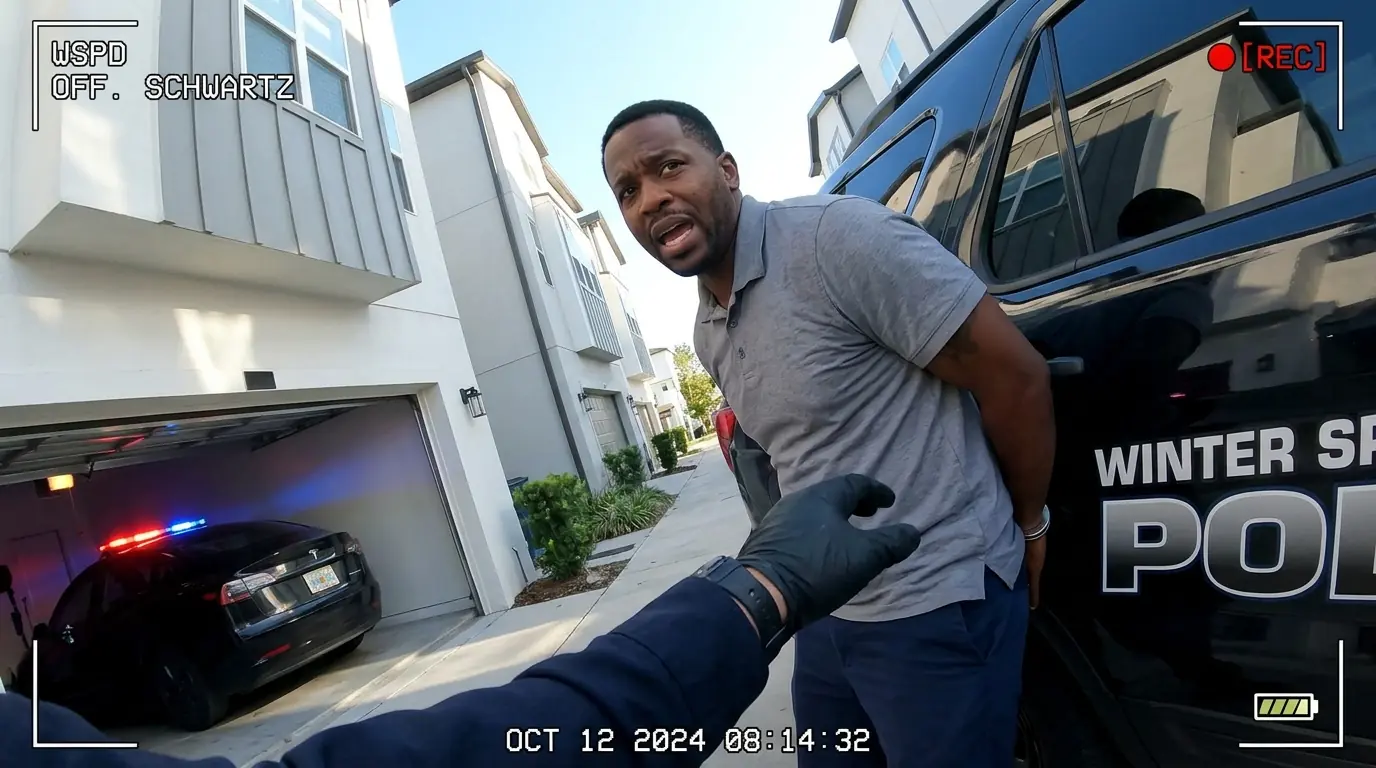
"Hands where I can see them!" the officer shouted. "Come out of the garage. Now." Andrew lifted both arms. The paper bag rattled, and he set it on the concrete when told to do so. He left his phone beside it, although his fingers resisted letting go of the one object that seemed capable of connecting him to anyone who knew his name. "What's happened?" he asked. "Is somebody hurt?" The answer was another command to turn around and walk backward toward the voice.
The officer's face was flushed and damp beneath his sunglasses. His nameplate read D. Rourke, though Andrew did not have the presence of mind to notice it until later. The officer said Andrew had fled from an attempted traffic stop, that lights and sirens had been activated, and that he had watched Andrew race through the neighborhood to escape him. Andrew tried to find a memory that corresponded to the accusation. He had driven home. He had turned into the alley and opened his own garage. He had not seen a police car behind him, had not heard sirens, and had not imagined anybody wanted him to stop.
"For what?" he said, and heard the strain in his voice. "I didn't know anyone was following me." Rourke ordered him to his knees. The driveway gravel pressed through Andrew's trousers while the officer instructed him to interlace his fingers behind his head. Somewhere above them a garage-door motor hummed as a neighbor opened another bay. Andrew thought of his children, who had climbed out of the car less than an hour earlier. On another morning, one of them might have been standing beside him when the officer drew his weapon. The thought frightened him more completely than the pistol itself.
Andrew was forty-one and had spent the morning following a routine so familiar he could have performed it half asleep. His daughter Lucy, seven, had forgotten her library book. His son Ben, four, had insisted on wearing the orange shirt with the dinosaur even though his school photograph required a plain collar. Their mother, Emily, had laughed as she put together lunches and reminded Andrew of a video meeting scheduled for nine thirty. He had dropped both children at their respective classrooms, collected breakfast from a drive-through, and started back toward the townhouse neighborhood where they had lived for eighteen months. The most serious problem on his mind was how to tell the project team that their software launch needed another week of testing.