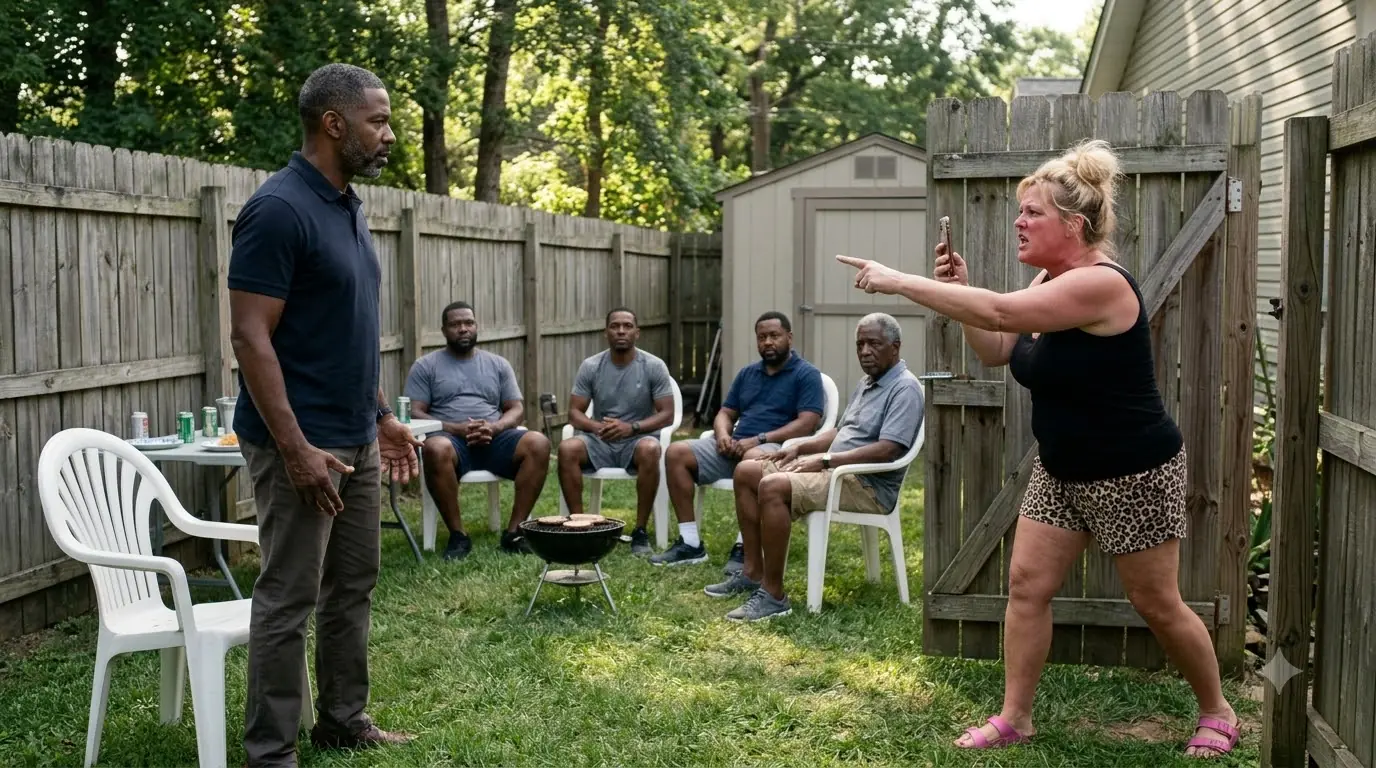
The first thing Chief Nathaniel Brooks noticed was that somebody had moved the gate latch. It was a small thing, hardly worth mentioning on a Saturday afternoon, but he had spent twenty-eight years teaching young officers that small things mattered. The latch had always settled toward the fence post with a crooked, metallic click. Now it rested against the inside rail, where someone unfamiliar with the gate had left it. He was carrying a platter of grilled corn when he saw it, and for a second he wondered whether his wife had gone into the side yard. Then a woman's voice came from beyond the fence and told five grown men that they did not belong in his neighborhood.
Nathaniel was fifty-three years old, a Black man with close-cropped silver hair, an old football injury in his right knee, and a reputation for making difficult conversations last longer than anybody wanted. He owned the brick house at the end of Briar Lane in a small Maryland city outside Baltimore. He had bought it eighteen years earlier, when his daughter was still learning to ride a bicycle and his son had been young enough to think every police car belonged to his father. The house had a narrow front porch, a garage that needed painting, and a backyard where Nathaniel could sit without anyone addressing him as Chief. On this particular afternoon, he had invited four friends over to celebrate the retirement of an old colleague and to make plans for a fishing trip they had been postponing for three years.
Captain Leon Price sat nearest the grill, broad across the shoulders, talking with his hands whenever the subject turned to college football. Lieutenant Curtis Hale occupied the chair beside him, occasionally correcting Leon's exaggerated accounts of games nobody else remembered. Detective Michael Grant, the youngest of the men at forty-four, had brought a cooler of soft drinks and smoked chicken because he knew Nathaniel's daughter disliked the smell of beer. Retired detective Harold Whitcomb sat closest to the back steps, holding a sweating bottle and watching the neighborhood's cardinals move through the old maple tree. They wore shorts, polo shirts, and comfortable shoes. Nobody wore a badge or carried an official vehicle into the yard.
Nathaniel's wife, Denise, had gone to the farmers market with their daughter, Amara, who had returned home for the weekend after beginning her second year of law school. Their son, Elliot, was working an evening shift at a community recreation center. The men were discussing whether they could persuade Harold to bring his ancient fishing boat to the Chesapeake when the stranger's voice rose over the fence. It arrived abruptly, the way a thrown stone interrupts a quiet pond.
"What are you people doing back there?" the woman demanded.
Leon turned his head. "Having a cookout, ma'am. Can we help you?"
"I asked what you're doing in this neighborhood."