The ring had been bought in London for another woman. It was a plain band of gold, a little heavy, and it lay in the palm of a man who sat alone in the best parlor of the last inn on the North Road. He was turning it over with his thumb, slowly, as though he were trying to remember what it was for. The fire beside him had burned low.
Snow ticked against the window. Somewhere below, a fiddle was playing a Christmas tune badly, and a room full of stranded travelers was singing it worse. The man did not seem to hear any of it. He only turned the ring and turned it, and watched the clock on the mantle as if it were an enemy he had agreed to meet. Ma Holmwell saw the ring before she saw the man.
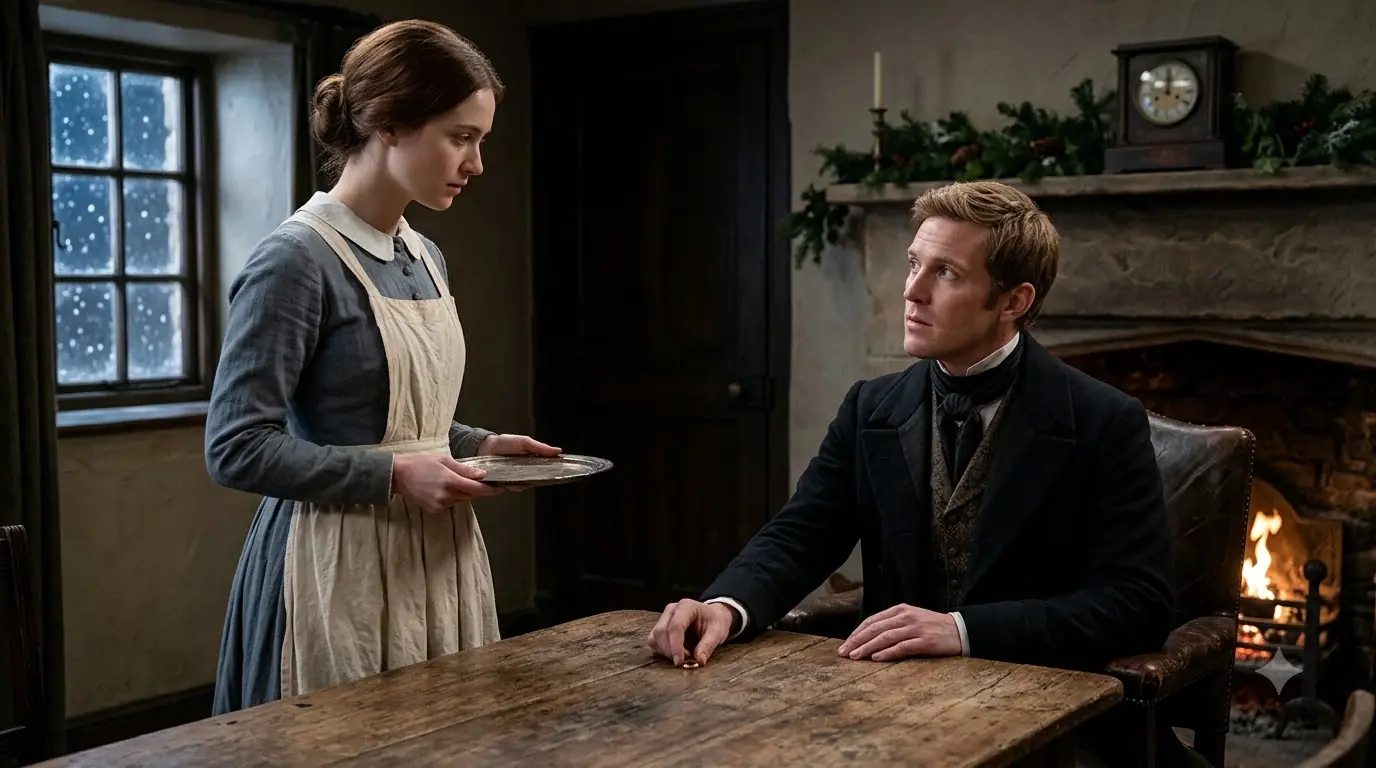
She came in with a tray of hot spiced ale held level against her hip because the stairs were crowded and the landlord was asleep in his chair by the tap room fire and somebody had to carry the trays. She had been carrying them since 4:00 in the afternoon when the snow began to fall in earnest and the coaches stopped running. By 6 every bed in the house was let. By 8 she had put two farmers in the hoft, a curate and his sister in her own small room under the roof, and a sick old gentleman in the landlord's parlor with a hot brick at his feet. Nobody had asked her to do any of it.
Nobody had thanked her either. That was the way of the house, and she had stopped expecting anything else. She set the tray down on the table by his elbow. She saw the ring in his hand, and she saw the second glass on the table, still full, the one that had been poured for the lady who had sat across from him at supper. The lady's chair was empty now.
Her cloak was gone from the hook by the door. Mour had watched her go an hour ago out into the yard in her traveling bonnet, climbing into the southbound mail without a word to anyone, while her maid ran after her with a hatbox. The whole house had seen it. The whole house was talking about it in whispers on the stairs and making guesses and enjoying itself. "Will there be anything more, sir?" she said.
She kept her eyes on the tray and not on the ring, because that was what a good servant did, and because the whole house was already staring at him enough without her. He looked up then. His eyes were very dark, nearly black in the low light, and his hair was the color of wet sand, cut short and ruffled, as if he had been pushing his hands through it. He was perhaps 30, perhaps a little more. There were no tears in his face.
There was only the look of someone who had been doing sums in his head, and getting the same answer every time. For a long moment, he did not speak. Then he closed his hand over the ring and set his closed fist on the table very gently beside the tray she had brought. You put the curate in your own room, he said. He said it quietly without reproach, his eyes still on her face, as though it were the one fact of the evening he had been waiting to check.