“We’ll take them.”
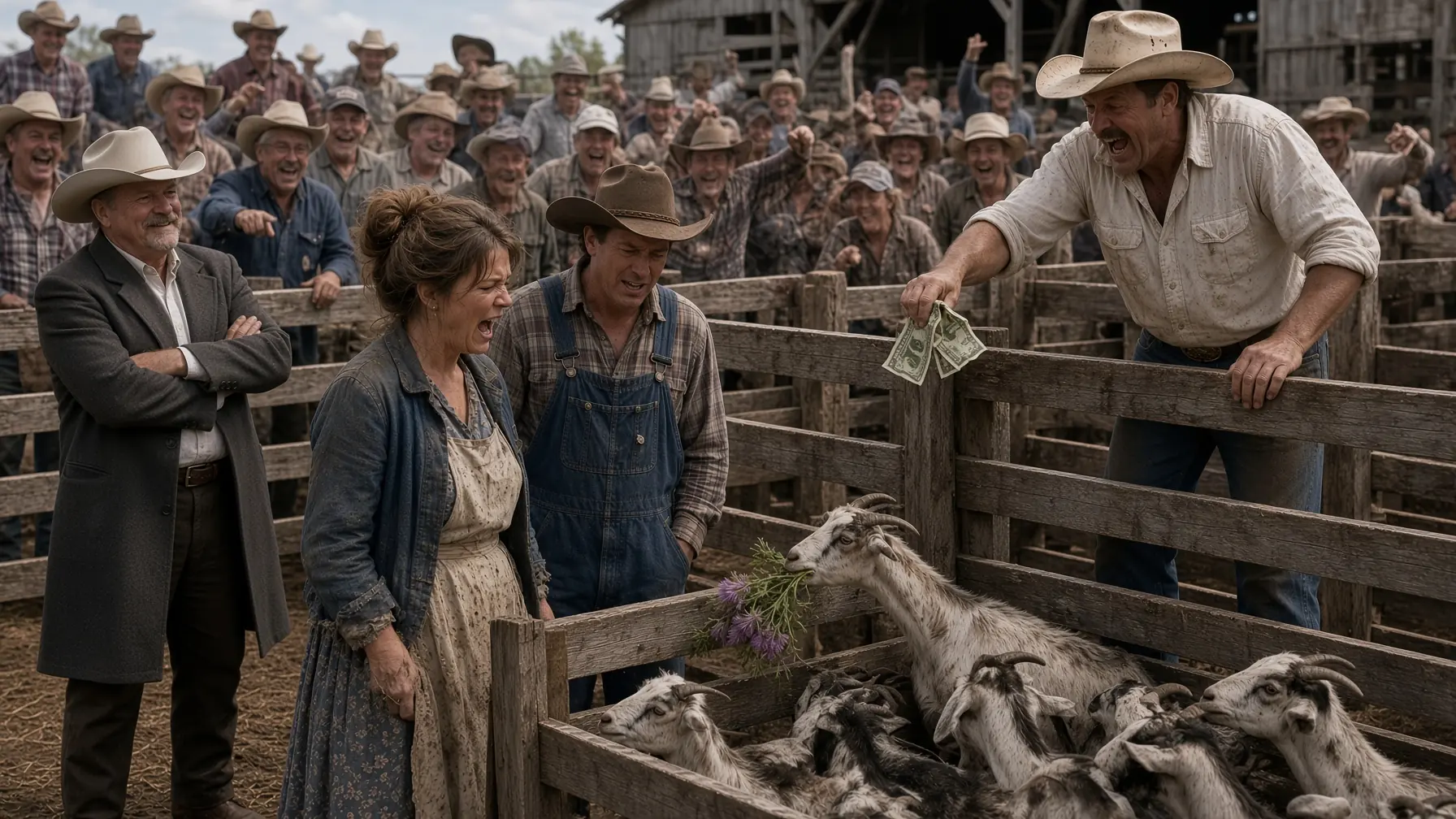
For one second, Caldwell’s stockyard became so quiet Margaret Doyle could hear one of the goats chewing.
Then the laughter exploded.
Men leaned against the auction rails and slapped each other on the shoulders. Somebody shouted that Aaron Doyle ought to start sleeping with one eye open because his wife had clearly lost whatever sense God gave her. Another man suggested Caldwell throw in the dead goat behind the rendering shed so Margaret could get the full value of her investment.
Aaron did not laugh.
He stood beside her with both hands gripping the top rail, staring at thirty-seven animals that looked as though misery itself had learned to walk. Several were missing patches of hair. One held a rear hoof off the ground. Two were so thin their ribs showed through their coats. A brown nanny with a torn ear stood apart from the others, head low, while a young black-and-white doe pushed repeatedly toward a corner where a purple thistle had grown through the fence.
The auctioneer looked down from his platform.
“Two dollars for the lot?”
Margaret nodded.
“For all thirty-seven?”
“Yes.”
The auctioneer glanced toward Aaron.
Aaron stared back with the expression of a man hoping someone would wake him.
The gavel came down.
“Sold.”
Howell Briggs laughed loudest.
He owned four hundred head of cattle, nearly eight hundred acres of bottomland and grazing slopes, and the largest hay barn in Bitter Creek Valley. Men listened when Howell talked because wealth gives ordinary opinions more weight than they deserve.
He stepped toward the Doyles.
“Margaret,” he said, “I knew you people were desperate. Didn’t realize you were this desperate.”
She looked at him.
“Howell.”
He pointed toward the goats.
“Those animals aren’t livestock. They’re liabilities.”
“One man’s liability just became my property.”
“Exactly my point.”
Aaron finally turned toward his wife.
“How are we getting them home?”
Margaret had not considered that part.
The laughter started again.
She ignored it.
“Walking.”
“Seven miles?”
“They have legs.”
“Some of them barely.”
Margaret looked toward Caldwell.
“You still have that old stock wagon?”
Caldwell hesitated.
“Axle’s bad.”
“Will it make seven miles?”
“If you go slow.”
“How much?”
He looked at the goats.
Then at Margaret.
“Bring it back tomorrow.”
Howell shook his head.
“You’re going to put thirty-seven sick goats on that hillside and expect them to save you?”
Margaret looked toward him.
“No.”
That seemed to disappoint him.
“What are you expecting?”
She watched the black-and-white nanny pull another mouthful of thistle through the fence.
“I’m expecting them to eat.”
Howell smiled.
“That’s your grand plan?”
“It’s more of a beginning.”
Aaron said nothing until the stockyard disappeared behind them.
He drove the borrowed wagon slowly, avoiding the deepest ruts. The goats shifted behind them with every turn. Margaret sat beside him with both hands folded over the two dollars she had not spent.
They had left home that morning with thirty-three dollars.
The cow Aaron wanted had sold for fifty-five.
Now they were returning with thirty-seven goats and thirty-one dollars.
For almost a mile, neither spoke.
Finally Aaron said, “I’m trying very hard not to ask what you were thinking.”
“You should ask.”
“I’m afraid of the answer.”
Margaret looked toward the hills.
“Our land won’t feed a cow.”
“We could buy hay.”
“With what?”
Aaron’s jaw tightened.
“You think these things don’t eat?”
“They don’t eat the same.”
“That is not the same as not eating.”
“No.”
She turned toward him.
“But they browse.”
Aaron looked briefly at her.
“Browse?”
“Brush. Leaves. Briars. Thistle. Woody clover. Some of the things we’ve spent three years wishing would disappear.”
“You know goats?”
“I know dairy.”
“You grew up around cows.”
“And goats.”
Aaron frowned.
“You never told me that.”
“You never asked.”
“My wife buys thirty-seven goats for two dollars and this is when I learn she knows goats?”
Margaret almost smiled.
“My aunt kept twelve.”
“Were they like these?”
“No.”
“That seems important.”
“It is.”
Aaron glanced toward the wagon again.
“How many do you think are going to live?”
Margaret did not answer immediately.
“I don’t know.”
That was the first honest answer of many.
When they reached the Doyle farm near sunset, the goats walked out of the wagon like survivors arriving somewhere they did not yet trust.
The farm was forty acres only if a person was generous enough to count every rock, slope, thicket, ravine, and strip of woodland as usable land. Aaron’s father had managed cattle there when rainfall was good and neighboring pasture could be rented cheaply, but those arrangements disappeared before Aaron inherited the place. The Doyles now kept chickens, a garden, two pigs when they could afford feed, and whatever hay they managed to cut from the least offensive pieces of ground.
The hillside behind the cabin was the valley joke.
Cattle avoided much of it.
A plow could not cross it without breaking something.
Thistle colonized every opening.
Wild mustard spread yellow across the lower slope each spring. Sumac grew along the fence. Blackberry canes tangled beneath the timber edge. Woody brush returned almost as quickly as Aaron cut it.
Margaret opened the pen.
The goats looked up.
The black-and-white nanny walked directly past the patch of grass Aaron had been trying to save and attacked a blackberry cane.
Another began stripping leaves from sumac.
The torn-eared doe found thistle.
Aaron watched.
“Well.”
Margaret folded her arms.
“Well what?”
“They’re eating.”
“I told you they would.”
“I’m withholding congratulations until morning.”
That turned out to be wise.
One goat was dead before sunrise.
Margaret found it beneath the shelter, curled against the fence.
She stood looking at the small gray body while the others moved around her.
Aaron approached quietly.
“I’m sorry.”
Margaret nodded.
She had expected losses.
Expecting them did not make finding one easier.
By the end of the first week, three more died.
The laughter from Caldwell’s auction stopped seeming distant.
Margaret separated the weakest animals, cleaned wounds, trimmed badly overgrown hooves, and treated external parasites with help from Dr. Thomas Leary, the valley veterinarian, who arrived after Aaron reluctantly agreed to spend part of their remaining money on a professional opinion.
Leary examined the herd one animal at a time.
“Where did you get these?”
“Caldwell auction.”
“How much?”
“Two dollars.”
He stopped.
“For one?”
“All.”
Leary looked toward Aaron.
Aaron said, “Please don’t.”
The veterinarian almost smiled.
“These animals have been neglected. Some are heavily parasitized. Several are underweight enough that you need to be careful feeding them back. Don’t dump grain into them because they look hungry.”
Margaret nodded.
“Good hay?”
“Small amounts. Clean water. Browse when they’re steady enough. Minerals.”
“How many milkers?”
Leary examined teeth and udders.
“Maybe eight currently lactating enough to matter. Another six or seven could freshen later if they recover and are bred properly.”
Aaron looked disappointed.
“Eight?”
Leary turned.
“You paid two dollars.”
“That keeps coming up.”
“It is statistically unusual.”
Margaret asked, “Disease?”
“Nothing obvious that makes me tell you to destroy the herd, but quarantine them from anybody else’s livestock. I’ll take samples. A few may not make it.”
He was right.
Thirty-seven became thirty-two.
Then thirty-one.
One old doe lingered for nine days before Margaret found her unable to rise. Leary came back and told her what she already knew.
They put the animal down.
Margaret cried afterward.
Aaron found her inside the barn washing the milk pail.
“We still have thirty.”
She nodded.
“That doesn’t make the seven disappear.”
“No.”
He stood behind her.
“Was this a mistake?”
Margaret stopped washing.
She considered lying.
Instead she said, “Maybe.”
Aaron leaned against the stall.
“Helpful.”
“You want me to promise thirty sick goats will save forty poor acres?”
“I’d settle for you telling me we aren’t idiots.”
Margaret looked at him.
“We might be.”
He stared.
Then laughed.
She did too.
It was the first time since the auction.
The goats recovered slowly.
By autumn, their coats improved. Hooves hardened. Several gained enough weight that their ribs no longer looked carved beneath their skin.
More importantly, the hillside changed.
The goats opened paths through brush Aaron had spent years fighting. They stripped leaves from young sumac, clipped blackberry growth, ate mustard before it seeded heavily, and attacked thistle heads with an enthusiasm no cow had ever shown.
Margaret rotated them.
Not because she had some sophisticated grazing system in the beginning.
Because she quickly learned what happened when goats stayed in one place too long.
They ate the best browse first.
Then returned to the same plants.
Then damaged them.
Then stood on bare ground demanding something better.
So Margaret began dividing the hillside with temporary fence.
A few days here.
A few there.
Move before everything disappeared.
Let vegetation recover.
Silas Pruitt’s widow noticed first.
Mrs. Pruitt lived two miles down the road with her eleven-year-old son, Nathan. Her husband had died in a logging accident the previous winter, leaving her a small cabin, one exhausted garden, and very little else.
She came to the Doyle place carrying a flour sack.
“I heard you have milk.”
“Some.”
“Goat milk?”
“Yes.”
“Does it taste terrible?”
Margaret smiled.
“Depends how clean the goat is, how clean the pail is, how fast you cool it, and whether you’ve already decided to hate it.”
Mrs. Pruitt considered that.
“Fair.”
She lowered her voice.
“Nathan’s thin.”
Margaret looked toward the boy waiting beside the gate.
He had always been small, but grief and a poor winter had made him look smaller.
“He eats?”
“When I can make him.”