The first time Judge Eleanor Price saw Police Chief Grant Halvorsen lose control, he was still wearing a smile.
It was the kind of smile powerful men learned to use when they wanted anger to look like patience. He stood behind the defense table in a dark ceremonial uniform, silver stars on his collar and enough ribbons on his chest to tell a story about thirty years of service. Six officers from his department sat behind him in the gallery, shoulder to shoulder, silent and straight-backed. At the plaintiff's table, twenty-three-year-old Malcolm Reed kept both hands folded so tightly in his lap that his knuckles had gone pale.
Judge Price had been on the bench for thirty-six years. She had watched defendants curse at her, attorneys collapse under pressure, witnesses change stories in the middle of testimony, and elected officials discover that a courtroom did not bend just because people outside it did. What she had never seen was a police chief come to a civil-rights hearing dressed like he was attending his own parade. She understood the message immediately, and she disliked it before he ever spoke.
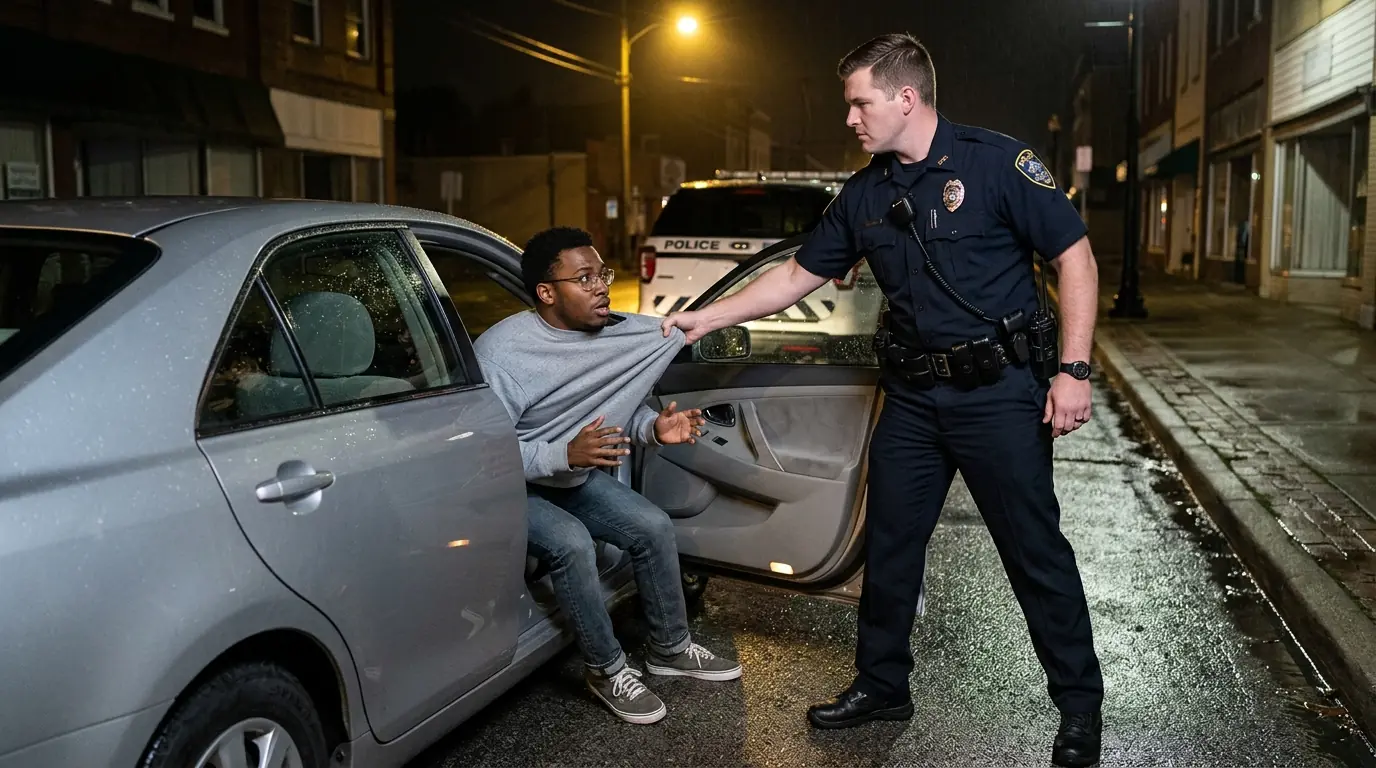
The case had begun four months earlier on a wet October night in Briar Falls, Ohio. Malcolm Reed had just left the university library after an evening accounting class and was driving a battered 2011 Toyota Camry toward the apartment he shared with his grandmother. He worked mornings at a medical supply warehouse, attended classes in the afternoon, and studied at night because that was the only schedule that allowed him to keep paying tuition without loans swallowing him alive. He was tired, hungry, and thinking about the leftover meatloaf his grandmother had promised not to finish.
At 10:08 p.m., a patrol cruiser pulled in behind him and lit the street blue and red.
Malcolm checked his speed. Thirty-four in a thirty-five. He checked the dashboard for warning lights, signaled, and pulled beneath a streetlamp beside a closed pharmacy. His grandmother, Lorraine, had spent years teaching him exactly what to do if police ever stopped him: engine off, window down, interior light on, hands high on the steering wheel, no reaching unless told. Malcolm had always thought she worried too much. That night he followed every instruction.
Officer Caleb Halvorsen approached from behind with one hand near his holster. He was thirty-one, six years into his career, broad-shouldered and neat, with the calm expression of someone who had been told most of his life that authority suited him. Malcolm recognized the last name before he recognized the face. Everyone in Briar Falls knew Chief Grant Halvorsen. His son had been featured in a department recruitment campaign the previous spring under a slogan about service running in the family.
Caleb stopped beside the window and shined his flashlight into Malcolm's eyes.
"License. Registration. Insurance."
Malcolm kept his hands visible. "Yes, sir. They're in my wallet and glove compartment. Which do you want me to reach for first?"
Caleb stared at him for half a second longer than necessary. "You always talk this much?"
"No, sir. I just don't want to reach without telling you."
"Wallet first."
Malcolm moved slowly, pulled out his license, and handed it over. Caleb studied the card, then looked past Malcolm into the car. There was a backpack on the passenger seat, two textbooks on the floor, and a warehouse jacket hanging from the rear headrest. Nothing moved. Nothing suggested danger.
"Where are you coming from?"
"Briar Falls State. Night class."
"At ten o'clock?"
"Library after class."
Caleb gave him a look that said the answer had somehow made things worse. "Open the glove box."
Malcolm did. The registration and insurance card were inside. Caleb took them and walked back to his cruiser. His dash camera recorded the entire stop from the moment the emergency lights came on.
The records check came back clean. Malcolm had no warrants, no criminal history, and only one minor speeding ticket from when he was nineteen. His insurance was valid. His registration was current. The car had never been reported stolen. There was no reason for the stop visible in the video, and later Caleb would give three different explanations for why he had initiated it.