The first thing Evan Hollowell noticed about Marjorie Sutton was that she never raised her voice when she was angry.
She did not need to.
Women like Marjorie had learned a different kind of authority. It lived in clipped smiles, neighborhood email chains, folded arms at property-line disputes, and sentences that began with “I’m only trying to help.” She chaired no official board, wore no badge, and held no elected office, yet somehow half the block behaved as if her approval mattered. Contractors answered her calls quickly. Delivery drivers knew her by name. Elderly neighbors let her organize their moving dates, estate cleanouts, and repair schedules because Marjorie was efficient, polished, and very good at making chaos feel manageable.
For nine years, Evan had thought she was simply exhausting.
Then she destroyed his paintings.
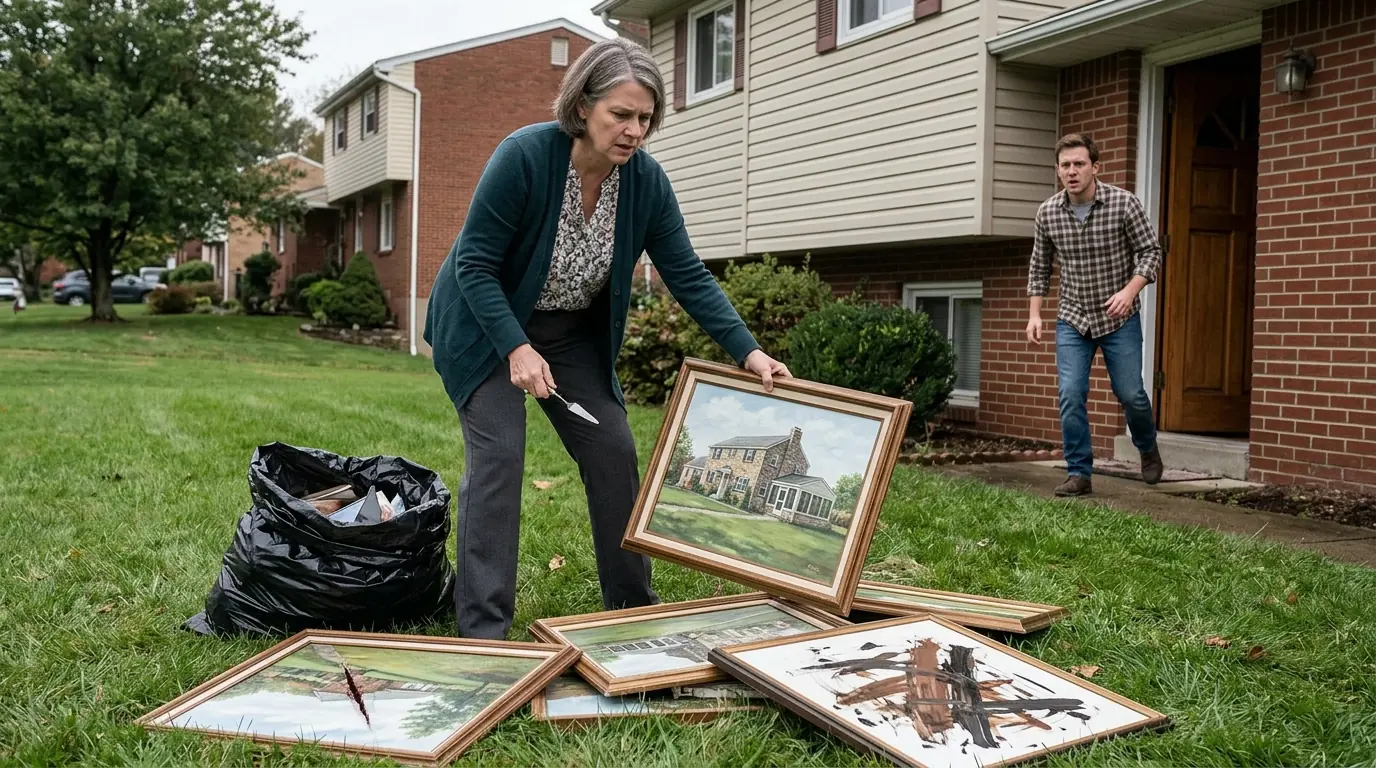
Evan was forty-three and made his living as a commercial illustrator from a converted garage behind his house in a quiet neighborhood outside Pittsburgh. Most days, he drew packaging mockups, architectural renderings, technical diagrams, and lifestyle scenes for companies that wanted every human face to look cheerful but not distract from the product. The work paid the mortgage. It also made him feel, by five in the afternoon, as though color itself had become an invoice.
So he painted for himself.
Landscapes mostly. Old houses. Riverbanks. Train bridges. Church roofs after rain. Things that did not send revision notes.
Helen Cavanaugh’s house became his favorite subject by accident.
It stood two properties behind his, beyond a narrow service alley and a line of maples that thinned in winter. Helen had lived there alone for decades in a stone house that seemed to change color with the sky. In January, it looked iron gray. In summer, it turned honey-colored at dusk. After rain, the stone took on a blue cast that Evan could never quite mix correctly no matter how many times he tried.
Helen herself had been eighty-two when she died in February. She had taught piano most of her life, outlived her husband by seventeen years, and developed the habit of appearing at Evan’s back fence every August with tomatoes he had not asked for.
“Too many again,” she would say, handing him a paper grocery bag.
“You say that every year.”
“And every year you take them.”
That was more or less the depth of their relationship.
He liked her.
He liked her house more than he felt comfortable admitting after she was gone.
The part he painted most often was the rear sunroom.
It had tall windows framed in dark green wood and a stained-glass transom above the double doors. The panel showed a tree: copper-colored branches, amber leaves, and a border of deep blue glass. When the afternoon sun hit at the right angle, colored light broke across the brick patio in fragments, the kind of thing Evan could paint twelve times and still feel he had missed.
So he painted it twelve times.
Morning fog. Spring rain. Late snow. Sunset. Daffodils under the windows. Thunderclouds over the roof. A version in almost monochrome gray except for the stained glass. Another with the blue border glowing so strongly it seemed lit from inside.
He never thought any of it mattered.
Then, one afternoon in May, Marjorie Sutton walked into his studio and stopped in front of the newest canvas.
She had come over because Evan invited her.
That was the part he would later find embarrassing.
He was preparing several paintings for a neighborhood arts festival and had told her, during a conversation about garbage pickup, that she could stop by if she wanted to see what he had been working on. Marjorie ran Sutton Home Transitions, a small estate-clearance and property-staging business. She knew furniture. Antiques. Old houses. Evan assumed she might enjoy the work.
At first, she did.
She moved through the studio with her hands folded neatly behind her back, stopping at a painting of the Monongahela, then a rain-soaked church, then a winter street scene.
“Your skies are better than your people,” she said.
“I don’t paint people unless someone pays me.”
“Probably wise.”
Then she reached the painting of Helen’s sunroom.
And froze.
Not dramatically.
No gasp.
No visible panic.
She simply stopped moving.
Her eyes fixed on the lower right corner of the canvas.
Evan waited for a comment.
None came.
After nearly ten seconds, Marjorie asked, “When did you paint this?”
“Last month.”
“What day?”
He laughed. “You’re asking an artist for accounting records?”
“Do you know?”
“Probably April eighteenth.”
Her gaze moved back to the canvas.
“Did you paint from memory?”
“Mostly reference photos.”
“What photos?”
He looked at her then.
“Photos of the house.”
“You keep them?”
“Usually.”
A beat passed.
Then she pointed toward the sunroom.
“You need to stop painting that house.”
Evan smiled because he thought she was joking.
She was not.
“Why?”
“It’s private property.”
“I paint it from public places.”
“That doesn’t make it respectful.”
“It’s a house, Marjorie.”
“It was Helen’s home.”
“I know.”
“She died recently.”
“I know.”
“Then find something else to paint.”
He folded his arms. “You really hate this one.”
“Especially that angle.”
That sentence stayed with him, though not strongly enough at first.
Especially that angle.
Marjorie’s business had been involved with Helen’s estate after her death. Helen’s only granddaughter, Maya Cavanaugh, lived in Colorado and could not immediately come east. Marjorie had helped during Helen’s final year with errands and appointments, then later helped secure the house, schedule cleaners, coordinate movers, and keep an eye on contractors.
At least, that was the version everyone on the block understood.