By eight-thirty on the second Saturday of December, the parking lot behind the VFW hall in Carver, Pennsylvania, had turned to brown slush. Snow had fallen overnight, then softened under a gray morning sky until every boot and tire carried a rim of mud.
Thirty-seven motorcycles stood in two crooked rows, most of them old Harleys with canvas bags, milk crates, or bungee-corded boxes strapped to their rear racks. In front of the line sat Dean "Bear" Sullivan's black 1978 Electra Glide, its red pinstriping dulled by road salt and winter grime, and tied to the top of its luggage was a one-eyed teddy bear that looked older than half the riders gathering around it.
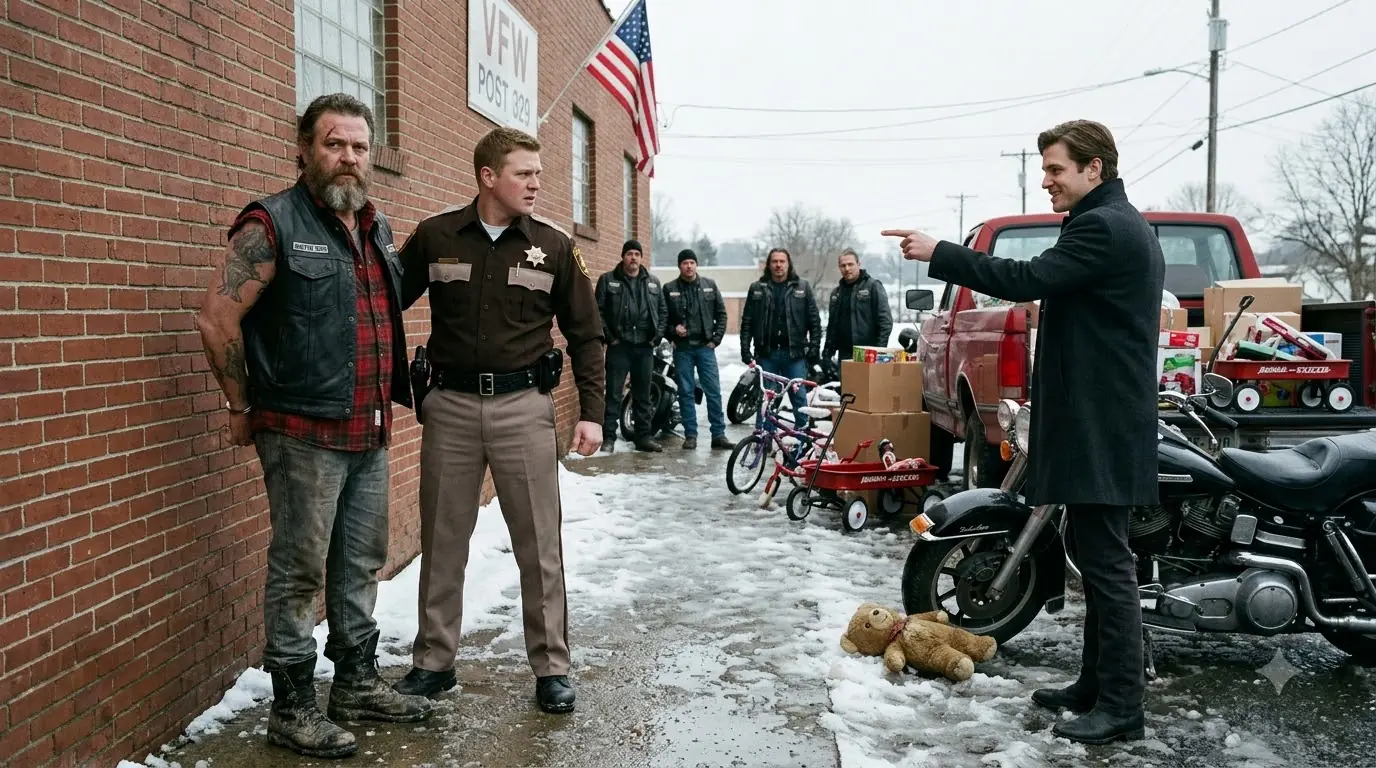
Dean was forty-eight, stocky instead of huge, with a brown beard gone silver around the chin and hands hardened by years of machine work. The scar over his left eyebrow pulled slightly when he squinted at the weather, and the tattoos on his forearms had faded into the blue-green color old ink earned honestly.
Under his brown leather jacket and black cut, a red flannel shirt showed at the collar. On the front of the vest, under his road name BEAR, a smaller patch read WINTER IRON - FOUNDING RIDER.
The Winter Iron Toy Run was not impressive by city standards. There was no corporate sponsor, no television crew, and no stage. A handwritten banner hung between two steel posts outside the VFW, and inside, volunteers were sorting dolls, toy trucks, boxed games, puzzles, bicycles, and winter coats into piles marked for hospital families, foster homes, and households the churches had quietly identified as struggling.
The riders did not care whether anyone called it impressive. For fifteen winters, they had shown up anyway.
Dean walked down the line checking straps and talking to people in short bursts. He reminded a young rider named Troy to keep the stuffed animals covered if the snow started again, helped an older woman tighten a bungee around two red wagons, then knelt beside his own Electra Glide to check the front tire.
Before standing, he brushed two fingers over the teddy bear tied behind the windshield. The bear's left eye had been hand-sewn years earlier with brown thread, and the faded blue ribbon around its neck had once belonged to his daughter Emily.
Emily had been nine when leukemia finished what two years of hospitals, needles, and bad news had begun. She had spent three Christmases in and out of pediatric wards, and the teddy bear had been on every bed, every ambulance ride, every overnight stay.
After she died, Dean could not bring himself to box it away with the clothes his wife eventually donated. Instead, the bear began riding at the front of the toy run each December, never given away, never explained unless someone asked with enough respect to deserve the answer.
At nine-fifteen, a new red pickup rolled too fast around the courthouse corner and splashed muddy water over the curb. The truck stopped at an angle across the unloading lane in front of the VFW, blocking two riders carrying boxes inside. The driver was Rick Danner, twenty-seven, clean-shaven, broad through the shoulders, and dressed in a wool coat that looked too expensive for the weather. Three friends climbed out with him, laughing before anything had happened.
Rick was the mayor's son, which in Carver meant something because Mayor Thomas Danner had held office for eleven years and had spent the last two trying to convince a regional development group that downtown could support an upscale shopping complex. The proposed renderings showed clean brick storefronts, decorative streetlights, planters, and almost no motorcycles.
Rick had absorbed his father's anxiety about appearances without absorbing any of the caution that politics usually taught. To him, the Winter Iron riders were not residents doing charity work. They were noise, leather, exhaust, and the wrong image for a town trying to look expensive.
He got out of the pickup and looked at the motorcycles as though they had been dumped there overnight. "Town finally running a charity for criminals?" he called.
Dean, who was lifting a box of toy trucks from a sidecar, did not look up. "Kids."
Rick frowned. "What?"
"Charity's for kids." Dean handed the box to a VFW volunteer. "Move the truck. You're blocking unloading."
Rick glanced back at the pickup, then at his friends. "Make me."
A few riders stopped what they were doing. No one moved toward him. Dean had spent enough years around men who wanted to start trouble to know the first useful thing was not to give them an audience they could control. He straightened, wiped his hands on his jeans, and said, "We're trying to leave by ten. Park it somewhere else."
Rick stepped closer to the Electra Glide. "Bikers buying toys. That's adorable." He picked up a boxed plastic fire truck from a pile and turned it over. "What is this supposed to do, clean up the image?"
"No," Dean said. "It's supposed to make a six-year-old happy."
"Same thing, probably." Rick tossed the box back onto the pile hard enough to dent a corner. His friends laughed, but the laugh was thinner this time.
The permit dispute had begun three weeks earlier. Mayor Danner's office had informed the VFW that the toy run's route through Main Street might conflict with "seasonal commercial traffic management." The wording had made Dean laugh. The riders had been using the same route for years under an old recurring permit that the borough solicitor ultimately confirmed was still valid. Rick had taken the reversal personally, as though thirty-seven motorcycles had defeated his family in court.