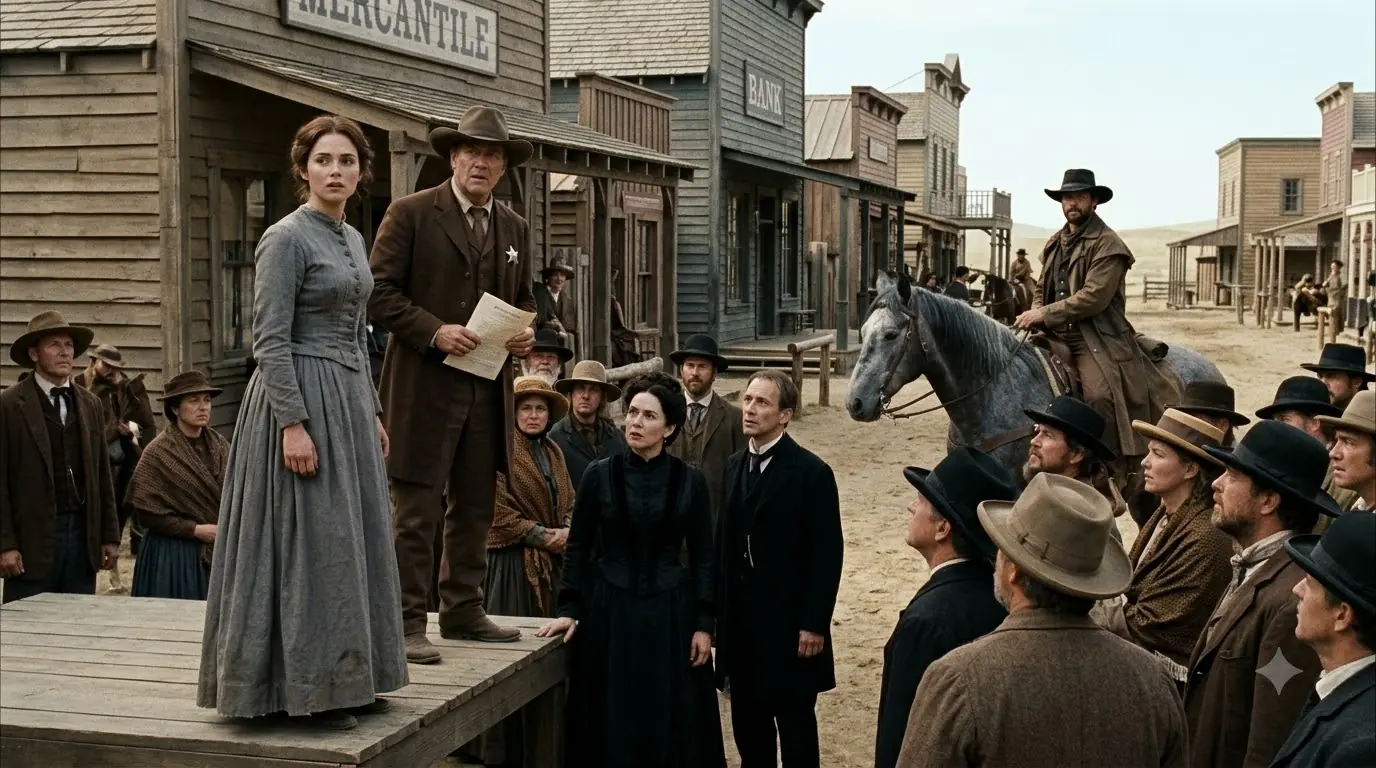
Clara Whitfield pressed her father's cold hand to her cheek one last time and swore she would never let them take what he'd built. Then the sheriff nailed an eviction notice to the coffin lid before the grave was even filled. 3 days later, her own stepmother stood her on an auction block in the town square and sold her like livestock to pay a debt she never made. Nobody moved to stop it. The dirt hadn't even settled over Henry Whitfield's grave when Marshall Owen Briggs came walking up the hill with a hammer in one hand and a folded paper in the other.
Clara was still kneeling in the mud. She heard his boots before she saw him. That heavy uneven crunch of a man who took his time because time was always on his side. Miss Whitfield. Briggs tipped his hat like he'd come to pay respects.
Sorry to do this here. Then don't. Ain't up to me. He crouched beside the fresh mound and laid the paper flat against the coffin's exposed edge where the gravediggers hadn't yet finished. Then he raised that hammer.
What are you doing? Clara was on her feet now. That's my father lying there. I know whose grave it is. He drove the first nail.
The sound cracked across the churchyard like a rifle shot and three or four towns folk who'd come to mourn flinched and looked away. Notice of eviction. Whitfield Ranch, all outbuildings, all stock, all acreage north of the creek. You got till Friday to vacate the property. Vacate.
The word wouldn't fit in her mouth. It's my home. My father owned that land free and clear. He owned it 30 years. He owed the Asheford Land and Cattle Bank $6,000.
Briggs drove the second nail. That's the long and short of it, ma'am. He never borrowed a dime from that bank in his life. He hated Silas Granger. He'd have burned the ranch before he'd take that man's money.
Well, Briggs stood, dusted his knees, and settled his hat. Papers say different, and papers is what a court looks at, not what a dead man hated. He touched the brim again, almost gentle. Friday, Miss Whitfield, I truly am sorry. He walked back down the hill, and Clara stood over her father's grave with a nail-studded lie fixed to his coffin lid.
And for the first time in her 24 years, she understood that grief was a luxury she was not going to be allowed. Evelyn Harper was waiting on the porch when Clara rode back to the ranch that evening, and she was already dressed in black. " You've been gone all day," Evelyn said. " People will talk. A grieving widow's daughter out riding while the household falls apart." "
You're not a widow," Clara swung down from the saddle. " You were married to my father 11 months. You barely knew him. I knew him well enough to know he'd want us to handle this with dignity. Evelyn's voice never rose.