The first time Grant Whitfield discovered his wife beneath a wagon, he had been married to her for six hours and had already begun to suspect that the arrangement would be more expensive than either of them anticipated. Not expensive in dollars. Those were accounted for in the contract locked in his study. He meant the other costs: a husband's comfortable expectations, a household's habits, and the quiet that had settled over Whitfield Ranch so completely that Grant sometimes forgot quiet could be another word for loneliness.
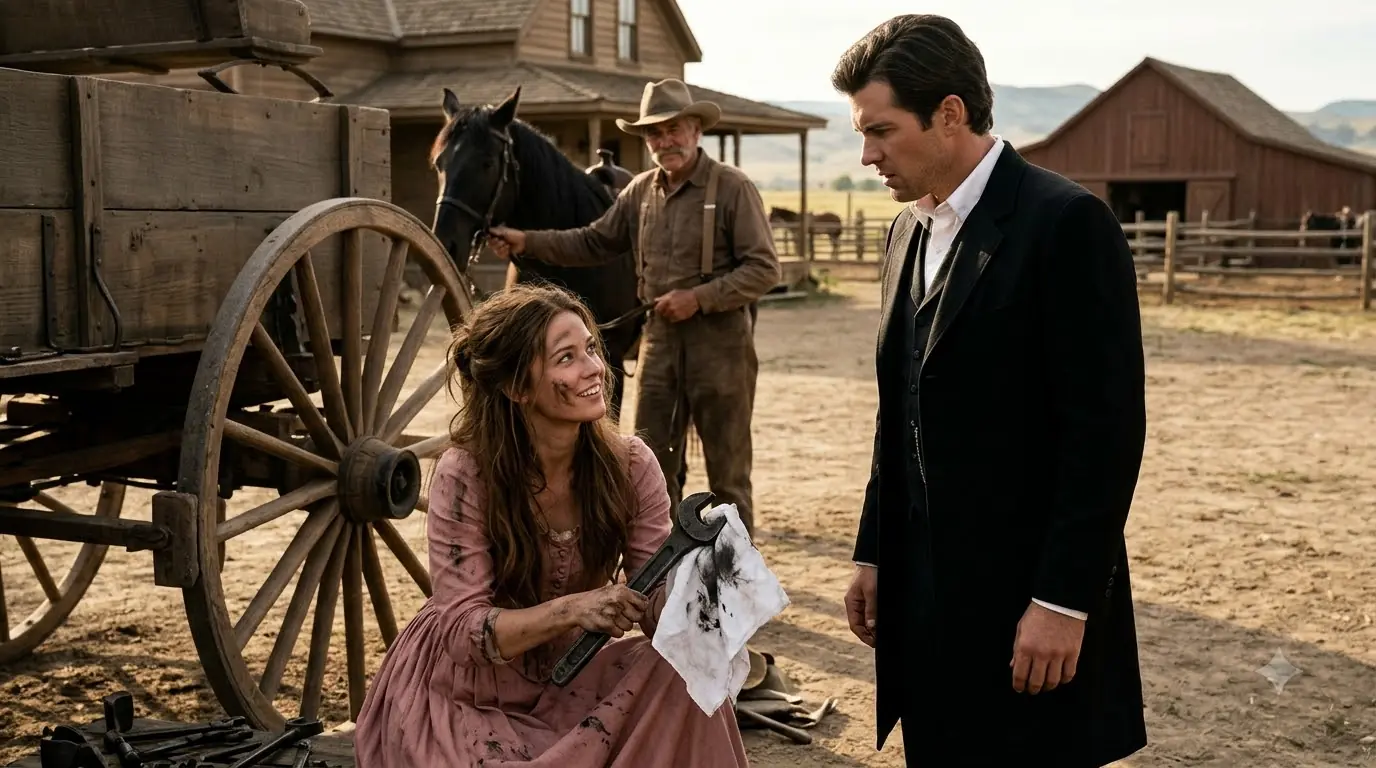
He had returned from inspecting the south pasture to find the yard empty except for his foreman, Amos Pike, standing beside a patient bay gelding. The July sun was white and unforgiving, flattening the Wyoming hills beyond the fences. Grant took one look at the farmhouse, one at the barn, and said, "Where is Mrs. Whitfield?" Amos moved a piece of straw from one corner of his mouth to the other. "Under the freight wagon, boss." Grant's first thought was that the man had finally lost whatever judgment he had preserved through thirty years of cattle winters.
"Under the wagon?" Grant repeated. "Yes, sir. Has been for close to twenty minutes." A metallic crack answered from across the yard, followed by the unmistakable voice of a woman scolding something that could not possibly understand her. Grant handed over the reins and walked toward the sound. Two small brown boots protruded beneath the wagon bed, kicking impatiently at the dirt. The woman attached to them was apparently arguing with an axle. "I will not be defeated by a piece of pigheaded iron," she informed it.
Grant cleared his throat. The boots stopped. His new wife rolled out on her back, a wrench held triumphantly above her head. Harriet Bell had married him in a small church in Cheyenne that morning wearing a rose-colored dress and an expression suggesting she had privately found the whole occasion rather entertaining. Now the dress bore grease marks from hem to waist, half her chestnut hair had escaped its pins, and a black streak curved across one cheek. She blinked up into the sunlight, noticed Grant, and smiled. "Oh, good. You must be my husband."
"You are underneath my wagon," he said. Harriet looked toward the underside, as though the location had been news to her. "An accurate observation." "Why?" "Because the left wheel was loose." "The left wheel was not loose." She sat up and brushed dirt from her elbow. "It isn't anymore, so perhaps we're both right." Behind them Amos made a sound that could have been either a cough or a laugh. Grant chose not to ask.
Harriet climbed to her feet and approached him with the wrench still in hand. She saw the white handkerchief tucked into his breast pocket, borrowed it before he thought to object, and rubbed the wrench until the bright metal disappeared under a smear of black. Grant watched the pristine linen turn the color of a wagon hub. Harriet followed his gaze and winced. "Ah. That was yours." "Indeed." "I shall have it washed." "I believe you have introduced substances that soap may never forgive." The foreman turned away, shoulders shaking.