The saloon doors crashed open so violently that the piano stopped in the middle of a note, leaving one thin chord trembling beneath the sudden howl of mountain wind. A towering man wrapped in weather-scarred wolf skins filled the doorway, a Winchester hanging from one shoulder and two hunting knives riding low against his hips, while melting snow darkened the floor around his enormous boots. In one dirt-stained hand he held half a slice of sourdough bread, and when he lifted it above the nearest card table his gray eyes looked almost wild. “WHO BAKED THIS BREAD?” Grayson Cade roared, and every person inside Caldwell’s Saloon became convinced somebody was about to die.
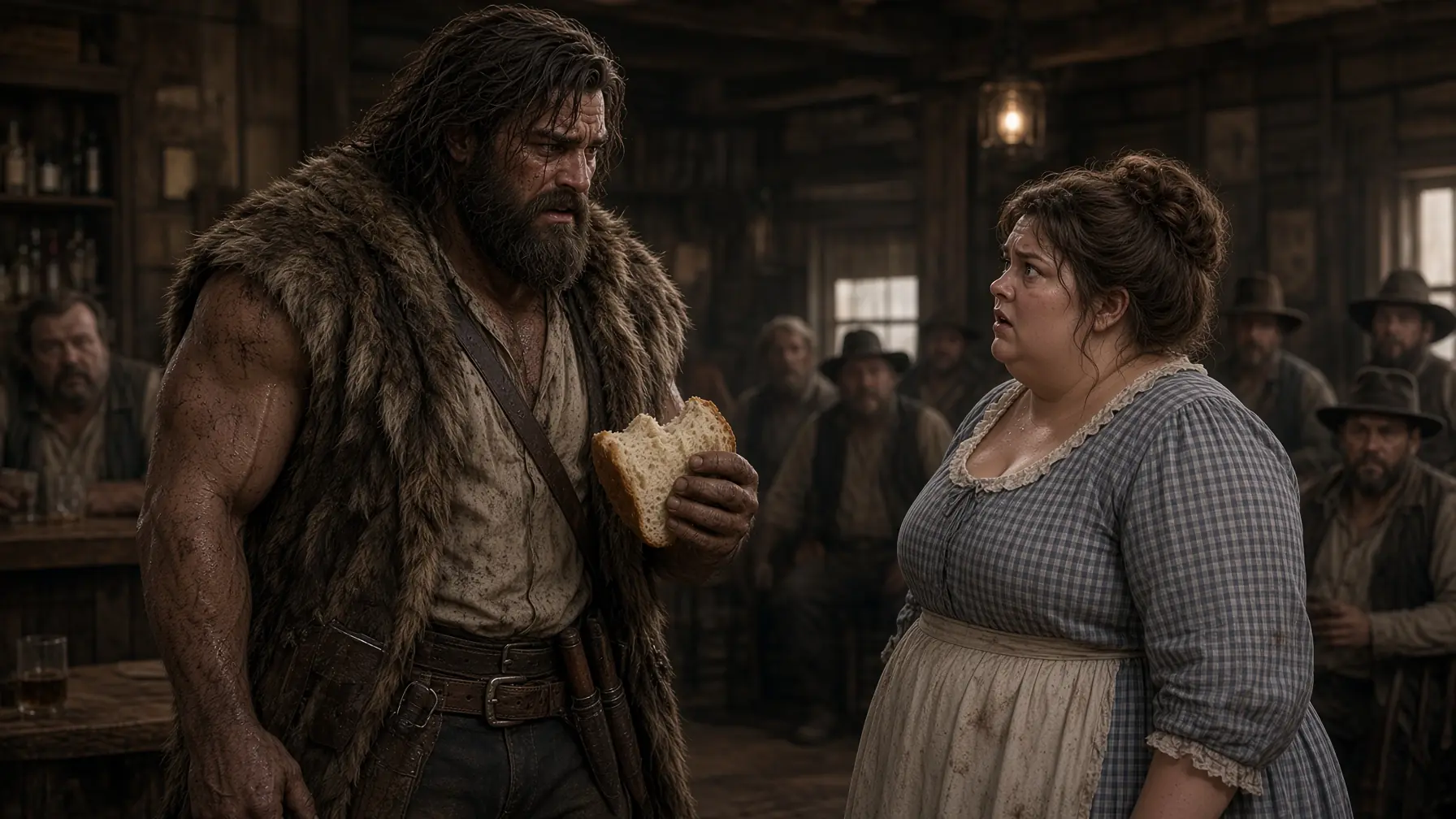
In the kitchen behind the bar, Henrietta Coulter closed her eyes and gripped the edge of the flour table until her knuckles whitened. Everyone in Silver Plume called her Hattie unless they were angry, cruel, or trying to remind her that nobody had ever cared enough to shorten her name affectionately before she came west. Her faded gingham dress stretched across her broad waist and heavy hips, flour streaked both sleeves, and sweat clung beneath strands of brown hair that had escaped the loose knot at the back of her neck. When Grayson demanded the baker’s name a second time, Hattie silently prayed that every man in the saloon had suddenly forgotten where bread came from.
Silver Plume in 1882 had been built against mountains that seemed offended by human ambition. Mines punched black openings into the slopes, ore carts screamed along narrow tracks, dynamite rolled through valleys like distant thunder, and fine mineral dust settled on windowsills, hats, lungs, and every loaf Hattie forgot to cover before cooling. Men came believing a silver claim might make them rich and stayed because leaving after failure required money too. The town had produced churches, hotels, laundries, gambling rooms, families, graves, and enough cruelty to convince Hattie that civilization did not always follow buildings.
She had arrived two years earlier with a carpetbag, twelve dollars, and a jar of sourdough starter wrapped inside three layers of wool. The starter was almost fifty years old and had belonged first to her grandmother Abigail Coulter, who called it Bessie because she believed anything that needed feeding deserved a proper name. Abigail had carried Bessie across three states, divided it for neighbors after fires and floods, revived it after one near-fatal summer of neglect, and taught Hattie that a living starter rewarded patience more reliably than most people did. By the time Hattie reached Colorado, Bessie was the closest thing she possessed to inheritance.
Jebidiah Caldwell employed Hattie because she accepted wages lower than any cook he had interviewed. He owned the boarding house attached to the saloon, rented narrow rooms to miners and salesmen, served meals to anyone who could pay, and considered every penny spent on employees a personal insult. Hattie cooked breakfast before dawn, prepared dinner, scrubbed the kitchen, kept pantry inventories, mended table linens, washed pots, baked bread, and occasionally balanced Caldwell’s supply accounts when he became too drunk to remember which invoices he had already paid. For all of that, she received twelve dollars a month, a cot-sized room beneath the back stairs, and constant reminders that she should feel fortunate.
Caldwell’s cruelty rarely required imagination. He called her heavy-footed when floorboards creaked beneath any person, asked whether flour disappeared into the bread or into Hattie, and once told a table of miners that feeding her probably cost more than heating the saloon through February. The parlor girls upstairs learned quickly that laughing with Caldwell made their own lives easier, so two of them sometimes giggled when Hattie crossed the room carrying trays. Hattie answered almost nothing because unemployment in winter frightened her more than humiliation. Every insult went into dough where her hands could press, fold, turn, and transform it into something useful.
That afternoon Caldwell had leaned through the kitchen doorway while Hattie shaped four sourdough loaves. “You burning my roast again, you heavy-footed cow?” he asked even though the beef was not yet inside the oven, and when Hattie ignored him he added, “Don’t waddle into the dining room tonight because I’ve got paying customers who came here to eat, not lose their appetite.” Hattie’s face burned, but she brushed flour from her palms and checked the loaf nearest the stove. “The bread will be ready at six,” she said, giving him the only answer his business required.
Those loaves were better than usual because Hattie had managed to obtain darker mountain honey from a beekeeper passing through town. She had also allowed Bessie to ferment longer in the cool pantry, added a small amount of rye flour, and scored each loaf with three diagonal slashes exactly as Abigail had taught her. The result emerged from the oven with a dark-gold crust, open crumb, gentle tang, and faint sweetness that Hattie could identify with her eyes closed. She brushed the tops lightly with water, listened to the crust crackle as the loaves cooled, and felt for one moment as though her grandmother stood beside her.
The serving girl, Nellie Ortega, carried two baskets into the saloon. Nellie was nineteen, sharp-eyed, quick with arithmetic, and saving every spare coin because she wanted to open a dressmaking shop with her married sister in Denver. She tore one heel from the warmest loaf before leaving the kitchen, stuffed it into her mouth, and whispered, “If Caldwell had any sense, he’d charge for this instead of the whiskey.” Hattie smiled and told her not to let Caldwell hear an idea that profitable.
Grayson Cade happened to enter five minutes later. Nobody in Silver Plume knew precisely where he lived because Grayson owned a timber claim, several trap lines, and a remote cabin somewhere above Clear Creek, and he spent enough time moving between mountain camps that people turned absence into myth. Rumors said he had killed three men with his bare hands, survived an avalanche by digging himself out with a knife, fought a grizzly using only an axe, and once carried an injured mule almost half a mile. Grayson denied nothing because he disliked conversation more than exaggeration.
What people actually knew was simpler. He stood six feet four inches tall, weighed well over two hundred pounds, could lift loads that required two ordinary men, and had a jagged scar cutting from his left eyebrow toward the temple. He trapped during winter, guided prospectors when he trusted them, supplied timber to several mining operations, and brought meat into town often enough that Caldwell always poured whiskey before Grayson ordered it. He came down from the mountains only when work, supplies, or loneliness became stronger than his preference for silence.
On that particular evening, Grayson had been awake nearly thirty hours after helping two injured miners down from a collapsed trail. He sat alone in his usual corner, ordered stew he barely touched, and accepted bread without looking because bread was simply what accompanied food. Then he bit through Hattie’s dark crust. Every muscle in his body stopped.
The taste did not merely remind Grayson of childhood. It carried him there with such violence that for one breath the saloon disappeared and he was seven years old again, sitting at a narrow pine table while snow struck the windows of a Wyoming cabin and his mother placed warm bread beneath his nose. The same sourness, the same hint of honey, the same rye beneath wheat, even the shape of the holes inside the crumb returned with impossible precision. Grayson stared at the slice until his hand began trembling.
His mother, Ruth Cade, had died sixteen years earlier. The cabin where he grew up burned the following spring after lightning struck the roof, destroying furniture, letters, blankets, tools, and the clay crock containing the sourdough starter Ruth had fed for most of Grayson’s childhood. He remembered carrying charred boards away from the ruins and finding pieces of the crock beneath ashes while his father stood several yards away refusing to speak. After that fire, Grayson had never tasted bread like Ruth’s again.
He took another bite to be certain. Memory returned even harder. Ruth humming beside the stove, flour on her cheek, his little sister laughing before fever took her at four, his father coming through a door with snow across his beard, and a warm loaf cooling beside a blue crock all existed again inside a mouthful of bread. Grayson stood so quickly his chair scraped backward.
That was when he crossed the room, threw open the doors to search for whoever might have carried the loaf from another town, and roared the question that terrified everybody. He did not realize how he sounded until the room went completely silent. The fear around him registered only after Caldwell emerged looking pale enough to match the flour Hattie had spilled earlier. Grayson was too deep inside memory to soften his voice.
“If the bread is bad, Mr. Cade, I’ll replace it,” Caldwell said, attempting a nervous laugh while keeping the bar between them. Grayson stared at him. “I didn’t ask if it was rotten, you pathetic worm, so tell me who baked it.”
Caldwell’s eyes flicked toward the kitchen. “My kitchen made it.”
“Your kitchen has hands?”
A miner near the wall coughed to hide laughter. Caldwell swallowed.
“I employ people.”
“Which one?”
In the kitchen, Hattie felt cold despite the oven. She knew angry men, not through colorful frontier stories but through childhood experience, and the distinction mattered because real anger rarely announced how far it intended to go. When she was twelve, her father threw a cast-iron pan after she burned stew, missing her head by inches and breaking the pantry door instead. The following morning he apologized with tears, then hit her again six weeks later over a misplaced harness buckle.
Hattie’s mother stayed until illness killed her because leaving with three children and no money seemed more dangerous than remaining. Abigail Coulter, Hattie’s grandmother, had taught her granddaughter privately that fear inside a house changed what people believed was possible outside it. Hattie left home at eighteen, worked wherever food and wages were offered, and promised herself she would never again stand silently while an angry man decided whether she was allowed to exist. Yet promises made far from danger became much harder when a giant stranger carrying knives demanded her name.
She could escape through the back door. The alley led toward the laundry, then to a narrow road where another boarding house might perhaps let her sleep on a kitchen floor. But Caldwell would withhold the month’s wages he already owed, her room contained everything she owned, and Bessie’s crock sat inside a wooden box beneath her bed. More importantly, the bread was good.
That last thought ignited something stubborn. Hattie looked at the four remaining slices on the kitchen board and whispered, “No.” She straightened the apron over her body.
“Nobody gets to make me ashamed of good bread,” she told herself. Nellie stared at her.
“You’re going out there?”
“Yes.”
“He looks like he eats people.”
“Then Caldwell should fear for his business.”
Nellie almost laughed, which gave Hattie enough courage to push through the swinging doors.
Every face turned toward her. Hattie felt the attention land first on her flour-streaked dress, then her broad body, then her face, and she heard one man whisper something before another elbowed him silent. Grayson’s gray eyes locked onto hers with such intensity that her legs nearly stopped. She forced them forward anyway.
“I did,” Hattie said. Her voice trembled once, so she swallowed and tried again. “I baked the bread, sir.”
Grayson started walking toward her. Men moved out of his path, Caldwell ducked farther behind the bar, and every heavy footstep struck the wooden floor with the slow finality of a hammer. Hattie remained where she stood even when Grayson stopped two feet away and blocked enough lamplight to cast her almost entirely in shadow. The half-eaten bread remained between two enormous fingers.
“Look at me,” he said.
Hattie had closed her eyes without realizing it. She opened them slowly, bracing for fury. Instead she saw tears.
Grayson’s jaw trembled. Moisture shone along the lower rims of eyes people in Silver Plume described as cold enough to freeze water. He lifted the slice slightly.
“Where did you learn this?” he asked.
Hattie blinked. “Learn what?”
“This bread.”
“My grandmother.”
“What was her name?”
The room disappeared for Hattie now too. “Abigail Coulter.”
Grayson inhaled sharply.
A tin cup fell somewhere near the card tables.
“Abigail May Coulter?” he asked.
Hattie stared. “Yes.”
Grayson sat down abruptly in the nearest chair as though his legs had stopped supporting him.
Caldwell slowly rose from behind the bar. “You know her grandmother?”
Grayson ignored him.
He looked at Hattie with an expression so unguarded that she forgot to be afraid. “My mother’s name was Ruth Bennett before she married my father.”
Hattie searched memory.
Nothing came.
Grayson continued. “She was fourteen when her parents died outside Independence, Missouri.”
Hattie’s heartbeat quickened.
“My grandmother lived outside Independence when she was young.”
“I know.”
Hattie stared.
Grayson looked at the bread.
“My mother used to tell me about a woman named Abigail Coulter who took her in during the winter after the fever killed her family.”
The room became silent again, but this time nobody feared violence. Grayson’s voice dropped until people strained to hear.
“She said Abigail gave her work, taught her bookkeeping, taught her to sew, and taught her to keep a starter alive because bread meant you could begin again with almost nothing.”
Hattie covered her mouth.
She knew the story.
Abigail had told it countless times without giving the girl’s married name. A fourteen-year-old orphan named Ruth Bennett had arrived at the Coulter farmhouse carrying her mother’s Bible and nothing else, and Abigail kept her for almost two years before Ruth married a teamster heading west. Abigail divided Bessie before the wedding and sent half in a crock wrapped with wool.
“My grandmother called her Ruthie,” Hattie whispered.
Grayson closed his eyes.
“My mother hated being called Ruthie.”
Hattie laughed before she could stop herself.
Grayson laughed too, one broken sound caught between grief and disbelief.
Every person in Caldwell’s Saloon seemed to exhale at once.
Hattie pulled out the chair opposite Grayson because suddenly remaining standing felt foolish. “Grandmother always said Ruthie threatened to throw the starter into a creek because feeding it every day was another chore.” Grayson wiped one eye with the back of his hand and nodded.
“She complained about feeding it until the day she died.”
Hattie smiled.
“She kept it though.”
“For twenty years.”
Caldwell emerged fully now that death seemed unlikely. “Well, isn’t this remarkable,” he said, wearing the oily smile Hattie had seen whenever he sensed money.
Grayson looked toward him.
The smile vanished.
“Bring her coffee.”
Caldwell pointed at Hattie. “She works here.”
“I know.”
“She can get her own.”
Grayson stood.
Caldwell immediately reached for a cup.
Hattie almost told Grayson she did not need defending, but the absurdity of Caldwell becoming polite because one customer stood up was too revealing to interrupt. Grayson sat again once the coffee arrived. Hattie wrapped her hands around the cup and watched him examine the bread.
“Your starter survived?” he asked.
“Yes.”
“Same one?”
“Same line.”
“Can I see it?”
Hattie hesitated. Bessie had been stolen once by a boarding-house cook who thought an old starter possessed magical value, and Hattie spent two days recovering the crock from a pantry where the woman abandoned it after discovering sourdough still required labor. She guarded the starter with the irrational protectiveness of someone whose family history could be held in both hands. Grayson noticed.
“Never mind,” he said immediately.
Hattie studied him.
“You can see it tomorrow.”
He looked surprised.
“Why tomorrow?”
“Because tonight I’m still deciding whether you shout too much.”
Several men laughed.
Grayson looked around.
“Apparently.”
Caldwell inserted himself again. “Now, Cade, if you like my cook’s bread that much, I can send four loaves up the mountain every week.”
Hattie looked toward him.
“My bread.”
Caldwell’s eyes narrowed.
“You bake it in my kitchen.”
“With my starter.”
“My flour.”
“I’m paid to bake meals, not give you ownership of a family recipe.”
A few miners looked down at their tables.
Caldwell smiled dangerously. “You’re paid whatever I say you’re paid.”
Grayson started to stand.
Hattie held up one hand.
He stopped.
The gesture surprised everyone, including Hattie.
She faced Caldwell.
“You owe me twenty-four dollars.”
Caldwell laughed. “I owe you nothing until month’s end.”
“You withheld half of last month claiming the pantry shortage came from waste.”
“It did.”
“I have the inventory.”
Caldwell’s face changed.
Hattie had begun keeping private copies after noticing food purchases did not match the shortages Caldwell blamed on employees. She had not planned a confrontation tonight, but Grayson’s bread question had pulled everything into a room full of witnesses. “The shortage was whiskey and coffee charged to the kitchen ledger after you took them for private card games.”
Caldwell stepped forward. “Watch yourself.”
Hattie’s stomach tightened.
She kept going.
“You also owe Nellie six dollars from extra shifts during the assay conference.”
Nellie appeared in the kitchen doorway.
Caldwell looked furious.
Grayson said quietly, “Sounds like you need better books.”
“I don’t need you in my business.”
“No.”
Grayson lifted the bread.
“You need her.”
Laughter spread cautiously.
Caldwell slammed one palm onto the bar.
“You’re finished after tonight, Hattie.”
There it was.
The consequence she had feared.
Her room, income, kitchen, and survival disappeared inside one sentence.
Hattie felt herself become strangely calm.
“Then pay what you owe me.”
Caldwell smiled.
“Get it from your mountain friend.”
Grayson rose.
Hattie turned toward him sharply.
“No.”
He stopped.
“This is mine.”
His jaw tightened.
Then he sat.
Hattie looked back at Caldwell. “I will collect my things.”
“You leave Bessie.”
The entire room seemed to understand that he had just crossed into something different.
Hattie’s face went cold.
“No.”
“You made it here using my flour.”
“The starter arrived in Colorado before I did.”
“Anything in my kitchen belongs to the house.”
Grayson’s chair creaked beneath his hand.
Hattie pointed toward the miners.
“Then their coats belong to you while they drink?”
Someone laughed.
Caldwell’s face reddened.
Hattie continued. “Nellie’s shoes? The piano player’s watch? Every tool a traveling carpenter carries through your door?”
“Don’t get clever.”