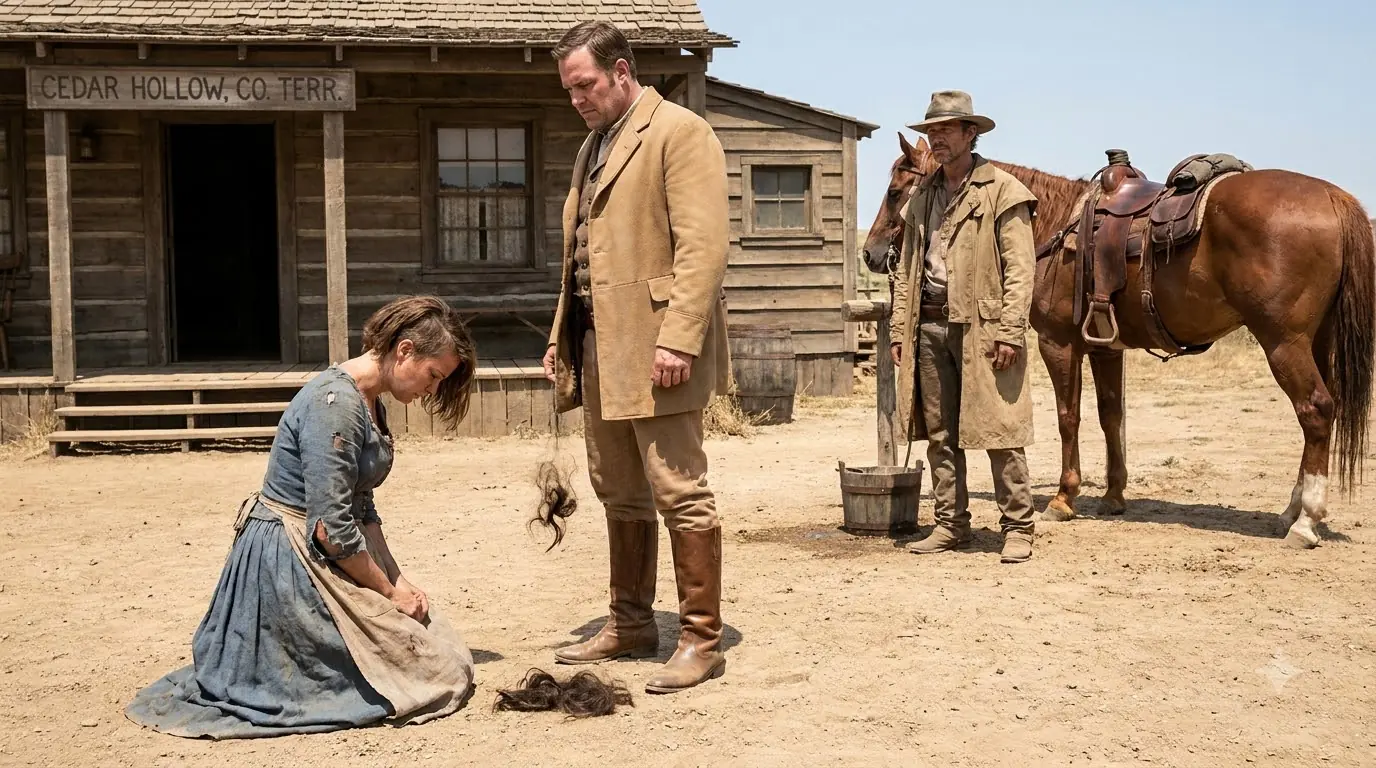
Your daddy's got till Friday to sign. Next time it won't be your hair I take. You'll want to remember exactly what you just did. It's the last thing you do you get to feel good about. Wade Garrick held up a fistful of dark hair like a trophy, letting it fall from his fingers into the dust.
And the young woman kneeling in front of him didn't make a sound anymore. She just stared at the ground, her scalp raw in patches, her hands shaking in her lap. Your daddy's got till Friday to sign, Henry. Next time it won't be her hair I take. From the edge of the yard, a stranger set down the water bucket he'd been carrying and didn't raise his voice at all.
You'll want to remember exactly what you just did. It's the last thing you ever do that you get to feel good about. Garrick laughed, the kind of laugh a man gives when he has never once paid for anything he's taken. Within 5 days, he would understand precisely how wrong that laugh was, and so would every rancher in the valley who'd ever signed a paper out of fear rather than choice. But to understand why a barn full of hair became the end of Wade Garrick's cattle empire, you have to go back 3 years to the spring he decided that Cedar Hollow's water belonged to whoever was willing to be cruelest to keep it.
Cedar Hollow sat in a narrow, fertile valley in the Colorado territory in the autumn of 1885, fed by a single dependable creek that ran the length of a dozen small homesteads before spilling out into open range. Wade Garrick had arrived in that valley 3 years earlier with a modest herd, a considerable line of Eastern credit, and an understanding, learned early and applied ruthlessly, that a man did not need to be the strongest or the fastest to own everything worth owning in a place like Cedar Hollow. He only needed to be willing to go further than anyone else was willing to go to stop him. Garrick was 42 years old, broad through the shoulders and precise in his movements, with a pair of flat brown eyes that had learned, over 3 years of methodical acquisition, exactly how much cruelty a frightened community would absorb before it finally broke. He did not consider himself a violent man in the way that dime novels described violent men.