The laughter began before Eleanor Price touched the piano. It traveled across the marble-floored recital hall in little ripples, polite enough that nobody would later admit to laughing at all, but sharp enough to find its way through the fabric of her gray work shirt. She stood at the edge of the stage with a cleaning-cloth mark still visible on her right sleeve, and watched a woman in the third row lean toward her companion. The companion covered her mouth, glanced at Eleanor's worn black shoes, and shook her head. At the far end of the audience, someone lifted a phone. Most of the people in the room expected a mistake. Several hoped for one. Eleanor, who had been asked to rescue the most important fundraising gala in the history of the Meridian Conservatory of Music, had not yet decided whether the room deserved the truth about her.
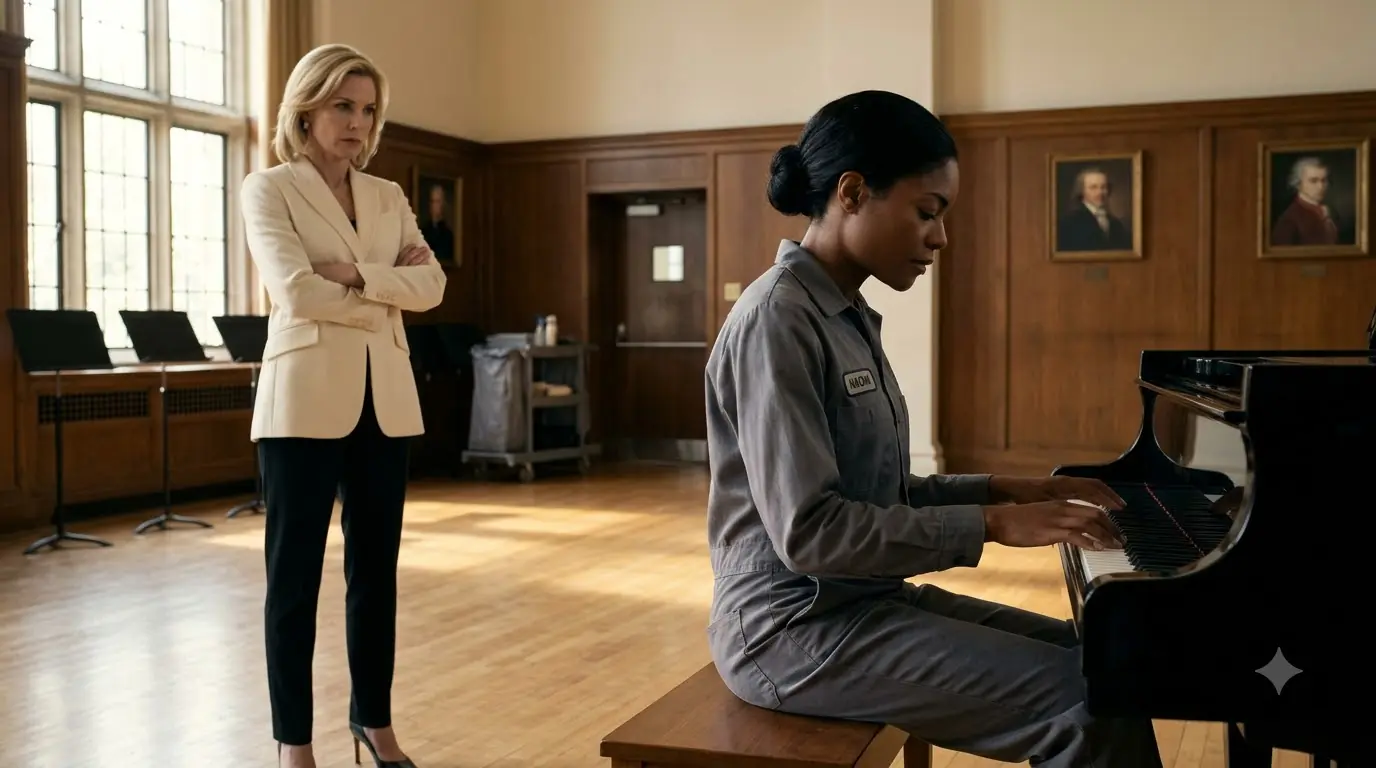
She had been awake since five that morning. At six, she had wiped rain streaks from the conservatory's tall front windows, emptied bins in twelve practice rooms, and lifted a leaking bag of kitchen trash into a wheeled container behind the loading dock. At nine, she had been instructed to polish the brass lettering on the donor wall. At eleven, she had learned that the institution's celebrated young pianist was too ill to perform. By two, the director had informed Eleanor that she could either play the Beethoven sonata that evening or take her chances with an approaching staff reduction. Now the house lights dimmed, and the audience watched a forty-nine-year-old Black woman employed as a custodian approach a concert grand worth more than everything in her rented apartment.
From the center aisle, Dr. Meredith Wainwright wore a pale-blue evening gown and the smile she used when the board was watching. "In the spirit of making music accessible to our entire community," she announced, "we are pleased to offer a very special addition to tonight's program. Please welcome a member of our own support staff, Ms. Eleanor Price." The applause sounded like rain beginning reluctantly on a dry roof. Eleanor noticed that Meredith had described her employment but had not once called her a musician. She noticed, too, that Celia Voss, the celebrated piano instructor who had mocked her that morning, was already sitting with her arms folded as though judging a disciplinary hearing.
Eleanor crossed the stage. A slight click came from her left knee, the familiar legacy of an old injury. She adjusted the bench, pressed the soft pedal once to feel its resistance, and looked down at the keys. She had spent thirteen years passing this instrument in the course of her work, thirteen years listening to students practice the same measures she once loved enough to organize her entire life around. Tonight the piano was finally hers for the length of a sonata, but the invitation had come with a threat disguised as generosity. She rested her hands in her lap and