What would you do if a duke offered you a flock of sheep no other buyer would touch? Animals so thin and matted the drovers laughed as they passed the pens. In the spring of 1856, in the muddy hill country above Willow Creek, 23-year-old Catherine Turner shook a gloved hand on that very bargain and led 93 ragged ewes home behind a borrowed cart. The village said she had bought her own ruin. But what the shears would reveal three seasons on would silence every voice that mocked her.
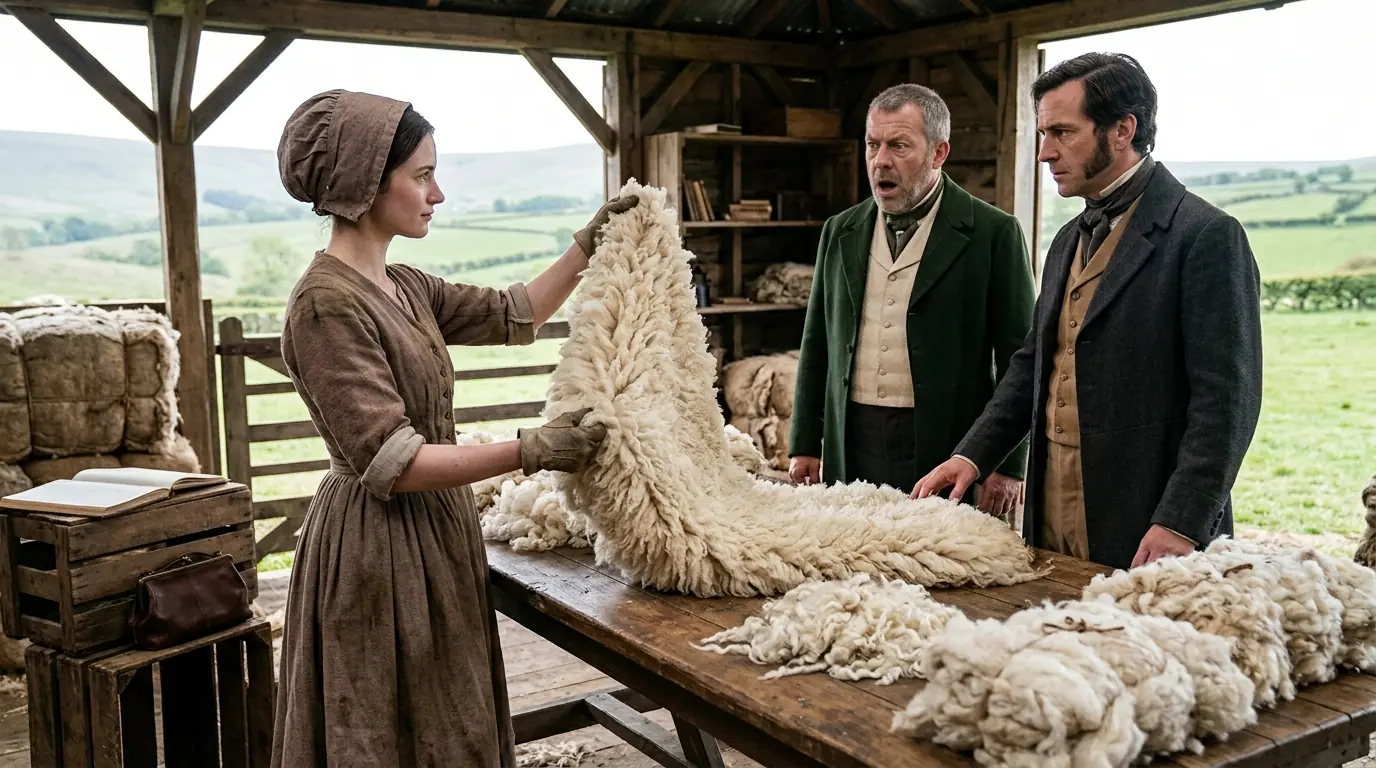
Catherine came up the lane on foot, her boots split at the seam and her shawl darkened almost to black by the wet. The cart had gone on ahead with the last of her mother's things, a tin box of thimbles and a chipped blue jug, and she had chosen to walk the final mile so the driver would not see her face when the cottage came into view. Six months since the funeral. Four months since the landlord in Ashby had turned her out for arrears she had not known her father left behind. Two months since she had written to her mother's cousin in Willow Creek and received a single line in reply.
"There is a room. Come if you must." She must. There had been nowhere else. The lane climbed between hedgerows heavy with hawthorn and the smell of the wet blackthorn was so like the smell of the churchyard on the morning of the burial that she had to stop and press her palm flat against the stone wall until the memory passed. A thrush called once from the thicket.
The rain thinned to a mist. When she raised her head the roofs of Willow Creek lay below her in the fold of the valley, slate and thatch, and one crooked chimney trailing smoke. And beyond them, the long gray rise of the Duke's grazing land, empty of any beast she could see. The cousin's cottage sat at the far end of the village, low and lime-washed, with a green door swollen shut by damp. Catherine had to lean her shoulder against it twice before it gave.
Inside there was a settle, a hearth cold since morning, and a woman she barely remembered rising slowly from a stool by the window. "You are thinner than your mother wrote," the cousin said. "I walked from the coach." "There is bread. Sit." Catherine sat.
The bread was hard at the crust and soft in the middle, and she ate it slowly, and the cousin watched her the way one watches a stray to see whether it will stay or bolt. Nothing more was said that first evening. In the loft above the kitchen, there was a straw mattress and a folded blanket smelling of lavender and mice, and Catherine lay in the dark listening to the rain begin again on the slates, and thinking that she had, in truth, arrived at the bottom of a long fall and would have to learn to stand from where she now lay. She did not yet know that the Duke's steward had been asking in the taproom of the Blue Boar whether anyone in the parish would take a certain neglected flock off his master's hands for the price of the pens they stood in.
By the end of the first week, Catherine had walked the parish twice, offering herself for any honest labor. She scoured a dairy floor for a shilling. She mended a fisherman's net for a bowl of stew. On the eighth morning, coming down past the Blue Boar with her hands raw from lye, she overheard two drovers laughing on the bench outside. "He will pay a man to take them," one said.
"Pay, mind you, and still no takers. They are half dead already. Fleece like felted rags. Ticks the size of currants." "His Grace wants the pasture cleared before Michaelmas." Catherine stopped in the road. She had grown up on her uncle's small holding above Ashby before the fever took him. And she knew sheep the way another girl might know her letters.
She knew a ruined flock could be brought back. She knew too that no one in Willow Creek would believe such a thing from a thin young woman in a mended shawl. She went that afternoon to the steward's office above the corn merchants, climbed the narrow stair, and stood in the doorway until he looked up from his ledger. "I will take them," she said. The steward laughed once.
Sharp and short. The way a man laughs when he thinks he has misheard. Then he saw her face and stopped. "Take what, girl?" "The flock."
"His Grace's ewes. The ones no one will buy." He set down his pen. He named the number. "93 head," he said. "And a ram besides."
And he named a price so small it was not truly a price, but a formality. A shilling and a signature to make the transfer lawful. He also named the pens they stood in, which she would have to remove within the fortnight. "You understand," he said slowly, "that these are not sound animals." "I understand."
"There will be no allowance. No feed. No shepherd's cottage." "I understand." He looked at her for a long moment. Then he drew a sheet of paper toward him and dipped his pen and asked her name and Catherine Turner spelled it out for him letter by letter and he wrote it down and he pushed the paper across the desk and she signed. The ink was thin and the nib scratched and when she straightened her hand was trembling and she pressed it flat against her skirt so he would not see.
By dusk the news was in every doorway. The Turner girl, that thin one, the cousin's charity case: 93 dying sheep and no land to put them on. The squire's wife laughed until she had to sit down. The publican shook his head. Even the vicar, meaning kindness, murmured that the Lord tried some souls sorely.
Could a girl with nothing turn a flock nobody wanted into a living? Was there something in those matted fleeces the drovers and the duke's own steward had failed to see? And what had made Catherine so certain standing in that doorway that she was not simply signing her name to her own ruin? What Catherine walked out to see the next morning, when she crossed the wet field to meet her flock for the first time, was worse than any rumor the village had spread.
Word of the bargain spread before Catherine had finished her supper. By the time she came down from the loft the next morning the cousin was already at the door speaking in a low voice with a neighbor and both women fell quiet when Catherine appeared. The cousin turned from the doorway, looked at her for a long moment, then said only, "You will need stronger boots than those." She did not ask whether Catherine had thought better of it in the night. She had lived long enough in Willow Creek to know that a signature on a steward's paper was not a thing undone by breakfast.
Out in the lane, the mockery had already thickened into something that felt almost pleasant to those who spoke it. Two women drawing water at the pump straightened when Catherine passed, and one of them said, loudly enough to be heard, that a shilling was a great sum for a heap of carrion. A boy running a hoop along the cobbles stopped to stare.
At the smithy, the smith laid down his hammer and watched her go by without a word, which was somehow worse than a word would have been. The village had made up its mind. She was the thin one, the cousin's charity case, the girl who had bought her own ruin from a duke too proud to give the beasts away for nothing.
At the corner by the churchyard wall, the squire came out of the lychgate with a spaniel at his heel. He was a broad man in a good coat, and he had heard the news at breakfast, and he was pleased by it in the way certain men are pleased when the world confirms what they have always suspected about it. He planted himself in the middle of the lane so that Catherine had to stop. "So you are the Turner girl," he said. "I am."