"Read this letter, sir. " The words were spoken so quietly that Harold Whitmore almost did not hear them above the soft mechanical hum of the orchid greenhouse, where he had been standing alone for the better part of 20 minutes, doing what he always did on Thursday evenings in late September, which was nothing in particular. He was holding a small pair of silver pruning shears in his left hand and a cut stem of Dendrobium in his right, and he had been thinking in the loose, unhurried way an old man thinks when no one is watching him, about his late brother Theodore, who had died 41 years ago in a hotel room in Caracas, and whose memory still arrived on certain evenings without warning. He turned slowly. The boy was standing on the far side of the long teak workbench, half hidden by a column of climbing jasmine. One small hand held out in front of him with a folded envelope balanced on his open palm.
He was perhaps 9 years old, maybe 10, in a clean denim jacket that had been buttoned all the way to the throat against the chill the boy had walked through to reach this particular greenhouse on this particular evening, and his shoes had been wiped carefully on the small mat outside the side door, which Harold knew because the mat was visible from where he stood, and the mud he had tracked across it earlier had been recently disturbed by smaller feet. Harold did not recognize the boy immediately. The estate covered 1,100 acres, and the staff who tended the grounds, the stables, the kennels, the orchards, and the small private chapel that his grandmother had built in 1923, numbered just over 60 people on any given week. He could not be expected, even by the most demanding standards of an old school household, to know every face that moved through the lower paths of the property. But he had been raised by a mother who believed that a man who could not name the people in his own gardens had no business calling them his own.
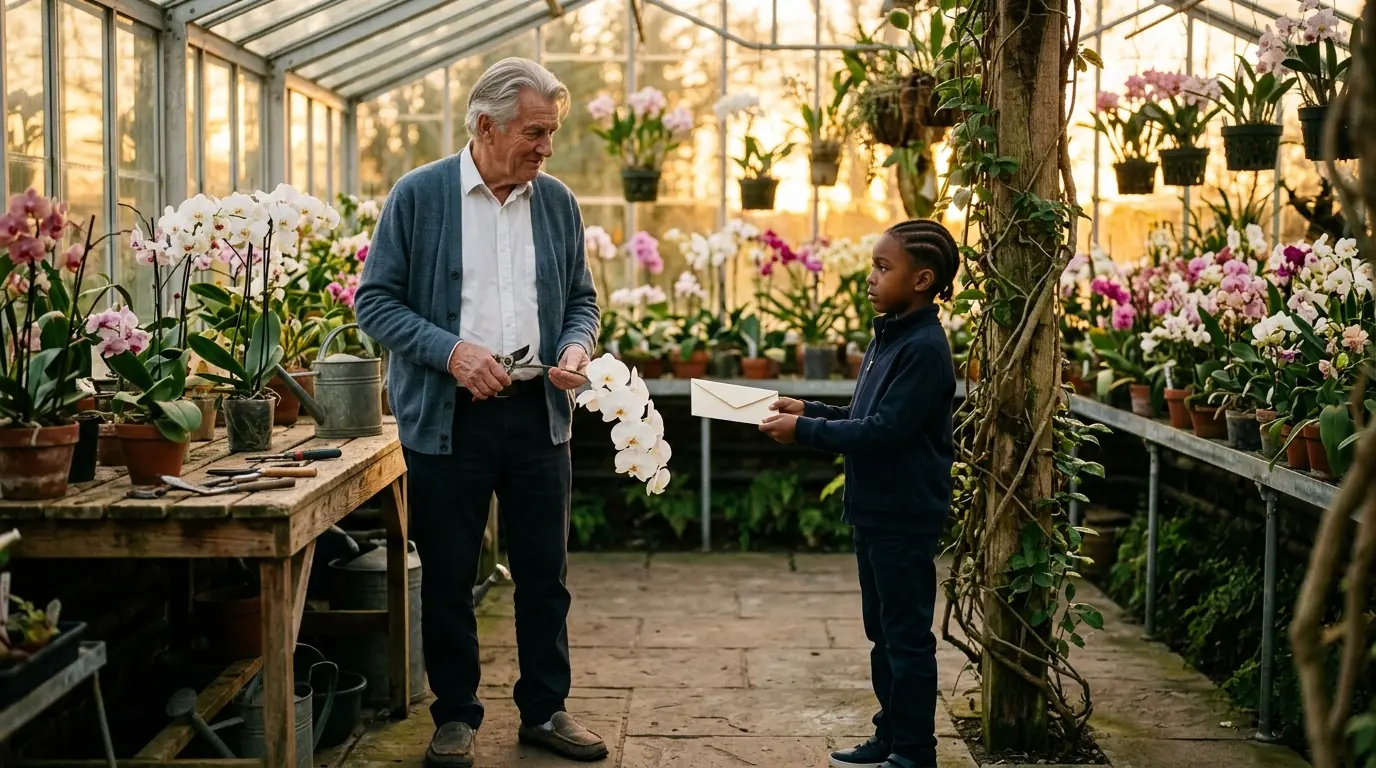
And so, he made it his business, in the long, quiet years since her death, to learn the names of as many of them as he could. He recognized the boy after a moment. His name was Caleb. His mother, Yolanda Briggs, had worked in the laundry of the main house for nearly 7 years, and she had begun bringing the boy with her after school sometime in the late spring, when whatever arrangement had previously kept him with an aunt in Wilmington had quietly come undone. Harold had passed the boy three times in the back corridor near the linen pantry.
He had not yet found the right moment to learn his name properly. He learned it now, the way a man learns most important things, by being given no choice in the matter. "What did you say, son? " Harold asked. His voice was the voice he used in the orchid house, which was softer than the voice he used anywhere else on the property, because the orchids, his wife Eleanor had once insisted, did not respond well to the tone he used in boardrooms. The boy did not lower his hand.
The envelope, Harold could see now, was a small, cream-colored thing of the kind sold in dime stores, sealed with a strip of ordinary household tape along the upper flap, and the boy's hand was trembling very slightly. Not from fear, Harold thought, but from the considerable effort it took for a 9-year-old to stand in an orchid greenhouse on a Thursday evening and hand a folded letter to a man whose name was carved above the front gates of the road he had walked up to deliver it. "Read this letter, sir," the boy said again, more clearly this time. "I think you need to read it before tomorrow morning, before the meeting. Please. " Harold Whitmore was 76 years old.
He had presided over Whitmore Continental Energy for 48 years. He had been handed many letters in many quiet rooms by many people who believed their letters were important. He had learned over the course of those decades that almost none of them were. But he had also learned by paying close attention to the shape of a hand and the weight of a silence, the small unmistakable difference between a letter that was unimportant and a letter that was simply being delivered by someone too small to be listened to. He set the pruning shears down on the teak bench.
He set the Dendrobium stem down beside the shears. He reached across the workbench and took the envelope from the boy's hand. The envelope was lighter than he expected. Harold turned it once in his fingers, the way he turned any document handed to him in any circumstance, examining first the seal and second the weight, and third the small particular smell that paper picked up from the place where it had been kept. This envelope smelled faintly of laundry soap and a child's pocket, which told Harold that the letter inside had been carried close to the boy's body for some hours before it had arrived in the greenhouse, and that wherever the boy had been keeping it, he had been keeping it carefully.
There was no name on the front of the envelope. There was no name on the back. The tape along the upper flap had been pressed down with the small unsteady pressure of a child's thumb, and there was a faint half circle of fingerprint visible in the adhesive where someone, the boy presumably, had checked at least once that the seal was holding. "Caleb," Harold said quietly, and he watched the boy's eyes widen slightly at the sound of his own name, the way the eyes of a child widen when an adult he has only seen from a distance turns out to know more about him than he had expected. "Where did this letter come from? " The boy hesitated.
He glanced once toward the side door of the greenhouse, the small reflexive glance of a child measuring the distance between himself and the path that led back toward the laundry building where his mother had almost certainly told him to stay this evening and where she almost certainly did not know he had gone. Then he seemed to decide something inside himself, the way Harold had seen grown men decide things in the small private moment before they signed contracts they could not undo, and he met Harold's eyes. "I can't tell you where I found it, sir. Not yet. I have to make sure you read it first because if I tell you where I found it before you read it, you might not read it.
And then it won't matter where I found it. " Harold looked at the boy for a long moment. He was, despite himself, somewhat impressed. The logic was the logic of a child, but it was the logic of a child who had been thinking about the problem for some considerable time before he had walked up the long gravel path to the greenhouse, and who had arrived at the only sequence of events that made sense from inside his particular set of constraints. Harold had built a great deal of his career on recognizing that kind of thinking in people, and he had learned not to dismiss it simply because the person doing the thinking happened to be 9 years old. "All right, Caleb," he said.
"I will read the letter, but I would like you to stay in this greenhouse while I read it. Will you do that? " "Yes, sir. " "Sit down on that stool by the door. Don't go anywhere. If your mother comes looking for you, I will speak to her myself. " "Do you understand? " "Yes, sir. " The boy walked across the slate floor to the small wooden stool beside the side door and sat down on it carefully, his hands folded in his lap. He did not slouch.
He did not swing his feet. He sat with the small upright stillness of a child who had been taught that the way a person held himself in an unfamiliar room said something true about the way that person had been raised. And he had been raised, Harold could see now, by someone who took the matter seriously. Harold turned back to the workbench. He pulled a small pair of reading glasses from the breast pocket of his cardigan, the cardigan Elena had given him for his 65th birthday, and which he still wore on Thursday evenings because Elena had liked the color, and he settled the glasses carefully on the bridge of his nose.
He picked up the silver pruning shears from the bench and used the tip of one blade to slit the tape along the upper flap of the envelope. He set the shears back down. He drew out a single folded sheet of plain white paper. He unfolded it. The handwriting was not a child's.
It was the handwriting of an adult, and it was the handwriting of an adult who had been trained at some point in her life to write the way certain women of a certain generation had been trained to write, with the small precise loops on the lowercase G's and the careful crossbars on the T's that came from convent schools and Catholic primary academies of a certain decade. Harold recognized the style immediately because his own mother had written that way, and his mother-in-law had written that way, and Elena herself, when she had been alive and writing letters at the small rosewood desk in the morning room, had written that way also. The letter was not long. It was perhaps 14 lines. Harold read it once quickly, the way he read any document the first time, to gather the shape of the thing, and then he read it again slowly, with the small interior pause between sentences that he had been using since he was 30 years old whenever a piece of paper in his hand contained information, he could not afford to misunderstand.
When he finished reading it the second time, he stood very still for a long moment with the letter in his hand, and he looked out through the south wall of the greenhouse where the long evening light was falling across the cutting garden in the particular way it fell only in the last 10 days of September. The letter said this, "Mr. Whitmore, my name is Patricia Donnelly. I worked as a personal secretary in the executive offices of Whitmore Continental Energy for 19 years. I retired in 2019.
I am writing to you because I do not know who else inside the building I can trust with what I am about to tell you, and because the boy who is bringing you this letter is the grandson of a woman I have known since we were both girls in Brooklyn, and I trust her grandson the way I trust her, which is completely. I am dying. The doctors have given me perhaps 4 weeks. I am writing this letter from a hospice in Trenton because there are things I have known for 11 years that I should have brought to you when I first knew them, and I did not because I was afraid, and because the man who would have been hurt by what I knew is the same man who paid for my mother's nursing home in her last years, and I told myself for a long time that the silence I was keeping was a small repayment of a kindness and not what it was, which was cowardice. The board meeting that you are scheduled to chair tomorrow morning at 10:00 concerning the proposed divestiture of the Marlin Bay Holdings is not what it appears to be.