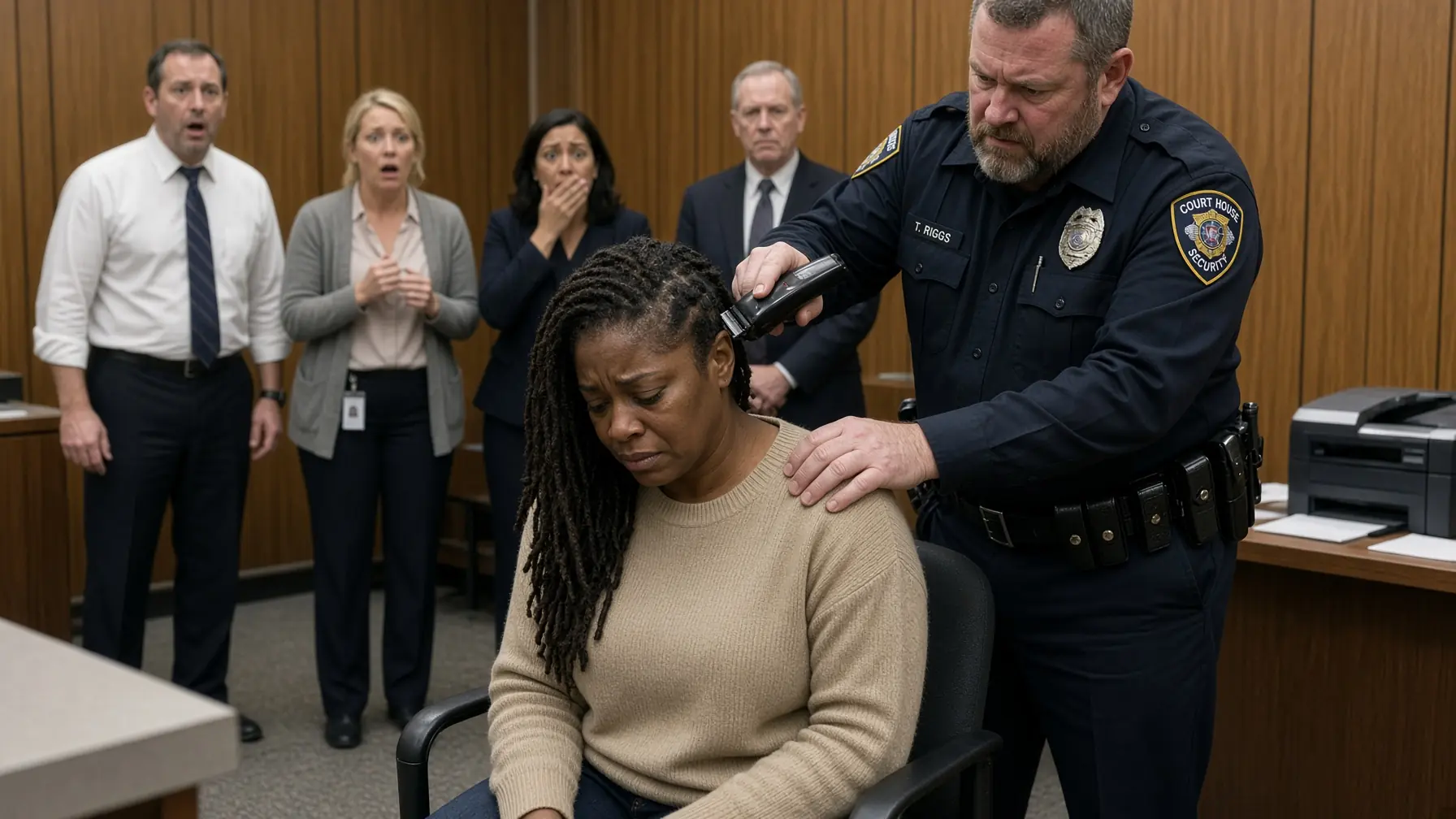
Footsteps echoed in the sterile holding cell, heavy and deliberate. Officer Thomas Riggs liked the sound of his own boots. He liked the weight of the clippers in his hand even more. He looked at the black woman handcuffed to the bench, seeing only a statistic. A nobody, a target for his petty cruelty.
He thought shaving her head would break her spirit. He didn't know the robe she was about to put on commanded more power than his badge ever could. The county courthouse at 6:00 in the morning possessed a specific suffocating atmosphere. It smelled of industrial pine cleaner, stale sweat, and decades of quiet desperation. For Officer Thomas Riggs, it was the smell of authority.
He had worked the holding cells behind courtroom 302 for 15 years. He knew the scuff marks on the linoleum. He knew which steel benches were bolted tight and which ones rattled when a detainee shook with withdrawals. Mostly he knew that within these concrete walls he was the absolute monarch. Riggs poured a cup of sludge-like coffee from the breakroom percolator.
He was a large man, his uniform stretched tight across a barrel chest, his face perpetually flushed. He operated on a very simple, very cynical binary. There were the people who mattered and the people who didn't. When he walked down the restricted rear corridor that morning, he saw someone who didn't. She was standing near the access door to the holding pens.
A black woman in her late 40s wearing a simple beige sweater and dark jeans. Her hair was worn in thick, immaculate locks that fell past her shoulders. To Riggs, her presence in the restricted zone meant only one thing, a stray defendant from the night shift who had wandered out of the processing queue. He didn't care how she got out. He only cared that she was breathing his air, standing in his hallway, looking around with a calm, analytical gaze that he instantly categorized as defiance.
"Hey," Riggs snapped, dropping his coffee cup into a nearby trash can. "You, hands where I can see them." The woman turned. She didn't flinch. She didn't cower.
She looked at him with dark, piercing eyes that seemed to take his exact measure in a fraction of a second. "Officer, I believe there has been a misunderstanding. I am—" "I didn't ask for your life story," Riggs interrupted, stepping into her personal space. He grabbed her arm. His grip was intentionally bruising.
"You're in a restricted area. That's a violation, which means you go in the box until I figure out whose docket you belong on." She didn't struggle. She let him guide her, but her posture remained entirely upright. I highly suggest you check the personnel log before you put your hands on me again, she said, her voice a low, steady baseline beneath his barking tenor.
Riggs laughed. It was a wet, ugly sound. "Right. You're special. Everyone in this building is special."
He shoved her into cell 4. It was the isolation tank, concrete floor, steel bench, and exposed toilet in the corner. He slammed the heavy steel door, but left the observation window open. He expected her to rattle the bars. He expected her to yell about her rights.
That was the usual script. Instead, the woman simply sat down on the steel bench. She folded her hands in her lap. She looked directly at him through the reinforced glass. Her silence irritated him.