The principal pointed at the boy in the last row and smiled as though he had just thought of a splendid joke. Three hundred people turned in their seats. Some were parents in evening clothes, some were donors whose names appeared above doorways, and some were students who knew exactly what that smile meant. The boy was fourteen years old, Black, the recipient of a scholarship that had made him both fortunate and conspicuous, and he had come to the spring concert intending to sit quietly until it was over. A polished grand piano waited beneath the auditorium lights. The principal raised his microphone and said, "Since the school is paying for everything, perhaps our scholarship boy can give us a little show."
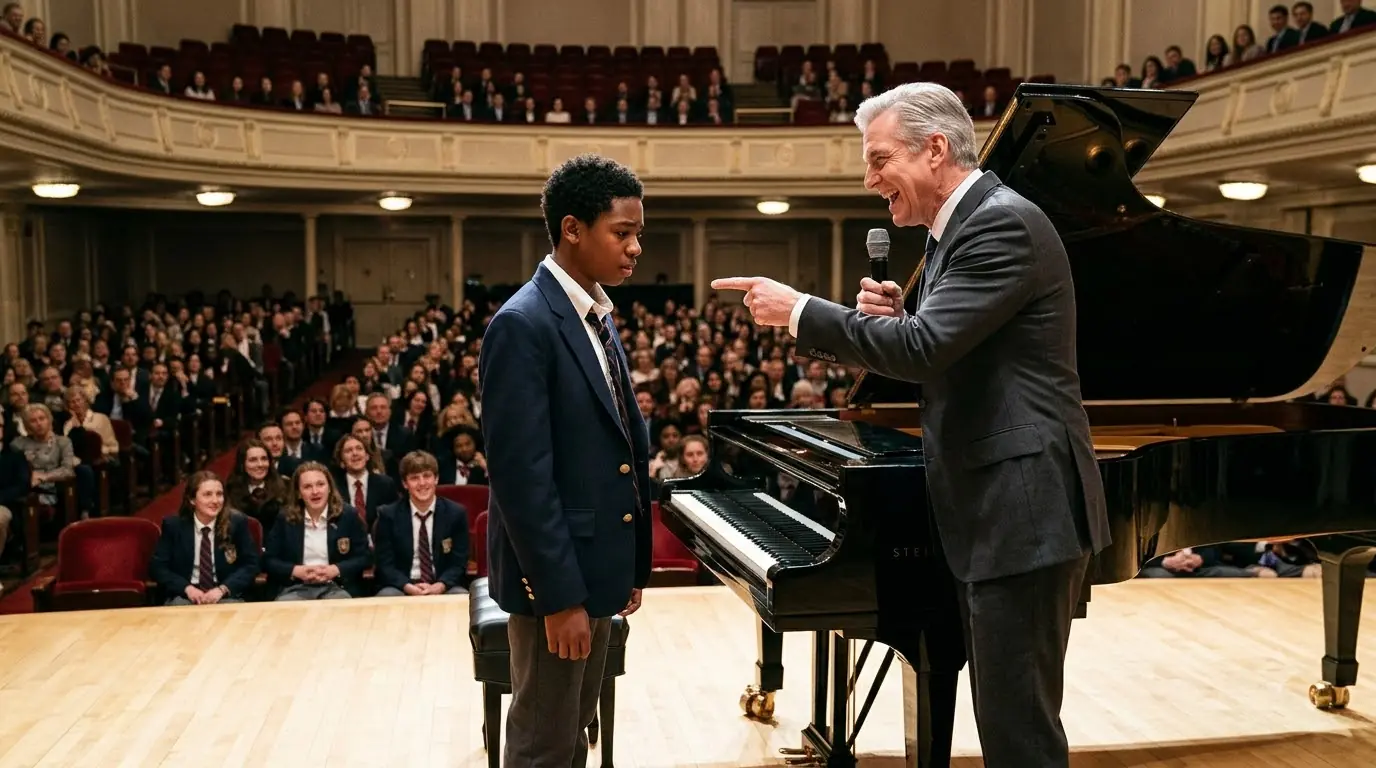
A few people laughed. It was not a loud or especially brave sound, but it was enough to tell the boy that the invitation had not been made in kindness. Beside the stage, the school's music teacher had just abandoned a difficult performance after losing her place, and the principal was looking for a way to recover the evening's confidence at somebody else's expense. The boy's uniform jacket was a little short in the sleeves, and his mother was not in the audience. He could refuse and provide the principal with an easy joke, or he could walk toward the piano and risk becoming a different kind of entertainment. He lifted his eyes from his folded program and said, "I'll play, sir, if that's all right."
The principal repeated the words in an amused voice. "If that's all right." More laughter came from the seats nearest the stage. Nobody knew the boy had spent eight months studying the very composition that had defeated the teacher, using an old upright at a neighborhood church whose middle C sometimes stuck and whose sustaining pedal squeaked. Nobody knew he had practiced portions of it without a piano at all, tapping the patterns silently on a kitchen table while his mother slept between shifts. And nobody knew that the choice the principal had just forced upon him would begin a reckoning much larger than a concert. The reckoning would not happen because a child played beautifully; it would happen because adults finally had to account for what they had allowed him to endure.
His name was Eli Parker. He lived with his mother, Renee, in a two-bedroom apartment on Chicago's South Side, three bus transfers and an entirely different world from the stone entrance of Bellweather Preparatory Academy. Renee worked as a patient transporter at a hospital and cleaned offices on several nights when she could find the hours. She had learned to measure a week by the little intervals between responsibilities: a bus arriving on time, a break long enough to eat a sandwich, a Sunday afternoon when the laundry machines were free. She rarely used the word sacrifice. Eli heard it from other people often enough to recognize that his mother did not want her life reduced to a dramatic lesson.
Their kitchen window overlooked an alley, a brick wall and a narrow strip of sky. There was an unreliable radiator beneath it and a table whose surface had been worn pale by homework, grocery bags and careful household calculations. Renee kept envelopes marked RENT, LIGHTS, TRANSPORTATION and FOOD in a shoebox above the refrigerator.