The first time eight-year-old Noah Hayes heard the motorcycle try to start, he knew the grown men had missed something. The starter strained behind the open doors of Vale Ironworks, a hard metallic whine followed by a cough that sounded almost human. Then came a violent kick against the engine stand, a shouted curse, and the sharp clang of a wrench dropped on concrete. Noah stopped sweeping. He had heard that sound before, years earlier, when his father had still been alive and the two of them had been allowed to stand together beside a black motorcycle in the back bay.
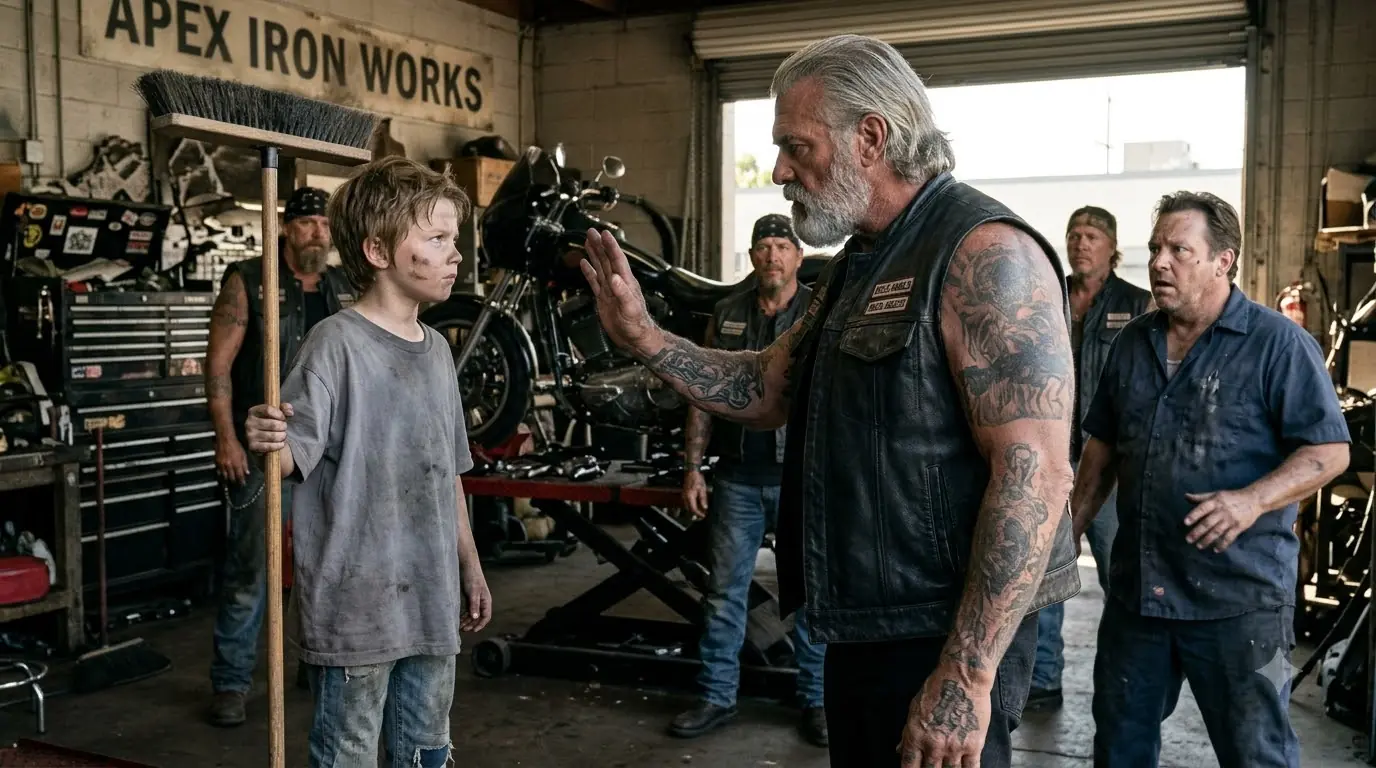
Nobody noticed the boy lower his broom. Six mechanics crowded around the machine, their broad backs hiding most of its frame, and behind them stood Warren Kincaid, a gray-bearded rider whose presence had made the entire shop strangely quiet. Warren was known as Gravel among the men who rode with him, a nickname earned on roads far from Oakland. His black leather vest was worn smooth at the edges. The patches across its back identified his motorcycle club, but the expression in his eyes was not the expression of a man seeking trouble. It was the expression of someone trying to hold on to the last physical piece of a dead friend.
"Again," Warren said.
Roland Vale, the garage owner, shook his head. "We've tried it eleven times this morning. Another attempt could bend something we can't replace."
"You told me you could repair it."
"I told you we'd try." Roland's voice caught, and he lowered it. "We have tried."
The motorcycle stood beneath the brightest work light in the shop. Its chipped black tank had once been painted by hand; the chrome carried scratches that polishing could never erase. It was a 1986 Harley-Davidson FXR, altered so many times that the service manuals Roland had stacked on a nearby bench were beginning to look like strangers invited to the wrong funeral. The machine had belonged to Edwin Mercer, known to everyone in the club as Dutch. Dutch had died three months before, and the memorial ride planned for Saturday would draw riders from across California. Warren had promised that Dutch's motorcycle would lead the procession. Now Friday was close, and the engine would not fire.
A younger mechanic named Tommy Brent stood by the tool cabinet, studying an ignition diagram on his phone. Big Dave Rourke, who could lift a transmission almost by himself, inspected a damaged pushrod. Pete Garrison, the shop's electrical specialist, had already replaced the battery twice. Each man had worked on expensive custom builds for years. Each man had reached the point where another suggestion felt like an insult.
Noah could see the black timing cover between two elbows. He could also see the faint crescent-shaped nick his father had once shown him, no larger than the tip of a fingernail. It had been made deliberately. His father, Arthur Hayes, used to say that a machine could have two histories: