The first thing Evelyn Pike said when she walked into my mother's birthday party was that families like ours were ruining the neighborhood. The second thing she did was point at my eleven-year-old nephew and demand to know which house he belonged to. And the third thing, the one that turned a painful afternoon into a criminal investigation, was to shove a burning charcoal grill onto the grass while my family stood around it. Until that instant, she had been loud, cruel, and entitled. Afterward, she became dangerous.
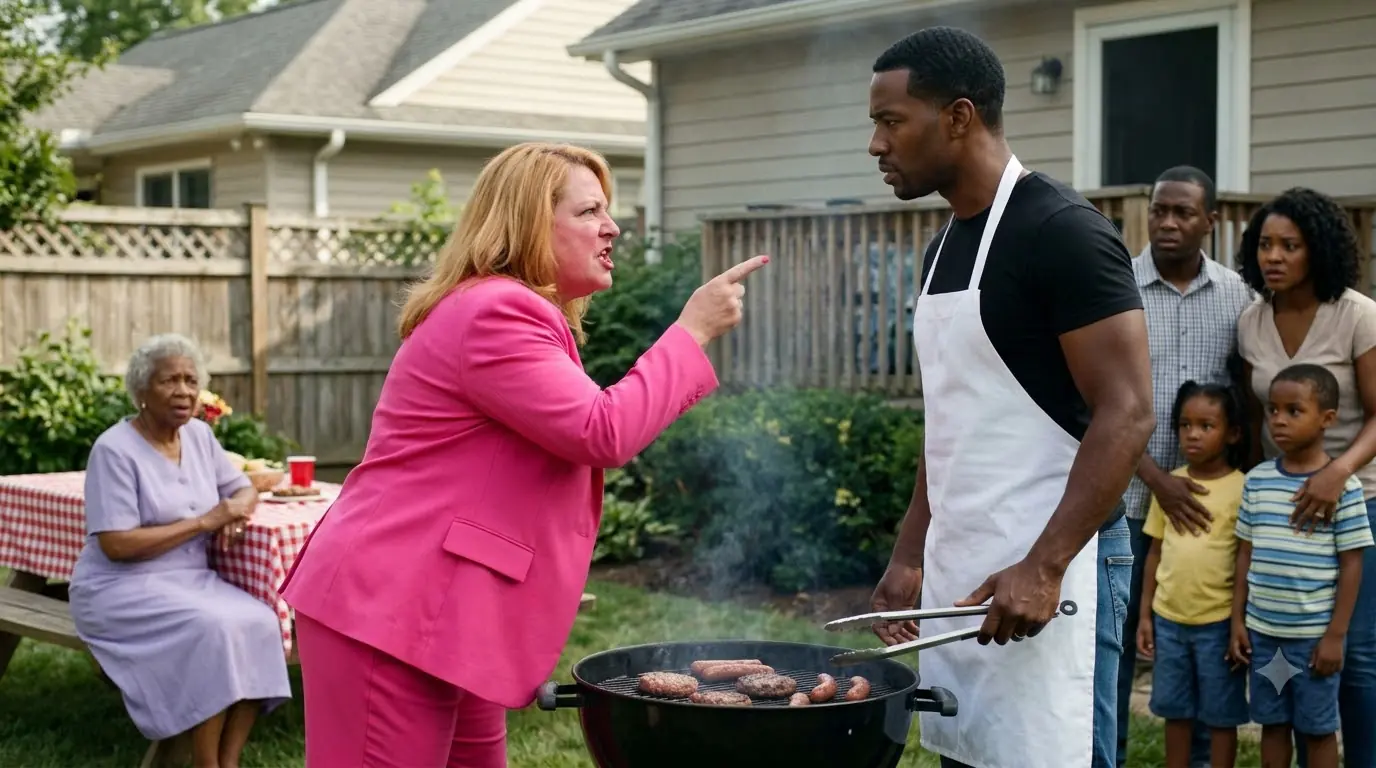
I remember the sound of the grill striking the ground almost as clearly as I remember the words. Metal rang against concrete, the lid rolled beneath the picnic table, and orange coals scattered across the lawn toward a little blue bicycle. One of my brothers grabbed my niece by the shoulder and pulled her away so fast her sneakers left the ground. My mother, who had turned seventy-three that very morning, sat frozen at the domino table with one white tile resting between her fingers. A grown woman had just endangered children because she did not like seeing a Black family celebrating in a backyard she did not control.
Evelyn was already raising her phone when I looked back at her. "They're attacking me," she told the emergency dispatcher, although no one had laid a hand on her. She described an armed Black man making threats in a private yard and said she had reason to believe he was impersonating a police officer. The man she meant was me. I was standing beside the ruined dinner wearing a black T-shirt, a flour-dusted white apron, and an expression I had learned to keep steady through more than twenty years of police work.
My name is Marcus Whitfield. At the time I was forty-seven years old and had been chief of police in Fairmont, Ohio, for eleven months. Before that I had spent twenty-two years in patrol cars, interview rooms, and command offices, learning that the fastest way to make a bad situation worse was to mistake authority for permission. I did not tell Evelyn any of this when she first entered the yard. My mother had asked me to cook for her birthday, and that afternoon my most important title was simply her son.
We lived in Briar Glen, a residential subdivision west of town, where maple trees shaded two-story houses and people talked about property values as though they were discussing the weather. Renee and I had bought our place six years earlier, after our daughter graduated from college and moved to Cincinnati for work. We had chosen it because of the deep backyard, the first-floor guest bedroom that made visits easier for my mother, and the easy drive to the police station. The house was not enormous. It was comfortable, carefully maintained, and paid for by two people who had worked hard for every improvement.
My wife, Renee, was a respiratory therapist at Fairmont Memorial Hospital, and she had a talent for making a gathering feel like it belonged to everyone. She could remember a cousin's favorite dessert from five years earlier, talk a quiet teenager into joining a card game, and make my mother laugh when the two of them disagreed about how much paprika belonged in potato salad. Renee was also the one who persuaded me to take a full afternoon away from the department. She had told me, with the firmness she reserved for patients who refused to follow medical advice, that the city would survive four hours without its chief.