The first time Noah Bennett met the man who would one day change his life, he was thirteen years old, barefoot, and trying to decide whether a dinner roll was worth being arrested for. The roll lay beside a silver platter in the service corridor of the Grand Mariner Hotel, where the air smelled of roasted beef and expensive perfume. Beyond the open doors, men and women in tailored clothes applauded a billionaire who had just promised another three million dollars to a rehabilitation foundation. Noah knew nothing about the foundation, but he knew what hunger felt like after two days of dividing a packet of crackers into meals. He reached for the bread at the exact moment a waiter turned the corner.
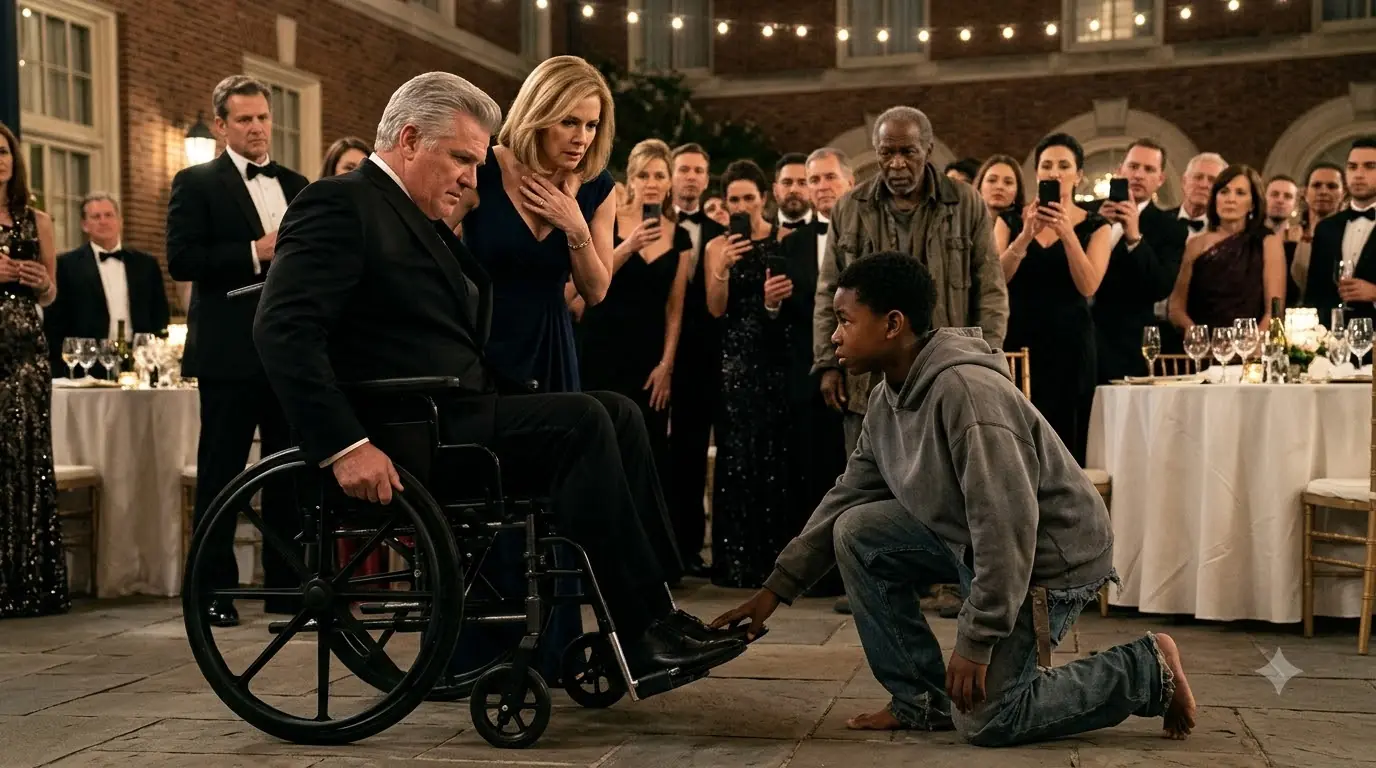
The waiter, a tired man named Felix, studied Noah's face and then glanced toward the ballroom. He did not call security. Instead he took two rolls, wrapped them in a clean napkin, and added an apple from a bowl meant for centerpieces. "There's a side gate past the fountain," he said quietly. "Go before someone decides to make a scene." Noah thanked him, but he did not leave. Across the courtyard he had caught sight of a wheelchair, and something about the man sitting in it held his attention.
The man was Charles Whitmore, fifty-eight, founder of a nationwide construction and commercial-property business, and the evening's largest donor. Photographs of his buildings had occupied the front pages of newspapers for decades. Once, he had crossed unfinished steel beams without looking down, wearing a hard hat that cost less than his wristwatch. Now he moved through the hotel courtyard in a customized chair with lightweight rims, an attendant a few steps behind him, and a practiced smile that made people laugh before he finished speaking. A fall at one of his own construction sites had damaged his lower spine three years earlier. He could transfer with help, manage much of his daily life, and sometimes feel faint sensations in his feet. The ability to walk independently had not returned.
Noah did not mistake any of those facts for a simple problem he could fix. His father had warned him against making promises about bodies, especially bodies already injured. But he saw the way Charles lifted one shoulder when he turned, the way the left foot rested against the chair, and the small grimace Charles tried to hide whenever he reached backward. Noah had spent much of his childhood watching people move. He knew how a body protected a painful place, and how that protection sometimes made another place hurt. He recognized the signs of a man exhausted not only by an injury but by the effort of acting as though he had accepted it.
From a table near the courtyard fountain, Charles raised a glass. "Here's to another year of medical miracles that haven't happened," he announced. A ripple of laughter traveled around the gathering. "My specialists have purchased vacation homes with the money I've spent, and I still have to ask somebody to fetch my shoes from the closet." His wife, Helena, touched his shoulder. She wore ivory silk and a composed expression that Noah recognized from photographs in the public library. Her smile remained in place, but her fingers tightened briefly against her husband's jacket.