Carolyn Price first noticed the bench on a bright Saturday afternoon because it was painted the wrong kind of blue. Not an ugly blue, exactly, but a cheerful lake-blue that stood out against the brown mulch, gray playground posts, and beige pavilion at Greenwood Commons in Maryland. She stopped halfway down the walking path, narrowed her eyes behind her sunglasses, and watched three children crowd around it while another boy sat alone at one end. On the backrest, in uneven white letters, someone had painted: YOU DON’T HAVE TO PLAY ALONE.
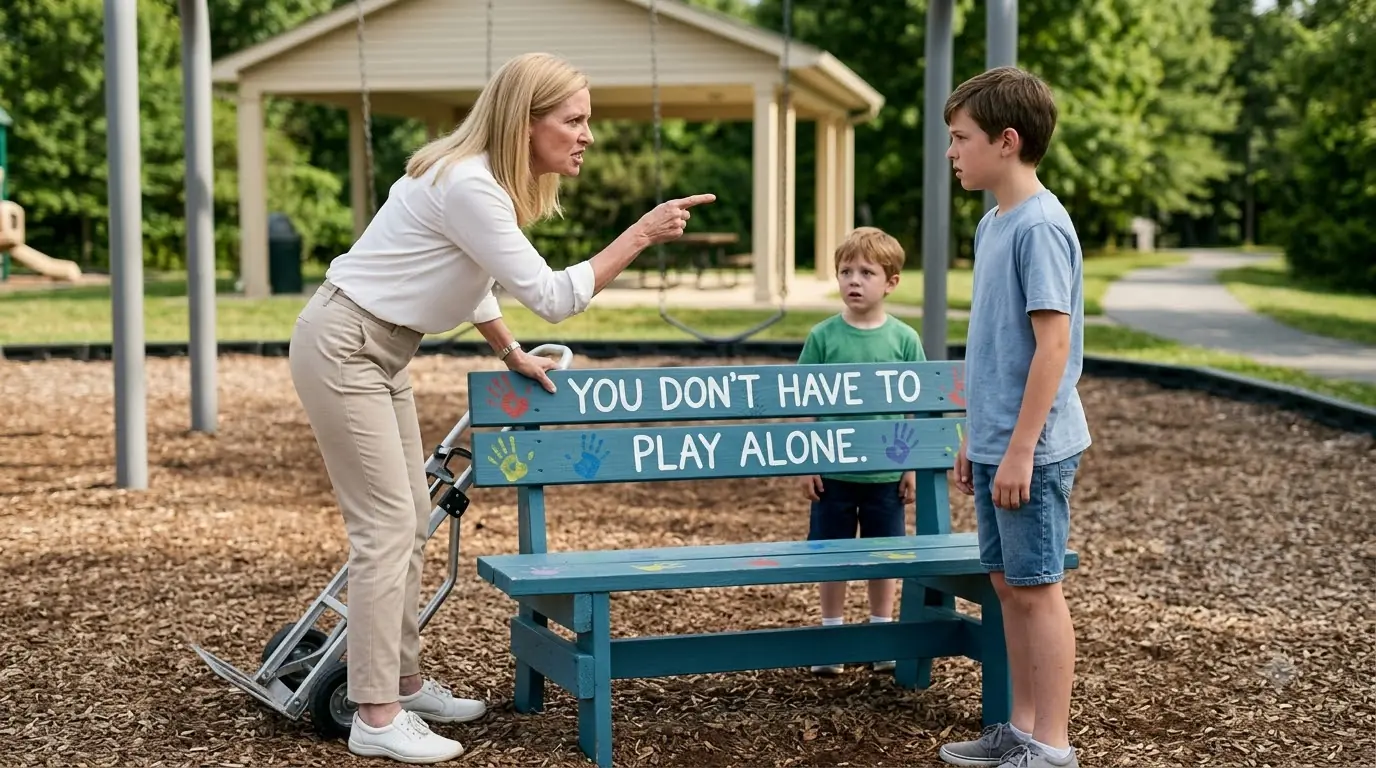
Carolyn’s first reaction was not anger. It was the uneasy tightening she always felt when something appeared in a common area without going through the chain of approval she believed kept the neighborhood from becoming careless. She had been chair of the Amenities Committee for four years, and during that time she had dealt with a cracked swing seat, a rusted pavilion grill, two residents who kept leaving folding chairs beside the basketball court, and a loose bolt on a climbing wall that could actually have hurt someone. To Carolyn, problems rarely announced themselves as problems at the beginning. They started as somebody saying, “It’s harmless.”
She walked toward the bench carrying the tablet she used for committee notes. “Who put that there?” she asked. Jamie Cole looked up from where he was crouched beside one of the legs. He was eleven, small for his age, with short brown hair and a faded T-shirt that had a strip of sawdust still clinging to one shoulder. “We did,” he said.
Carolyn looked from Jamie to the bench and then to the children nearby. “Who approved it?” “Mr. Cho said we could try it,” Jamie answered. “Mr. Cho is one board member. That does not make this approved playground equipment.”
Jamie’s mother had warned him that adults sometimes asked questions they already thought they knew the answer to, and the safest thing was not to turn those questions into arguments. “He said it was a pilot,” Jamie said carefully. “We sent him the drawing first.” Carolyn tapped the side of her tablet. “A pilot does not erase liability.”
Jamie glanced at the boy sitting on the bench, eight-year-old Noah Foster, who had moved into Greenwood Commons barely three weeks earlier. Noah’s sneakers did not quite reach the ground. His fingers were knotted together between his knees, and the moment Carolyn said “liability,” his eyes dropped as if the word somehow meant him. “It’s just a bench,” Jamie said.
“Nothing is ‘just’ anything when someone gets hurt.” Carolyn walked around it, pressing one hand on the backrest, inspecting the screws, then looking toward the swing set. “This is too close to the fall zone.” Jamie’s father had helped measure twice. Still, Jamie did not argue. “We can move it.” Carolyn looked at him, surprised by the answer. “You should not have installed it in the first place.”