The day they tried to take my water tank away, a crane was already on its way to my house. What the president of our homeowners association did not know was that a wildfire was burning beyond the ridge, the county booster station had lost power, and six hydrants were about to become little more than painted iron. She had called my five-thousand-gallon tank an ugly industrial eyesore. Before nightfall, the fire chief would stand in front of it, point at the connection I had installed with my own hands, and order her to stay away. The stranger part was what we learned afterward, when somebody finally opened a folder the association had kept closed for four years.
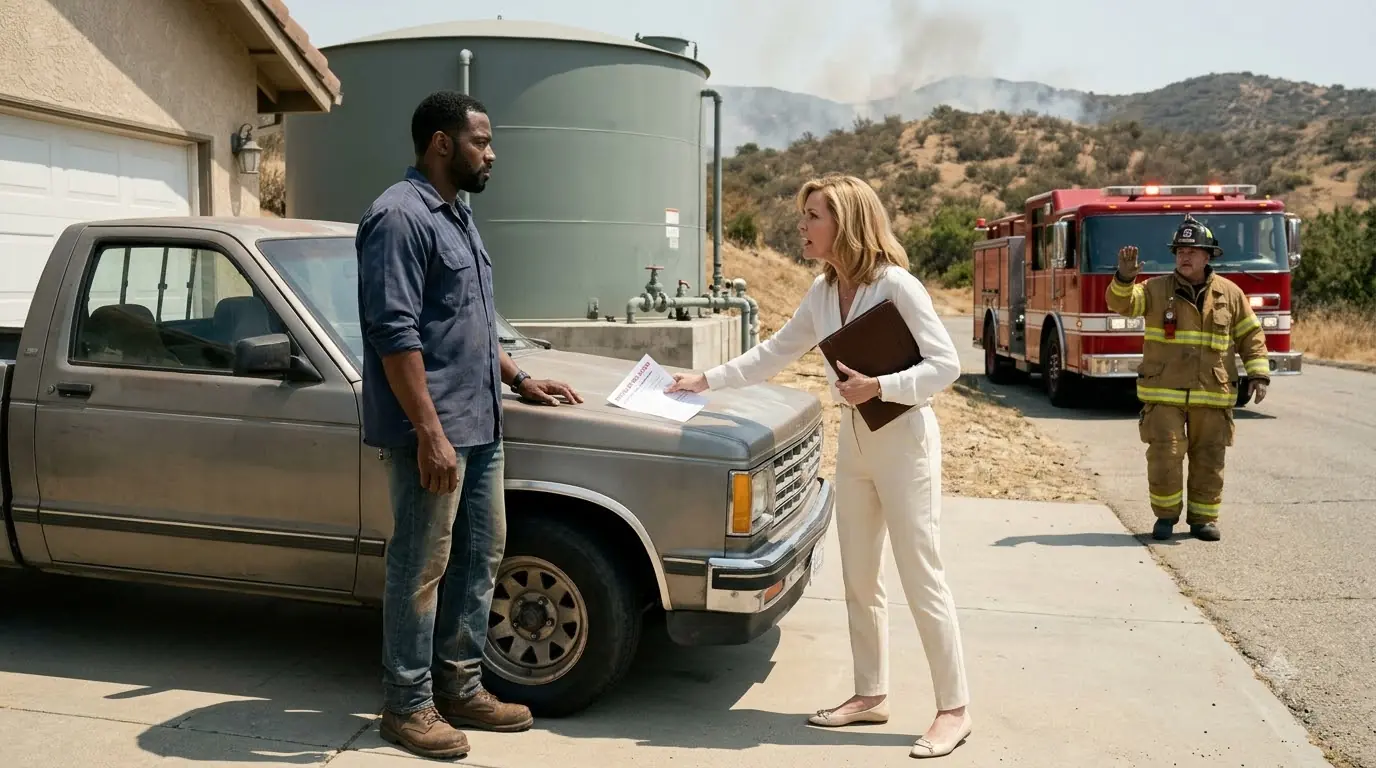
My name is Marcus Bell, and I lived at the northern edge of Pine Hollow Estates, a neighborhood of ninety-one houses outside a small foothill town in Northern California. The town had grown quickly during the years when everybody wanted a house near open country but still within commuting distance of a hospital, a distribution center, or the interstate. Our streets were curved and carefully named after trees, although several of those trees had never grown there. The houses had tidy lawns, two-car garages, and back patios facing a long slope of manzanita, oak, and summer-dried grass. On clear mornings I could see the ridge from my kitchen window, and for a long time I considered that view the best thing I owned.
I bought the house because it was quiet and because, after twenty-two years in industrial water systems, I wanted to live somewhere a pump motor did not dictate the rhythm of my day. I had worked in warehouses, food plants, machine shops, and isolated properties where the nearest municipal supply might be miles away. I had watched good engineers make expensive mistakes by assuming that water would always arrive at the pressure shown on their drawings. More than once I had stood beside a fire crew during a test and seen the disappointment in a captain's face when the gauge settled too low. That face stayed with me longer than any number on a report.
My father used to tell me that a skilled worker ought to pay attention to the things that other people considered boring. He was a maintenance mechanic at a paper mill, the kind of man whose name was almost never printed in a company newsletter but whose absence could shut the entire place down. When I was thirteen he let me hold a flashlight while he replaced a failed bearing on a conveyor. The company manager arrived halfway through and asked how much longer the repair would take without saying hello to either of us. Afterward, my father wiped grease from his hands and said, 'Machines don't care who gets the credit, Marcus. They just care whether somebody did the work.'
That was the lesson I carried into adulthood. I had a small contracting company, three reliable technicians, and a workshop behind a commercial building across town. We installed reserve tanks, pressure controls, distribution manifolds, and equipment that hardly anyone noticed until it mattered. I had enough money to replace my truck, though I