The first thing I noticed was the lock lying in two pieces on the concrete. The second was the silence. For sixteen years, whenever I opened that garage, the old green Jeep had been waiting for me in some stage of repair, its square headlights staring from the shadows like a patient dog. That Saturday, the garage was empty. Fresh gouges scarred the doorframe. A length of chain lay abandoned beside the workbench my father had built, and the bright steel of a severed padlock caught the noon sun. I stood in the doorway with my keys in my hand, trying to understand how an ordinary morning had ended with a piece of my family missing.
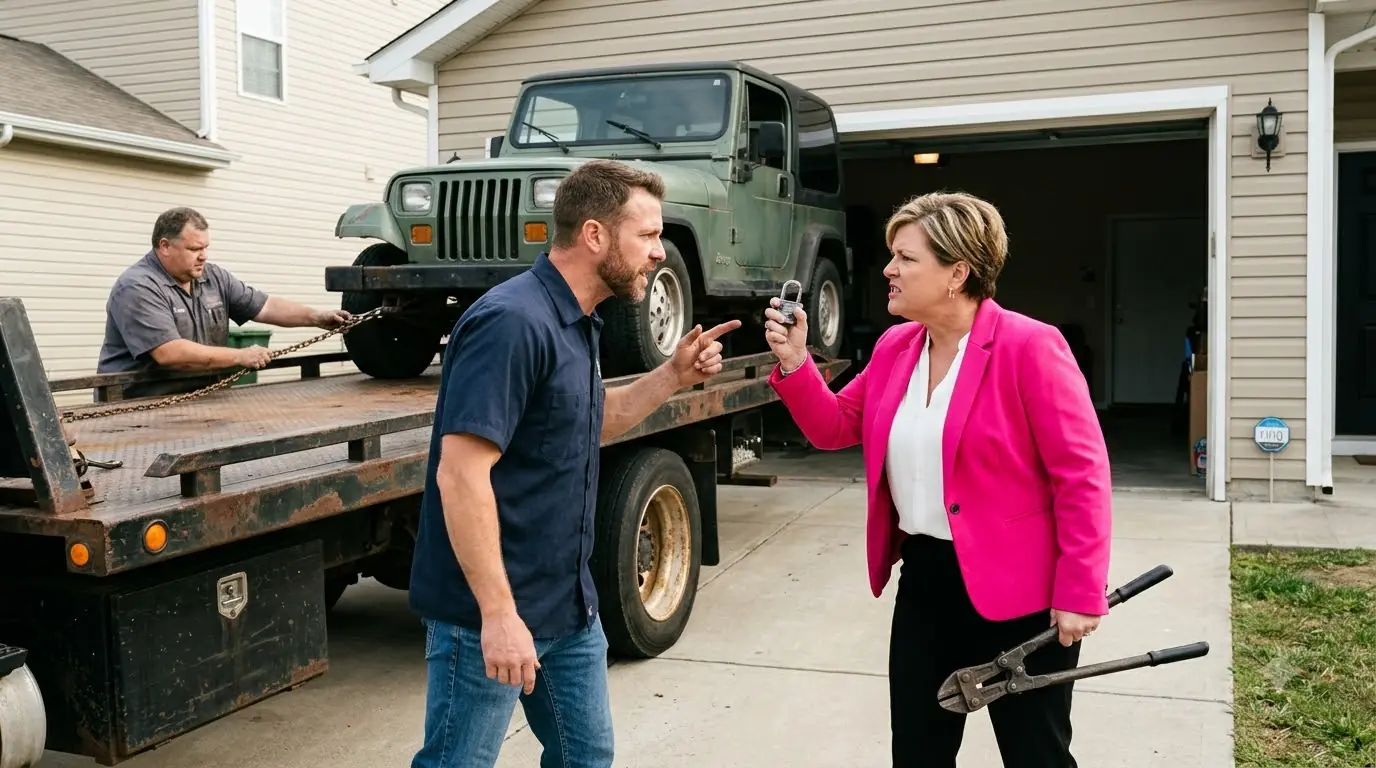
Across the street, Evelyn Price stood beneath the maple tree in front of her house, arms crossed over a pink cardigan. She was watching me with an expression I had learned to distrust. For two years, Evelyn had treated the Jeep as a personal insult, but even I had not imagined she would take bolt cutters to my garage. Then I remembered the notification on my phone, the grainy image of her standing beside a tow truck, and the terrible calm in Detective Luis Ortega's voice when I called him. I looked down at the broken lock again. Whatever Evelyn thought she had accomplished, she had walked into something far larger than a fight about neighborhood rules.
To explain how it happened, I have to go back to the morning before the lock was cut, and then farther still, to a garage in a little town west of Columbus where my father first taught me what it meant to keep something running. My name is Owen Carter. I was forty-one that fall, married to a patient school librarian named Leah, and employed as a senior mechanic at Bellamy Automotive. I was good at engines, less good at speaking up in rooms full of people, and particularly bad at pretending an unfair rule was reasonable just because somebody in a blazer had printed it on official-looking paper.
Our neighborhood, Maple Ridge, had once been a pleasant collection of modest houses and shade trees at the edge of town. Children rode bicycles in looping circles around the cul-de-sac, and neighbors carried casseroles to one another after surgeries and funerals. We had a small park, a weathered wooden gazebo, and a homeowners association that, for most of its history, had existed to collect reasonable dues and keep the common areas mowed. Nothing in the original documents prohibited an owner from keeping a legally registered vehicle in a private garage. Nothing said an association president could enter that garage. But Evelyn Price had spent six years persuading people that the distinction between community leadership and personal authority was a matter of tone.