Well, your parents must have had very good lungs, Harriet replied, picking up her wine glass and standing. She ignored the panicked look of the footmen who rushed to pull out her heavy chair. She walked down the length of the table, heels clicking on the hardwood floor, until she reached the chair directly to Sebastian's right. She sat down, placing her glass on the linen cloth. Sebastian went completely rigid.
He looked at her as if she had just placed a live grenade next to his dinner plate. “There,” Harriet said, smoothing her napkin over her lap. “Now we do not have to shout.” Do you actually manage this entire estate yourself, or do you have a steward who does the real work? For a long moment, Sebastian said nothing.
His jaw worked. He looked down at his plate, then back at her. Slowly, the tight lines around his mouth relaxed just a fraction. “I have a steward,” he murmured, “but he is incompetent.” I do most of it myself.
“Good,” Harriet said. I like ledgers. You can show me tomorrow." Sebastian blinked. "Ledgers?
You want to look at the estate ledgers?" "I managed a boarding house budget for three years, your grace. I am quite capable of doing arithmetic, and I refuse to spend my days doing needlepoint while waiting to die." A strange expression crossed Sebastian's face. It was gone before Harriet could categorize it.
He took a slow sip of his wine. "Very well, Harriet. Tomorrow we will look at the ledgers." It was a tiny victory, but as Harriet lay awake that night in the cavernous cold bed, listening to the wind howl around the stone turrets of Ashcroft Hall, she knew ledgers wouldn't be enough. She was living with a phantom, and she didn't know how to exorcise him.
Three weeks passed. They settled into a bizarre, sterile routine. Harriet woke early, breakfasted alone, and then marched into the estate office. True to her word, she took over the household accounts. She found them in a state of chaotic neglect.
Sebastian paid his bills, but he bled money out of sheer apathy. Harriet ruthlessly cut costs on luxury imports they didn't consume, and raised the wages of the tenant farmers, a move that made the estate steward turn purple, but which Sebastian authorized with a careless wave of his hand. "Do what you want," he had said, not looking up from a snifter of brandy. It was barely noon. That was the problem.
Sebastian drank. He didn't become violent or loud. He became a stone. He drank to numb the edges, pouring dark amber liquid into his glass in the library, staring into the hearth fire for hours on end. Harriet tried to ignore it.
She told herself it wasn't her business. Their arrangement was financial. She had a warm bed, excellent food, and purpose in managing the house. She had no right to demand his emotional sobriety, but Edward's ghost was a heavy third occupant in the house. It came to a head on a rainy Tuesday afternoon.
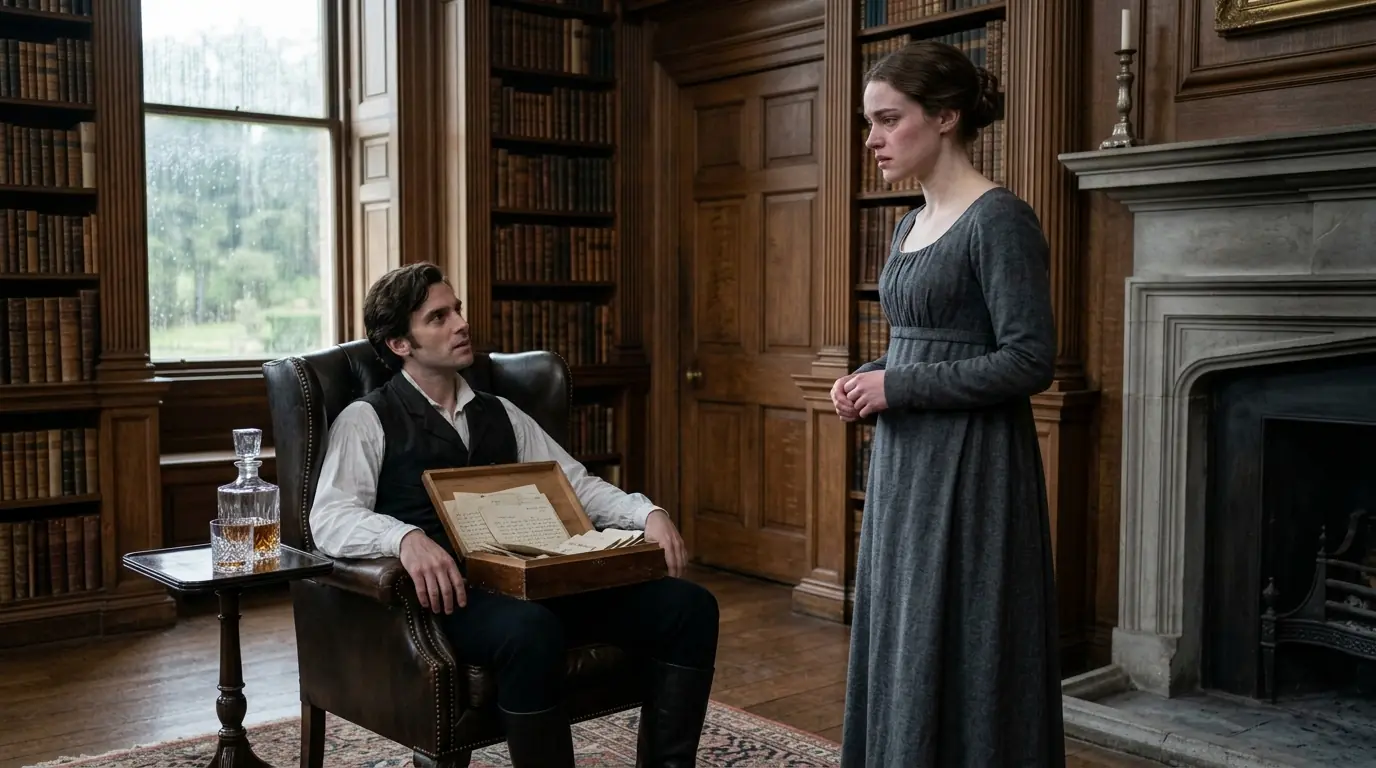
Harriet was in the library hunting for a specific book on crop rotation. The room was dark, smelling intensely of old paper, leather, and stale alcohol. She found Sebastian sitting in a wingback chair by the unlit fireplace. He was asleep, his head resting against the high back of the chair. A half-empty decanter of whiskey sat on the table beside him.
In his lap, loosely gripped in one hand, was a small, familiar wooden box. Harriet stopped breathing. It was Edward's cigar box, the one he used to keep his letters in. Drawn by an invisible string, Harriet stepped closer. Sebastian looked younger in sleep, the harsh, cynical lines of his waking face smoothed out.
But even unconscious, he looked troubled. His brow was furrowed, his breathing shallow and rapid. Harriet looked down at the box. The lid was open. Inside were a stack of letters.
She recognized her own handwriting on some, Edward's frantic scrawling script on others. She reached out, intending only to close the lid. Sebastian's hand snapped out like a viper. He gripped her wrist. Hard.
Harriet gasped, her heart leaping into her throat. Sebastian's eyes flew open. They were wild, unfocused, dark with some ancient terror. He stared at her, but he wasn't seeing her. He was seeing smoke and blood.
"Don't," he rasped, his voice ragged. “Don't leave him.” Sebastian, Harriet said clearly, forcing her voice to remain steady despite the bruising grip on her arm. “It is Harriet.” “You are in Derbyshire.”
“You are home.” He blinked. Once, twice. The wildness slowly drained from his eyes, replaced by a sudden, sharp realization. He looked at his hand wrapped around her wrist, and he let go, as if her skin burned him.
He scrambled back in the chair, running a trembling hand over his face. God, I apologize. I I was dreaming. Harriet rubbed her wrist. It throbbed, but she didn't step back.
She looked at the wooden box. You read his letters. Sebastian wouldn't look at her. He stared at the floorboards. “Sometimes.”
“Why?” “Because it is all I have left of him.” “It's not all you have left,” Harriet said softly. “You have me.” Sebastian let out a harsh, bitter laugh.
He finally looked up, and the self-loathing in his eyes was staggering. Yes, I have you. The living reminder of my failure. Every time I look at you across that dining table, Harriet, I see his eyes. I see the sister he begged me to protect while he bled out in the mud.
The words hit her like a physical blow. She had known it, of course. She had known she was a penance. But hearing it spoken aloud stripped away the thin veneer of civility they had built. Anger, hot and sudden, flared in Harriet's chest.
She was done being accommodating. She was done being the good, quiet spinster. “How dare you?” She whispered. Sebastian stiffened.
“Harriet—” “No, how dare you?” She took a step toward him, her hands balling into fists at her sides. "Do you think you have a monopoly on grief? Do you think you are the only one who lost him? I was his commander.
It was my job to bring him home." "He was my brother." Harriet's voice cracked, echoing loudly in the cavernous library. "He was my brother. He was the only family I had left in this miserable world.
He was my whole life. You lost a friend and a soldier. I lost my future." Sebastian stared at her, stunned into silence. Harriet was breathing heavily, tears finally pricking the corners of her eyes, but she refused to let them fall.
"I did not agree to this marriage to be your daily flagellation," she snapped, stepping closer, forcing him to look at her, really look at her. "I am not a ghost, Sebastian. I am a living, breathing woman. I am sitting at your table. I am fixing your ruined ledgers.
I am trying to make a life in this tomb you call a home." She pointed a shaking finger at the wooden box. "You want to drown yourself in whiskey and guilt? Fine. Drink yourself into an early grave, but do not use my brother's memory as your excuse.
Edward loved life. He would despise what you are doing to yourself. And he would despise how you are treating me." Sebastian's face was ashen. He opened his mouth, but nothing came out.
Harriet turned on her heel. "Keep the letters," she threw over her shoulder. "They are dead paper. I am going for a walk." She stormed out of the library, the heavy oak door slamming shut behind her with a finality that rattled the windows.
Left alone in the quiet, smelling of dust and whiskey, Sebastian looked down at his trembling hands. For the first time in three years, the fog of his grief had parted, pierced by a very sharp, very real anger from a woman he had assumed would just quietly fade into his wallpaper. He looked at the empty doorway. His chest felt strangely tight. Not with guilt this time, but with something alarmingly like awe.
Harriet expected the carriage to be waiting for her the next morning. She had yelled at a duke. She had desecrated the sacred shrine of his grief. By all the laws of their unbalanced transactional marriage, she expected to be banished to a remote dower house on the Scottish border. Instead, when she descended the grand staircase at eight o'clock, she found Sebastian standing in the foyer.
He was not holding a snifter of brandy. He was wearing riding leathers, a heavy wool coat, and boots caked in fresh mud. The shadows under his eyes were still there, stark against his pale skin, but his jaw was not locked in its usual rigid line. He looked at her as she reached the bottom step. "The west fields are failing," he said.
It was not a greeting. It was a statement of fact. Harriet paused, her hand resting on the carved mahogany banister. "I noticed that in the ledgers. The yield has dropped by thirty percent over the last two years.
My steward blames the soil. The tenants blame the steward. I am going to ride out and look at the drainage trenches." He slapped his riding crop against his thigh, a sharp, rhythmic sound in the quiet hall. "You cut the import budget yesterday by half to buy new iron plows.
If you are going to spend my money, you should see the mud you are investing it in. It was a challenge, a clumsy, abrasive olive branch. “I don't have a riding habit,” Harriet said. “Wear whatever you have. I don't care about fashion.
Just wear thick boots.” An hour later, Harriet found herself gripping the pommel of a sidesaddle perched atop a massive gray mare that felt roughly the size of a warship. She had lied by omission. She hadn't just lacked a riding habit. She hadn't ridden a horse since she was twelve years old, and her father's vicarage had boasted nothing more fearsome than an arthritic pony.
Sebastian rode a black gelding with effortless, irritating grace. He watched her white-knuckled grip on the reins. “You look terrified,” he noted. “I am merely calculating the distance between my skull and the ground,” Harriet shot back, refusing to look at him. She stared fixedly at the mare's ears.
“If I fall and die, Sebastian, you will have to find another spinster to balance your ledgers.” A strange sound emanated from Sebastian's throat. It was a harsh, choking noise. It took Harriet a full three seconds to realize it was a laugh. It was a rusty, unused sound startled out of him before he could suppress it.