He didn't marry her for love. He married her because her brother died bleeding out in his arms on a muddy battlefield, extracting a final, desperate promise. Harriet was twenty-eight, entirely penniless, and weeks away from the dreary, humiliating life of a paid companion. Sebastian was a duke who hadn't felt a single human emotion in three years.
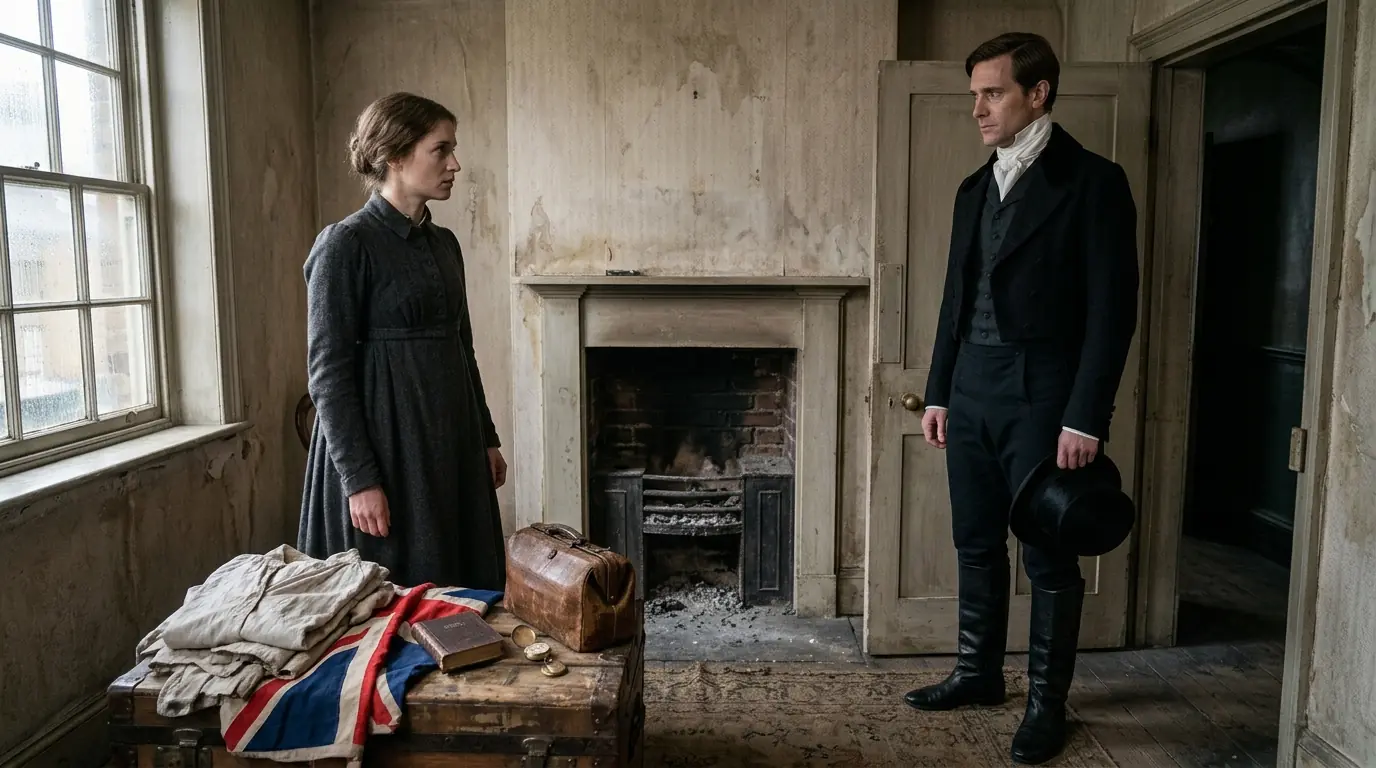
It was supposed to be a transaction, a roof in exchange for a cleared conscience. But guilt is a terrible foundation for a marriage, and proximity is a dangerous thing. The smell of boiled cabbage and damp wool was suffocating. Harriet Cavendish stood in the center of the cramped London sitting room, a stack of worn woolen shirts in her arms, Edward's shirts.
She pressed her face into the fabric. They didn't smell like him anymore. They just smelled like the cheap lye soap the landlady used. Edward was dead. The phrase still felt like a stone she had to swallow every morning.
He had been gone for six months, cut down at Waterloo, leaving Harriet with nothing but a folded flag, a rusted pocket watch, and a mountain of boarding house debt. At twenty-eight, Harriet was practically ancient in the eyes of society. She had never possessed the sort of startling beauty that made men overlook a lack of dowry. Her hair was a sensible dishwater brown. Her jaw was a little too sharp, her eyes a little too assessing.
She was a spinster. The word didn't sting anymore. It was merely a fact of her geography, like the relentless rain streaking the warped glass of her window. A sharp rap at the door shattered the quiet. Harriet didn't move.
"Mrs. Higgins, I told you I will have the rent on Tuesday. I am selling the silver candlesticks tomorrow." The door opened. It wasn't the landlady. Sebastian Ashcroft, the Duke of Whitmore, had to duck his head to clear the low door frame.
He looked entirely absurd in the dingy room. His dark wool coat was immaculately tailored, absorbing the meager light. His boots were polished to a mirror shine, tracking a single offending leaf onto the threadbare rug. Harriet dropped the shirts onto a trunk. "Your Grace."
Sebastian didn't offer a bow. He just stared at her. He looked exhausted. There were deep, bruised shadows beneath his eyes, and the harsh line of his mouth suggested a man who spent his days clenching his teeth against a persistent ache. He was Edward's commanding officer, Edward's best friend, and according to the letters Edward used to send, the man who had held him as he took his last breath.
"Miss Cavendish." His voice was gravel, low and scraped raw. "Pack your things." Harriet blinked. "I beg your pardon?"
"Your lease here is terminated. The arrears have been paid. My carriage is waiting downstairs. You will come with me to Whitmore House." She let out a dry, incredulous laugh.
She crossed her arms, anchoring her feet to the floorboards. "I most certainly will not. I appreciate your charity, Your Grace, but I do not require a guardian. I have secured a position in Bath as a companion to an elderly dowager. I leave next week."
"You are not going to Bath to fetch a deaf woman's lapdog." Sebastian said flatly. He stepped further into the room. The space felt instantly smaller. Edward asked me to look after you.
“Edward is dead.” The words cracked like a whip. She hadn't meant to sound so vicious, but the grief was a live wire. Sebastian flinched. It was a minuscule movement, just a tightening of the skin around his eyes, but she saw it.
“I am aware,” he said softly. “I buried him.” But before he closed his eyes, I gave him my word. I told him you would never want for anything. I don't want for anything now.
I have a plan. A plan to live in servitude. Sebastian closed the distance between them. He smelled of rain, expensive leather, and something metallic. Fear, maybe.
Or exhaustion. “Marry me, Harriet.” The silence in the room became absolute. A carriage rattled past on the cobblestones outside. “You are out of your mind,” she whispered.
“I am remarkably lucid.” He didn't drop his gaze. I need a wife. The peerage demands an heir, and my aunts are circling like vultures, waving debutantes in my face at every turn. I have no interest in courtship.
I have no interest in love. I want a quiet life. You need a home, financial security, and protection from a world that is exceptionally cruel to unmarried women without means. It was the most unromantic proposal in the history of England. Harriet respected him for it.
“A transaction,” she said. “A partnership.” I am not a beauty, your grace. Nor am I docile. If you want a quiet life, you are knocking on the wrong door.
“I don't want a porcelain doll,” Sebastian countered, his voice losing a fraction of its iron control. “I want Edward's sister. I want to know that I kept the only promise that matters to me anymore." Harriet looked at him. Really looked at him.
She saw the guilt eating him alive. He wasn't offering her a rescue. He was offering himself a penance. He wanted to shackle himself to a plain impoverished spinster because he felt he didn't deserve happiness after Edward died. She was to be his living hair shirt.
Pride told her to point him to the door. Pride told her to pack her single valise, go to Bath, and read Bible verses to an old woman until she died of boredom. But Harriet was cold. She was so terribly bone-deep cold. And she had been hungry for three days.
She looked at the peeling wallpaper. She looked at the Duke's heavy wool coat. "I will not be a ghost in your house," she said quietly. "You will be the Duchess of Whitmore," he replied. "You will answer to no one."
She held his gaze for a long moment. She didn't offer her hand. She didn't smile. "Fine. Give me five minutes to pack."
They were married three days later in a cavernous empty church in Mayfair. The vicar rushed through the liturgy, clearly offended by the lack of flowers, music, and guests. Harriet wore a dark blue traveling gown, the nicest thing she owned, though the hem was frayed. Sebastian wore stark black. He looked less like a groom and more like a man facing a firing squad.
When he slid the heavy gold band onto her finger, his skin was ice cold. He didn't kiss her. The vicar did not suggest it. Within an hour of the I dos, they were in a carriage heading north to his sprawling estate in Derbyshire. The journey took four days.
They spoke perhaps a hundred words in total. “Are you warm enough?” Yes, thank you. We will stop at the next inn for dinner. Very well.
It was excruciating. Harriet spent the hours staring out the window at the passing countryside, watching the green hills blur into gray rain. She felt entirely unmoored. Harriet Cavendish, the pragmatic spinster, had vanished into the ether, replaced by her grace, the Duchess of Whitmore. A title that felt as heavy and unwieldy as a stolen crown.
When they finally turned onto the miles-long gravel drive of Ashcroft Hall, Harriet felt a heavy weight drop into her stomach. The house was not a home. It was a fortress, vast, imposing, built of dark, weathered stone that seemed to drink the meager afternoon light. Dozens of windows stared out like empty eyes. As the carriage pulled to a halt, a small army of servants filed out the grand double doors, lining up with military precision.
Sebastian stepped out first, offering her his hand. She took it. His grip was firm, impersonal. "Welcome to Ashcroft Hall," he said, his voice flat. He led her up the stone steps.
The housekeeper, a severe woman with a ring of heavy iron keys at her waist, curtsied deeply. "Your grace, welcome home. And welcome, your grace." The woman's eyes darted over Harriet's plain blue dress, taking in the lack of a maid, the single scuffed trunk the footman was hauling from the boot, Harriet lifted her chin. She knew what they saw.
A charity case. A bizarre misstep by their stoic master. "Show my wife to her chambers." Sebastian ordered, not looking at Harriet. "I will be in my study.
I'm not to be disturbed." Without another word, he turned and walked down a long, echoing corridor. The sound of his boots on the marble floor faded into the shadows. Harriet was led up a sweeping, grand staircase to the Duchess's suite. The rooms were staggering.
High ceilings plastered with intricate gold leaf, walls lined in pale green silk, a fireplace large enough to roast a pig, and a bed draped in heavy velvet. It was beautiful. It was terrifying. She stood in the center of the vast carpet, clutching her small reticule. The silence of the house pressed against her eardrums.
She had traded the noisy, cramped poverty of London for an absolute, gilded isolation. That evening, they dined at opposite ends of a table that could comfortably seat thirty. The distance between them was comical. A massive silver candelabra sat dead center, obscuring Sebastian's face. Harriet could only see his hands as he methodically cut his meat.
The footmen hovered like ghosts, silently replacing plates and refilling crystal goblets. The clink of silver against porcelain was deafening. Harriet chewed a piece of roasted pheasant. It tasted like ash. She swallowed hard, pushing her plate away.
She couldn't do this. She could not live forty years in a mausoleum, pantomiming a marriage with a man who couldn't bear to look at her. "Is the food not to your liking? Sebastian's voice floated down from the other end of the mahogany expanse. The food is fine, Harriet said, projecting her voice so it carried.
“The geography is the problem.” Sebastian leaned slightly to the left, peering around the silver candelabra. “Excuse me?” “I said, the geography. You are practically in Scotland, Sebastian.
If you want me to pass the salt, I should have to hire a postboy.” He stared at her. It was the first time she had used his Christian name. It felt strange on her tongue, intimate and sharp. This is how my parents dined, he said stiffly.