The first thing the backhoe uncovered was not dirt.
It was stone.
Not the loose limestone that turned up everywhere in that part of Kansas.
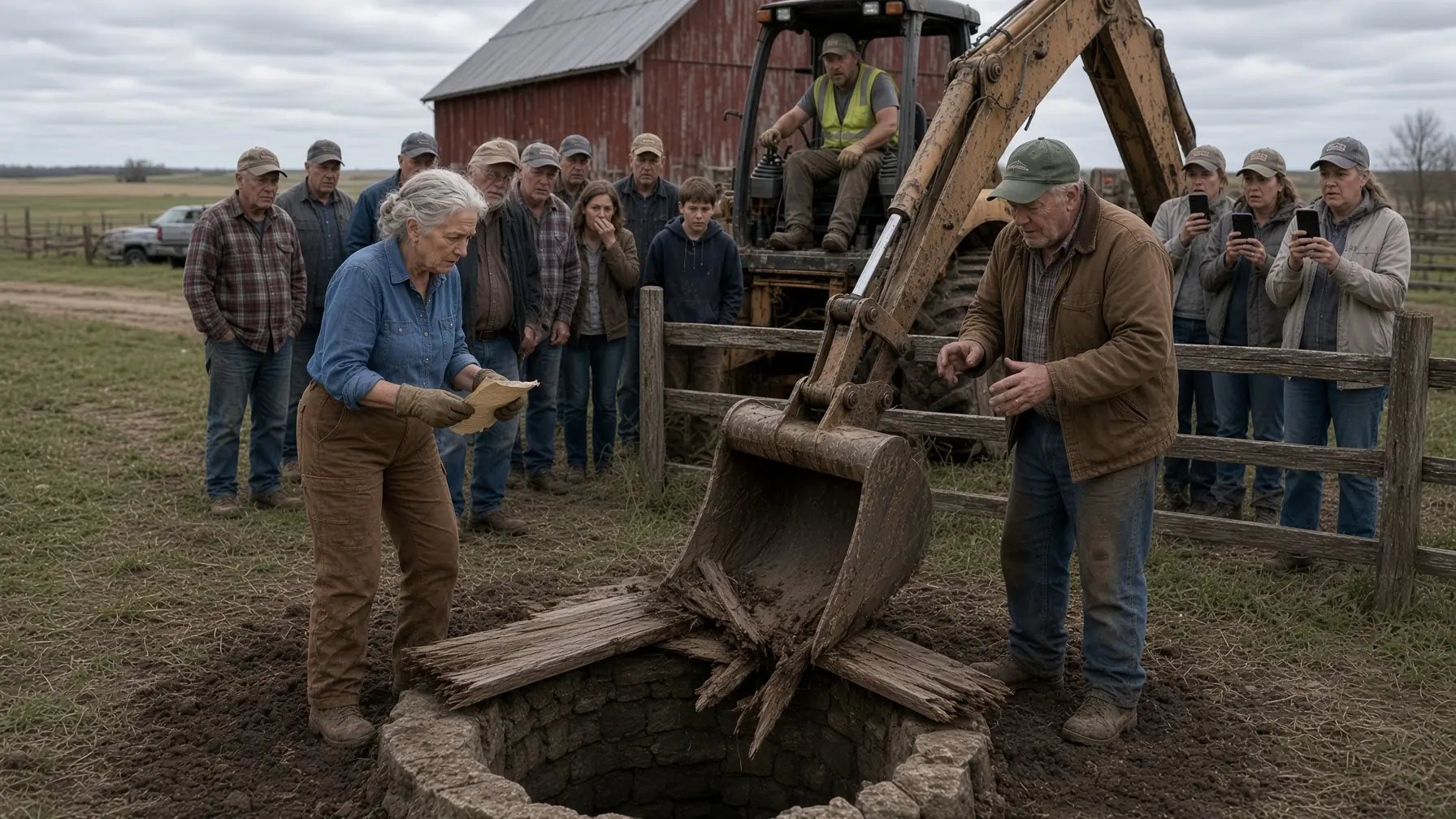
This was different.
Square.
Dressed.
Fitted.
The machine operator shut down the engine and climbed out of the cab.
Edith Hargrove stood beside the excavation wearing mud-caked boots, work gloves, and the faded green jacket she had owned since her husband was alive.
“What is it?” she asked.
The operator pointed down.
“Someone built this.”
Edith climbed carefully into the shallow cut.
She was sixty-three, strong enough to manage a 240-acre farm but old enough to know that wet clay could put a person on the ground without asking permission.
She knelt beside the exposed block.
Brushed soil from its face.
Then stopped.
Chisel marks.
Straight.
Even.
Deliberate.
The stone had been cut by hand and set as part of something larger.
Behind the fence, Glen Talbot stood beside his pickup.
Three days earlier, Glen had laughed when Edith hired the backhoe.
Now he was not laughing.
The old well behind the Hargrove barn had been capped for almost seventy years.
Everyone in Millbrook Crossing knew that.
Children were warned to stay away from the rotten boards above it.
Farmhands used the old stone ring as a landmark.
Nobody remembered anyone drawing water from it.
The accepted explanation was simple.
The well went dry.
Edith’s father sealed it.
End of story.
At least that was what everyone believed until the backhoe bucket cut three feet deeper and struck iron.
The operator climbed back into the machine.
Worked slowly.
The dirt peeled away.
A rusted pipe appeared beside the old shaft.
Not vertical.
Horizontal.
It ran away from the well toward the lower hayfield.
Glen crossed the fence without asking.
He stared into the excavation.
“That doesn’t make sense.”
Edith looked at him.
“What part?”
“It’s a well.”
“So?”
“Why would a well have a pipe going sideways?”
Edith rubbed mud between her fingers.
“That,” she said, “is what I paid the backhoe to find out.”
The laughter had started the previous Monday.
Glen saw the equipment arriving and drove his truck across the field.
He rested both arms on the fence.
“Edith.”
She looked over.
“What?”
“You lose something?”
“No.”
“Then why are you digging up that old well?”
“Because it’s there.”
Glen laughed.
“That thing’s been dry since Eisenhower.”
“So everyone says.”
“Your father capped it.”
“I know.”
“He probably had a reason.”
“Probably.”
“You planning to spend five thousand dollars proving him right?”
Edith looked toward the old boards.
“Maybe.”
Glen removed his cap and wiped his forehead.
“You always this stubborn?”
“Yes.”
That answer traveled through town faster than the backhoe could dig.
By noon, the feed store knew.
By two o’clock, the co-op knew.
By evening, someone at Rosie Turner’s café had decided Edith believed treasure was buried beneath the barn.
Another person claimed she had hired a dowser.
A third insisted the state had found oil.
None of it was true.
Edith corrected none of it.
She had learned long ago that explaining a thing too early only gave people more material to argue with.
The truth was sitting inside her kitchen.
A water-stained ledger.
And one sentence written in pencil.
Edith found the ledger inside her grandmother’s cedar chest.
The chest had been moved from room to room for forty years.
First her grandmother’s house.
Then Edith’s parents’ place.
Then the Hargrove farmhouse after Edith’s mother died.
Nobody had opened it seriously in years.
When Edith finally did, she found quilts.
Old letters.
A wedding dress yellowed at the collar.
Receipts.
Seed catalogs.
And three farm ledgers tied with cotton string.
The oldest belonged to her grandmother, Irene Hargrove.
Irene married into the family in 1934.
The Dust Bowl years.
Edith knew the family stories.
Blowing soil.
Dead calves.
Wheat fields that failed.
Women hanging wet sheets over windows to keep dust out of babies’ lungs.
But Irene’s ledger was different from the stories.
It was practical.
Rainfall.
Hay yields.
Planting dates.
Cattle losses.
Well depths.
Dates of dust storms.
Pages of measurements written by a woman who had been raising children while the world outside turned brown.
Near the middle of one ledger, Edith found a page labeled:
Summer 1936 — Lower Water Work
Below it was a name.
E. Holt — Soil Conservation
Then several numbers.
Elevation notes.
Distances.
And one sentence written lightly in pencil:
The well remembers what the fields forgot.
Edith read it twice.
Then again.
She had no idea what it meant.
That was why she started digging.
Her son Matthew did not approve.
He lived in Wichita and worked for an engineering contractor.
When Edith told him she planned to reopen the old well, he was silent for almost ten seconds.
Then:
“Mom.”
“Yes.”
“Please tell me you’re not climbing into an abandoned well.”
“No.”
“Good.”
“I hired a backhoe.”
Another pause.
“That was not the part I was hoping to hear.”
She explained the ledger.
Matthew listened.
Then said:
“That sentence could mean anything.”
“I know.”
“It could mean nothing.”
“I know.”
“You’re spending money based on one line written ninety years ago.”
“Not one line.”
“What else?”
“Measurements.”
“What kind?”
“I don’t know yet.”
Matthew sighed.
“Then call the extension office before you turn your farm into an archaeological site.”
Edith did.
The first person she reached asked about well abandonment permits.
The second explained that reopening an old water structure might require county review depending on what it was and how it connected to groundwater.
Edith answered:
“That’s why I’m trying to figure out what it was.”
The clerk said:
“Please don’t enter the shaft.”
Edith promised.
She meant it.
Mostly.
The side pipe changed everything.
An ordinary farm well was supposed to bring water up.
This one appeared designed to send water out.
That evening, Edith spread Irene’s ledger across the kitchen table.
She traced the old measurements with one finger.
Thirty-two feet south.
Eighteen west.
Grade fall.
Lower field.
She had spent her entire life on the farm.
Suddenly, familiar ground looked like a coded map.
She drove to the Millbrook County Historical Society the next morning.
The volunteer at the desk, a retired librarian named Nora Bishop, listened to Edith’s question.
“Do you have Soil Conservation Service records from the thirties?”
Nora raised an eyebrow.
“Specific enough to be dangerous.”
“I have a name.”
“What name?”
“E. Holt.”
Nora disappeared into the back room.
She returned with nothing.
Then tried courthouse storage.
Nothing again.
Finally she remembered several boxes transferred from an old county agricultural office years earlier.
They were in the basement.
Dusty.
Poorly indexed.
One box smelled strongly enough of mildew that Nora insisted they open it near a fan.
Edith spent two afternoons reading reports.
Most were useless to her.
Erosion surveys.
Windbreak proposals.
Contour farming demonstrations.
Farm pond plans.
Then she found a typed sheet with a heading from 1936.
Demonstration Water-Conservation Installation — Hargrove Farm
Edith sat down.
The report described a cooperative project carried out during the early years of federal soil-conservation work.
The Hargrove property had been selected because the lower fields repeatedly retained moisture after neighboring ground dried.
A field engineer named Edwin Holt had identified a shallow seep along a limestone layer.
The project objective was not to drill a deep well.
It was to intercept that shallow water.
Collect it.
Filter sediment.
Then distribute limited flow by gravity to low areas where it could support livestock water and maintain soil moisture during dry periods.
Edith read the page three times.
Then whispered:
“You clever woman.”
Nora looked over.
“Who?”
“My grandmother.”
Work became harder immediately after the discovery.
Three inches of spring rain turned the excavation into a mud pit.
One wall slumped.
Two days of careful exposure disappeared beneath wet soil.
The rental pump seized after pulling silt for less than an hour.
A repair shop in Newton kept it overnight.
Glen appeared at the fence again.
This time he did not laugh.
“You’re going to hurt yourself chasing this.”
Edith stood beside the muddy hole.
“That concern almost sounds sincere.”
“It is.”
“Thank you.”
“You still going?”
“Yes.”
“Of course you are.”
He shook his head.
Then left.
The next afternoon, he returned carrying two lengths of drainage hose.
Edith looked at them.
“What’s that?”
“Your hose is too short.”
“I thought I was wasting my time.”
“You can waste it with proper equipment.”
That was the closest Glen came to admitting curiosity.
Matthew arrived Friday night intending to stay one day.
He brought work boots because he knew his mother well enough not to pretend he would remain clean.
Saturday morning, he saw the cut limestone.
Then the horizontal pipe.
Then Irene’s ledger.
He crouched beside the exposed work for almost twenty minutes.
Finally:
“This isn’t a normal well.”
Edith handed him coffee.
“I know.”
“Why didn’t Grandpa ever tell you about it?”
“He was born after it was built.”
“He capped it.”
“Maybe he didn’t understand it either.”
Matthew looked toward the field.
“Where does the pipe go?”
“That’s tomorrow’s problem.”
He stayed three days.
By Sunday afternoon, the man who had driven from Wichita to prevent his mother from digging was operating the post-hole auger while Edith marked possible pipe locations with orange flags.
The old county plat made things more confusing.
It showed a line running south toward a pond that no longer existed.
But the actual buried pipe bent west.
Toward a shallow swale beside the old windbreak.
That swale had always been strange.
Even in dry August weather, the soil there stayed softer than surrounding ground.
Edith’s father avoided driving loaded wagons through it.
Nobody knew why.
The family explanation was simply:
“That place holds moisture.”
Now Edith wondered whether the moisture had been arriving deliberately.
The backhoe followed the pipe carefully.
Iron for a section.
Then older clay tile.
Some broken.
Some packed with roots.
Twenty yards farther west, the line disappeared beneath the windbreak.
Matthew looked at the old map.
“This says south.”
Edith looked at the trench.
“The ground says west.”
“So either the map is wrong—”
“Or Holt changed the design.”
Matthew smiled.
“You sound happy about that.”
“I like people who change their minds when the dirt disagrees.”
The biggest discovery came inside the original well structure.
Once the collapsed fill had been removed safely and the walls stabilized enough for inspection from above, they found the shaft was wider on one side.
Not round.
A small chamber extended toward the limestone shelf.
Stonework formed a low intake gallery.
Inside were layers of coarse gravel.
Smaller stone.
Dark carbon-rich material that might once have included charcoal.
The arrangement was not a modern water-treatment system.
It was a sediment-control structure.
Water seeping through fractured limestone could enter slowly.
The gravel kept larger material out of the pipe.
The lower flow reduced silt.
The side chamber protected the outlet.
Edith stared down into it.
“My grandmother called this a well.”
Matthew said:
“Probably because ‘shallow limestone interception gallery’ doesn’t fit well into dinner conversation.”
Edith smiled.
“Your grandmother would’ve called it that.”
This time Edith called the extension office with a different request.
“I need someone who understands shallow groundwater and old agricultural water systems.”
Two days later, Dr. Leah Monroe arrived.
She was thirty-eight and worked with a state-university extension partnership on rural water and soil management.
She brought testing equipment.
Maps.
A groundwater probe.
And the cautious expression of someone who had learned never to trust a homeowner’s description of an “ancient engineering system” before seeing it.
Twenty minutes later, the expression changed.
“This is real.”
Edith folded her arms.
“I assumed so.”
“No.”
Leah pointed toward the stonework.
“I mean this is unusually intact.”
She studied the old report.
Then the elevation.
Then the pipe.
“What Holt found was probably a perched water-bearing layer.”
Matthew asked:
“Meaning?”
“A shallow zone where water accumulates above a less permeable layer.”
“Not the main aquifer?”
“Probably not.”
Leah looked at Edith.
“That matters.”
“Why?”
“Because this system may have been drawing from a small local seep that responds differently from deeper groundwater.”
“It’s not infinite.”
“It won’t irrigate two hundred acres.”
“It may not even flow strongly year-round.”
“But if the gradient is right…”
She looked toward the lower field.
“It could have supplied a steady trickle to selected areas.”
Edith asked:
“For ninety years?”
Leah smiled.
“The geology has been here longer than your family.”
“The question is whether the system survived.”
It had.
Not perfectly.
Not completely.
But enough.
Root intrusion blocked several clay sections.
One iron junction had collapsed.
Sediment filled a lower outlet.
Another line had been cut decades earlier when a fencepost was installed.
The crew spent two weeks tracing what remained.
They did not simply reconnect everything.
Leah insisted on water testing first.
Bacteria.
Nitrates.
Basic chemistry.
The water was not approved automatically for household drinking.
That had never been Edith’s main goal.
For agricultural use and controlled field-moisture applications, the results were more encouraging.
The flow was small.
A fraction of what a modern irrigation pump could deliver.
But it was consistent.
Gravity moved it.
No electricity.
No diesel.
No pressure pump running all summer.
Just elevation.
Edith finally understood several mysteries from childhood.
Why one strip of hay stayed green longer.
Why the west swale remained soft.
Why corn planted near the lower field sometimes survived hot weeks better than corn fifty yards uphill.
The old system had not been irrigating the entire farm.
Nothing so dramatic.
It had been quietly adding moisture to selected low areas.
A little water.
Repeated over time.
Enough to matter.
At some point, the system partially clogged.
Later generations forgot the pipe routes.
Her father saw a dangerous old shaft and capped it.
A reasonable decision with the information he had.
The water kept moving through the limestone.
The farm kept benefiting in small ways.
But the explanation disappeared.
The fields remembered.
The family forgot.
Now Irene’s sentence made sense.
The well remembers what the fields forgot.
Word spread.
Again.
This time nobody was laughing.
Farmers came after dinner to look.
Some stood at the edge of the excavation with arms crossed.
Others asked Leah questions.
Glen appeared almost every evening.
One day he stared at the stone chamber.
“I’ve farmed next door fifty-two years.”
“I never knew this existed.”
Edith said:
“I lived here sixty-three.”
“I didn’t either.”
“That make you feel better?”
“No.”
“Good.”
He smiled.
Then became serious.
“My grandfather talked about Hargrove hay staying green in ’54.”
Edith looked at him.
“Drought year?”
“Bad one.”
“He said your place had some trick.”
“Nobody remembered what?”
“No.”
Glen looked down into the stonework.
“Guess the trick was plumbing.”
“Patient plumbing.”
The historical society became involved next.
Nora found additional photographs.
One showed three men standing beside a trench in 1936.
Another showed Edith’s grandmother.
Irene Hargrove.
Twenty-four years old.
Work dress.
Boots.
Hair tied back.
She stood beside Edwin Holt holding a clipboard.
On the back someone had written:
Mrs. Hargrove insists west outlet lower than survey indicates. Engineer checking grade.
Matthew laughed when he read it.
“Runs in the family.”
Edith took the photograph from him.
“What?”
“Arguing with engineers.”
She looked at the image.
“No.”
“She was right.”
A later field note confirmed it.
The original route toward the southern pond had been changed after additional level measurements showed the western swale provided a better gravity fall.
Edwin Holt revised his drawing.
That explained why the old plat did not match the actual line.
The engineer had changed course when the land contradicted the paper.
Edith liked him immediately for that.
Restoration took most of the summer.
They did not rebuild every original element.
Some clay pipe was too fragile.
Modern food-grade or agricultural-rated pipe replaced failed sections where appropriate.
The historic stone chamber remained.
Original materials were documented before any alteration.
The open shaft received a secure modern cover.
A sampling point was installed.
Flow was measured.
The system was divided so water could be directed only where it was useful.
No one pretended 1936 engineering should be preserved blindly simply because it was old.
The principle mattered more than nostalgia.
Gravity.
Slow flow.
Low energy.
Water placed where it produced the most value.
By August, the difference could be seen.
Not from the highway.
Not dramatically.
The Hargrove farm did not transform into a green oasis while every neighboring field turned brown.
That would have been a lie.
Rainfall still mattered.
Soil still mattered.
The system’s total flow was limited.
But the lower hayfield held moisture longer.
One livestock-water point remained more reliable.
A strip near the windbreak stayed productive through several hot weeks without pumping water from the deep well.
Edith kept records.
Flow rate.
Rainfall.
Soil moisture.
Temperatures.
Hay yield.
She refused to claim success based on color alone.
Leah approved.
“You’re becoming annoying.”
Edith looked at her.
“Because I take measurements?”
“Because you call me whenever they don’t match your theory.”
“Isn’t that your job?”
“It was quieter before I met you.”
By October, people who had mocked Edith in May were asking about their own old wells.
She gave all of them the same warning.
“Do not start digging because mine was interesting.”
First:
Find records.
Understand the structure.
Check permits.
Make sure old wells are handled safely.
Assume nothing about water quality.
Have dangerous shafts evaluated properly.
Some old capped wells were simply old capped wells.
One farmer excavated around his and found nothing but a deteriorated stone shaft.
Another found an abandoned cistern.
A third uncovered a tile drainage line unrelated to irrigation.
Edith considered that just as important.
The lesson was not:
Every old well hides a secret.
The lesson was:
Ask before assuming.
Glen came over one Saturday with his grandson.
The boy was thirteen and fascinated by the stonework.
“Did people really build all this by hand?”
“Mostly.”
Edith said.
“Why?”
“Because pumps and electricity weren’t always available.”
“Is old stuff better?”
“No.”
That answer surprised him.
Edith continued.
“Some old things are brilliant.”
“Some old things are dangerous.”
“The trick is figuring out which is which.”
Glen looked at her.
“That should probably be written somewhere.”
“It is now.”
Matthew returned to Wichita at the end of summer.
He had not changed his entire career because of one excavation.
Life was not that tidy.
But he began taking additional coursework related to water resources and agricultural systems.
On weekends, he came back to help install monitoring equipment.
One evening, mother and son sat on the barn steps.
Matthew looked toward the old well.
“You really would’ve dug even if I told you not to.”
“Yes.”
“You know that’s irritating.”
“Yes.”
“What if it had been nothing?”
Edith thought.
“Then I would’ve paid too much money to learn it was nothing.”
“That wouldn’t bother you?”
“It would.”
“But not as much as wondering for twenty years.”
Matthew nodded.
Then:
“Grandma Irene would’ve liked this.”
“You never met her.”
“No.”
“But I’ve met you.”
Edith smiled.
“Smart mouth.”
“Runs in the family.”
The county historical society eventually documented the Hargrove installation as a surviving example of Depression-era soil and water conservation work.
Not the only one in Kansas.
Not a lost technology that modern engineers had somehow forgotten.
That kind of exaggeration irritated Leah.
Instead, it was valuable because it showed how farmers and early conservation workers adapted simple principles to specific land.
Topography.
Geology.
Gravity.
Local materials.
Patient observation.
University students visited.
Extension agents brought small groups.
They discussed modern equivalents.
Drainage-water management.
Spring development.
Soil-moisture conservation.
Low-energy distribution.
Not because everyone should rebuild 1930s systems.
Because old solutions sometimes revealed questions modern systems had become too powerful to ask.
How little energy could the job require?
Where did water naturally want to go?
How much was enough?
Could storage, timing, and gravity reduce pumping demand?
Those were current questions hiding inside old stone.
The following summer was dry.
Not catastrophic.
But dry enough that everyone watched the sky.
Glen’s deep irrigation well ran more often.
So did several others.
Edith used hers too.
The restored gravity system did not replace it.
But every gallon arriving without pumping was a gallon she did not have to lift from deeper ground.
Her lower hayfield stayed productive several weeks longer.
The livestock point supplied water steadily.
The difference was modest.
On a farm, modest differences paid bills.
Glen noticed.
One evening he leaned on the same fence where he had laughed the previous spring.
“You know what bothers me?”
“Several things, probably.”
“I’m serious.”
“So am I.”
He pointed toward the old well.
“I remember your father covering that.”
Edith looked at him.
“You were there?”
“I was twelve.”
“He hired my dad to help.”
“What did he say?”
Glen thought.
“Called it dangerous.”
“Said nobody used it.”
“Did he say it was dry?”
Glen frowned.
“No.”
Edith stared.
“Everyone always said it was dry.”
“Maybe we added that part later.”
That sentence stayed with her.
Maybe we added that part later.
Families did that.
Communities too.
One generation forgot the details.
The next filled the gaps with the simplest explanation.
Then repetition hardened explanation into history.
The well was dry.
Her father capped it because it was useless.
Nobody said those exact words.
Eventually everybody remembered them.
That was how certainty sometimes formed.
Not from evidence.
From repetition.
Edith returned to Irene’s ledger that night.
She read pages she had skipped before.
Crop failures.
Dust storms.
A sick child.
A cow lost during calving.
Then another entry from August 1936.
Holt says flow small. Told him small is more than none. Lower hay holding.
Edith smiled.
There it was.
The entire project in one sentence.
Small is more than none.
Modern agriculture often thought in horsepower.
Gallons per minute.
Acres per hour.
Tons.
Bushels.
Scale.
Irene had lived in a time when survival meant respecting small advantages.
A few more days of green hay.
A reliable stock tank.
Moisture held in the right soil.
Enough water delivered without fuel.
Nothing spectacular.
Just useful.
Three years after Edith first lifted the lid of the cedar chest, the old well no longer looked abandoned.
A secure steel cover protected the shaft.
A small plaque near the barn described the 1936 project.
The original stone chamber remained beneath it.
Flow monitoring equipment sat nearby.
The distribution lines disappeared underground exactly as they had for generations.
Most visitors expected something visually impressive.
A rushing spring.
A huge cistern.
Some dramatic underground river.
Instead Leah usually showed them a modest stream of water entering a measuring container.
“That’s it?”
Someone would ask.
Edith always enjoyed the disappointment.
“That’s it.”
“But how does that help?”
“It keeps doing it.”
“Every minute.”
“Every hour.”
“When conditions support the seep.”
“Gravity doesn’t send a fuel bill.”
That usually changed the expression.
One afternoon, a high-school agriculture class visited.
A girl named Hannah stayed after the others.
She stared at Irene’s original ledger inside a protective sleeve.
“Why did your grandmother write everything down?”
Edith considered.
“Because memory lies.”
The girl looked surprised.
“Not always on purpose.”
Edith continued.
“But people simplify things.”
“Paper helps argue back.”
Hannah pointed toward the pencil sentence.
“The well remembers what the fields forgot.”
“What did she mean?”
Edith looked through the barn doorway toward the lower field.
“I think she meant that the land keeps evidence longer than people keep explanations.”
The girl smiled.
“That sounds like something for a book.”
“My grandmother put it in a farm ledger.”
“Better place for it.”
Edith agreed.
Glen never stopped teasing her completely.
That would have been unnatural.
At the co-op one morning, he told three men:
“I supported the well project from the beginning.”
Edith stood behind him.
“You laughed for forty minutes.”
Glen turned.
“I was encouraging skepticism.”
“You called it a hole with retirement benefits.”
“That was supportive.”
The men laughed.
Edith did too.
She no longer needed anyone to remember the beginning correctly.
She had records.
Years later, Matthew asked what made her keep going when everyone thought the project was foolish.
They were repairing fence near the windbreak.
Edith thought about the obvious answer.
Her grandmother’s ledger.
But that was only part of it.
Finally she said:
“The sentence made me curious.”
“That’s all?”
“No.”
She pointed toward the field.
“I’d lived here my whole life.”
“I knew that swale stayed wet.”
“I knew the lower hay lasted longer.”
“I knew the old well was built better than a useless hole needed to be.”
“I just never put those things beside each other.”
Matthew nodded.
“So Grandma gave you the missing piece.”
“No.”
Edith smiled.
“She gave me permission to ask whether the pieces belonged together.”
That was different.
And more important.
People eventually called the Hargrove well a discovery.
Edith disliked that word slightly.
The well had never been lost.
It sat behind the barn where everyone could see it.
The damp swale had never been hidden.
The greener hay had been visible every dry summer.
The old pipe was beneath the same soil the family crossed every day.
Irene’s ledger had waited inside a chest less than fifty feet from Edith’s kitchen.
Nothing had vanished.
Only the connection between the pieces had.
That was what Edith recovered.
Not a magical source of water.
Not forgotten technology capable of solving modern drought.
A connection.
A shallow limestone seep.
A carefully built intake.
A gravity line.
A grandmother’s measurements.
An engineer willing to redraw his plan when the slope proved him wrong.
A family that had benefited from the system long after forgetting it existed.
The practical value was real.
But the larger lesson mattered more.
Evidence does not become worthless because nobody has looked at it recently.
Old knowledge does not become wisdom merely because it is old.
And skepticism is useful only until it becomes an excuse not to investigate.
Edith spent money.
Made mistakes.
Lost two days of excavation to rain.
Broke a pump.
Found collapsed pipe.
Paid for testing.
Rejected assumptions she had hoped would be true.
Some parts of Irene’s notes turned out incomplete.
One map was wrong.
One outlet no longer existed.
The original system needed modern repair to operate safely.
That was the actual work.
Not believing.
Checking.
Again and again.
One evening, long after the visitors had gone, Edith walked behind the barn alone.
The sun had dropped low.
Kansas wind moved across the hay.
She stood beside the old well and rested one hand on the steel cover.
For most of her life, it had been a dead thing.
At least in her mind.
A dangerous hole.
Family junk.
One more piece of farm history nobody needed.
Then a pencil sentence changed the question.
Not the answer.
The question.
That was enough.
Edith looked toward the west swale.
Green still lingered along the low ground.
She imagined Irene standing there in 1936 beside Edwin Holt.
Young.
Dust on her dress.
Watching men dig through limestone while neighbors probably wondered why anyone would spend effort on a trickle of water.
Maybe they laughed too.
Edith hoped so.
It made the story feel properly inherited.
She smiled.
Then said aloud:
“You were right.”
No one answered.
Only wind.
Grass.
And somewhere beneath her boots, a small steady flow of water moving downhill through a line nearly ninety years old.
The well had remembered.
Eventually, someone remembered to listen.