"You want to suspend him for helping my mother?"
The man in the doorway had not raised his voice. That was what made the question so difficult to answer.
Twelve-year-old Oliver Pierce sat opposite the principal with his backpack between his knees and a damp pink attendance notice in his hands. His mother stood beside the window, still wearing the pale blue uniform of the nursing home where she had worked the night shift. On the principal's desk lay a photograph of an empty bus stop, a school rule book, and the plastic identification card Oliver had been told not to touch.
The visitor looked from the notice to Oliver's face. He was tall, silver at the temples, and carried a dark briefcase that appeared too expensive for the scuffed office carpet.
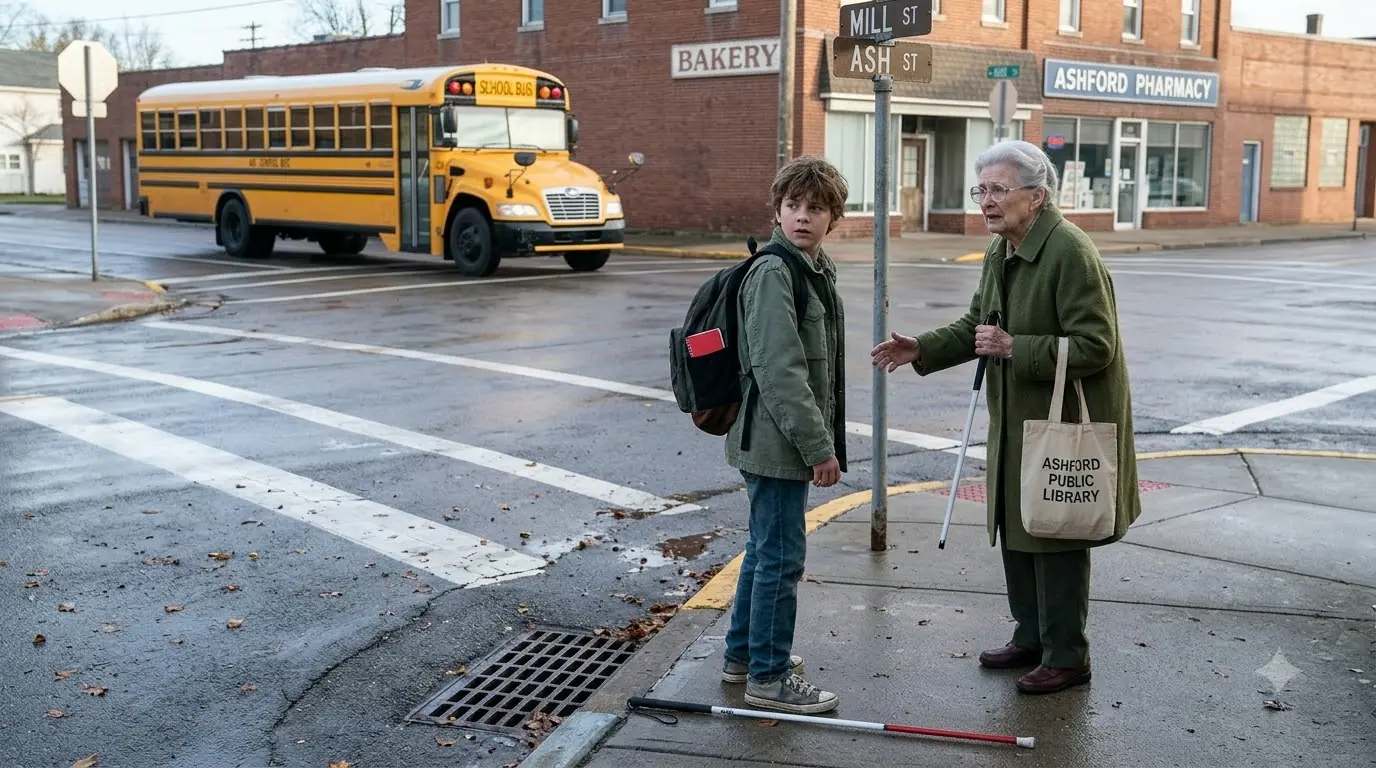
"My mother is Evelyn Hale," he said. "She's seventy-nine. She can barely see a person's outline. Yesterday morning she was stranded near Mill Street with a dead phone and a cane that had broken. This boy stayed with her until somebody came. Are those facts in your report?"
Principal Marisol Kent folded her hands. "Mr. Hale, we're not discussing a suspension. We're discussing an accumulated attendance problem. And I didn't invite you to this meeting."
"No," he said. "You invited the district's transportation director. I came because I learned why you wanted to speak to him."
Oliver looked up sharply. He had never heard the man's name before. Yet the expression on his face suggested that somebody in the room knew a great deal more than Oliver did.
The previous morning had begun with a small, ordinary disaster. A screw had fallen out of the handle of Oliver's mother's lunch carrier, scattering crackers across the kitchen floor at six seventeen. His father, whose left knee had not been right since a warehouse accident, had bent down to retrieve them and found he could not get back up without gripping the stove. The refrigerator had stopped humming again, and the light above the sink blinked twice before settling.
No one in the Pierce house called those things emergencies anymore. They were simply the way a Thursday began.
The family lived in Ashford, Ohio, a brick-and-siding town of nineteen thousand people that had grown around two foundries and then spent thirty years adjusting to their absence. West of the river were newer subdivisions with sidewalks, streetlamps, and school buses that stopped beneath covered shelters. East of it, where the Pierces rented half of an aging duplex, the sidewalks began and ended according to decisions made decades before most of the children using them had been born.
Oliver's mother, Leah Pierce, worked as a certified nursing assistant at Maple Glen Care Center. She was thirty-eight, practical and affectionate in gestures so economical they could be mistaken for impatience. She cut sandwiches into neat halves, remembered every school form, and could tell how frightened one of her patients was by the way that person held a cup. She also forgot to eat when the household bills were due. The second envelope from the electric company had been tucked behind the sugar canister for four days.