Footsteps echoed like gavel strikes against the polished marble floor. Each click a countdown to a confrontation that would shatter a corrupt legacy. In a system where a tarnished badge often acted as an impenetrable shield, one arrogant officer thought he was completely untouchable. He believed the quiet woman sitting in the defendant's chair was just another powerless victim to be trampled and silenced.
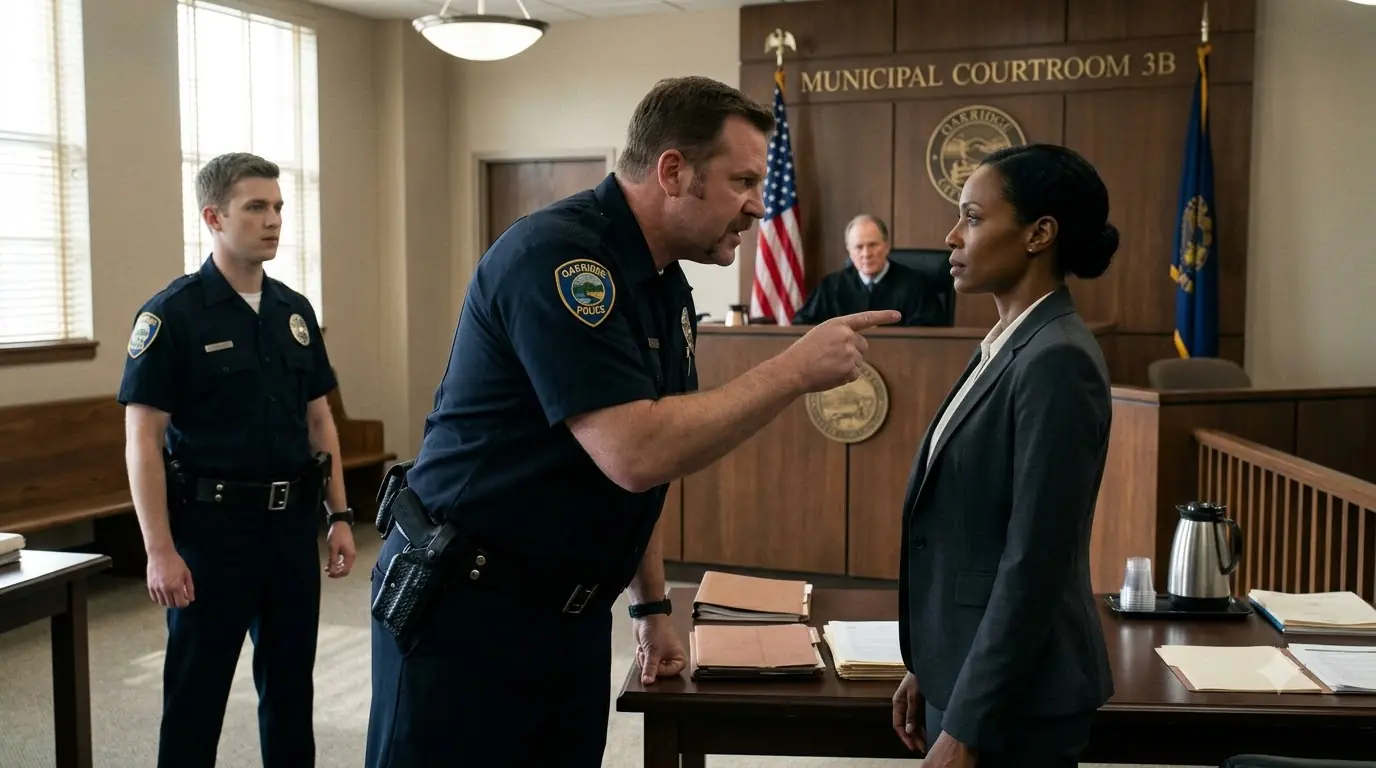
He was dead wrong. What he didn't know was that the woman he was about to brutalize held his entire career and his freedom in the palm of her hand. Morning sunlight struggled to pierce the tall grime caked windows of municipal courtroom 3B in the city of Oakidge. Inside the air was heavy with the scent of cheap lemon floor wax and the stale lingering anxiety of thousands of defendants who had sat on these hard wooden benches before.
Sitting in the second row, leaning casually with one arm draped over the back of the pew, was officer Barnaby Murray. He was a man composed entirely of sharp angles and unearned confidence. His police uniform was pressed to a razor-sharp crease, his brass buttons gleamed, and a meticulously trimmed mustache sat above a perpetual mocking smirk. To the casual observer, he looked the part of a dedicated public servant. To those who knew the streets of Oakidge, Barnaby Murray was a walking nightmare.
Murray had been on the force for 12 years, and in that time, he had amassed an internal affairs file thick enough to use as a doorstop. There were seven separate complaints of excessive force, three allegations of racial profiling, and a dozen more grievances citing insubordination and intimidation. Yet, thanks to a deeply entrenched network of union protections, a willfully blind previous police chief, and a few powerful friends in the local government, Murray had never faced a day of suspension. He had learned early on that the system was a machine. And as long as you knew which gears to grease, you could grind anyone you wanted into the dirt.
Today's trial was supposed to be a routine victory lap. A simple case of obstruction of justice and resisting arrest that he had manufactured from thin air on a rainy Tuesday night 2 months prior. At the defense table sat Veta Jackson. She did not look like the belligerent, aggressive suspect Murray had described in his highly fictionalized police report. Veta was dressed in a tailored, understated charcoal suit.
Her dark hair was pulled back into a neat professional shiny, and her posture was impeccably straight. She wore no makeup that drew attention, no flashy jewelry, and displayed no signs of the nervous twitching typical of people facing criminal charges. She sat with her hands folded cleanly over a yellow legal pad, her dark eyes sharp, observant, and completely devoid of fear. Beside her Alan Wells, a chronically overworked public defender whose tie was slightly askew and whose briefcase looked as though it had survived a war. Alan was flipping frantically through his thin stack of notes, sweating under the harsh fluorescent lights.
He had begged Veta to take a plea deal. "A misdemeanor, a fine, and probation," Alan had whispered frantically in the hallway just 30 minutes earlier. "Murray is a golden boy in this courthouse. Judges love him. Juries believe him.
We don't have dash cam footage because his magically malfunctioned and it's his word against yours. Please, Miss Jackson, you don't want to risk jail time. Veta had only looked at Alan with a calm, almost pitying expression. Her voice is smooth, unwavering tenor. I will not plead guilty to a crime I did not commit.