In the spring of 1887, Clara Bell was given away for two dollars because the town of Red Creek had mistaken silence for emptiness.
She was eighteen years old, slender from too many winters of bad meals, with dark brown hair she usually braided herself and gray eyes that missed almost nothing. Clara had been deaf since birth. She did not hear wagon wheels grinding through dust, market men shouting prices, church bells carrying over rooftops, or the cruel laughter that followed her through town. But she saw mouths curl. She saw shoulders shake. She saw fingers point.
And she understood far more than people thought.
Red Creek sat under the wide Wyoming sky like a handful of buildings someone had dropped into the prairie. There was a mercantile, a blacksmith, a feed store, a church, two saloons, a sheriff’s office, and enough gossip to keep all of them busy. Most people in town had known Clara since she was a child. Very few had ever learned how to speak to her.
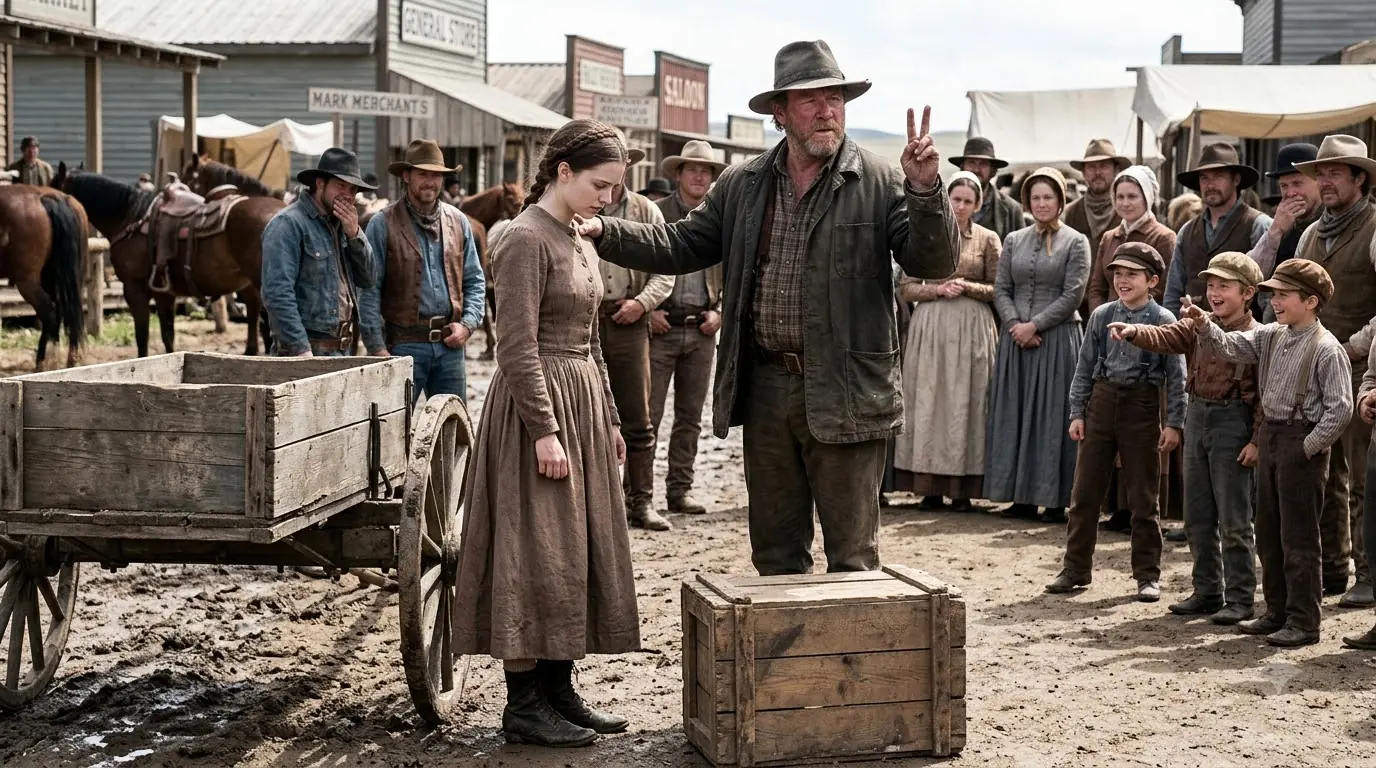
Her mother had tried.
Before fever took both her parents when Clara was nine, Mary Bell had invented a small language between them. Some signs came from gestures learned from travelers. Some came from books. Others belonged only to mother and daughter: two fingers tapped against the heart meant home; a thumb across the palm meant wait; both hands opened toward the sky meant safe. Clara had learned to read lips too, though people spoke too quickly or turned away before finishing.
After her parents died, Clara went to live with her father’s brother, Amos Bell.
Amos was not openly violent. He was something Clara came to fear more: indifferent.
He fed her when he remembered. Gave her work when he needed it. Spoke about her in front of her because he assumed she understood nothing. Over the years, Clara learned to read enough of his mouth to know the words burden, useless, strange, and simple.
By eighteen, she cooked, cleaned, mended harness, kept his chickens alive, remembered accounts better than he did, and could tell from a horse’s nostrils when it was going lame before most men noticed a limp. Amos still referred to her as if she were a chair he regretted inheriting.
That spring, he lost money gambling.
Clara discovered that before he admitted it.
She noticed the empty whiskey bottles increasing. She saw men come to the house after dark. She watched Amos hide letters under the flour bin and count coins twice before buying feed. Then one morning, he told her to put on her brown dress and follow him to town.
She thought perhaps he meant to find her work.
Instead, he stopped beside an old wagon in the market square.
People gathered slowly.
Clara watched Amos climb onto a crate.
His face had the red, swollen look it got after drinking. He spoke loudly, one hand on her shoulder as though presenting livestock. Clara caught only pieces from his lips.
Girl.
Deaf.
Work.
Two dollars.
At first, she thought she had misunderstood.
Then someone laughed.
Another man asked something.
Amos held up two fingers.
Two dollars.
Clara went cold.
The market blurred around her.
She could not hear the cruelty, but she could see it everywhere. Men grinning. A woman covering her mouth. Two boys imitating the way Clara sometimes shaped words she could not hear. One merchant shaking his head as though Amos were foolish not for what he was doing, but for expecting anyone to pay.
Clara looked down.
Her hands were shaking.
She pressed them against the sides of her dress.
That was when Samuel Hayes rode into the square.
Samuel was thirty-eight and looked older when he was tired, which was often. He owned a modest cattle ranch eight miles outside town, mostly by persistence rather than luck. His wife Anna had died in childbirth six years earlier, along with the baby. Since then, Samuel had become known as a man who kept to himself, paid his debts on time, helped with roundups when asked, and left gatherings before anybody noticed he had arrived.
He had come to Red Creek for salt, fence staples, and lamp oil.
Instead, he saw a crowd.
Samuel hated crowds.
He would have ridden past if he had not noticed the girl standing beside Amos Bell.
Clara’s expression stopped him.
She did not look confused.
She looked humiliated.
That mattered.
Samuel dismounted.
“What’s going on?” he asked a man near the wagon.
The man laughed. “Amos is selling his deaf niece.”
Samuel’s face hardened.
“Selling?”
“Well, giving away. Two dollars, apparently.”
Samuel walked through the crowd.
Amos saw him and smiled.
“Hayes. You need help at that ranch of yours?”
Samuel looked at Clara.
She looked back.
He could tell immediately that she was following his face.
Not blankly.
Carefully.
“You understand me?” he asked, speaking slowly.
Clara hesitated, then nodded.
The market went quieter.
Samuel looked at Amos.
“You said two dollars?”
Amos shrugged. “She eats. She works if shown. Doesn’t talk much. Good deal if you ask me.”
Samuel’s jaw tightened.
“She is a person.”
Amos rolled his eyes. “Then treat her like one after you pay.”
For one dangerous second, Samuel considered hitting him.
Then he noticed Clara watching.
He reached into his coat.
Two silver dollars landed in Amos’s palm.
“I’ll take responsibility for her.”
The laughter stopped.
Clara’s face did not change.
Samuel turned toward her and pointed first to himself, then toward his wagon.
He did not touch her.
He did not order.
He waited.
Clara looked at Amos.
Her uncle had already pocketed the coins.
Then she looked at Samuel.
He held out his open hand, not toward her body, but toward the wagon, as if offering a choice he knew was not much of one.
Clara picked up the small cloth bag containing everything she owned.
She walked beside him.
The ride to the Hayes ranch took nearly two hours.
At first, Samuel tried speaking.
He pointed toward the town behind them.
“Red Creek.”
Clara nodded.
He pointed forward.
“Home.”
She looked at him sharply.
Samuel realized the word might frighten her.
He corrected himself.
“My home.”
Then, after thinking, he pointed toward her and raised his brows.
Clara touched her chest.
“Clara,” she mouthed.
Samuel understood.
“Clara.”
She watched his lips carefully.
Then pointed to him.
“Samuel.”
A faint smile touched her mouth.
That was the first moment he realized how much work everyone else had avoided.
She was not unreachable.
They had simply never tried.
The ranch sat in a shallow valley bordered by low ridges and cottonwoods. There was a weathered house, a red barn fading toward brown, a corral, a windmill, and open pasture stretching north toward a line of rocky hills. Samuel kept around sixty head of cattle, three horses, chickens, and an old dog named Boone who distrusted strangers but adored anyone carrying food.
Boone barked when Clara climbed down from the wagon.
She did not react.
Samuel felt foolish for expecting her to.
Then Clara crouched.
She extended her hand.
Boone approached, sniffed, and leaned against her knee within seconds.
Samuel stared.
“Traitor,” he told the dog.
Clara saw his lips move, then saw Boone’s tail.
She smiled again.
Inside, Samuel showed her a small bedroom near the back of the house.
It had once been meant for his wife’s sister during visits. The quilt was faded. The dresser had one uneven leg. But the window faced east, and morning light filled the room.
Samuel pointed to the bed.
Then to Clara.
“Yours.”
Clara touched the blanket.
Her expression changed so slightly he almost missed it.
Then she pointed toward the kitchen, toward herself, and mimed sweeping.
“You think you owe me work?” Samuel asked.