The first thing Caleb Hart heard beneath the blizzard was a child trying not to cry. It came from the old hay barn, beyond the corral where snow had climbed nearly to the top rail, and it stopped him with his lantern halfway raised. He had buried his younger brother eleven months earlier, and since then he had grown accustomed to a ranch so quiet that even the wind sounded like company. But the voice from the barn was real, thin and frightened, and when he pulled back the door he found a small boy standing between him and three shapes huddled under horse blankets. The boy lifted both hands as though surrendering. "Please, mister," he whispered. "Don't wake my sister. She's sick."
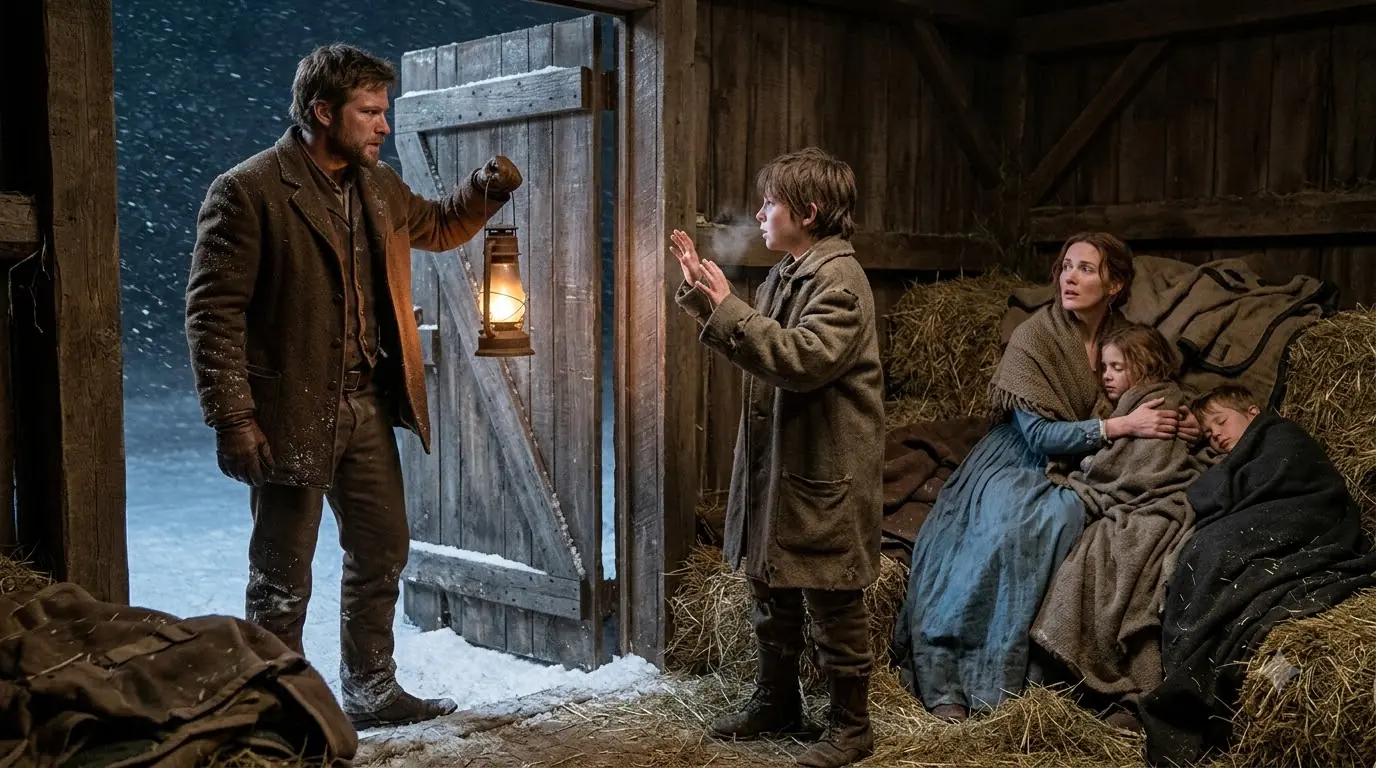
Caleb kept the lantern low. The boy was perhaps ten, with dark hair stuck to his forehead and a man's wool coat dragging around his ankles. Behind him a young woman sat upright in the straw, holding a little girl against her chest while a younger boy slept with his face tucked beneath her arm. The woman's cheeks were hollow with cold, but she looked straight at the stranger in the doorway. "We haven't stolen anything," she said. "The door was open, and the road disappeared behind us." Caleb asked how long the girl had been ill, and the woman hesitated before admitting the fever had begun the previous afternoon. He had intended to order them toward town at daybreak; instead he stepped into the barn and knelt beside the child.
The girl's breathing was quick and shallow, and her small hands burned against his fingers. Caleb knew enough from winters spent miles from a doctor to recognize that another night in the barn might kill her. He told the mother to gather whatever she could carry and sent the older boy to wake his brother. "My name is Thomas," the boy said, gripping the lantern handle as though Caleb might change his mind. "Then, Thomas, you can help me find the path," Caleb answered. The woman watched him lift her daughter carefully from the straw, and something in her guarded expression gave way to a bewildered relief.
They crossed the yard in a white roar, Caleb carrying the girl beneath his coat while the woman kept her sons close. Inside, he laid the child on the settle near the stove, warmed blankets, and brought water before asking a single question about their past. The younger boy, Noah, stared at the kitchen as if he had stumbled into a palace, although the ceiling leaked in one corner and the floorboards had never matched. "Your floor is wet," the woman said apologetically, looking at their melting footprints. "It's been wet before," Caleb replied. "I expect it'll dry again." She gave him her name then: Abigail Ellison, widow of Samuel Ellison, with Thomas, eight-year-old Elsie, and five-year-old Noah depending on her.
At the name Samuel Ellison, Caleb felt a faint recognition. He had bought cattle at the Cedar Creek auction the previous spring, and he remembered a quiet rancher who counted every coin twice and had refused an unusually generous offer for a strip of creekside land. Samuel had died soon afterward,