Leonard Pierce had learned to move slowly whenever people around him were in a hurry. At sixty, with an old spinal injury that made his left leg unreliable and a folding cane always within reach, speed had become something he measured rather than assumed. On a humid Tuesday afternoon in Greenville, South Carolina, he stood beside his cousin Darnell's pickup in the parking lot of a small townhouse complex, waiting for Darnell to finish a phone call with a contractor. Leonard had spent the morning at a rehabilitation clinic, and the only thing he wanted was a cold drink and fifteen quiet minutes before the drive home.
The cane rested against the rear tire behind him. It was aluminum, black, and folded at the center with a rubber grip worn smooth from years of use. Leonard had placed it there because he needed both hands free to adjust the brace under his jeans. Darnell was ten feet away with his phone to his ear when a patrol SUV turned into the lot faster than either man expected. The cruiser stopped hard, the driver's door opened, and Officer Trent Maddox stepped out with one hand already drawing his weapon.
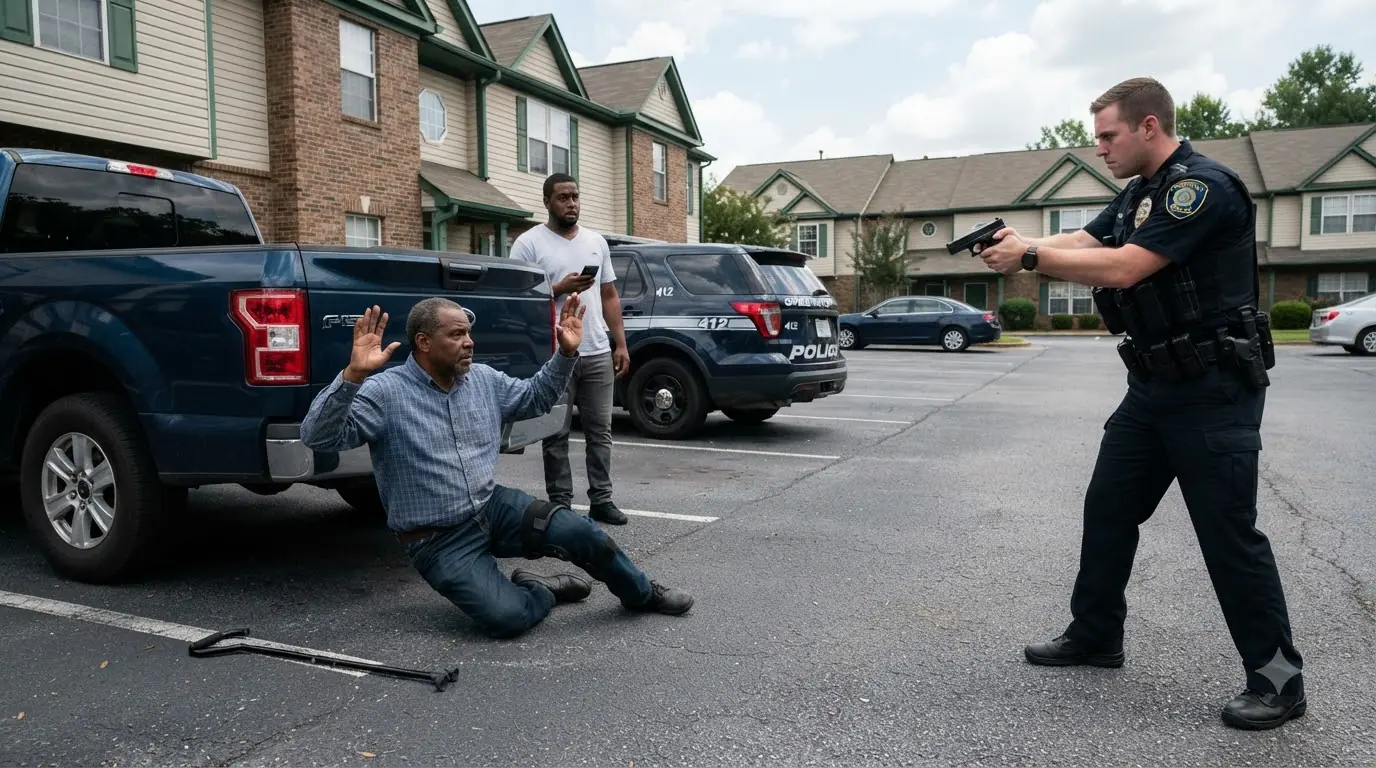
"Hands where I can see them!" Maddox shouted.
Leonard froze, startled more than afraid. His palms came up immediately, fingers spread, his brace still half-adjusted beneath his pant leg. Darnell ended his call and raised his free hand too. Neither man understood what was happening, but the tone in Maddox's voice made one thing clear: there would be no room for confusion if he decided to interpret it as resistance.
"On the ground," Maddox ordered. "Both of you. Now."
Leonard looked down at the pavement, then back at the officer. "I can kneel, but I can't drop fast," he said. "I've got a spinal injury." Maddox did not answer the explanation. He moved closer with the weapon still aimed and repeated the order, louder this time, as though volume could make Leonard's body function differently.
Darnell lowered himself first, carefully, his eyes on Maddox. Leonard began to bend at the waist, using the side of the truck for balance. His left knee shook before it reached the pavement. The movement was slow, awkward, and painful, but he kept both hands visible the entire time. Maddox shouted again anyway.
"Do you not understand English? Get down!"
"I'm trying," Leonard said. "I told you, I'm disabled."
For a fraction of a second, Leonard thought the explanation had landed. Maddox's eyes flicked toward the cane behind the tire. Then his expression hardened. "Don't reach for that," he snapped.
"I'm not reaching for anything. That's my cane."
Maddox later claimed he believed the object was a firearm. The body camera would show something different. It would show Leonard's hands above shoulder height, the cane still lying untouched behind the wheel, and Maddox advancing without once asking what the object was before deciding what it meant.
Leonard finally got both knees down. His back spasmed immediately, sending a sharp line of pain through his hip. He shifted his weight to his right hand because he could not keep his spine upright from that position. Maddox interpreted the movement as disobedience.
"Hands behind your back!"
"If I put them behind me, I'll fall," Leonard said. "Give me a second."
Maddox gave him less than one.
He stepped forward, planted one boot high between Leonard's shoulder blades, and forced him downward. Leonard's palms hit the pavement first, then his forearms. His cheek struck the concrete hard enough to make his vision flash white. The sound Darnell made was not a word so much as a burst of disbelief.
"Hey! He's doing what you told him!"
Leonard tried to turn his face away from the pavement. "You just slammed my head," he said, breathless. "I told you I've had a spinal injury."
Maddox pulled one of Leonard's wrists behind him. "You weren't listening."
"I was getting down."
"Stop resisting."
"I'm not resisting. I can't move the way you want me to."
The difference between those two sentences would become one of the central questions of the case. Leonard was not refusing the command. He was physically limited in how quickly he could carry it out. But in the seconds that followed, Maddox treated limitation as defiance, and once he made that choice, every movement Leonard made to protect his injured back was interpreted through the same assumption.
A second patrol car arrived. Corporal Jasmine Cole stepped out, assessed the scene, and immediately looked from Leonard to the cane on the ground. "Where's the weapon?" she asked.
"Behind the truck," Maddox said. "He was reaching for it."
Cole walked around the rear tire, bent down, and picked up the folded cane by its rubber handle. Her expression changed. "This?"
Maddox glanced at it. "It looked like a gun from where I was."
Leonard heard the words from the ground. He closed his eyes for a second. The pain in his neck was starting to throb, but what stayed with him was the speed with which a guess had become a justification.
Darnell stepped forward until Cole raised a hand to stop him. "That is his mobility cane," he said. "He uses it every day. He told your officer he was disabled. I heard him."