“Clean that up. That’s what you people are here for.”
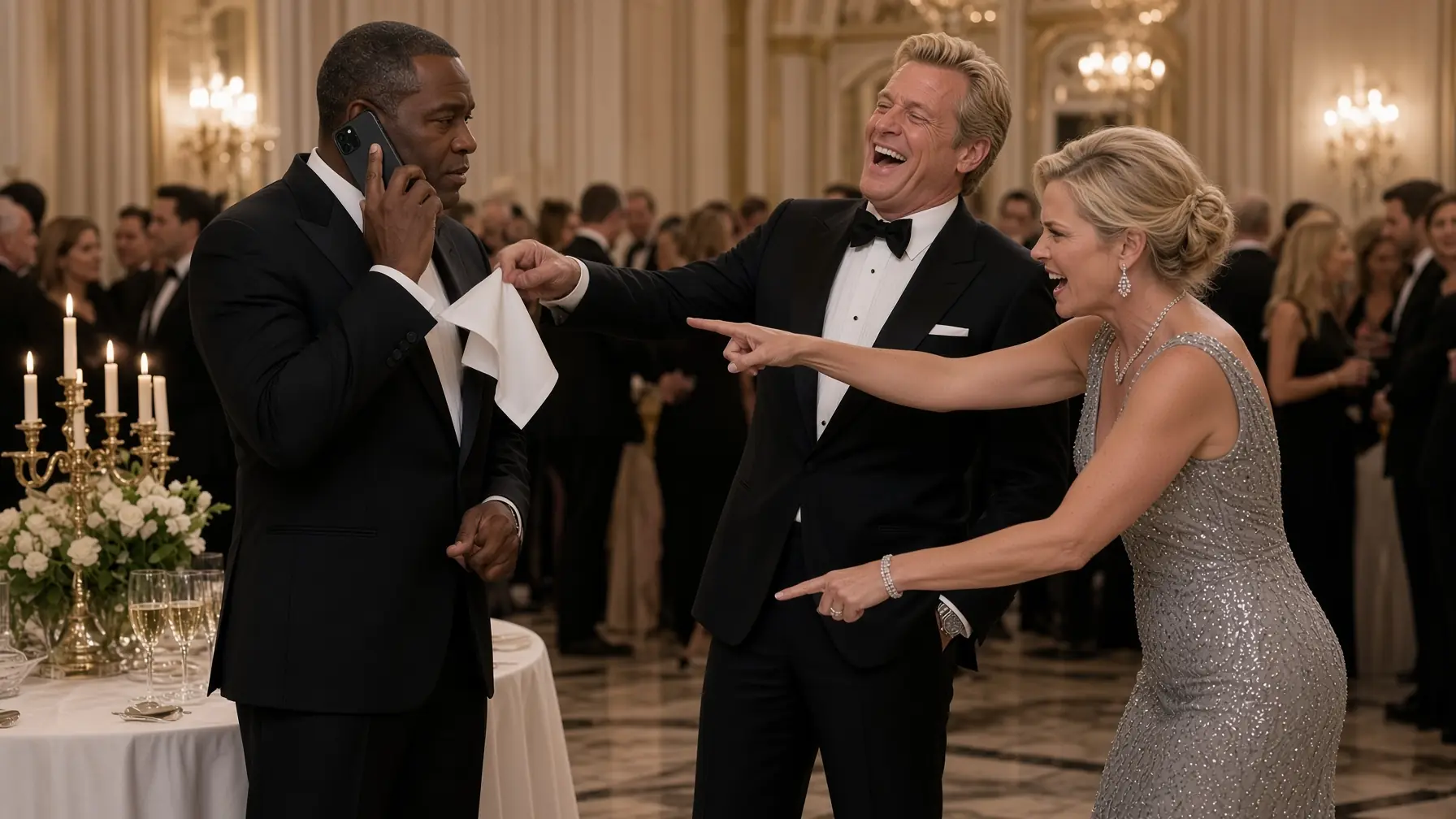
The sentence carried farther than Vanessa Langford intended, far enough to reach the neighboring tables beneath the crystal chandeliers of Manhattan’s Halcyon Grand Hotel. A few guests laughed because Edward Langford III was laughing, and in rooms built around inherited wealth, people often decided what was funny by watching the richest person at the table.
Malcolm Reed looked down at the champagne dripping across the marble near his polished shoes. He was fifty-three, tall, broad through the shoulders, and dressed in a black tuxedo tailored so precisely that anyone looking carefully would have recognized he was not wearing a hotel uniform. Nobody at the Langford table was looking carefully.
Vanessa lifted her empty glass toward him. “Well?”
Malcolm raised his eyes. “Well what?”
“Get someone to clean it.”
Edward smirked. “Or do it yourself. You’re standing right there.”
Several people laughed again.
Malcolm did not.
That bothered Edward more than anger would have.
“You got a problem?” he asked.
“No.”
“Then be useful.”
Malcolm glanced toward the ballroom entrance. His chief legal officer had not arrived yet, nor had the investment-banking team scheduled to join him before the evening’s private presentation.
So he stayed.
Not because he wanted to collect insults.
Because for six months Reed Global Holdings had been considering the largest transaction in its history, a proposed combination with Langford International that advisers valued, depending on stock price and structure, at nearly $150 billion. Malcolm had spent those six months reading financial statements, environmental disclosures, labor reports, antitrust forecasts, litigation schedules, internal audit summaries, and executive-retention agreements.
Something about the Langford organization had bothered him from the beginning.
Not one dramatic scandal.
Patterns.
Too many employee complaints settled quietly.
Too many senior executives who had departed without explanation.
Too many reports describing an unusually centralized family culture in which Edward’s father, Charles Langford Jr., still influenced decisions despite holding no formal operating role.
And now Malcolm was standing six feet from the family itself.
Edward mistook his silence for weakness.
“You deaf?”
Malcolm looked at him.
“No.”
Vanessa laughed. “Then why are you standing there?”
“I was wondering how long you intended to continue.”
Edward leaned back.
The men beside him smiled.
Vanessa said, “Continue what?”
Malcolm adjusted one cuff.
“This.”
Something in his voice made one guest stop smiling.
Edward did not notice.
“You know,” Edward said, “these events used to have standards. Now everybody gets inside if they know somebody.”
Malcolm answered, “That concerns you?”
“It should concern everyone.”
Vanessa looked Malcolm up and down. “What company are you with?”
Malcolm almost told her.
Instead, he asked, “Why?”
“So I know who invited you.”
A younger man at the table laughed into his drink.
Malcolm nodded slowly.
Then Edward said the sentence that changed the evening.
“Honestly, I don’t care who invited him. Somebody tell hotel management their staff shouldn’t be drinking with guests.”
Malcolm looked at the untouched glass in his hand.
Then at Edward.
“You believe I work here?”
Edward spread his hands. “Don’t you?”
“No.”
Vanessa’s smile weakened.
Edward shrugged. “Then congratulations. You’re overdressed and lost.”
A young server standing near the buffet heard the exchange. Her name was Isabel Torres, twenty-seven, and she had been working private events at the Halcyon for almost three years.
She knew Malcolm’s name.
The hotel had received a detailed security and guest list because several corporate leaders attending the gala were internationally recognizable. Malcolm Reed appeared near the top.
Isabel hesitated.
People in hospitality learned early that correcting wealthy guests could cost more than allowing wealthy guests to embarrass themselves.
Malcolm caught her eye.
He gave the smallest shake of his head.
Not yet.
Across the ballroom, Edward resumed talking to two investors about the merger.
“Our family keeps strategic control,” he said. “Reed gets scale, we get access to their infrastructure and Asian markets. Frankly, they need this more than we do.”
Malcolm listened.
One investor asked, “Have you met Reed yet?”
“Not personally.”
“You’re announcing tomorrow without meeting the CEO?”
“My father’s dealt with their people.”
Edward waved dismissively.
“CEOs come and go.”
Malcolm almost smiled.
That answered another question.
The proposed transaction had been described publicly as a merger of equals, although economically Reed Global shareholders would receive slightly more than half the combined company. Malcolm’s board had been uncomfortable with the Langford family’s insistence on disproportionate influence after closing.
Edward apparently considered that influence guaranteed.
Malcolm removed his phone.
He sent one message.
Hold signing package. Do not release tonight. Need board call before execution.
His general counsel, Caroline Price, answered twenty seconds later.
Issue?
Malcolm typed:
Governance. Conduct. Confirm nothing binding executed.
Her reply came immediately.
Nothing binding beyond existing confidentiality/exclusivity framework. Definitive agreement not signed. Board authority required.
Malcolm put the phone away.
Edward noticed.
“Calling your supervisor?”
The table laughed.
Malcolm said, “Something like that.”
Vanessa leaned toward Edward. “He has an attitude.”
“Everybody does now.”
She looked at Malcolm. “You people always think every room belongs to you.”
The laughter ended before anyone consciously decided to stop.
One of the older investors looked down.
Another guest turned his chair slightly away.
Malcolm remained still.
There it was.
Not ambiguity.
Not misunderstanding.
Vanessa had said exactly what she meant.
Edward did not correct her.
Instead, he smiled.
Malcolm looked toward Isabel.
This time she was already holding her phone near her waist.
Not pointed dramatically.
Recording audio.
He did not stop her.
Edward said, “What?”
Malcolm answered, “Nothing.”
Then he removed his phone again.
“Caroline.”
His general counsel answered.
“Malcolm?”
“Move tonight’s board call forward.”
There was a pause.
“To now?”
“Ten minutes.”
“Understood.”
Edward’s expression shifted.
Malcolm continued, “Ask audit committee chair to join. I want the employee-relations diligence memo circulated again.”
Caroline did not ask why.
“Done.”
He ended the call.
Vanessa stared at him.
Edward frowned.
“Who the hell are you?”
Before Malcolm could answer, the ballroom doors opened.
Two people entered.
Caroline Price walked first, wearing a dark evening suit rather than a gown, followed by Reed Global chief financial officer Daniel Cho. They crossed the room with the hurried restraint of executives trying not to create a spectacle.
Caroline spotted Malcolm.
“Mr. Reed.”
Edward Langford stopped moving.
Daniel reached them.
“Malcolm, directors are assembling now.”
Nobody at the table laughed.
Vanessa looked first at Caroline, then Malcolm.
Her face changed slowly.
Edward stood.
“Reed?”
Malcolm looked at him.
“Yes.”
“The Malcolm Reed?”
“I’m not aware of another one involved in your transaction.”
Edward’s mouth opened.
Closed.
Vanessa whispered, “Oh my God.”
Malcolm placed his glass on the table.
Edward recovered first.
People raised in powerful families often developed an extraordinary ability to behave as though embarrassment had happened to someone else.
“Well,” he said, forcing a laugh. “That explains the misunderstanding.”
Malcolm said nothing.
Edward extended his hand.
“Malcolm. Edward Langford.”
“I know.”
Edward’s hand remained in the air.
Malcolm did not take it.
Vanessa spoke quickly. “We genuinely thought you were with the hotel.”
“I understood that.”
“It was a joke.”
“No.”
Vanessa blinked.
Malcolm continued, “It became a joke after you learned my name.”
A guest at the next table lowered his eyes.
Edward’s hand finally dropped.
“Listen, this is awkward, but there’s no reason to turn one stupid misunderstanding into something larger.”
Caroline stood several feet behind Malcolm.
She had spent twenty-nine years practicing corporate law and knew exactly when remaining silent was more valuable than speaking.
Edward looked toward her.
“Caroline, right?”
“Yes.”
“We’ve spoken.”
“We have.”
“Tell him.”
Caroline raised an eyebrow.
Edward lowered his voice. “Tell him this is ridiculous. We’re hours away from final approval.”
Caroline answered carefully.
“We are not hours away from final approval.”
Edward’s face tightened.
“What does that mean?”
“It means the Reed board has not approved execution of the definitive agreement.”
“My father was told—”
“Your father was told the transaction was progressing toward final board consideration.”
Edward looked at Malcolm.
“You're threatening a $150 billion deal because Vanessa made a stupid comment?”
Malcolm’s expression remained unchanged.
“No.”
“Then what is this?”
“This is six months of due diligence meeting ten minutes of useful information.”
Edward stared.
Malcolm continued.
“Your organization has unresolved employee-relations complaints involving senior management.”
“That’s normal for a company our size.”
“Some are.”
“We disclosed them.”
“You disclosed settlements.”
Malcolm paused.
“You did not disclose the cultural explanations we kept hearing during management interviews.”
Edward’s face hardened.
“Cultural explanations?”
“People afraid to challenge family members.”
“That’s insulting.”
“Tonight has been informative.”
Edward stepped closer.
“Don’t use some social misunderstanding to renegotiate.”
Malcolm almost laughed.
“You still think this is about price.”
“What else would it be about?”
“Control.”
Edward looked confused.
Malcolm said, “Your family wants governance rights after closing that assume we trust your judgment.”
He glanced toward Vanessa.
“Tonight helped answer that question.”
Edward’s father appeared twenty minutes later.
Charles Langford Jr. was seventy-four, silver-haired, and considerably more disciplined than his son. He crossed the ballroom rapidly after receiving three calls and found Malcolm speaking quietly with Caroline beside the balcony doors.
“Malcolm.”
“Charles.”
Charles glanced toward Edward.
“What happened?”
Malcolm answered, “Ask him.”
Charles did.
Edward gave a shortened version involving mistaken identity, humor that had “landed badly,” and Malcolm supposedly overreacting because tensions around the deal were high.
Charles listened.
Then he asked, “Was there a racial remark?”
Edward hesitated.
Vanessa answered, “It wasn’t meant racially.”
Charles closed his eyes.
That told Malcolm more than any speech could have.
Charles looked at his son.
“What did she say?”
Vanessa crossed her arms.
Malcolm answered for her.
“You people always think you belong where you don’t.”
Charles looked at Vanessa.
She said, “He was standing near the servers.”
Malcolm remained silent.
Charles turned to Edward.
“And you?”
Edward said nothing.
Charles understood.
His shoulders dropped slightly.
He looked older.
“Malcolm, privately.”
They stepped onto the balcony.
Manhattan lights spread beneath them.
For almost a minute, Charles said nothing.
Then he asked, “Are you walking away?”
“I don’t know yet.”
“My son is an idiot.”
“This isn’t only about your son.”
Charles nodded once.
“The diligence.”
“Yes.”
Charles looked through the glass toward the ballroom.
“You think this confirms it.”
“I think it makes concerns harder to dismiss.”
Charles gripped the railing.
“You know what happens if this transaction collapses.”
“Yes.”
“Employees will suffer.”
“That matters.”
“Shareholders will lose billions.”
“That matters too.”
“Our stock will drop.”
“Probably.”
Charles looked at him.
“And you can live with that?”
Malcolm answered, “I have to live with whatever company exists after we close.”
Charles said nothing.
Malcolm continued.
“You’re asking my board to combine our businesses, assume substantial liabilities, integrate two hundred thousand employees, and give your family meaningful governance influence.”
He looked through the glass.
“I need confidence in the people exercising that influence.”
Charles’s voice became quiet.
“And you don’t have it.”
“No.”
They returned inside.
The Reed Global board call began at 10:35 p.m.
Malcolm joined from a private conference room upstairs with Caroline, Daniel, two outside advisers, and secure video connections to eleven directors. Nobody discussed hurt feelings.
They discussed risk.
Caroline reviewed the employee-relations diligence findings.
Daniel reviewed projected synergies and breakup exposure.
An outside director asked whether the Langford behavior witnessed that evening was relevant legally or merely reputationally.
Caroline answered, “Legally, tonight alone does not terminate anything because no definitive merger agreement has been executed. From a governance perspective, directors may consider management culture, integration risk, disclosure quality, executive retention, reputational exposure, and whether previously identified concerns have been adequately explained.”
Another director asked Malcolm what he recommended.
He waited.
Then said, “Do not approve signing.”
Nobody gasped.
Boardrooms rarely behaved like ballrooms.
The chair asked why.
Malcolm answered, “Because I no longer believe the governance package we negotiated protects Reed shareholders sufficiently from Langford family influence.”
A director asked whether revised terms could solve that.
“Possibly.”
“Would you support reopening terms?”
Malcolm thought about Edward’s laughter.
Vanessa’s sentence.
Charles asking whether employees would suffer.
Then he thought about the diligence file.
“No.”
The board discussed the matter for nearly ninety minutes.
The final vote was not unanimous.
Two directors preferred delaying the transaction rather than abandoning it. One argued that shareholders might accuse the board of allowing social controversy to interfere with economic value.
Malcolm agreed that concern deserved serious consideration.
Then Caroline reminded the board that deal economics were only as valuable as the assumptions supporting them. Integration projections depended on senior-management cooperation, employee retention, litigation exposure, and governance stability.
Shortly after midnight, the Reed Global board voted not to authorize execution of the proposed transaction.
The deal was not “canceled with one phone call.”
It simply never became binding.
That distinction eventually mattered to regulators, lawyers, shareholders, and journalists.
Downstairs, Edward waited.
Charles waited beside him.
Vanessa had left.
Malcolm returned to the ballroom carrying no paperwork.
The guests had thinned considerably, although enough remained to recognize from his expression that something had changed.
Charles approached first.
“Well?”
Malcolm looked at him.
“The board declined authorization.”
Edward stood.
“What?”
Charles remained motionless.
Malcolm said, “Reed Global will not execute the definitive agreement.”
Edward laughed once.
It sounded frightened.
“You’re kidding.”
“No.”
“A hundred and fifty billion dollars.”
“Approximately.”
“Because of tonight?”
Malcolm shook his head.
“Tonight was evidence.”
“Of what?”
“That concerns already identified during diligence were not theoretical.”
Edward stared at him.
“You arrogant son of a—”
“Edward.”
Charles’s voice stopped him.
Edward turned on his father.
“You’re going to let him destroy this?”
Charles answered, “You helped.”
That finally silenced him.
The following morning, Reed Global and Langford International issued carefully written statements confirming that discussions had ended without a definitive agreement. Neither statement mentioned racism, champagne, ballroom staff, Vanessa, or Edward.
Public companies did not usually write press releases like revenge monologues.
The market reacted anyway.
Langford International shares fell sharply because investors had priced in expectations that the combination would proceed. Reed Global moved less dramatically, while analysts immediately began asking what had failed during due diligence.
Then the video appeared.
Isabel Torres had recorded part of the exchange.
She did not sell it to Malcolm.
She did not hand it to Reed Global legal counsel.
She sent a copy to herself, then later provided it to an attorney after journalists began contacting hotel employees. Someone else had recorded Edward’s later confrontation from another angle.
Within forty-eight hours, portions circulated widely.
Malcolm refused television interviews for the first week.
That frustrated everyone.
Commentators wanted the triumphant Black CEO who had sacrificed $150 billion to teach a racist billionaire family a lesson.
Reality was less convenient.
Reed Global had not sacrificed $150 billion.
That was the approximate enterprise value of a proposed combined transaction.
And Malcolm had not personally destroyed it because somebody insulted him.
A board had refused to approve an unsigned deal after a long due-diligence process uncovered risks that one ugly evening made harder to ignore.
When Malcolm finally spoke publicly, he said exactly that.
“A transaction of this size cannot depend on one person’s anger,” he told an interviewer. “It also cannot ignore evidence about how leadership behaves when it believes the person in front of them has no power.”
That quotation traveled farther than anything Malcolm said in the ballroom.
Langford International began its own internal review.
Several independent directors demanded access to employee complaints that previously had been summarized for them rather than provided directly. That review uncovered no secret criminal empire, but it did reveal weaknesses in how allegations involving family members and senior executives were escalated.
Edward temporarily stepped away from merger and investor responsibilities.
Months later, the company announced that he would not return to an executive leadership role.
Vanessa disappeared from public discussion much sooner.
Malcolm never commented about her again.
Isabel remained at the Halcyon.
The hotel promoted her several months later, but not because Malcolm demanded it.
He had called the general manager once.
Not to secure a job.
To make sure she was not disciplined for documenting an incident involving powerful guests.
“She spoke when people with considerably more protection stayed silent,” Malcolm said.
The manager answered, “We noticed.”
Malcolm’s father, Harold Reed, had died twelve years before that evening.
He had spent thirty-four years maintaining hotels, office towers, and convention centers. Malcolm grew up knowing the smell of industrial floor cleaner, hearing stories about broken boilers at two in the morning, and understanding that wealthy buildings survived because thousands of people whose names never appeared on plaques arrived before everybody else.
Harold never taught his son to hate rich people.
He taught him to watch how people treated workers.
“You want to know who somebody is?” Harold once told him. “Watch the way they talk when they think the person listening can’t do anything for them.”
That sentence stayed with Malcolm.
The ballroom had simply demonstrated it.
One year after the failed transaction, Reed Global completed a much smaller acquisition. The deal barely interested television audiences because nobody was publicly humiliated during the signing.
It performed well.
Langford International recovered too, although under pressure from shareholders its board added independent oversight, revised executive conduct procedures, and reduced several special governance privileges historically associated with the founding family.
Charles Langford eventually requested a private meeting with Malcolm.
They met for breakfast.
No journalists.
No lawyers.
Charles arrived first.
“I should have dealt with Edward years earlier,” he said.
Malcolm stirred his coffee.
Charles continued, “I kept telling myself he’d grow into responsibility.”
“Did he?”
“No.”
They sat quietly.
Then Charles asked something Malcolm did not expect.
“Did you enjoy it?”
“The deal failing?”
“The moment he realized who you were.”
Malcolm thought about the ballroom.
The laughter.
Isabel’s frightened face.
Vanessa pointing toward the spilled champagne.
For a few seconds, yes, there had been satisfaction.
He did not lie.
“A little.”
Charles nodded.
“I probably would have too.”
Malcolm continued, “Then I spent three weeks explaining to shareholders why a transaction we had worked on for half a year was dead.”
“So the satisfaction faded.”
“Rapidly.”
Charles smiled.
Before leaving, he said, “For what it’s worth, I’m sorry.”
Malcolm looked at him.
“For the deal?”
“No.”
Charles paused.
“For what happened before they knew your name.”
That was the apology Malcolm accepted.
Because it identified the actual offense.
Years later, people still told the story incorrectly.
They said a Black billionaire entered a gala disguised as a waiter.
He had not.
They said he secretly owned the hotel.
He did not.
They said he froze the Langford family’s bank accounts from his phone.
Impossible.
They said he seized their company, fired Edward on the spot, and walked away while the orchestra played.
None of that happened.
What happened was both less theatrical and more revealing.
Malcolm Reed entered a ballroom wearing a tuxedo and his own name on the guest list.
A powerful family looked at his skin, his position near the catering staff, and their assumptions about who belonged in rooms like that.
They decided he served them.
Then they behaved accordingly.
By the time they learned he was one of the people deciding the future of their company, nothing Malcolm could have said would have been as useful as what they had already shown him.
That became the lesson he repeated later to young executives.
“Never make an important decision purely because someone insulted you.”
He would pause.
“But never ignore what an insult reveals.”
The distinction mattered.
Malcolm had spent his career building systems meant to evaluate risk before money moved.
That evening, the Langfords had given him information no spreadsheet could produce.
Not about their wealth.
Not about their brand.
About judgment.
And judgment was exactly what Reed Global had been preparing to buy into for $150 billion.
That was why Malcolm never considered his best line of the evening to be something clever he said after revealing his identity.
It happened much earlier.
Edward had pointed toward the spilled champagne and told him to be useful.
Malcolm had said almost nothing.
He simply watched.
Because sometimes the most expensive mistake powerful people make is assuming that the person they are humiliating has no reason to remember it.