Veteran police captain Elias Grant eased his aging sedan through the rain-slicked streets of the city just after midnight. The wipers swept steadily across the windshield, cutting through the persistent drizzle that had fallen all evening. At sixty-two years old, with over four decades on the force, Grant had learned to carry the weight of the job in silence. His shoulders were broad but slightly stooped from years of patrol, investigations, and the quiet burden of leadership. Tonight, after a grueling sixteen-hour shift filled with domestic disputes, narcotics busts, and paperwork that never seemed to end, all he craved was the simple comfort of his modest home, a strong black coffee, and the worn leather armchair that had witnessed more late-night reflections than he cared to count.
The streets were unusually quiet, the kind of calm that often preceded unseen trouble. Neon signs from closed shops reflected in puddles, and distant sirens echoed like ghosts in the distance. Grant drove with both hands on the wheel, his mind replaying the day’s events. He had always believed policing was about protection, not domination. That belief had guided him through promotions, commendations, and the inevitable politics of the department. Little did he know that this ordinary drive home would become the defining moment of his career.
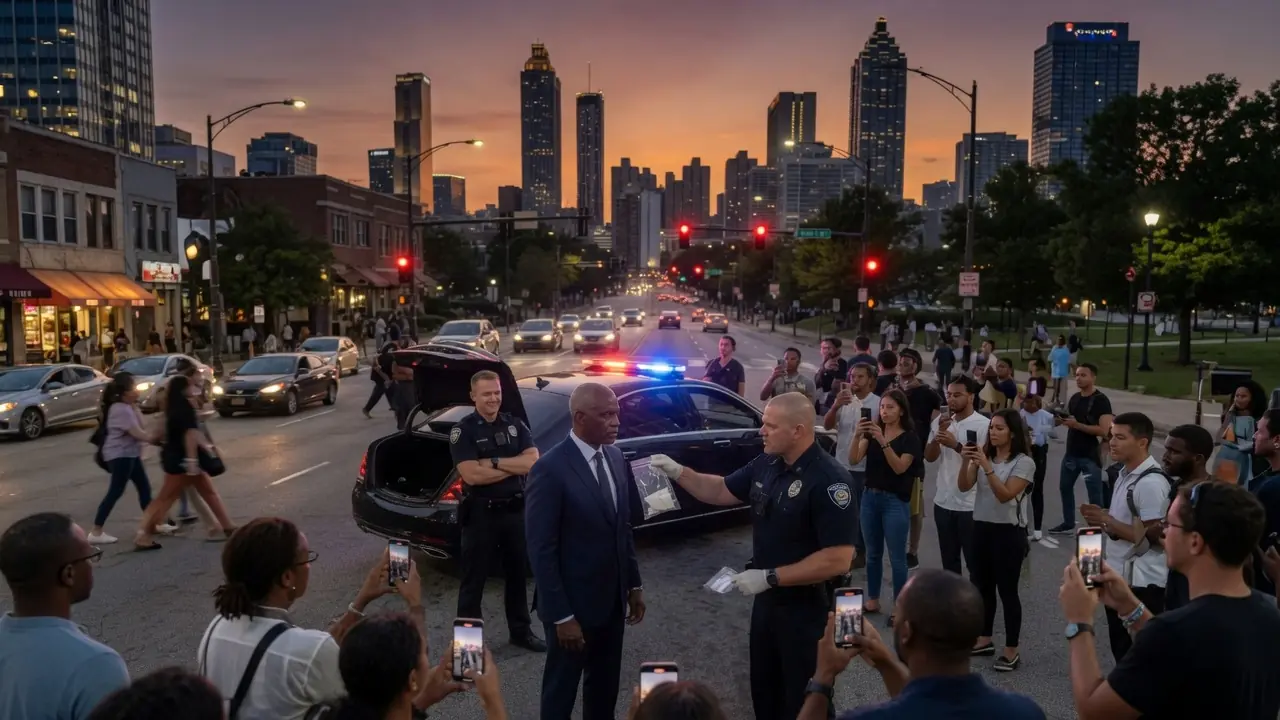
Suddenly, flashing red and blue lights erupted in his rearview mirror. A patrol car surged forward, its siren giving a short, aggressive burst. Grant signaled smoothly and pulled over to the curb, his movements deliberate and textbook. He placed his hands visibly on the dashboard and waited. His registration and insurance were valid. He had not exceeded the speed limit. He had committed no violation. Yet the young patrol officer who approached the driver’s side window carried an air of unchecked arrogance. Barely in his mid-twenties, with a fresh uniform and a chip on his shoulder, the officer rapped sharply on the glass.
“License and registration. Now,” he demanded, his tone dripping with mockery before Grant could even speak.
Grant handed over the documents calmly. What followed was nearly forty-five minutes of escalating humiliation. The officer ridiculed Grant’s age, calling him “grandpa” and questioning why an “old man” was out so late. He accused him of suspicious behavior with no evidence, then called for backup. Two additional units arrived within minutes, their officers joining in the spectacle. They searched the vehicle without proper justification or consent, tossing maps, old case notes, and personal belongings onto the wet pavement. They threatened arrest for “obstruction,” made derogatory comments about Grant’s appearance and service record, and even ran his plates multiple times in an attempt to find something—anything—to justify their actions.
Throughout the entire degrading encounter, Captain Grant never raised his voice. He did not argue, resist, or invoke his rank. Decades of experience had taught him a profound truth: patience often revealed more about a person’s character than any confrontation ever could. While the officers laughed and postured, believing they had found an easy target in an elderly Black man driving alone at night, Grant’s sharp mind was cataloging every detail. Badge numbers, unit designations, radio call signs, facial features, exact wording of threats, procedural violations, and the casual cruelty in their laughter—all of it was burned into his memory with the precision of a seasoned investigator.
Grant allowed the officers to finish their illegal search. He even permitted them to handcuff him “for safety” and escort him back to the station in a patrol car. He sat quietly in the holding area, maintaining his composure while the young officers continued their taunts, unaware of the storm they had unwittingly invited. Hours later, when he was finally brought before the senior command staff for what they assumed would be a routine processing, the atmosphere shifted dramatically.
In a calm, steady voice that carried the weight of authority earned over a lifetime, Grant revealed his true identity. He slid the sealed authorization documents across the polished conference table—documents signed by the Chief and IA directors granting him sweeping powers to investigate and reform the department. The room fell into absolute, suffocating silence. The young patrol officer who had led the harassment turned ghostly white, his knees visibly weakening as the realization crashed over him: the “easy target” he had mocked and abused was the very captain now tasked with rooting out misconduct throughout the entire agency.
Shock rippled through the command staff. Phones were silenced. Careers flashed before eyes. Immediate, high-level investigations were triggered that night. Body-camera footage was seized and reviewed in full. Radio transmissions, dashcam recordings, GPS data from the patrol units, and years of suppressed complaints were reopened. Grant took personal charge of the operation. Over the next several months, he conducted exhaustive interviews with honest officers who had feared retaliation, pored over dusty case files long buried in archives, protected whistleblowers from reprisals, and meticulously constructed cases strong enough to withstand legal challenges.
The consequences were swift and decisive. The officers involved in the traffic stop were suspended pending full review. The lead patrol officer was ultimately charged with abuse of authority, civil rights violations, falsifying reports, and multiple departmental policy breaches. Several supervisors who had turned a blind eye to earlier warnings resigned in disgrace rather than face termination and possible prosecution. The scandal dominated local news cycles for weeks, shining a harsh light on systemic failures. Encouraged by the momentum, dozens of families who had suffered similar abuses for years finally came forward with their stories, creating a wave of accountability that extended far beyond that single rainy night.
Under Captain Grant’s unwavering leadership, the department underwent sweeping, transformative reforms. New protocols mandated stricter oversight for traffic stops and searches. Body-camera usage became non-negotiable with severe penalties for tampering. Mandatory ethics and constitutional policing training was expanded and made ongoing. Internal Affairs received greater independence and resources. Community oversight boards were strengthened. Slowly but surely, a culture of intimidation and silence began to give way to one rooted in responsibility, transparency, and genuine service.
Young officers entering the academy learned a different ethos: authority existed to protect the public, not to lord over it. Seasoned veterans who had grown cynical witnessed a genuine shift, inspiring many to recommit to the ideals that had first drawn them to the badge. Months after the initial stop, Grant returned quietly to the same stretch of road where it had all begun. He drove with the same steady hands and calm expression, but the atmosphere had changed. Citizens waved as he passed. Local business owners stepped out to greet him. Community leaders stopped their cars simply to express gratitude for the man whose patience and integrity had exposed deep corruption and sparked meaningful reform.
When Captain Elias Grant finally retired after guiding the department through its most turbulent yet redemptive period, he left behind more than just memories. The force was smaller in headcount but immeasurably stronger in character and public trust. Neighborhoods that once feared the sight of a police cruiser now began to see them as partners. New generations of officers carried forward the profound lesson demonstrated on that rainy night: true leadership is not measured by how loudly or forcefully power is exercised, but by the wisdom, patience, integrity, and moral courage to use it only when justice truly demands it. In the quiet years that followed, many would still speak of the night an old captain’s silence roared louder than any shout, forever changing the soul of the department he had served so faithfully.