“You hearing me, old-timer, or did you switch off the hearing aid?”
Lieutenant Jax Miller’s voice cut through the low hum of the Rusty Anchor.
The jukebox continued playing an old country song, but no one seemed to hear it anymore. Conversations weakened around the room as heads slowly turned toward the corner booth.
Mark Douglas did not look up.
He sat alone beneath a flickering blue beer sign, wearing a faded red shirt and a canvas jacket darkened at the shoulders by rain. A single glass of inexpensive whiskey rested between his hands.
At seventy-two, Mark looked like the kind of man people noticed only long enough to step around.
His gray hair had been cut short with no concern for style. Deep lines crossed his face, and a pale scar disappeared beneath the collar of his shirt.
But his hands were steady.
Perfectly steady.
Miller leaned over the table.
Behind him stood four members of his platoon, young Navy SEALs recently returned from an overseas deployment. They wore civilian clothes, but their haircuts, posture, and the trident pins fastened discreetly to two jackets revealed who they were.
They had spent most of the evening celebrating a successful extraction.
Their voices were loud.
Their stories became more impressive with every round.
Now they wanted the corner booth.
“We need the table,” Miller said. “Our people always sit here after a mission.”
Mark raised the glass and took a slow drink.
Then he set it down.
“I’ll be finished soon.”
The soft clink against the wood sounded louder than it should have.
Miller glanced back at his men.
One of them smiled.
Another shook his head as though the old man had failed a simple test.
Miller turned back.
“I don’t think you understand. This booth is for active-duty operators.”
Mark’s eyes finally rose.
They were gray and slightly clouded by age, but there was nothing uncertain in them.
“I paid for my drink,” he said. “I’ll leave when it’s empty.”
A few stools away, the bartender stopped drying a glass.
Daniel Sullivan—Sully to everyone who knew him—had served twelve years in the Marine Corps before a damaged knee and a second failed surgery ended his career.
He had seen arrogant young service members before.
Most grew out of it.
Some needed assistance.
“Lieutenant,” Sully said, “there are six empty tables.”
Miller did not turn.
“This one has the unit plaque.”
A small brass plate was fastened to the wall beside the booth.
FOR THOSE WHO WENT OUT AND DID NOT RETURN.
The plaque did not name any unit.
It did not say the table belonged to active-duty personnel.
Miller placed one hand against the wood.
“We’re celebrating men who just came back from doing the work.”
Mark glanced at the plaque.
“That table was not built for celebrating.”
The words were quiet.
Miller’s jaw tightened.
One of the younger men, Petty Officer Cole Davis, stepped forward.
“Maybe Grandpa served lunch on a ship once and thinks that counts.”
The men laughed.
Mark did not react.
Davis continued.
“What was your specialty, sir? Potatoes? Laundry?”
“Enough,” Sully warned.
Miller raised a hand toward the bartender.
“Stay out of this. It’s team business.”
“No,” Sully replied. “It’s bar business when you bother a paying customer.”
Miller finally looked at him.
The lieutenant was twenty-nine years old, physically powerful, and accustomed to rooms changing when he entered. His latest mission had gone well, and several senior officers had praised his judgment.
That praise had followed him into the bar.
So had the whiskey.
“We aren’t bothering him,” Miller said. “We’re helping him find a more appropriate seat.”
Mark looked down at his glass again.
He had been coming to the Rusty Anchor on the same night every year for nearly two decades.
He always arrived shortly after eight.
He sat in the corner booth.
He ordered one whiskey.
At 9:17, he raised the glass toward the empty seat across from him.
Then he left.
Sully had noticed the ritual but had never asked about it.
Mark did not seem like a man who welcomed questions.
Tonight, the young SEALs had arrived shortly before nine.
They did not know that Mark was waiting for the minute when a helicopter had disappeared from a radio channel thirty-four years earlier.
They did not know whose memory occupied the empty side of the booth.
They saw only an old man in their preferred seat.
Miller pulled out the chair across from Mark and sat without invitation.
“Let’s make this easy,” he said. “We all served. At least I’m assuming you did.”
Mark remained silent.
“In the teams, people earn names,” Miller continued. “Names that mean something.”
He pointed toward himself.
“Viper.”
Mark showed no reaction.
Miller pointed toward Davis.
“Sledge.”
Davis lifted his bottle in acknowledgment.
“He breaks doors,” Miller explained. “I strike before people know I’m there.”
Mark glanced briefly toward the men.
“Did you choose those names yourselves?”
A patron near the jukebox coughed to hide a laugh.
Miller’s smile disappeared.
“No.”
“Good.”
“What is that supposed to mean?”
“Nothing useful should be named by the person trying to impress others with it.”
The men behind Miller became quiet.
The lieutenant leaned forward.
“And what did they call you?”
Mark did not answer.
“Come on,” Miller said. “If you’re going to sit beneath a memorial plaque, tell us what you earned.”
Mark watched the whiskey catch the blue light from the sign.
“I didn’t come here to tell stories.”
“Maybe because you don’t have any.”
Mark’s fingers tightened slightly around the glass.
For a moment, the bar disappeared.
The air became thick and wet.
The smell of stale beer changed into mud, salt water, burned fuel, and mangrove roots.
Mark was thirty-eight again.
Rain struck broad leaves overhead. Somewhere beyond the black water, automatic fire moved from left to right as men searched the shoreline.
A radio whispered against his ear.
“Reaper, the boat is gone. We have wounded. No extraction until daylight.”
Mark pressed one hand against the blood soaking through another man’s shirt.
“How many can walk?”
“Four.”
“How many can fight?”
A pause.
“Three.”
Mark looked across the flooded trees.
“Then tell the three they are carrying the other four.”
His commander’s voice returned through static.
“They know you’re in the mangroves.”
“They know where we entered.”
“You’re on your own.”
Mark had looked toward the frightened young officer beside him.
Lieutenant David Vance was barely twenty-three, bleeding from his temple and trying not to show fear in front of the others.
Mark touched the knife secured to his chest.
“No,” he said into the radio. “I’m not.”
The memory released him.
The Rusty Anchor returned.
Miller was still waiting.
“What was it?” he asked again. “What did they call you?”
Mark looked at him.
“You don’t want to know.”
The men laughed.
Miller leaned back.
“I think everyone here wants to know.”
“Leave it alone,” Sully said.
The bartender was no longer merely irritated.
He was watching Mark’s right wrist.
When Mark lifted the whiskey, the cuff of his jacket moved back slightly. On the inside of his wrist was a small circular scar surrounding a faded black mark.
A compass ring divided by a narrow blade.
Sully had seen that symbol only once.
It appeared in an old photograph kept inside the bar owner’s office safe.
The owner, retired Navy Captain Thomas Avery, stood in the picture beside seven men whose faces had been obscured before the image was declassified.
Only one man’s wrist was visible.
The same circle.
The same blade.
Years earlier, Avery had taped a telephone number inside the safe.
He gave Sully one instruction.
“If a man carrying that mark ever enters this bar and trouble starts, call. Do not ask his name. Do not try to prove anything. Just call.”
Sully placed the glass he was holding beneath the counter.
Then he moved quietly toward the office.
At the booth, Mark pulled a crumpled ten-dollar bill from his pocket.
He placed it beside the glass.
“I’ve had enough.”
He started sliding toward the end of the seat.
Miller stood and blocked him.
“Not so fast.”
Mark remained seated.
“Move.”
“You don’t walk away when an officer is speaking to you.”
Mark’s eyes hardened.
“You are not my officer.”
“I’m a commissioned officer in the United States Navy.”
“And this is a bar.”
A few patrons looked down at their drinks.
Miller’s face reddened.
The alcohol had removed whatever judgment remained beneath his pride.
“You take up a memorial booth, refuse to identify your service, and insult active operators.”
“I refused to entertain children.”
Davis moved forward.
“What did you call us?”
Mark turned toward him.
“You heard me.”
Miller placed both hands on the table.
“You think age gives you permission to disrespect us?”
“No.”
Mark stood.
His knees made a faint cracking sound, but he rose without using the table for support.
He was five feet nine inches tall.
Miller stood several inches above him.
Yet when Mark straightened, something changed in the room.
He did not square his shoulders or form fists.
He simply became still.
The stillness was different from fear.
It was the absence of wasted movement.
“You came to my table,” Mark said. “You mocked me. You mocked whatever service you imagined I gave. And now you are blocking the door.”
Miller’s eyes narrowed.
“You still haven’t answered.”
“Answered what?”
“Your call sign.”
Mark looked almost tired.
“Reaper.”
The word was spoken without drama.
No one laughed immediately.
Then Davis smiled.
“That’s what you’re going with?”
Miller shook his head.
“Reaper. Of course.”
He pointed toward the old man’s red shirt.
“You expect us to believe you were some secret killer?”
“No.”
“Then prove it.”
“I don’t owe you proof.”
Miller stepped closer.
The space between them disappeared.
“You owe respect to the men doing the job now.”
Mark looked at the trident on Miller’s jacket.
“The symbol does not make you the man.”
That was the sentence that broke what remained of the lieutenant’s control.
Miller put one hand against Mark’s shoulder and pushed.
It was not a full-force strike.
He meant to move the old man backward and restore the hierarchy he believed the room had challenged.
Mark did not stumble.
His eyes dropped toward the hand.
Then returned to Miller’s face.
“That was a mistake.”
From behind the bar, Sully came running.
“Lieutenant, stand down.”
Miller turned.
Sully stepped between them.
“I said stand down.”
“This civilian touched me first.”
“No, he didn’t.”
“You weren’t here.”
“I have cameras.”
Miller looked toward the ceiling.
His anger flickered with uncertainty.
Sully lowered his voice.
“You need to take your men and leave.”
“Who gave you authority over me?”
“The owner of this bar.”
“I don’t care who owns it.”
“You should.”
Miller shoved Sully’s shoulder aside.
The bartender struck the edge of a stool but remained standing.
Mark’s expression changed.
He moved half a step forward.
Miller raised his hand toward Mark’s collar.
The front door opened so hard that it struck the wall.
Every person in the bar turned.
A tall man in Navy service dress stood in the entrance. Rows of ribbons covered his chest, and two silver stars shone on each shoulder board.
Vice Admiral David Vance entered without removing his cap.
Behind him were his chief of staff and two security personnel in dark suits.
The room froze.
Miller dropped his hand.
“Admiral on deck!”
The young SEALs snapped to attention.
Davis struck the table with his bottle in his haste, spilling beer across the wood.
Admiral Vance did not acknowledge them.
His eyes found Mark.
For several seconds, he remained near the door.
The anger in his face gave way to something else.
Recognition.
Disbelief.
Grief.
He walked across the bar.
His polished shoes moved through sawdust and old stains without hesitation.
Mark watched him approach.
The admiral stopped three feet away.
Then he raised his right hand.
He saluted.
The salute was held in complete silence.
Miller stared.
A two-star admiral was saluting an old man in a faded red shirt.
Mark’s face softened.
He slowly returned the salute.
“At ease, David.”
Vance lowered his hand.
His eyes were wet.
“It has been a long time, Master Chief.”
“Not long enough, apparently.”
A few nervous breaths moved through the room.
The admiral almost smiled.
“We heard you’d gone to ground.”
“I retired.”
“You disappeared.”
“Retirement works better when people stop looking.”
Vance glanced toward the whiskey.
“Same night?”
Mark nodded.
“Tommy?”
“Thirty-four years.”
The admiral looked toward the empty seat across the booth.
He removed his cap.
“I should have remembered the date.”
“You have a fleet to worry about.”
“I remember the men who carried me home.”
Mark’s gaze shifted briefly toward Miller.
“So do I.”
The warmth disappeared from Vance’s expression.
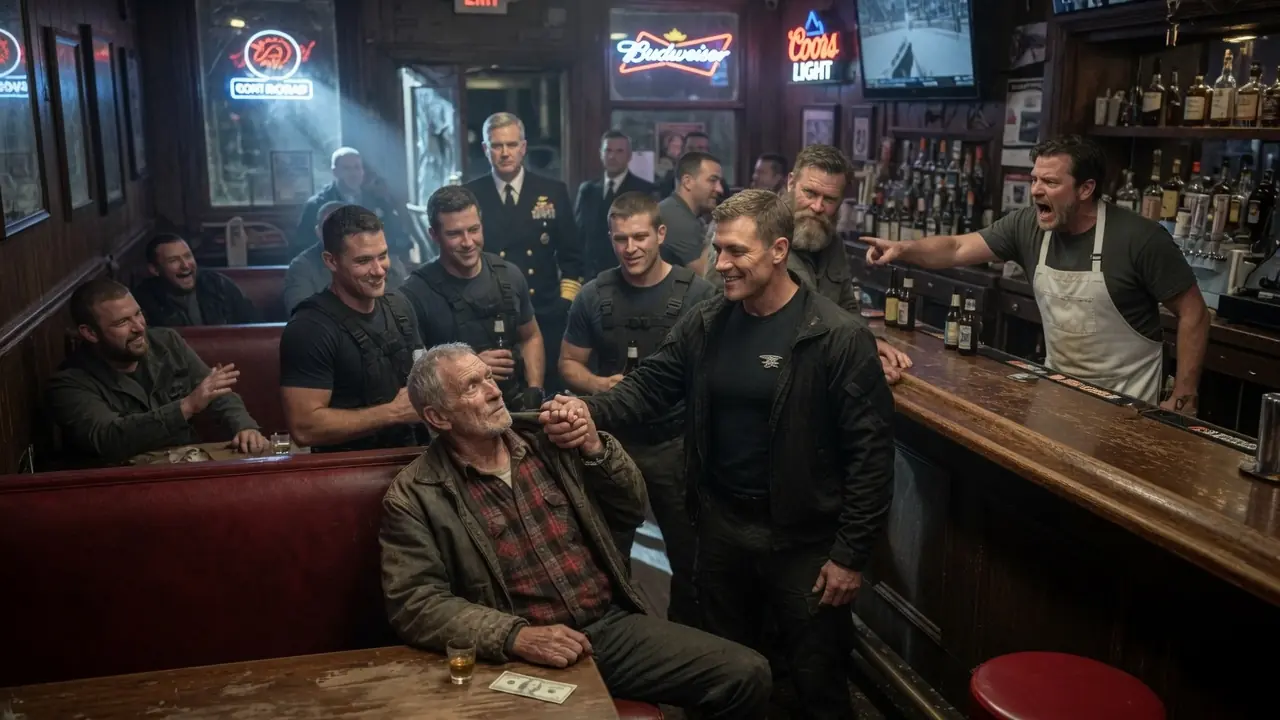
He turned.
Lieutenant Miller stood rigid beside the table.
His skin had become pale.
Vance looked at the young officer’s hand, then at Mark’s shoulder.
“Did you put your hands on him?”
Miller swallowed.
“Sir, there was a disagreement over the booth.”
“That was not my question.”
“Yes, sir.”
“You pushed him?”
“Yes, sir.”
“Why?”
Miller’s mouth opened.
No answer came.
Vance stepped closer.
“Was he threatening anyone?”
“No, sir.”
“Was he intoxicated?”
“No, sir.”
“Did he identify himself as active military?”
“No, sir.”
“Then under what authority did you physically confront a civilian in a private business?”
Miller’s voice weakened.
“I exercised poor judgment, sir.”
Vance stared at him.
“You exercised contempt.”
He looked toward the rest of the team.
“Which of you participated?”
No one moved.
“That question was not optional.”
Davis stepped forward.
“I did, sir.”
Another young operator followed.
Then the other two.
Vance faced the group.
“You came into a memorial bar wearing symbols earned by better men. You drank until discipline became optional. Then you selected an elderly patron and attempted to humiliate him because you believed he lacked the power to resist.”
“Sir,” Miller began, “we didn’t know who he was.”
The admiral’s voice dropped.
“That is the most damning thing you could have said.”
Miller went silent.
Vance moved closer until only inches separated them.
“Respect that appears only after learning someone is important is not respect. It is fear.”
The words settled over the room.
Vance pointed toward Mark.
“This is retired Master Chief Mark Douglas.”
Miller stared at the old man.
“You will not find most of his record in your training database. The operations connected to his unit remained classified for decades, and portions remain sealed.”
Mark spoke from behind him.
“David.”
The admiral looked back.
“Leave the details buried.”
“They need to understand.”
“They need to learn. That isn’t the same as knowing everything.”
Vance considered this.
Then he nodded.
He turned back to Miller.
“I can tell you what I witnessed personally.”
The admiral placed his cap on the table.
“In 1989, I was a junior officer attached to a maritime advisory team operating near the San Esteban coast. Our boat was ambushed during a recovery mission.”
His eyes moved briefly toward the empty booth.
“We lost the engine and took fire from both banks. The boat grounded in a mangrove channel. Two men died before we reached cover. Seven of us were wounded.”
The bar remained silent.
“Extraction was denied because the channel had become too dangerous for aircraft. A reaction force could not reach us before daylight.”
Vance looked at Miller.
“We had less than an hour before the people hunting us closed the distance.”
He nodded toward Mark.
“Master Chief Douglas was operating several miles away with one partner, Thomas Bell.”
Mark’s eyes lowered at the name.
“They heard our distress transmission,” Vance continued. “Their mission orders required them to remain concealed. Assisting us meant abandoning an operation that had taken months to prepare.”
“What did they do?” Sully asked quietly.
Vance looked toward him.
“They came.”
The admiral continued.
“Bell stayed with the wounded while Douglas moved into the mangroves. We could hear gunfire shifting away from us, one position at a time.”
Mark’s face remained expressionless.
“By midnight, the route east was open. Douglas returned with a bullet through his thigh and told us to move.”
Vance’s voice thickened.
“He and Bell carried men who could not walk. They crossed three miles of flooded ground while an enemy force searched both sides of the channel.”
Miller’s eyes moved toward Mark’s legs.
The admiral continued.
“At the extraction point, another ambush began. Bell remained behind to cover the final helicopter.”
Mark stared at the empty seat.
“He never boarded.”
Vance paused.
“Master Chief Douglas attempted to return for him. We had to drag him onto the aircraft after he collapsed from blood loss.”
No one spoke.
Vance turned toward the plaque beside the booth.
“Captain Avery installed that plate after purchasing this bar. The booth was dedicated to Thomas Bell and others who did not return.”
Miller looked at the empty seat.
The entire confrontation changed shape inside his mind.
Mark had not occupied the booth because he failed to understand its meaning.
He came because he was part of it.
“You asked for his call sign,” Vance continued.
Miller lowered his head.
“Yes, sir.”
“Reaper was not a name he chose. It was not printed on shirts or announced in bars.”
The admiral’s voice sharpened.
“It was used over the radio because opposing forces began abandoning positions when they believed he was near. Our own personnel used it because his real name could not appear in mission traffic.”
Mark shook his head.
“Names become larger than the men carrying them.”
Vance looked at him.
“Some men spend their lives trying to become legends. You spent yours trying to escape one.”
“That should tell you something about legends.”
The admiral turned toward Miller again.
“You described your team as the tip of the spear.”
Miller did not answer.
Vance continued.
“A spear has a shaft, a hand, and generations of people who learned where to aim it. The tip is useless when it believes it created the weapon.”
Miller’s eyes remained forward.
“Sir, I have no excuse.”
“No.”
Vance looked toward his chief of staff.
“Notify the unit commander. Lieutenant Miller and the four operators with him are suspended from operational duties pending an investigation.”
Miller’s face tightened.
“Yes, sir.”
“They will undergo alcohol screening and a formal review of conduct unbecoming, assault, and misuse of rank.”
“Yes, sir.”
Vance looked at the spilled bottles.
“You will also compensate the establishment for every damaged item and apologize to Mr. Sullivan.”
The men nodded.
Miller finally looked at Mark.
“Master Chief, I—”
Mark raised one hand.
“Not tonight.”
Miller stopped.
“You’re sorry because an admiral entered the room,” Mark said. “You don’t yet know whether you’re sorry for what you did.”
The lieutenant’s face burned.
Mark continued.
“Go home sober. Think about the man you believed I was before you learned my name. That is the man you owe the apology to.”
Miller lowered his eyes.
“Yes, Master Chief.”
“Do not call me that until you understand what it means.”
Vance gestured toward the door.
“Leave.”
The young SEALs collected their jackets.
No one rushed.
No one spoke.
Each man placed money on the bar before walking out.
Miller was last.
At the door, he looked back at Mark and the empty seat.
Then he left.
The bar remained silent.
Admiral Vance turned toward Mark.
“I am sorry.”
“You didn’t raise them.”
“I am responsible for the culture that did.”
Mark studied his former junior officer.
“You always took too much onto yourself.”
“I learned from you.”
“Then you learned the wrong lesson.”
Vance sat across from him in the seat Mark had kept empty.
The old man’s eyes hardened.
The admiral stopped halfway.
“Tommy’s seat?”
Mark nodded.
Vance moved to a chair at the end of the table instead.
Sully brought another glass.
Vance looked at Mark.
“May I?”
Mark checked the clock behind the bar.
It was 9:16.
“One minute.”
Sully poured two small measures of whiskey.
At 9:17, Mark lifted his glass toward the empty seat.
“To Thomas Bell,” he said.
Vance raised his own.
“To the man who stayed.”
They drank.
No one else in the room touched a glass.
Mark placed his whiskey on the table.
“I came here for quiet.”
“You chose the wrong bar.”
“It used to be quieter.”
Vance smiled faintly.
“Can I drive you home?”
“I have a truck.”
“You still drive?”
“I’m old, not dead.”
“That distinction was unclear for several years.”
Mark looked at him.
“I heard you became an admiral.”
“You could have called.”
“I heard you became busy.”
Vance’s smile faded.
“We searched for you after Avery’s funeral.”
“I attended.”
“No one saw you.”
“That was the idea.”
They sat together for another fifteen minutes.
Vance did not ask about classified missions, old wounds, or where Mark had spent the missing years.
He asked whether Mark’s roof still leaked.
Whether his hands hurt in winter.
Whether he still repaired fishing boats for people who could not afford a mechanic.
The questions mattered more.
When Mark stood to leave, several patrons rose.
Not in formation.
A biker near the door stood first.
Then two sailors beside the pool table.
A woman who had been drinking alone near the jukebox placed both feet on the floor and rose as well.
Soon almost everyone in the bar was standing.
No one applauded.
Mark preferred it that way.
He buttoned his canvas jacket.
At the door, he looked back at Sully.
“The lieutenant paid for the drink.”
Sully glanced toward the money left on the bar.
“He paid for the whole bottle.”
“Then keep the rest for the door.”
Mark stepped into the rain.
Vance followed him outside.
The old man’s truck was parked beneath a broken streetlight. It was a faded Ford with rust above the rear tires.
“Mark.”
He stopped.
Vance stood beneath the awning.
“I never thanked you.”
“You thanked me on the helicopter.”
“I was twenty-three and half-conscious.”
“You were loud enough.”
“I built my career on the second chance you and Tommy gave me.”
Mark looked toward the rain.
“Then use it well.”
“I am trying.”
“I know.”
Vance hesitated.
“Will I see you again?”
“Same night next year.”
“At 9:17?”
“Do not take the booth.”
Mark climbed into the truck.
Vance watched the red taillights disappear along the wet road.
Inside the Rusty Anchor, Sully placed Mark’s empty glass on the highest shelf behind the bar.
No one sat in the corner booth for the rest of the night.
The disciplinary review began the following morning.
The investigation confirmed that Miller had consumed alcohol while still representing himself as an officer, used his rank to intimidate a civilian, blocked Mark’s movement, and initiated physical contact.
He was removed from his leadership position.
The other men received penalties based on their individual involvement, including temporary suspension from deployment, alcohol counseling, and formal reprimands.
Admiral Vance refused to make the event disappear.
He also refused to end five careers simply to produce a dramatic example.
“Punishment without education creates quieter arrogance,” he told the review board. “Not better sailors.”
For ninety days, Miller and the others were assigned to the Naval Special Warfare heritage center.
Their work was not ceremonial.
They cleaned archival storage.
Digitized old reports.
Interviewed retired service members.
Assisted veterans who arrived with boxes of photographs and documents no one else had thought important enough to preserve.
They learned how many of the people who shaped their community no longer looked dangerous.
Some walked with canes.
Some could not remember dates.
Some had missing fingers, damaged lungs, or minds that returned unexpectedly to old battlefields.
A silver-haired veteran named Raymond Cole visited the museum during Miller’s third week.
He had served as a boat mechanic.
Miller almost dismissed the story as ordinary.
Then Cole explained how he kept a damaged patrol craft moving for six hours while under fire, allowing twenty men to reach safety.
Miller began understanding the lesson Mark had given him.
History did not announce itself.
Sometimes it wore hearing aids.
Sometimes it forgot where it parked.
Sometimes it sat alone in a bar because the man it was waiting for had been dead for thirty-four years.
Six weeks after the incident, Miller found Mark’s name in a partially declassified report.
Most lines were blacked out.
The remaining paragraph described the San Esteban extraction.
Senior Chief Douglas declined evacuation until all surviving personnel were aboard. Senior Chief Bell remained behind after the final aircraft came under fire. Douglas attempted reentry despite severe blood loss.
A handwritten note appeared at the bottom.
Call sign Reaper refused all individual commendations. Requested recognition be transferred to Bell.
Miller read the page three times.
That evening, he drove to the Rusty Anchor alone.
Sully was wiping down the counter.
“He isn’t here,” the bartender said.
“I know.”
Miller placed an envelope on the bar.
“What is that?”
“A written apology.”
“To Mark?”
“To the man I thought he was.”
Sully studied him.
Miller continued.
“I don’t know where he lives.”
“Yes, you do not.”
“Can you give it to him?”
“I can.”
Sully did not reach for the envelope.
“Are you expecting a response?”
“No.”
“Forgiveness?”
“No.”
“What are you expecting?”
Miller looked toward the empty corner booth.
“To stop pretending embarrassment is the same thing as change.”
Sully picked up the envelope.
“That sounds more promising.”
Mark received the letter two days later.
He read it on the porch of his small house near the coast.
Miller did not describe his punishment.
He did not ask Mark to save his career.
He wrote about the assumptions he had made before learning Mark’s identity.
He admitted that if Vance had never entered the bar, he would have gone home believing he had successfully removed a troublesome old man.
The final paragraph read:
I thought the worst thing I did was disrespect a hero. It was not. The worst thing was believing respect had to be earned before basic decency was given. I cannot undo that night. I can make sure the next person does not need an admiral to prove he deserves a chair.
Mark folded the letter.
He placed it beside a photograph of Thomas Bell.
Tommy was twenty-nine in the picture, standing knee-deep in seawater with a grin far too wide for the serious men around him.
“You would have liked that,” Mark said.
The photograph did not answer.
Several months later, Mark visited the heritage center to donate a weather-damaged notebook belonging to Bell.
Miller was working in the archive room.
When he saw Mark, he immediately stood.
“Mr. Douglas.”
Mark placed the notebook on the table.
“I received your letter.”
Miller waited.
“It was a good letter.”
“Thank you.”
“Letters are easy.”
Miller nodded.
“I know.”
“What have you done since?”
The lieutenant described the interviews, the records, and the training proposal he had written for younger operators.
He wanted new members of the unit to study the people who came before them, not as legends stripped of flaws, but as human beings whose sacrifices built the profession.
Mark listened.
“Are you returning to operational duty?”
“The review board meets next month.”
“Do you want to return?”
Miller considered the question.
“Yes.”
“Why?”
“Because I still believe in the work.”
“That is not enough.”
“I want to lead differently.”
“Better.”
Miller looked at him.
“Do you think I deserve another chance?”
Mark rested one hand on Bell’s notebook.
“That is the wrong question.”
“What is the right one?”
“What will you do if they give it to you?”
Miller remained silent.
Mark nodded toward the notebook.
“Tommy wrote down everything. Mistakes included. Read it before you build your training.”
“Am I allowed?”
“That is why I brought it.”
Miller touched the cover carefully.
“Thank you.”
Mark began walking toward the door.
“Mr. Douglas?”
He stopped.
“I am sorry.”
Mark looked back.
This time, no admiral was present.
No squad watched.
No career depended on the answer.
“I know,” Mark said.
Then he left.
Miller eventually returned to duty, but not immediately and not in command.
He rebuilt trust slowly.
Years later, after becoming an instructor, he began every leadership course with a photograph of an empty booth beneath a brass memorial plaque.
He never revealed classified details.
He did not use Mark’s call sign to entertain students.
He told them only what they needed to learn.
“I once believed rank gave me authority over everyone in the room,” he would say. “Then I met a man who had carried more responsibility than I could understand and never needed to mention it.”
Someone would usually ask who the man was.
Miller always gave the same answer.
“That does not matter.”
Then he pointed toward the empty seat.
“What matters is who I believed he was before I knew.”
Mark continued visiting the Rusty Anchor every year.
He arrived alone.
Sully kept the booth open.
At 9:17, Mark lifted one glass toward Thomas Bell’s empty place.
Sometimes Admiral Vance joined him, sitting at the end of the table.
They spoke less as the years passed.
Old friends often do.
The silence between them no longer needed to be filled.
One rainy evening, a group of young sailors entered while Mark was finishing his drink.
The bar was crowded.
The only open seat was across from him.
A nervous sailor approached.
“Sir, would you mind if I sat here?”
Mark looked toward the memorial plaque.
Then at the young man.
“Who are you drinking to?”
The sailor glanced at the empty chair.
“My brother. He died last year.”
Mark pushed the chair out with his boot.
“Sit down.”
The sailor joined him.
Neither asked about rank.
Neither asked about call signs.
They drank quietly beneath the plaque honoring those who had gone out and never returned.
To the sailors on the nearby base, Mark Douglas gradually became a rumor.
Some said he had been a spy.
Others claimed he once crossed an entire country alone.
The stories became larger every year.
Mark ignored them.
He knew how legends worked.
They polished away fear, grief, bad decisions, and the names of people who did not survive.
The real story was smaller.
A group of wounded men had needed help.
Mark and Tommy went.
One came home.
One did not.
That was why Mark returned to the booth.
Not to be recognized.
Not to be saluted.
Not to remind younger men that he had once been dangerous.
He came because Thomas Bell deserved to have someone remember the exact minute he disappeared from the radio.
The call sign Reaper belonged to another life.
A younger man moving through darkness with a rifle and knife.
The man sitting in the Rusty Anchor wanted only a quiet drink.
But when arrogance mistook his silence for weakness, an entire room learned something it would never forget.
The most powerful man in the bar had not been the loud lieutenant.
It had not been the two-star admiral who entered through the door.
It was the old man who possessed every reason to destroy a young officer’s future and chose instead to leave him enough dignity to become better.
Mark Douglas had taken lives during his years of service.
That was not the reason good men respected him.
They respected him because after everything the world had taught him about violence, he still understood when not to use it.