The wind that swept across the Bone Yard always carried the taste of rust and forgotten roads. It howled between the stacked carcasses of old cars and half-buried motorcycles like a restless ghost looking for a home that no longer existed. In the middle of that metallic graveyard, beneath a leaning tin roof held up by more hope than steel, sat a single working garage. The hand-painted sign over the bay door had faded to almost nothing: VOSS REPAIR. Most days the only customers were the crows and the occasional coyote.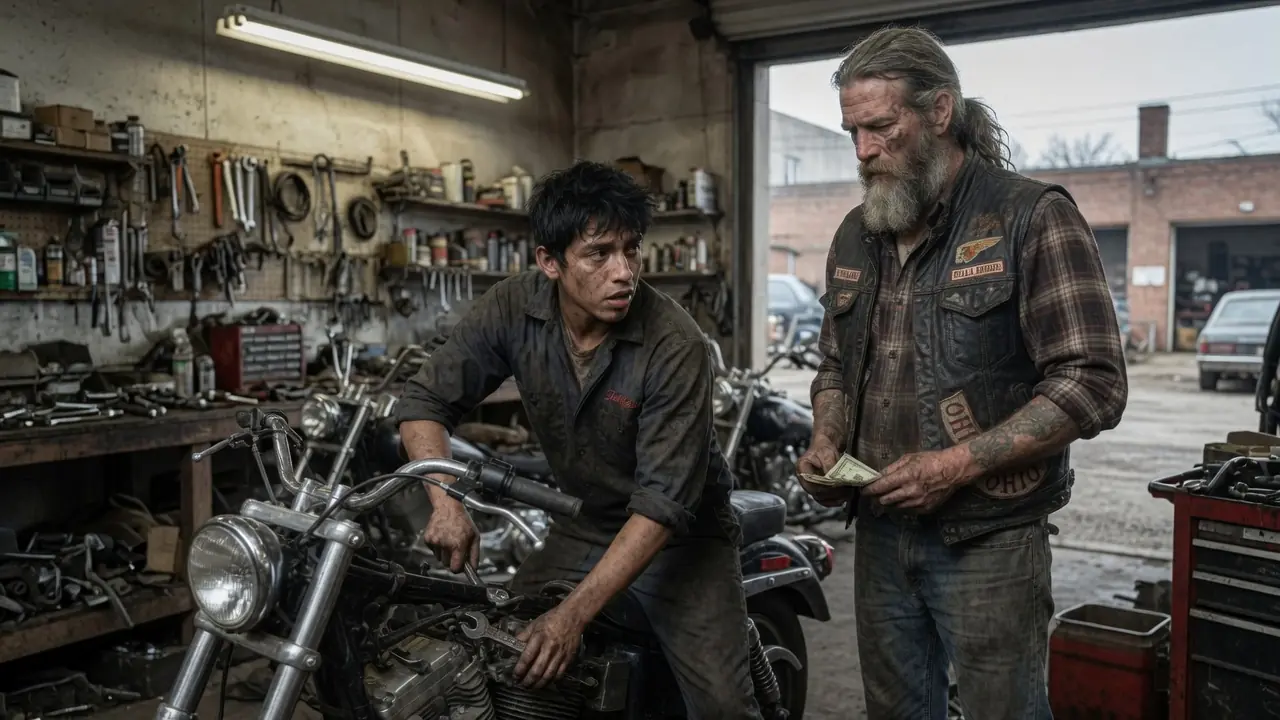
Elena “Ellie” Voss was twenty-eight and already felt older than the desert. She moved through the cluttered bay with the quiet economy of someone who had learned early that noise attracted the wrong kind of attention. Her black hair was tied back with a strip of old innertube. Grease permanently stained the creases of her knuckles. A small silver skull pendant hung at the base of her throat, warm from her skin, the only thing she had never pawned.
That October afternoon the sky hung low and bruised. Ellie was underneath a 1978 Sportster that had no business still running when the sound reached her—an uneven, coughing thunder that did not belong to any of the local machines. She rolled out on the creeper and stood, wiping her hands on a rag that had given up being clean years ago.
An Indian Chief rolled into the yard on a dying engine. The bike was beautiful in the way old things can be beautiful—deep burgundy paint faded by sun, whitewall tires cracked but still proud, chrome dulled by miles. The rider was a woman in her mid-fifties, leather jacket soft with age, gray-streaked dark hair braided tight down her back. She killed the motor and the silence that followed felt heavy.
Ellie waited.
The woman swung a leg over and stood with the careful balance of someone whose body remembered more crashes than it wanted to admit. She looked at the garage, at the Bone Yard, at Ellie. Her eyes were the same storm-gray as the sky.
“Engine’s finished,” the woman said. Her voice was low, smoked by years of open roads. “I can feel it coming apart. You take work?”
Ellie glanced at the stack of overdue notices pinned under a magnet shaped like a middle finger. Rent was three weeks late. The parts supplier had cut her off. The only thing in the fridge was half a jar of peanut butter and a beer she was saving for a day that felt less like surrender.
“Depends,” Ellie answered. “You got cash?”
The woman pulled a thin fold of bills from her inside pocket. It was not much. “What’s left of everything I own.”
Ellie walked around the Indian slowly. She already knew. Cracked cases. Blown main bearings. Probably a spun rod. Three thousand dollars easy, maybe more if she had to chase rare parts. She opened her mouth to say the real number, the honest number that would send the woman back onto the highway to die with her bike.
The woman studied her face for a long moment. “You sure?”
“I’m sure.”
That night Ellie did not sleep. She worked under the single hanging bulb until her shoulders burned and her eyes watered from the solvent. She pulled the engine, split the cases, and stared at the damage the way a doctor stares at a diagnosis no one wants to hear. The Indian needed a full rebuild. She did not have the money for the parts.
She had one thing left of value besides the pendant: a complete set of high-compression pistons and cylinders she had been saving for her own bike, a black 2003 Softail she kept under a tarp in the back. The Softail was her escape plan. When the Bone Yard finally collapsed under its own weight she was going to ride west until the ocean forced her to stop.
At 3:17 a.m. she unwrapped the pistons.
By dawn the Indian’s engine was in pieces across two workbenches. Ellie moved like a woman possessed. She cleaned every bearing race by hand. She true-d the flywheels on an old truing stand that had belonged to her grandfather. She did not think about the Softail. She did not think about the rent. She only thought about the way the older woman’s hands had trembled slightly when she talked about the bike, the same way Ellie’s own hands trembled when she remembered things she tried not to remember.
On the second night the rain came hard, turning the Bone Yard into a black mirror. Ellie was fitting the new cylinders when headlights swept across the open bay. Not the soft glow of a civilian car. The hard white spears of high beams on a lifted truck.
She killed the shop light and stepped into the shadows with the shotgun she kept behind the tool chest. The truck idled at the edge of the yard. Two men got out. She recognized the silhouette of the passenger even before he spoke. Jax “Reaper” Cole. Former sergeant-at-arms of the club that had once called her sister and then called her traitor.
“Ellie Voss,” Reaper called into the rain. “We know you’re in there. Club business. Come out and make it easy.”
Ellie chambered a round. The sound was loud in the wet dark.
The driver laughed. “Still playing hard, huh? We just want the package. Hand it over and we walk.”
Package. Ellie closed her eyes. Five years ago she had ridden with them. Five years ago she had seen something she was never supposed to see—money, guns, and a body that was not supposed to be found. She had taken photographs. She had walked away. The club had burned her colors in front of her and told her if she ever spoke she would disappear the same way the body had.
She still had the photographs. Hidden in a waterproof tube under the Softail’s gas tank.
The men waited. Rain drummed on the tin roof. Finally the truck doors slammed and the headlights swung away. They would be back. They always came back.
Ellie turned on the light again and kept working.
Morning of the third day the older woman returned on foot, soaked to the bone, carrying two paper cups of coffee that had gone cold. She stopped in the bay doorway and stared at the Indian. The engine was back together. Fresh oil gleamed on the cases. The bike looked reborn.
“Jesus,” the woman whispered.
Ellie wiped her hands. “She’ll run. I put better pistons in her. Stronger than stock. She’ll outlive both of us if you take care of her.”
The woman set the coffee down and walked slowly around the bike. When she looked up her eyes were wet. “What do I owe you?”
“Nothing.”
“Bullshit.”
Ellie shrugged. “I needed the work more than I needed the money.”
The woman stepped closer. Rain dripped from the ends of her braid. “Name’s Mara. Mara Kane.”
Ellie felt something cold slide under her ribs. Kane. The name she had not heard spoken aloud in fifteen years.
She forced her voice to stay level. “Ellie.”
Mara’s gaze dropped to the silver skull at Ellie’s throat. For a fraction of a second her face changed—shock, recognition, something like grief. Then the mask slid back into place.
“You always wear that?” Mara asked quietly.
“Always.”
Mara nodded once, as if confirming something only she understood. She reached into her jacket and pulled out a small folded square of paper. “If those men come back, give them this. Tell them Mara Kane said the debt is paid in full.”
Ellie took the paper without looking at it. “You in trouble?”
“Been in trouble since the day I was born. Difference is now I’m done running from the wrong things.”
She swung a leg over the Indian. The engine caught on the first try, deep and healthy. Mara looked at Ellie one last time.
“You remind me of someone I used to know,” she said. “Someone braver than she ever gave herself credit for.”
Then she rode out of the Bone Yard into the clearing storm, leaving the smell of rain and two-stroke oil behind her.
Ellie stood in the bay for a long time after the sound faded. Finally she unfolded the paper. It was a hand-drawn map of the old industrial district on the north side of town, with an X marked over a derelict warehouse and three words written in sharp black ink: COME ALONE. MIDNIGHT.
She almost burned it. Almost.
That night she rode the Softail for the first time in months. The pistons she had given away left the bike feeling hollow, but it still ran. She tucked the photographs into her jacket, checked the shotgun in the scabbard, and headed north.
The warehouse smelled of pigeon shit and old diesel. Ellie killed the Softail a block away and walked the rest. The side door was unlocked. Inside, a single battery lantern threw a circle of light on the concrete floor. Mara stood in the middle of it. She was not alone.
Reaper and two other men from the old club stood with their arms folded. Reaper smiled when he saw Ellie.
“Look at this. The ghost brings the rat. How poetic.”
Mara’s voice cut across the space like a blade. “She’s under my protection.”
Reaper laughed. “You’re a ghost yourself, Mara. Club put you in the ground fifteen years ago. Nobody’s gonna care what happens to either of you.”
Ellie stepped into the light. “What do you want?”
Reaper’s smile widened. “The pictures. And the hard drive. And then you disappear for real this time.”
Ellie looked at Mara. The older woman’s face was unreadable.
“You set me up,” Ellie said.
Mara shook her head once. “I brought you here so you could end it. On your terms.”
Reaper’s hand moved toward the gun at his waist. Ellie was faster. The shotgun came up level.
“Don’t,” she said.
The next thirty seconds were pure chaos. One of Reaper’s men went for a pistol. Ellie fired high, the blast deafening in the closed space. Concrete chips flew. Mara moved like a woman half her age, driving an elbow into the second man’s throat. Reaper charged Ellie. She sidestepped and brought the butt of the shotgun across his temple. He dropped hard.
When the echoes died only the three of them were still standing. Reaper groaned on the floor. His men were down and moaning.
Mara kicked the guns away and looked at Ellie. “You still have the photographs?”
Ellie nodded.
“Give them to me.”
Ellie hesitated. Then she reached into her jacket and handed over the tube. Mara opened it, glanced at the contents, and walked to a rusted barrel in the corner. She dropped the photographs in, poured lighter fluid from a small can, and struck a match. The fire bloomed bright and hungry.
“That was the last leverage the club had over either of us,” Mara said. “Now we walk out clean.”
Ellie stared at the flames. “Why?”
Mara turned. In the firelight her face looked younger and older at the same time. “Because fifteen years ago I made a deal to keep you alive. I let them tell the world I was dead. I let you believe I abandoned you. I rode as far as the roads would take me and I never looked back, because looking back would have gotten you killed.”
The words landed like fists.
Ellie felt the garage floor tilt under her boots. “You’re lying.”
Mara reached up and unfastened the top button of her shirt. Beneath it, on a thin silver chain, hung a second skull pendant—identical to the one around Ellie’s neck, only older, the silver worn smooth by decades against skin.
“I left this with your grandfather the night I disappeared,” Mara said. “Told him to give it to you when you were old enough. Told him to tell you I died in a wreck. Safer that way.”
Ellie’s hand rose to her own pendant without conscious thought. The metal was suddenly burning hot.
“You were twelve,” Mara continued, voice rough. “The club was going to use you to keep me in line. I couldn’t let that happen. So I became a ghost. I rode. I waited. I watched from a distance when I could. When I heard you were still fixing bikes out here in the middle of nowhere, still carrying my face in your stubbornness, I came to see if the girl I left behind had become someone who still understood the old code.”
Ellie could barely speak. “What code?”
“Help without expecting anything back. Protect the ones who can’t protect themselves. Never leave a rider on the side of the road if you can still turn around.” Mara’s eyes shone. “You fixed my bike when you had nothing left to give. You used the parts meant for your own escape. That’s the code, Elena. That’s how I knew you were still mine.”
The warehouse was silent except for the soft crackle of the dying fire.
Reaper stirred on the floor. Mara walked over, crouched, and spoke quietly so only he could hear. Whatever she said drained the last of the fight out of him. He nodded once, eyes wide with something close to fear.
Mara stood. “He’ll take the message back. The club is done with both of us. The debt is paid.”
They rode out of the industrial district together—Ellie on the Softail that no longer had its best parts, Mara on the Indian that now carried them both into a future neither had expected to see.
Dawn was breaking when they reached the Bone Yard. The sky was the color of old chrome. Mara killed her engine and looked at the leaning garage, the stacks of dead cars, the single living light still burning inside.
“You built this alone,” she said.
Ellie shrugged, throat tight. “Didn’t have much choice.”
Mara smiled, small and fierce. “Neither did I. But choices change.”
She reached into her saddlebag and pulled out a folded leather cut. The back patch was simple: a winged skull over crossed wrenches, and beneath it the words BONE YARD CHAPTER. Under that, in smaller letters: FRIEND OF THE ROAD.
“I started something new,” Mara said. “Not a club that takes. A club that fixes what’s broken. Riders who still remember the code. There’s a place for you if you want it. Not as a prospect. As family.”
Ellie took the cut. The leather was soft, already broken in. She held it for a long time.
Then she put it on.
They spent the morning drinking the last of the cold coffee and talking the way people talk when fifteen years of silence finally breaks. Ellie learned that Mara had ridden under a dozen different names, that she had buried more friends than she could count, that she had never stopped wearing the matching pendant. Mara learned that Ellie had almost married once, that she still dreamed of the ocean, that she had never stopped looking for the mother she was told was dead.
When the sun was high Mara stood and walked to the Softail. She laid a thick envelope on the seat.
“For the parts you gave away,” she said. “And for the rent. And for whatever comes next.”
Ellie did not open it. She already knew it was more than enough.
Mara swung onto the Indian. The engine caught like a promise.
“I’ll be back in a week,” she said. “We’ll figure out the rest. There’s roads left to ride, Elena. Roads that don’t end in graveyards.”
She rode out through the Bone Yard gates, the burgundy Indian gleaming in the hard light. Ellie watched until the sound was only a memory.
Then she went back into the garage, turned on every light she owned, and began to rebuild her Softail with the money her mother had left behind. Outside, the wind still carried the taste of rust, but for the first time in years it also carried something else—the low, steady thunder of engines that might one day come home.
Weeks later the first of them arrived. A young couple on a battered Sportster that needed new rings. An old man on a shovelhead that had thrown a rod two states away. A woman riding alone with a broken clutch cable and nowhere else to go. Ellie fixed them all. Sometimes she took money. Sometimes she took nothing but a promise to ride safe and remember the code.
Above the tool chest she hung a single photograph: two women standing beside an Indian Chief and a black Softail, the desert stretching endless behind them. Both wore the same silver skull at their throats. Both smiled like people who had finally stopped running.
On the wall beside the photo a new sign hung in fresh black paint:
BONE YARD REPAIR
HOME OF THE CODE
EVERYONE RIDES OUT
And beneath it, in smaller letters that only the ones who understood would notice:
Some families are born.
Some are forged in grease and grace.
Some simply refuse to stay buried.
Ellie Voss wiped her hands on a clean rag, listened to the wind in the Bone Yard, and waited for the next engine that needed saving.
She no longer waited alone.