“Is this supposed to be some kind of joke?”
The question cut through the desert air more sharply than a rifle report.
Corporal Mason Evans stood beneath the corrugated shade roof of Firing Point Seven, one hand resting on his tactical vest and the other gesturing toward the rifle on the bench. At twenty-one, Evans carried himself with the rigid confidence of a young Marine who had learned enough to feel certain and not yet enough to recognize how dangerous certainty could be.
“Sir, you cannot be serious about bringing that thing onto an advanced training range.”
The old man seated beside the bench did not turn.
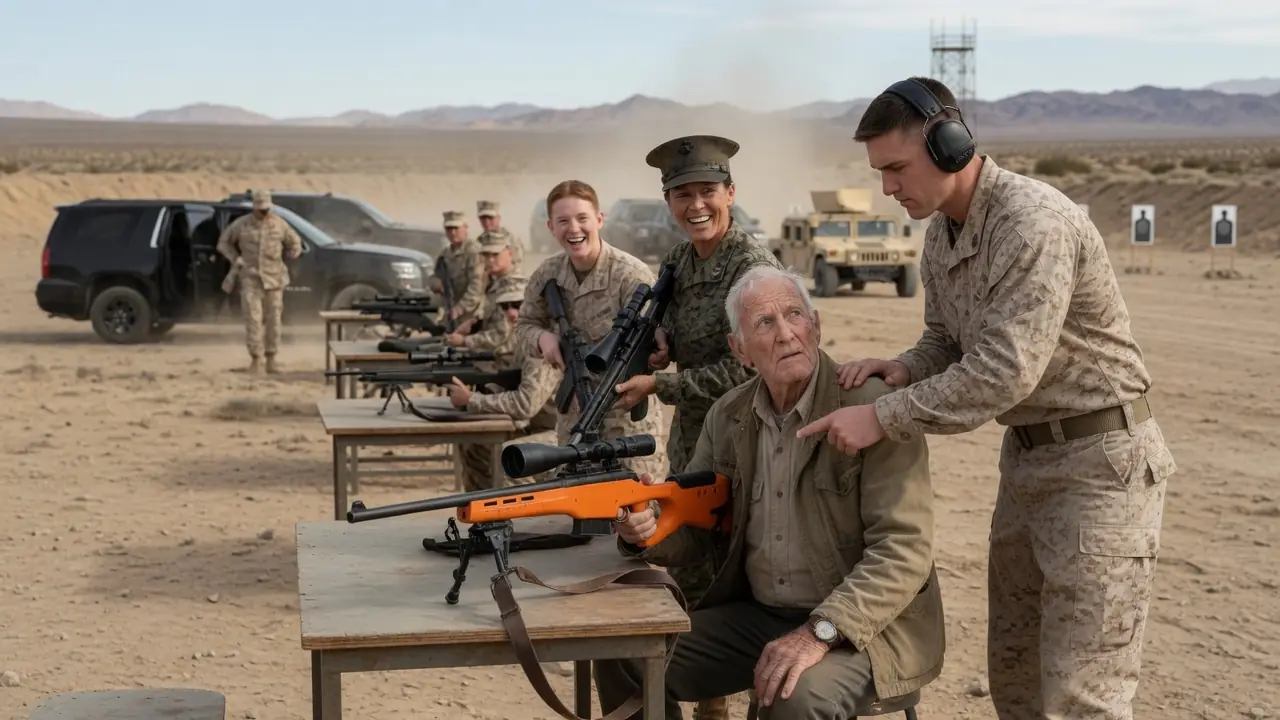
Alan Palmer kept his eyes on the distant target line, where heat rose from the Mojave Desert in rippling waves. At eighty-two, his shoulders had narrowed and the skin around his eyes carried the deep lines of age, but his posture remained straight.
The rifle beside him was difficult to ignore.
Its long chassis had been machined by hand. The scope sat unusually low over the receiver, and the stock had been shaped for one specific shooter rather than factory production.
But the most noticeable feature was the color.
Bright orange.
Not hunting orange on a small strip or safety marking.
The entire stock and chassis were coated in flat, nonreflective orange paint.
Among the black, tan, and olive weapons lined along the range, Alan’s rifle looked almost absurd.
A freckled private standing behind Evans laughed.
“Maybe it shoots foam darts.”
Another Marine joined in.
“Careful, Corporal. Grandpa might challenge you to a water fight.”
Their laughter moved along the firing line.
Alan heard every word.
He did not respond.
His hands rested calmly on his knees while the rifle remained untouched beside him.
That silence irritated Evans more than an argument would have.
He stepped closer.
“This is a restricted range for active-duty training. First Recon is conducting long-distance qualification today. We have sensitive equipment in use, and your homemade rifle is not part of the exercise.”
Alan continued watching the target line.
Evans looked around.
Several shooters at nearby benches had stopped preparing their equipment. A civilian technician paused beside a weather station. Two instructors near the observation tower turned toward the confrontation.
The corporal could feel an audience forming.
He mistook that attention for support.
“Did you hear me?”
Alan finally looked at him.
His eyes were pale gray and remarkably steady.
“I heard you.”
Evans seemed surprised by the strength of the voice.
“Then pack up.”
“I have a reservation for this firing point.”
“Not during our qualification.”
Alan glanced toward the laminated schedule clipped near the bench.
“My time begins at eight. Your unit begins at ten.”
Evans looked at his watch.
It was 8:17.
The private behind him stopped smiling for half a second.
Evans recovered quickly.
“Our team arrived early to calibrate equipment.”
“That does not change the schedule.”
The corporal’s face tightened.
“You are interfering with military training.”
Alan returned his gaze downrange.
“No. I am sitting at the firing point assigned to me.”
The old man’s calm felt like a challenge.
Evans stepped into his line of sight.
“This is not the local veterans’ club, sir. We are preparing for an advanced sniper course. Some of our targets are beyond two thousand yards. The sensor system alone costs more than most houses.”
He pointed toward the orange rifle.
“The last thing we need is a stray round from a garage project damaging equipment or contaminating our data.”
Alan’s expression did not change.
“It will not.”
“You expect me to take your word for that?”
“No.”
Alan reached into a worn canvas range bag.
The Marines tensed, though his movement was slow and deliberate.
He removed a leather wallet softened by decades of use. From it, he produced a base access card, a range certification, and the printed reservation approval.
He held them out.
Evans took the documents and examined them.
The authorization was valid.
The range certification was current.
The highest safety classification had been approved by the range office.
Evans turned the access card over as if expecting to find a flaw on the back.
PALMER, ALAN J.
The expiration date was still four years away.
“Who issued this?”
Alan nodded toward the bottom of the card.
Evans read the signature block.
The authorization had come from the Office of the Base Commander.
His embarrassment deepened.
“Fine. You have access.”
He handed the documents back.
“But access does not mean you are qualified to use this firing point during a Recon exercise.”
Alan placed the card inside his wallet.
“My qualifications are listed on the second page.”
Evans had not read the second page.
He did not admit it.
Instead, he looked toward the rifle.
“That thing does not meet any current Marine Corps specification.”
“No.”
“So what exactly is it?”
“Mine.”
The answer produced another laugh from the Marines.
Evans folded his arms.
“You built it?”
“Yes.”
“In your garage?”
“Part of it.”
The freckled private stepped closer.
He reached toward the stock.
“This feels like printed plastic.”
His finger touched the orange surface.
Alan’s hand moved.
Not quickly.
Not violently.
He simply placed two fingers between the private’s hand and the rifle.
“Do not touch it.”
The young Marine withdrew.
Something in Alan’s eyes had changed.
The patient expression remained, but beneath it now rested something old and hard.
For an instant, the desert disappeared.
Alan smelled wet earth, blood, and machine oil.
Rain hammered the roof of a field shelter that had been assembled from canvas and bamboo. Mortar fire struck the valley in slow, measured intervals, each explosion walking closer.
A young pilot lay on a cot nearby with one leg splinted and fever burning through his body.
“They know where we are,” the pilot whispered.
Alan’s younger hands worked a file across a piece of aluminum salvaged from a damaged aircraft mount.
“They know where we were.”
“They’ll find us.”
“Not before the helicopter does.”
The pilot stared at the rifle components spread across the ammunition crate.
“Why orange?”
Alan kept working.
“So our people can see it from the air.”
“And the enemy?”
“They will only see it if I fail.”
The memory vanished.
The desert range returned.
The private had stepped behind his corporal.
Alan’s fingers remained lightly against the rifle stock.
“Do not touch another man’s weapon without permission,” he repeated.
The private’s face reddened.
Evans interpreted the correction as disrespect.
“You do not give orders to my Marines.”
“I gave him advice.”
“He did not ask for it.”
“Most people need advice before they know enough to ask.”
A few of the nearby shooters looked away to hide their reactions.
Evans took another step forward.
His boots stopped inches from Alan’s stool.
“Let me explain how this is going to work. You are going to unload that rifle, pack it into your case, and leave the firing point. If you refuse, I will call security and have you removed.”
Alan studied him.
“On what grounds?”
“Disruption of training.”
“I was here first.”
“Unsafe equipment.”
“You have not inspected it.”
“Failure to obey military personnel.”
“You have no authority over civilians using an authorized range reservation.”
Evans’s jaw flexed.
The old man had answered every accusation without raising his voice.
That made the corporal feel smaller.
And feeling small in front of his Marines was something he did not know how to tolerate.
“You think a printed permit gives you the right to interfere with an active-duty unit?”
Alan looked at the rank insignia on Evans’s uniform.
“No, Corporal. The range regulations do.”
The use of his rank sounded like a correction.
Evans leaned closer.
“Maybe you are confused.”
Alan’s eyes narrowed slightly.
“About what?”
“Where you are. What year it is. What kind of equipment belongs on a modern military range.”
The private behind him laughed nervously.
Evans continued.
“You probably fired rifles before I was born. That does not make you qualified now.”
Across the range, retired Master Sergeant Frank Miller watched from the tower.
Everyone called him Gunny, even though he had left active service six years earlier. He now worked as the civilian range safety officer, which allowed him to remain close to the Marine Corps without pretending his knees could still survive it.
Miller had noticed Alan when he signed in.
The name stirred a memory.
Not a clear memory.
A fragment from a classified-history briefing during his time as an instructor.
A man in a valley.
A downed pilot.
A rifle assembled from scavenged parts.
An impossible shot that opened an extraction corridor.
Most of the briefing had focused on tactics rather than the shooter’s identity.
But Miller remembered two details.
The rifle had been orange.
And the man had been called Palmer.
He walked into the tower office and found the sign-in sheet.
ALAN J. PALMER.
Miller felt cold despite the desert heat.
He pulled out his phone.
The range commander answered on the fourth ring.
“Long Range Operations.”
“This is Miller at Point Seven. I need the command duty officer.”
“Is there an incident?”
“There is about to be.”
The line transferred.
Second Lieutenant Daniel Harris answered.
“Duty officer.”
“Lieutenant, this is retired Master Sergeant Miller at the long-distance facility. I have a disciplinary problem involving First Recon personnel and a civilian shooter.”
“Call their company leadership.”
“I would, except the civilian is named Alan Palmer.”
Silence.
“Should that mean something to me?”
Miller closed his eyes.
Young officers.
“Run the name through the secure registry.”
“I do not normally perform background checks because a civilian has an argument at the range.”
“Run it.”
The lieutenant hesitated.
Miller lowered his voice.
“And tell whoever is above you that the argument concerns an orange rifle.”
“What?”
“Just do it.”
He ended the call.
Lieutenant Harris sat inside the base command center staring at his phone.
Gunny Miller was not a dramatic man.
That alone convinced him to check.
He typed Alan Palmer’s name into the personnel-access system.
The screen paused.
Then a red window appeared.
RESTRICTED PERSONNEL PROFILE.
ACCESS AUTHORITY: O-7 OR ABOVE.
Harris stared.
O-7 meant brigadier general.
He tried a secondary search.
The same restriction appeared.
He stood so quickly that his chair rolled backward into a cabinet.
Colonel William Price was reviewing logistics reports when Harris entered his office without waiting.
The colonel looked up sharply.
“Lieutenant?”
“Sir, I received a call from the long-distance range.”
“Then why are you in my office?”
“There is a civilian there named Alan J. Palmer.”
Price’s expression changed.
It was subtle but immediate.
“What did you say?”
“Alan Palmer, sir.”
“Who is with him?”
“First Recon personnel. There is apparently some kind of confrontation.”
Price came around the desk.
“What kind?”
“I am still confirming.”
“What else?”
Harris swallowed.
“Gunny Miller said it involved an orange rifle.”
All color left the colonel’s face.
He picked up the secure telephone.
The commanding general answered personally.
“General Marcus.”
“Ma’am, this is Colonel Price. Alan Palmer is at the long-distance facility.”
A pause.
“The Alan Palmer?”
“Yes, ma’am.”
“What is happening?”
“First Recon Marines appear to be challenging his range access.”
“Challenging?”
Harris could hear the general’s voice through the receiver.
Price looked toward him.
“One corporal may be attempting to remove him.”
“Do not call the range,” General Marcus said. “Do not warn them. I want to see this myself.”
“Yes, ma’am.”
“Have my vehicle brought around.”
Price lowered the phone.
He looked at Harris.
“Contact the First Recon commander.”
“Yes, sir.”
“Tell him to meet us at the range.”
“What should I tell him this concerns?”
Price’s eyes hardened.
“Tell him his Marines may have just insulted the man whose work helped create the doctrine they are training to use.”
Back at Firing Point Seven, Evans had reached the limit of his patience.
“All right. I am done asking.”
He reached for Alan’s shoulder.
The old man looked at the approaching hand.
He did not flinch.
“Do not do that.”
Evans stopped for only a fraction of a second.
Then pride pushed him forward.
“I am escorting you away from the firing line.”
Before his hand made contact, a low vibration moved through the ground.
At first, it sounded like distant artillery.
Then it became the roar of multiple engines approaching at high speed.
Everyone turned toward the access road.
A convoy appeared through the dust.
A military police vehicle led three black government SUVs directly toward the range. They bypassed the normal parking area and crossed the packed desert dirt in a tight formation.
The vehicles stopped behind the firing line.
Doors opened almost simultaneously.
Colonel Price emerged from the first SUV.
The First Recon commander stepped out behind him, his face tense and confused.
Then the rear door of the second SUV opened.
Brigadier General Rebecca Marcus stepped onto the range.
She wore an immaculate desert uniform and carried no briefcase, no assistant’s folder, and no expression of patience.
Her single star caught the sunlight.
Every Marine on the range snapped to attention.
Corporal Evans dropped his hand.
“Attention on deck!”
General Marcus ignored him.
She walked past the Marines.
Past the range instructors.
Past Colonel Price.
Her gaze remained fixed on the old man beside the orange rifle.
Alan rose slowly from the stool.
The general stopped three steps away.
She brought her heels together.
Then she saluted him.
Not casually.
Not as a ceremonial courtesy.
Her salute was exact, deliberate, and held with the respect of one warrior acknowledging another.
“Mr. Palmer,” she said, her voice carrying across the silent range. “It is an honor to meet you.”
Alan inclined his head.
“General.”
“I apologize for what occurred before my arrival.”
“You did not cause it.”
“No. But they wear the same uniform I do.”
Only then did she lower her hand.
Corporal Evans stood rigid, his face drained of color.
General Marcus turned toward him.
“Corporal, identify yourself.”
“Corporal Mason Evans, ma’am. First Reconnaissance Battalion.”
“Were you attempting to remove Mr. Palmer from this range?”
Evans swallowed.
“Yes, ma’am. I believed he posed a safety concern.”
“Based on what inspection?”
He hesitated.
“I had not inspected the rifle, ma’am.”
“Based on what violation?”
“He was occupying a point needed for training.”
“Was the firing point reserved for him?”
Evans glanced toward the schedule.
“Yes, ma’am.”
“Was his access valid?”
“Yes, ma’am.”
“Was his certification current?”
“Yes, ma’am.”
General Marcus stepped closer.
“Then what safety concern remained?”
Evans had no answer that did not reveal the truth.
The rifle looked strange.
The owner looked old.
He had assumed both were useless.
“I exercised poor judgment, ma’am.”
“No.”
The general’s voice became colder.
“You exercised no judgment. You exercised arrogance.”
The corporal’s shoulders stiffened.
General Marcus looked toward the other Marines.
“Which of you touched the rifle?”
The freckled private raised one trembling hand.
“I did, ma’am.”
“Were you given permission?”
“No, ma’am.”
“Do you normally put your hands on another shooter’s weapon?”
“No, ma’am.”
“Then why did you do it today?”
The private stared straight ahead.
“Because I did not take it seriously.”
General Marcus turned toward the orange rifle.
“That may be the first honest answer I have heard since arriving.”
She walked to the bench.
Her fingers hovered near the stock but did not touch it.
She looked at Alan.
“May I?”
He nodded.
The general rested one hand lightly on the orange chassis.
The Marines watched.
“This weapon is called the Mark V Palmer rifle,” she said. “It was never mass-produced under that name. Parts of its design became the basis for several precision systems developed over the next three decades.”
Evans stared at the rifle.
General Marcus continued.
“Mr. Palmer served in military special operations before most of the missions were publicly acknowledged. Afterward, he worked as an engineering consultant on long-range ballistics, stabilization systems, optics mounting, and field-expedient weapon design.”
She looked toward the corporal.
“Several features on the rifle you carry today came from problems he solved before your parents met.”
Evans instinctively glanced toward the modern rifle resting near his pack.
The general gestured toward Alan’s weapon.
“This orange rifle began as a field-built prototype during a recovery mission in Southeast Asia.”
The range remained silent.
“In 1971, an aircraft went down inside a valley controlled by enemy forces. One pilot survived. Mr. Palmer reached him before the search teams did.”
Alan’s eyes moved toward the desert.
The general continued carefully.
“The valley was too narrow for a conventional landing. Enemy positions covered the only possible extraction route. For three days, Mr. Palmer kept the pilot alive while building a precision rifle from a damaged receiver, aircraft aluminum, salvaged optics, and parts taken from three separate weapons.”
The freckled private stared at the orange stock.
General Marcus’s voice softened.
“The paint came from an emergency aircraft marking kit. He coated the rifle so rescue aircraft could locate their position through the jungle canopy once the threat was removed.”
Evans looked toward Alan.
“You made it visible on purpose?”
Alan answered.
“After the shot.”
The general nodded.
“The enemy commander controlling the valley believed the Americans were trapped. He positioned himself beyond the range of the rifles then in common service.”
She looked at the Marines.
“Mr. Palmer fired once.”
No one moved.
“The commander fell. The enemy formation lost coordination. The rescue helicopter entered the valley and removed the pilot.”
A young sergeant near the back spoke before realizing he had done so.
“What distance?”
General Marcus looked toward Alan.
He answered without pride.
“Far enough.”
The general almost smiled.
“Declassified estimates place the shot beyond twenty-four hundred yards under conditions that made modern calculations unreliable.”
The Marines looked at their digital weather meters, laser rangefinders, and ballistic computers.
Alan had possessed none of them.
General Marcus continued.
“The pilot later became General Thomas Whitaker. He commanded this installation before I entered the academy.”
Colonel Price lowered his head slightly.
Everyone on the base knew Whitaker’s name.
A training hall, an airfield road, and a scholarship fund carried it.
General Marcus looked toward Evans.
“You saw an old man.”
The corporal’s face burned.
“You saw an orange object and decided it was a toy. You encountered something outside your experience and assumed the failure belonged to it rather than to your understanding.”
She pointed toward the insignia on his chest.
“The uniform does not make you the most knowledgeable person in every room. It makes you responsible for recognizing when you are not.”
Evans stood motionless.
“You mocked his age. You questioned his mental condition. You threatened to detain him after confirming he had valid authorization.”
Her voice dropped.
“That is not confidence, Corporal. It is cowardice wearing authority.”
Evans’s eyes lowered.
“Look at me.”
He raised them.
“Do you understand?”
“Yes, ma’am.”
“Do you?”
His voice cracked slightly.
“Yes, ma’am.”
Alan finally spoke.
“General.”
She turned.
“They are young.”
“That is not an excuse.”
“No.”
Alan looked at the Marines.
“But it is a condition that sometimes improves.”
A few of the older instructors exchanged glances.
Alan rested one hand on the rifle.
“Pride is useful. It gets you through difficult training. It makes you want to be worthy of the people beside you.”
He looked directly at Evans.
“But pride must be pointed outward. Toward the mission. Toward the standard. The moment you point it at people beneath you, it becomes vanity.”
Evans swallowed.
“Yes, sir.”
“You do not need to call me sir.”
“I believe I do.”
Alan studied him for a moment.
Then he nodded.
General Marcus remained less forgiving.
“Corporal Evans, you and every Marine who participated in this incident will report to Colonel Price at 0600 tomorrow.”
“Yes, ma’am.”
“You will also apologize to the range staff for disrupting their operations.”
“Yes, ma’am.”
“For the next thirty days, your unit will assist the base museum with restoration and documentation of historical equipment. You will study the people who developed the systems you now use.”
“Yes, ma’am.”
She turned toward their commander.
“Major, ensure it is done.”
“It will be, ma’am.”
General Marcus then looked at Alan.
“Mr. Palmer, your firing point remains reserved.”
Alan glanced toward the clock.
“I have lost twenty-three minutes.”
The general looked at Evans.
The corporal understood immediately.
“Sir, my squad will clear the point.”
Alan shook his head.
“You came here to train.”
Evans stared.
“You want us to stay?”
“I want you to stop wasting the morning.”
The Marines moved quickly.
They carried their equipment to the adjoining benches and prepared in silence.
No one laughed at the orange rifle again.
Alan began his session.
He inspected the bolt, checked the chamber, and adjusted the support beneath the stock. Every movement was economical.
Evans watched from several benches away.
The old man’s hands carried none of the uncertainty he expected.
Alan did not hurry.
He studied the wind flags.
He examined the dust moving across the valley floor.
Then he closed his eyes.
The private whispered, “Why is he doing that?”
Gunny Miller answered from behind them.
“Listening.”
“To what?”
“The wind passing the tower. Vehicles on the access road. Changes in air pressure.”
Evans looked skeptical, but he kept the thought to himself.
Alan opened his eyes.
The target was positioned at 1,800 yards for his scheduled session.
He adjusted the scope, settled behind the rifle, and placed his shoulder against the stock.
The orange weapon fired.
Its report was deeper than the Marines expected, but controlled.
Several seconds passed.
The electronic target display flashed.
A hit appeared less than an inch from center.
Alan cycled the bolt.
He made a minute correction.
The second round struck the center ring.
The third entered almost the same mark.
No one spoke.
Alan completed the five-round group and stood.
General Marcus examined the monitor.
The spread was smaller than many active-duty shooters produced at half the distance.
Evans stared at the target display.
Alan began packing his equipment.
“You are finished?” the corporal asked before remembering himself.
“My reservation ends at nine.”
Evans looked at the clock.
It was 8:58.
Alan placed the rifle inside a hard case.
The bright orange disappeared beneath black foam.
He lifted the case.
Evans stepped forward.
“Mr. Palmer.”
Alan waited.
The young Marine’s face no longer carried the sharp confidence from earlier.
“I apologize.”
The words were quiet.
“Not because the general ordered me to. I judged you before I knew anything about you.”
Alan said nothing.
Evans continued.
“I used my rank to cover the fact that I was embarrassed. I touched your equipment without permission. I mocked your age and questioned whether you understood where you were.”
His voice grew unsteady.
“There is no excuse.”
Alan looked at him for several seconds.
“An apology is useful only if it changes the next decision.”
“Yes, sir.”
“The next old man may not have a general coming for him.”
Evans lowered his eyes.
“I understand.”
“No,” Alan said gently. “You are beginning to.”
The following month was more difficult for Evans than any field exercise he had completed.
General Marcus did not assign pointless physical punishment.
She ordered education.
Evans and his squad spent mornings cleaning display weapons, cataloging field equipment, and preserving handwritten records at the base museum.
In the afternoons, they studied veterans whose names had almost disappeared from official history.
They read about medics who remained with wounded soldiers under fire.
Pilots who flew damaged aircraft away from civilian areas.
Engineers who designed equipment in field workshops because official supply chains could not reach them.
They discovered that many innovations they considered modern had begun as desperate solutions built by people with little more than tools and necessity.
Evans read every available declassified page concerning Alan Palmer.
Much of the record remained hidden.
The visible parts were enough.
After military service, Alan had spent thirty years advising research teams. He never accepted public credit for several systems he helped develop.
He refused interviews.
He returned medals to their cases.
When asked why he did not publish a memoir, he once answered that the men who mattered most would not be alive to correct him.
The orange rifle remained the only object from his service he continued to use.
Three weeks after the incident, Evans saw Alan inside the base library.
The old man stood near a shelf of engineering manuals, reading titles through a pair of thin glasses.
Evans approached.
“Mr. Palmer.”
Alan turned.
The corporal stood at attention even though he wore civilian clothes.
“I wanted to apologize again.”
“You already did.”
“I had not earned it yet.”
Alan closed the book in his hand.
“What changed?”
“I learned how much I did not know.”
“That is usually the beginning.”
Evans looked toward the shelves.
“I read the declassified report.”
Alan’s expression remained neutral.
“Reports leave things out.”
“Was the pilot really there for three days?”
“Four.”
“The report says three.”
“The report begins after they knew he was alive.”
Evans absorbed that.
“Were you alone?”
Alan looked through the library window toward the desert.
“No one is alone in a place like that. You carry every person who trained you, every person waiting for you, and every person who did not make it home.”
Evans hesitated.
“Why did you keep the rifle orange?”
Alan’s hand rested on the book.
“Because men have a habit of repainting difficult memories until they look respectable.”
He looked at Evans.
“I prefer to remember things as they were.”
The corporal nodded.
“I hope someday I can be the kind of Marine who deserves to stand near men like you.”
Alan gave him a faint smile.
“Start by deserving the men standing beside you.”
A week later, General Marcus closed the long-distance range for a special demonstration.
The event was not public.
Only senior range personnel, selected instructors, Evans’s squad, and several weapons engineers attended.
A new experimental target system had been installed at 2,300 yards.
It was not a qualification test.
No one expected an eighty-two-year-old man to prove anything.
Alan agreed to fire only because the engineers wanted comparative data from the original Mark V.
The orange rifle lay on the bench.
This time, no one laughed.
Evans helped carry the ammunition case but did not touch the rifle.
Alan settled into the prone position.
The desert wind had become unpredictable. Air moved across the range in layers, pushing dust east near the firing line while heat currents farther out bent toward the north.
Digital instruments displayed changing values.
The engineers debated which reading mattered most.
Alan watched the mirage through his scope.
He asked for the electronic wind display to be turned off.
One technician looked surprised.
“Sir?”
“It is changing faster than the screen can decide what happened.”
General Marcus nodded.
“Turn it off.”
The display went dark.
Alan placed his cheek against the stock.
For almost two minutes, he did not move.
Evans watched his breathing slow.
The old man seemed to disappear into the rifle.
Then came one shot.
The sound rolled across the desert.
No one spoke while the round traveled.
The target monitor remained blank.
Two seconds.
Three.
Four.
A green indicator appeared.
The camera zoomed.
The impact sat inside the central scoring ring, less than two inches from the exact center.
A low sound moved through the observers.
Not cheering.
Disbelief.
Alan remained behind the rifle.
He adjusted the scope by a fraction.
The second shot struck closer.
The third overlapped the first two.
Only then did he sit up.
One engineer stared at the data.
“The system predicted almost a full meter of additional drift.”
Alan removed his ear protection.
“The system averaged the wind.”
“Yes.”
“The wind did not agree to be averaged.”
General Marcus smiled.
Evans approached after the rifle had been cleared and cased.
“That was incredible.”
Alan looked toward him.
“No.”
The corporal seemed confused.
“It was disciplined. There is a difference.”
Alan placed the case in Evans’s hands.
This time, he had given permission.
“Carry it to my truck.”
Evans held the orange rifle with both hands.
Its weight surprised him.
Not because it was unusually heavy.
Because he now understood what it carried.
The range had taught him more than ballistics that month.
Strength did not always enter loudly.
Experience did not need to announce itself.
And age did not erase what discipline had built.
Alan walked beside him toward the parking area.
His pace was slow, but steady.
A young private opened the truck’s rear compartment without being asked.
Evans placed the case inside carefully.
Before closing it, he looked once more at the flash of orange visible between the foam panels.
The color no longer seemed ridiculous.
It looked like survival.
It looked like a promise made beneath a jungle canopy to a wounded man who needed to be found.
It looked like a reminder that the tools now considered history had once been the only things standing between life and death.
Alan reached for the truck door.
Evans spoke.
“Mr. Palmer?”
“Yes?”
“Do you think people like me can really change?”
Alan considered the young Marine.
“People change when embarrassment becomes responsibility.”
Evans nodded.
“And when does that happen?”
“When you stop asking how the mistake made you feel and begin asking who could have been harmed by it.”
Alan climbed into the truck.
The engine started.
Evans stepped back and saluted.
This time, no general had ordered him.
Alan looked through the open window.
Then he returned the salute with a small, precise motion.
The orange rifle left the range in the back of an ordinary pickup truck.
No convoy followed it.
No cameras recorded its departure.
Within minutes, the desert swallowed the vehicle in heat and distance.
But the lesson remained.
Years later, when Sergeant Mason Evans became an instructor, he kept a small photograph inside his classroom.
It showed an old man seated behind a bright orange rifle beneath the Mojave sun.
New Marines occasionally asked about it.
Evans never began by listing Alan Palmer’s medals, classified missions, or impossible shots.
He told them about the first morning.
About the laughter.
About the hand he had nearly placed on an old man’s shoulder.
About how certain he had been while knowing almost nothing.
Then he gave every class the same warning.
“The most dangerous ignorance is the kind that feels like authority.”
Afterward, he would point toward the orange rifle in the photograph.
“That weapon looked ridiculous to me because I had not earned the knowledge required to understand it.”
He would pause.
“The man beside it looked weak because I had not developed the character required to recognize strength.”
No one laughed.
And somewhere beyond the base, Alan Palmer continued visiting ranges when his health allowed.
He never wore his medals.
He never announced his history.
He arrived with an old canvas bag, a valid reservation, and a rifle painted the color of rescue.
Those who knew him gave him space.
Those who did not sometimes stared.
Alan did not mind.
He had survived too much to fear being misunderstood by strangers.
He knew what the orange meant.
He remembered the rain striking the canvas shelter.
The wounded pilot asking whether the helicopter would arrive.
The enemy moving closer through the valley.
His younger hands building a weapon from whatever remained.
He remembered looking through a salvaged scope and understanding that one shot would decide whether two men returned home or disappeared into a place no one would ever find.
The rifle had never been a toy.
The color had never been decoration.
It was a beacon created by a man who believed rescue was still possible, even when the entire world around him suggested otherwise.
And that was why Alan never repainted it.